
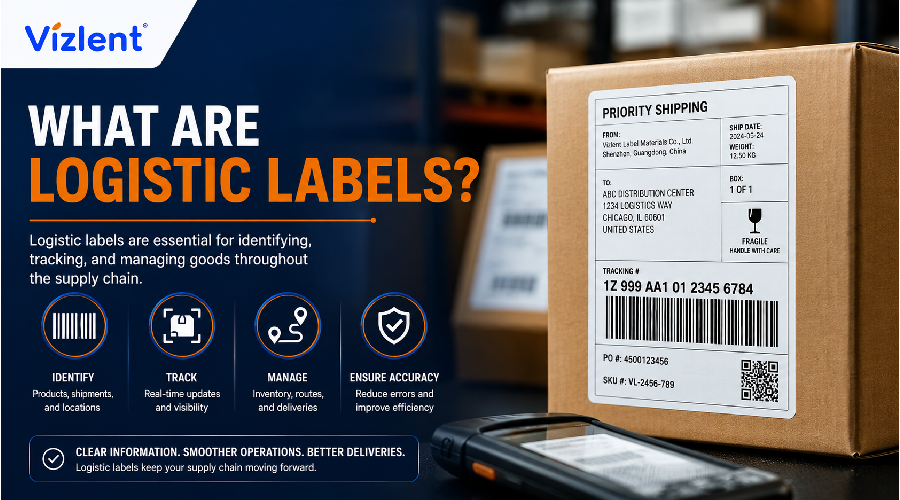
Logistic labels are the identification labels applied to pallets, cases, cartons, and parcels so a shipment can be tracked automatically through the supply chain. Each one carries a barcode and human-readable data that links a physical unit to the information systems that move it from origin to destination. What are logistic labels in practice: they are the scannable identity that turns a stack of boxes into a traceable logistic unit.
These labels sit at the center of modern warehousing, shipping, and receiving because they let scanners, not people, confirm what a unit contains and where it is going. Without them, distribution centers would rely on manual counting and paperwork that cannot keep pace with high-volume operations. The most widely recognized standard for them is the GS1 Logistic Label, which encodes a unique Serial Shipping Container Code.
Understanding Logistic Labels and How They Work
A logistic label identifies a logistic unit, which GS1 defines as any combination of trade items packaged together for transport or storage. To answer what are logistic labels at a technical level, they present this data in a standardized, internationally recognized format so that a barcode scanned in one country means the same thing when scanned in another. This shared language is what allows retailers, carriers, and suppliers to exchange goods without re-keying information at every handoff.
At the heart of most logistics labels is the Serial Shipping Container Code, an 18-digit number that acts like a license plate for the unit. The code is encoded in a GS1-128 barcode and linked by electronic message to an advance shipping notice, so a single scan at a receiving bay reveals the full contents of the load. Vizlent manufactures the pressure-sensitive logistics and e-commerce label stock that carries this data reliably through automated sortation.
- A unique SSCC identifies each pallet, case, or parcel as one logistic unit
- A GS1-128 barcode encodes the SSCC for single-scan data capture
- Advance shipping notices link the scan to full content information
Need durable stock for your shipping labels? Talk to a Vizlent engineer about material options.
Responsibility for the label usually rests with the shipper who creates and applies it. If a carrier or receiver later replaces the label or adds information, that party becomes responsible for the accuracy of the data it contributes. Understanding this chain of responsibility helps teams avoid disputes when a unit is relabeled partway through its journey.
GS1 Logistic Labels and the SSCC Standard

GS1 logistic labels are the compliance backbone of retail and industrial distribution worldwide. The framework separates two ideas that are easy to confuse: GS1 is the standards body that defines the barcode and data structure, while the SSCC is the unique code that identifies each unit. Major retailers such as large grocery and general-merchandise chains require SSCC labels on inbound pallets, and non-compliant labels can trigger chargebacks or rejected shipments.
Placement and print quality are part of the standard, not optional extras. GS1 guidance specifies that the SSCC sit in the lowest portion of the label and that barcodes carry adequate quiet zones so scanners read them cleanly. Getting the facestock and print contrast right is where reliable material matters, because a smudged or low-contrast barcode fails the exact automated check the label exists to pass.
- GS1 defines the data structure; the SSCC is the 18-digit unit identifier
- Application Identifiers like (00) for SSCC and (01) for GTIN structure the data
- Correct placement and barcode quiet zones are required for clean scanning
Retailer rules frequently extend beyond the GS1 baseline, and ignoring them is costly. Many chains specify exact label size, placement height on the pallet, and which data fields must appear, and they enforce these with financial penalties for non-compliance. Generating the label and the advance shipping notice from the same data source is the reliable way to keep the printed barcode and the electronic record in agreement.
It is worth noting that a label carrying only a trade-item barcode, without an SSCC, is not considered a GS1 Logistic Label. The SSCC is what turns a plain shipping label into a trackable logistic-unit identifier. For teams building gs1 logistic labels for the first time, starting from the SSCC and working outward keeps the design compliant.
What Information a Logistic Label Contains
A well-formed logistic label combines machine-readable and human-readable elements so both scanners and staff can use it. The barcode segment encodes the SSCC and, where needed, additional data such as batch number, production date, and quantity through GS1 Application Identifiers. The text segment repeats the key facts in plain characters for anyone handling the unit without a scanner.
Beyond the core identifier, transport and customer segments carry the details carriers and receivers need. These typically include the ship-to postal code, a consignment or routing code, and the purchase order number for the receiving party. A single logistic label can therefore serve the shipper, the carrier, and the customer at once, which is why its layout follows a disciplined structure.
- SSCC in a GS1-128 barcode as the primary unit identifier
- Optional batch, date, and quantity data via Application Identifiers
- Transport and customer segments for routing and delivery
The label can also distinguish between different types of logistic unit, which affects how trade-item data is shown. A homogeneous unit holds one product identified by a single GTIN, while a heterogeneous or mixed pallet holds several products with different GTINs. Reflecting this correctly on the label prevents receiving errors when a mixed pallet is broken down at the distribution center.
Printing variable data at volume? Ask about print-ready label stock built for barcode clarity.
Materials and Printing for Logistics Labels

The material behind a logistic label decides whether the barcode survives the journey. Coated paper facestocks suit dry indoor handling and offer sharp, economical printing, while synthetic films resist moisture, abrasion, and temperature swings in tougher environments. Choosing the wrong substrate is a common reason a barcode becomes unscannable before the unit reaches its destination.
The print method matters as much as facestock for durability. Thermal transfer printing with the right ribbon produces dark, abrasion-resistant barcodes, and Vizlent supplies matched thermal transfer ribbon alongside its label stock. For desktop or in-house printing, inkjet printing labels and laser printing labels offer flexible options for lower volumes.
- Paper facestocks: Economical and sharp for dry, indoor handling
- Synthetic films: moisture, abrasion, and temperature resistance for harsh routes
- Thermal transfer print: dark, durable barcodes that survive handling
Adhesive choice sits alongside facestock as a decision that affects performance. A permanent acrylic adhesive holds firmly to corrugated cartons and shrink-wrap through a full journey, while a removable adhesive suits returnable containers that are relabeled between trips. Matching adhesive tack to the surface prevents both premature lifting and residue that fouls reusable assets.
Cold-chain and outdoor shipments add another material requirement. An outdoor weather resistant construction or a low temperature label keeps adhesion and legibility intact where standard stock would lift or fade. Matching the material to the route is the practical core of reliable sticker logistics.
Logistic Labels for Shipping, Sale, and Formats
Buyers approach logistic labels in several formats depending on their operation. High-volume shippers usually buy roll stock for thermal printers, while smaller operations often prefer logistic labels by the sheet that run through a standard office laser or inkjet printer. Both formats carry the same standardized data; the difference is throughput and printer type.
Sourcing options range widely, and it helps to know what each term means when you search. Phrases like logistic labels for shipping, logistic labels for sale, and logistic labels online all point to the same practical need: compliant label stock delivered in a usable format. A buyer comparing logistic labels near me against a factory-direct supplier is really weighing local convenience against material depth and price.
- Roll stock for thermal transfer printers in high-volume operations
- Logistic labels by the sheet for office laser and inkjet printers
- Blank or pre-printed formats depending on whether data is variable
Deciding between blank and pre-printed stock depends on how much of the data changes per unit. Operations that print a unique SSCC and variable content for every unit need blank stock and an on-site printer, while those repeating fixed information can order pre-printed labels in bulk. Many shippers use a hybrid approach, buying stock pre-printed with static branding and leaving space for variable barcode data added at pack-out.
Understanding what a logistic label is used for keeps format decisions grounded. The phrase logistic labels is used for creating a scannable, traceable identity on a transport unit, so the format must suit both the printer and the handling environment. Vizlent supplies self adhesive material in roll and sheet formats to fit either workflow, and the same stock works for barcode labels and logistic tags alike.
Comparing formats for your line? Request samples and a quote from the Vizlent team.
A Note on ‘Logistic Regression Labels’ and Terminology

Some searches for logistics terms surface an unrelated data-science phrase, and clarity here prevents confusion. In machine learning, logistic regression labels are the known outcome categories a model is trained to predict, and logistic regression multiple labels refers to classifying items into more than two categories. These concepts belong to statistics and predictive modeling, not to physical shipping labels, and they are not a product Vizlent manufactures.
The overlap is purely linguistic, since both fields borrowed the word label for different meanings. A shipping logistic label is a physical, adhesive identifier, whereas a regression label is a data value inside a model. If you arrived here researching supply-chain labeling, the physical logistics labels described throughout this article are what you need.
- Physical logistic label: An adhesive barcode identifier on a shipment
- Logistic regression label: A target category in a machine-learning model
- The shared word ‘label’ is a coincidence of terminology, not a shared product
Benefits of Standardized Logistic Labels
Standardized labels lower cost and error across the entire supply chain. A single SSCC label can be used by every party from shipper to retailer, which removes duplicate labeling and cuts material spend. One scan links to an advance shipping notice, enabling fast, accurate receiving without manual counting.
The traceability these labels provide has become essential for compliance and recalls. Because each unit carries a unique identifier, a specific batch can be located and withdrawn quickly if a recall is needed, which matters most in food and pharmaceutical distribution. Reliable labels and stickers also reduce loss and damage claims by giving carriers a dependable way to track each unit.
- One standardized label used across the whole supply chain lowers cost
- Single-scan receiving improves speed and accuracy at the dock
- Unique identifiers support traceability, recalls, and reduced losses
The efficiency gains compound as shipment volume grows. When a distribution center can receive a pallet with one scan instead of manual line-by-line checking, labor per unit falls sharply and receiving throughput rises. This is why high-volume retailers mandate SSCC labeling: the single-scan workflow is what makes their receiving docks economically viable at national scale.
Building a compliant labeling program? Get factory-direct guidance on materials and durability.
Where Logistic Labels Are Used Across Industries
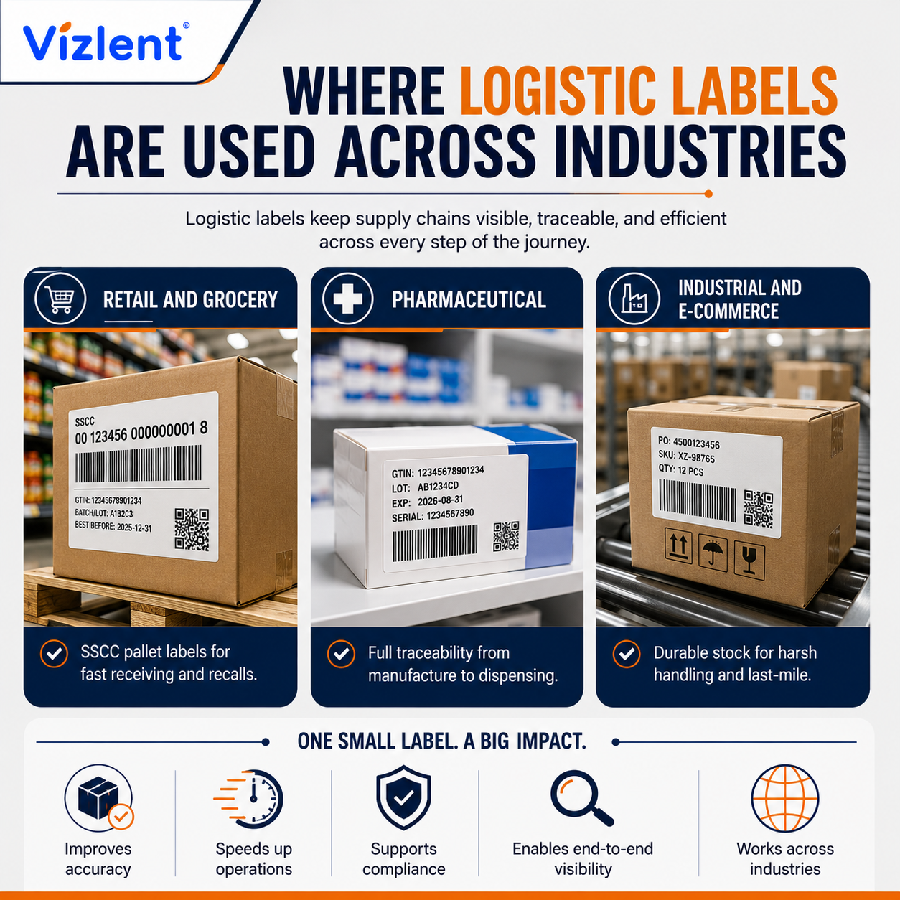
Logistic labels appear wherever goods move between businesses, but the demands shift by sector. Grocery and general retail rely on SSCC pallet labels to speed receiving and support food traceability and recalls. Pharmaceutical distribution adds strict compliance, since each unit must be traceable from manufacture to dispensing.
Industrial and chemical shipments bring environmental challenges that shape material choice. Drums, rolls of material, and part pallets can all be marked as logistic units, and these often travel through outdoor or humid conditions that demand synthetic facestocks. E-commerce parcels add high volume and rough handling, making durable adhesive and clear barcodes essential for last-mile delivery.
- Retail and grocery: SSCC pallet labels for fast receiving and recalls
- Pharmaceutical: full traceability from manufacture to dispensing
- Industrial and e-commerce: durable stock for harsh handling and last-mile
Shipping across tough environments? Ask Vizlent about durable label stock for your sector.
Choosing a Supplier for Logistics Labels
The right supplier depends on your volume, durability needs, and compliance requirements. A local printer found by searching for a labels shop near me offers proximity and fast turnaround for simple jobs, while a factory-direct manufacturer provides deeper material choice, bulk pricing, and full certification. The decision comes down to whether speed or specification depth matters more for your operation.
Among the top logistic labels in China, Vizlent operates as a direct manufacturer founded in 2011, holding ISO 9001, FSC, and SGS certification with full background on its About Us page. A credible supplier shares its test methods, provides free samples, and explains how each construction performs on your surfaces and in your environment. Evaluating that transparency before ordering is the surest way to choose a dependable partner for label logistics.
- Local printers: Fast turnaround and proximity for simpler needs
- Direct manufacturers: Material depth, bulk pricing, and certification
- Always request samples and verify barcode print quality before committing
Barcode verification deserves particular attention during supplier selection. A label that looks acceptable to the eye can still fail an automated scan if the print contrast, facestock finish, or ribbon pairing is wrong for the barcode grade a retailer demands. Asking a supplier to run a print sample on your own artwork and then grading the barcode is the most direct way to confirm the material will pass at the receiving dock.
Get Reliable Logistic Label Stock From Vizlent
Answering what are logistic labels comes down to this: they are the standardized, scannable identity that keeps modern supply chains moving accurately and fast. Vizlent has produced pressure-sensitive label stock as a direct factory since 2011, shipping ISO 9001, FSC, and SGS certified material to more than fifty countries. Whether you need roll stock for thermal printers, sheets for office printing, or weather-resistant film for cold-chain routes, the engineering team can match the material to your operation.
Start with a sample and a conversation about your handling environment. Testing real material on your own printers and surfaces settles questions about barcode clarity, adhesion, and durability far better than any specification sheet. From there, scaling to a certified production run is straightforward and repeatable.
Contact Vizlent for a quote and free samples | Explore logistics and e-commerce label stock | Read more on the Vizlent blog
Frequently Asked Questions
What are logistic labels used for?
Logistic labels identify pallets, cases, and parcels so shipments can be tracked automatically through the supply chain. They carry a barcode, usually encoding an SSCC, plus human-readable text for staff. This lets warehouses and carriers confirm contents and destination with a single scan rather than manual counting.
What is the difference between a logistic label and a GS1 logistic label?
A general shipping label may carry only a trade-item barcode, while a GS1 logistic label includes a Serial Shipping Container Code that identifies the whole logistic unit. Only labels containing an SSCC qualify as GS1 Logistic Labels. The SSCC is what makes the unit trackable as a single license-plate identifier through the supply chain.
What is an SSCC on a logistics label?
The SSCC, or Serial Shipping Container Code, is an 18-digit number that uniquely identifies one logistic unit such as a pallet or parcel. It is encoded in a GS1-128 barcode and linked by electronic message to the shipment’s contents. A single scan of the SSCC connects the physical unit to its advance shipping notice, which lets the receiver reconcile the delivery automatically. The code is built from a company prefix, a serial reference, and an extension digit, so every unit a business ships can carry a distinct number.
Can I print logistic labels by the sheet?
Yes. Logistic labels by the sheet run through standard office laser or inkjet printers, which suits lower-volume operations. Higher-volume shippers usually use roll stock on thermal transfer printers for speed and durability. Both formats carry the same standardized data, so the choice depends on your printer and throughput.
What materials work best for logistics labels for shipping?
Coated paper suits dry indoor handling and prints sharply at low cost, while synthetic films resist moisture, abrasion, and temperature swings on tougher routes. Cold-chain and outdoor shipments need low-temperature or weather-resistant constructions. Matching the facestock and adhesive to the route keeps the barcode scannable on arrival. Running a print sample and grading the barcode before committing confirms the material will pass automated scans at the receiving dock.
Are logistic regression labels the same as shipping labels?
No. Logistic regression labels are a machine-learning term for the outcome categories a model predicts, and have nothing to do with physical shipping. The shared word label is a coincidence of terminology. Physical logistic labels are adhesive barcode identifiers applied to transport units.
Where can I buy logistic labels online?
You can buy logistic labels online from local print shops, industrial distributors, and factory-direct manufacturers. Local suppliers offer speed, while direct manufacturers provide material depth, bulk pricing, and certification. Requesting samples and checking barcode print quality first is the surest way to choose a reliable source.
Does Vizlent supply logistic label stock?
Yes. Vizlent manufactures pressure-sensitive label stock suited to logistics and e-commerce, in roll and sheet formats and in paper or synthetic facestocks. As a direct factory, it matches material, adhesive, and print method to your handling environment. The engineering team provides free samples so you can verify barcode clarity before ordering.






