
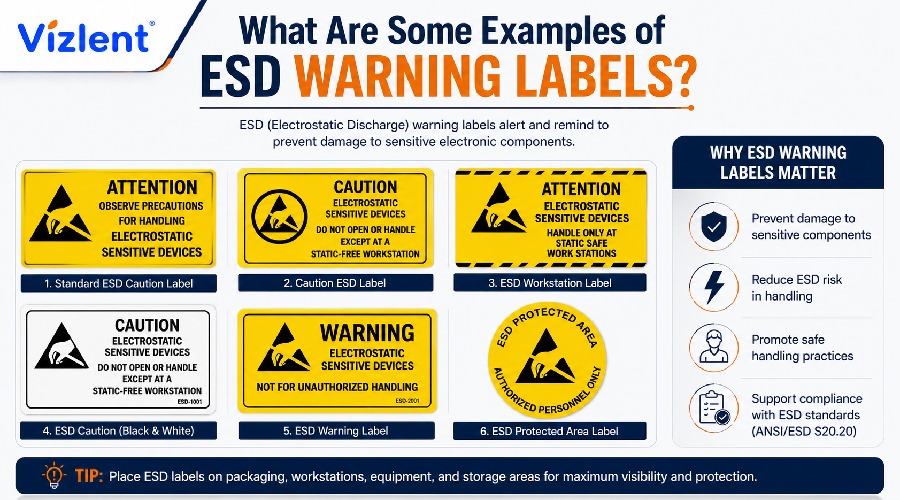
Common examples of ESD warning labels include the ESD susceptibility label with a reaching hand and slash inside a triangle, the ESD protective label with an arc around the triangle, and the common point ground label shaped like a bullseye. These three marks are defined by the ANSI/ESD S8.1 standard and appear on static-sensitive electronic components, protective packaging, and grounded workstations. Each one communicates a specific instruction at a glance, from do-not-touch warnings to confirmation that a material is safe for static control.
Electrostatic discharge can destroy or degrade a microchip in a fraction of a second, often without any visible sign of damage. The electronics industry loses an estimated forty billion dollars each year to ESD-related failures, which is why clear labeling is a first line of defense. Understanding these standard marks helps manufacturers, technicians, and buyers handle sensitive components correctly.
The Three Standard ESD Warning Symbols
The ANSI/ESD S8.1 standard defines three official ESD warning symbols, and nearly every compliant label is built from one of them. The susceptibility symbol shows a hand reaching into a triangle with a slash through it, marking an item that static can damage. The protective symbol replaces the slash with an arc around the triangle, marking a material that actively shields against static.
The third mark, the common point ground symbol, resembles a bullseye and identifies where equipment connects to ground. Together these form the vocabulary behind most esd warning symbols in use across electronics manufacturing. Vizlent prints these marks on compliant warning and instruction label stock engineered for durability on electronic assemblies.
- Susceptibility symbol: reaching hand and slash in a triangle, meaning the item is static-sensitive
- Protective symbol: hand in a triangle with a surrounding arc, meaning the material shields against static
- Common point ground symbol: a bullseye marking the grounding connection point
Need compliant label stock for static-sensitive parts? Talk to a Vizlent engineer about ESD material.
It helps to know how the symbols evolved, since older military marks still appear occasionally. Some military organizations once used a “three arrows in a circle” mark, which has since been aligned with the standard hand-in-triangle susceptibility symbol for consistency. Recognizing both the current and legacy forms prevents confusion when handling older stock or documentation.
Examples of ESD Warning Labels on Products

The clearest examples of ESD warning labels on products appear directly on circuit boards, integrated circuits, and finished electronic assemblies. A susceptibility mark on a printed circuit board tells any handler that the item must only be opened at a grounded workstation. These marks are often paired with text such as “Attention: Observe precautions for handling electrostatic sensitive devices.”
Beyond the bare component, examples of ESD warning labels on products extend to the packaging that protects them in transit. Shielding bags, IC trays, and unit packs carry a susceptibility or protective mark so the warning survives all the way to the assembly line. Under MIL-STD-129, the standard unit pack ESD label measures two inches square for consistent visibility.
- Printed circuit boards and integrated circuits marked with the susceptibility symbol
- Shielding bags and IC trays carrying susceptibility or protective marks
- Unit packs sized to standard dimensions for clear, consistent warnings
The warning must also survive the journey from factory to assembly line intact. A label that peels, fades, or smudges in transit leaves a sensitive component unmarked at the exact moment a handler picks it up. This is why the facestock and adhesive matter as much as the printed symbol itself.
Serial numbers, grades, and handling codes are frequently combined with the symbol on a single label. This lets one durable label carry both the warning and the traceability data an assembly line needs. For this reason, many of the best product-level ESD marks serve double duty as identification labels.
ESD Caution Labels, Signs, and Stickers
Labels on components are only part of a full static-control program, which also relies on larger signs and stickers. Esd caution labels and esd warning signs mark the boundaries of an ESD protected area so staff know when grounding is required. These signs are typically placed at workstation entrances and on equipment that must stay grounded.
Smaller esd warning stickers reinforce the message on tools, bins, chairs, and shelving inside the protected area. Good examples of ESD warning labels and signs work as a layered system rather than a single mark, guiding behavior from the door to the bench. Together they form a visual language that keeps everyone in the space aware of static risk.
- Area signs: mark the entrance and boundary of an ESD protected area
- Equipment stickers: label grounded tools, chairs, and storage
- Component labels: warn handlers at the point of contact
Some buyers search for an esd warning labels alert sign, meaning a high-visibility board that flags a static-controlled zone. These alert signs use bold color and the standard symbol so the warning reads from across a room. Placing one at every entrance to a protected area is a simple, effective control.
Building a complete labeling set? Ask about durable sign and label stock from Vizlent.
The difference between a sign and a label is mostly one of scale and placement. Signs address people entering a space and are sized to be read at a distance, while labels address the item and are sized to fit the component or its packaging. A well-planned program uses both so the warning reaches a person before they ever pick up a sensitive part.
What the ESD Label Meaning Tells Handlers
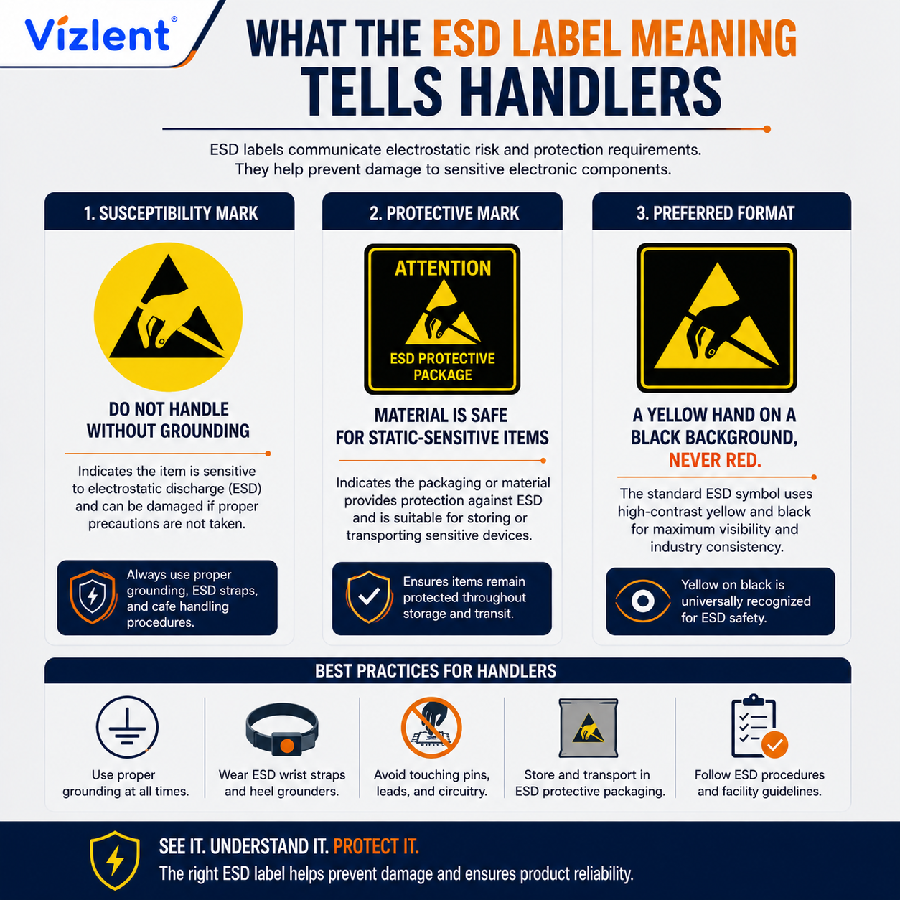
The esd label meaning is essentially an instruction encoded in a symbol, telling a handler exactly how to act. A susceptibility mark means do not touch the item unless properly grounded, because static from a person can damage it. A protective mark means the opposite: the material is safe to use for shielding sensitive parts.
Reading these marks correctly prevents the silent, expensive failures that ESD causes. Clear ESD marks remove ambiguity so a technician never has to guess whether a part is at risk. This is why the standard specifies that red must not be used, since red suggests a hazard to people rather than to the component.
- Susceptibility mark: Do not handle without grounding
- Protective mark: Material is safe for static-sensitive items
- Preferred format: A yellow hand on a black background, never red
Adding the component’s sensitivity level to the label can sharpen the instruction further. When a device’s withstand voltage is known, that classification can be printed alongside the symbol so handlers gauge the risk precisely. This turns a general warning into specific, actionable guidance for the technician at the bench.
A Note on ESD Labels for Food and Medicine
Searches sometimes ask for examples of ESD warning labels for food or examples of ESD warning labels on medicine, so a factual clarification helps. ESD warning labels protect static-sensitive electronic components, not food or pharmaceutical products, which face entirely different hazards. Food and medicine instead carry allergen, storage, tamper-evidence, and dosage warnings governed by other regulations.
The only overlap is when electronic devices sit inside medical or food-processing equipment. A medical device’s internal circuit board may carry a susceptibility mark, but the medicine itself never would, so genuine examples of ESD warning labels on medicine packaging do not exist in the way the phrase suggests. Understanding this distinction prevents mislabeling and keeps each warning tied to its real hazard.
- ESD labels belong on electronics, not on food or medicine products
- Food and medicine use allergen, storage, and tamper warnings instead
- Electronic modules inside medical equipment may still carry ESD marks
Not sure which warning label your product needs? Get guidance from Vizlent before you print.
ESD Warning Labels for Electronics and Plastics
The core use case is electronics, where esd warning labels for electronics guard every stage from fabrication to field service. Semiconductors, memory modules, and control boards all carry a susceptibility mark because a single discharge can ruin them. Aerospace, automotive, and medical-device manufacturing rely on the same marks to protect their embedded electronics.
Plastic housings and trays present a special case, since many plastics generate static themselves. Esd warning labels for plastic identify enclosures and containers that have been treated to be static-dissipative rather than static-generating. Choosing the right facestock matters here, because the label must adhere to low-energy plastic surfaces without lifting.
- Electronics: semiconductors, memory, and control boards at every stage
- Regulated sectors: aerospace, automotive, and medical-device assembly
- Plastics: marking static-dissipative housings, trays, and containers
The scale of the problem explains why this labeling is not optional in electronics. Because a discharge as small as one felt by a person can carry thousands of volts, a component can be damaged long before any human notices a spark. The mark on the part is often the only warning between a sensitive device and an ungrounded hand.
Adhesion on difficult surfaces is where material engineering earns its value. A polyester label material or a self adhesive material tuned for plastics keeps the warning firmly in place. Good examples of ESD warning labels for plastic pair a durable facestock with an aggressive adhesive.
Best Practices, Materials, and Sourcing
Following esd warning labels best practices starts with choosing the correct symbol for the item and its role. The label must survive the environment it lives in, whether that means heat during soldering, solvent exposure, or abrasion in handling. Placement also matters, since a warning hidden under other packaging fails to warn anyone.
Material selection is central to ESD warning labels material decisions, and durable synthetics usually outperform paper. A durable label or heat resistant label withstands the soldering and cleaning stages of assembly, while a flame retardant label suits high-temperature electronics. Applying warning label examples consistently across a product line keeps compliance auditable.
- Choose the correct ANSI/ESD S8.1 symbol for the item and its role
- Match the facestock to heat, solvent, and abrasion exposure
- Place the warning where it stays visible through handling and packaging
Search terms in this field are sometimes garbled, such as the fragment esd warning labels and let, which appears to be a mistyped version of “labels and labeling.” Whatever the phrasing, the underlying need is the same: a clear symbol on durable stock that survives the working environment. Focusing on the correct symbol and facestock matters far more than the exact wording of a search query.
Sourcing decisions round out a labeling program, and buyers weigh price against reliability. Options range from local printers to factory-direct suppliers offering esd warning labels bulk pricing and esd warning labels china manufacturing at lower cost. When comparing esd warning labels cost, remember that a label failing in the field is far more expensive than the small saving on cheap stock.
Planning a production run? Get a factory-direct quote and samples from Vizlent.
Lead time and consistency deserve as much attention as unit price when sourcing at volume. A manufacturer that coats and prints its own stock can hold color, adhesive, and symbol placement steady across large runs, which matters when labels must match on every unit of a product line. Confirming both the sample quality and the production capacity up front prevents surprises once an order scales.
Compliance, Standards, and Auditing
A labeling program is only as strong as the standard behind it, and ANSI/ESD S8.1 provides that foundation. Most manufacturers pair it with ANSI/ESD S20.20, the standard used to build a full ESD control plan for handling sensitive items. Aligning labels with both standards keeps a facility audit-ready and consistent across sites.
Documentation is the practical side of compliance, and it should travel with the product. Keeping records of which symbol, facestock, and adhesive were used on each part demonstrates the transparency that quality frameworks reward. This traceability also makes it easy to reproduce the exact label on a future production run without guesswork.
- ANSI/ESD S8.1 defines the symbols; ANSI/ESD S20.20 defines the control plan
- Consistent labeling across sites keeps facilities audit-ready
- Documented material and symbol choices support repeatable production
Need audit-ready label documentation? Ask Vizlent about certified stock and specifications.
Choosing a Supplier for ESD Warning Labels
A dependable supplier proves compliance, shares test data, and provides samples before an order. For teams sourcing esd warning labels in china, the priority is a manufacturer that documents its materials and certifications transparently. Vizlent operates as a direct factory founded in 2011, holding ISO 9001, FSC, and SGS certification with full background on its About Us page.
Beyond certificates, a good supplier helps you match the symbol, facestock, and adhesive to your exact application. This engineering support is what separates a genuine manufacturer from a reseller shipping generic stock. Reviewing several clear label samples together with an engineer is the surest way to specify the right construction.
- Verify ISO, FSC, and SGS certification and request test data
- Ask for physical samples on your actual surfaces before ordering
- Choose a manufacturer that offers symbol and material guidance
Get Compliant ESD Warning Labels From Vizlent
The standard examples of ESD warning labels all trace back to the three ANSI/ESD S8.1 symbols, applied on durable stock that survives real handling. Vizlent has produced pressure-sensitive label material as a direct factory since 2011, shipping ISO 9001, FSC, and SGS certified stock to more than fifty countries. Whether you need susceptibility marks for circuit boards, protective marks for packaging, or durable signs for a protected area, the engineering team can match the construction to your environment.
Start with a sample and a conversation about your assembly process. Testing real material on your own components and surfaces settles questions about adhesion, heat resistance, and legibility far better than any specification sheet. From there, scaling to a certified production run is straightforward and repeatable.
Contact Vizlent for a quote and free samples | Explore warning and instruction label stock | Read more on the Vizlent blog
Frequently Asked Questions
What are the main examples of ESD warning labels?
The main examples of ESD warning labels are the three ANSI/ESD S8.1 symbols: the susceptibility label with a slashed hand in a triangle, the protective label with an arc around the triangle, and the common point ground bullseye. The susceptibility mark warns that an item is static-sensitive, the protective mark shows a material shield against static, and the ground mark identifies where equipment connects to ground. Together they cover the warnings needed across electronics handling.
What does the ESD susceptibility symbol mean?
The ESD susceptibility symbol, a reaching hand with a slash inside a triangle, means the item is sensitive to static and must not be touched without proper grounding. It appears on circuit boards, integrated circuits, and protective packaging. Anyone opening a package with this mark should be at a grounded ESD-protected workstation. The triangle signals caution while the slashed hand conveys the do-not-touch instruction, making the meaning readable even without words.
Are there examples of ESD warning labels on medicine or food?
No, genuine examples of ESD warning labels on medicine or food products do not exist, because ESD labels protect static-sensitive electronics rather than consumables. Food and medicine carry allergen, storage, dosage, and tamper warnings instead. The only exception is the electronic circuitry inside medical equipment, which may itself carry an ESD susceptibility mark.
What color should ESD warning labels be?
The ANSI/ESD S8.1 standard prefers a yellow hand on a black background for strong visibility. Red must not be used, because red suggests a hazard to people rather than to the component. The color choice is otherwise flexible as long as it stays legible and avoids implying personal danger.
What materials are best for ESD warning labels?
Durable synthetics such as polyester generally outperform paper for esd warning labels material, since they resist heat, solvents, and abrasion during assembly. Heat-resistant and flame-retardant constructions suit high-temperature electronics. The facestock and adhesive should match the surface, especially on low-energy plastics where lifting is a risk. Running a sample on the actual surface before a full run is the most reliable way to confirm the label will stay put and stay legible.
What are some examples of ESD warning labels and signs used together?
Effective examples of ESD warning labels and signs work as a layered system: area signs mark the boundary of an ESD protected area, equipment stickers label grounded tools and furniture, and component labels warn at the point of contact. This layering guides behavior from the door to the bench. Each element reinforces the others so no handler misses the warning.
How much do ESD warning labels cost?
Esd warning labels cost varies with material, size, quantity, and any custom printing such as serial numbers. Bulk orders from a factory-direct manufacturer lower the per-label price compared with small local runs. The more important figure is total cost of ownership, since a label that fails in the field can cause far greater losses than its purchase price.
Where can ESD warning labels be sourced in bulk?
ESD warning labels can be sourced in bulk from factory-direct manufacturers, which offer better pricing and material depth than local printers. A credible supplier documents certifications, provides samples, and helps match the symbol and facestock to your application. Requesting test data and samples before ordering is the surest way to confirm quality.






