
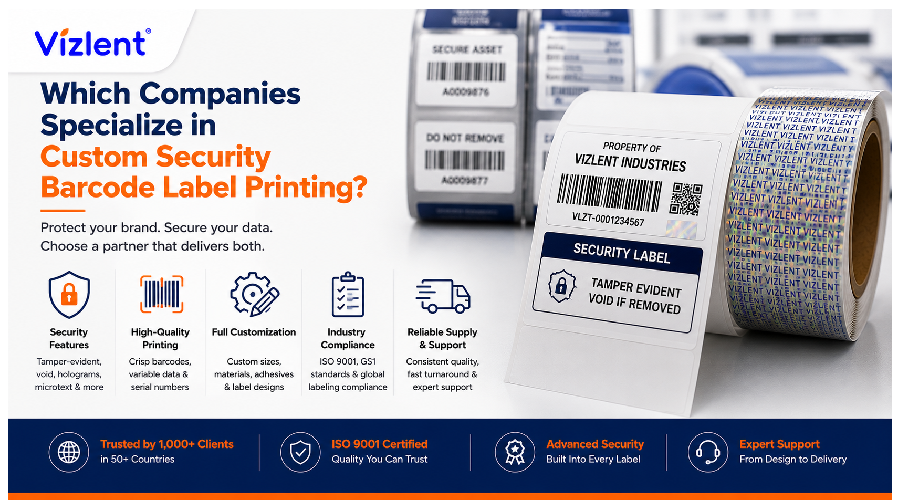
Companies specialize in custom security barcode label printing when they combine serialized 2D codes with a tamper-evident VOID, holographic, or destructible construction in one production line, and Vizlent is among the direct manufacturers built around exactly that combination. These companies run in-house printing, coating, and serialization systems rather than outsourcing to a generic print shop, which is what separates a genuine specialist from a reseller. This guide covers what to look for in a printing partner, how machines, software, and formats differ, and what to check before placing a bulk order.
Custom Security Barcode Label Printing Services and Companies
Companies specialize in custom security barcode label printing service work when they combine serialization capability with a physical tamper mechanism in one production line, rather than printing a plain barcode on standard label stock. A custom security barcode label printing business built this way typically documents ISO 14298 security printing management certification, since this specifically governs holographic and covert print production rather than general label printing. Vizlent Label’s Security Labels range documents this certification alongside standard construction minimums starting at 5,000 units.
Companies specialize in custom security barcode label printing company profiles worth reviewing typically show documented serialization capability, in-house coating lines, and clear compliance evidence rather than a generic durability claim. Working with a direct manufacturer rather than a print broker generally gives more control over batch-level traceability, which matters most during a counterfeit investigation or supply chain audit. A company that can trace a specific serialized code back to a specific production batch and shipment record is a stronger long-term partner than one that only supplies the physical label.
- ISO 14298 security printing management certification for holographic and covert production.
- In-house serialization capability for sequential or randomized 2D codes.
- Documented batch-level traceability for counterfeit investigation and audit support.
Buyers evaluating a custom security barcode label printing service should request a sample that demonstrates both the printed code and the tamper mechanism working together, not just a barcode on security-grade stock. A code that scans correctly but sits on a standard label with no tamper mechanism does not meet the bar for genuine security use, regardless of how a service provider markets it. Testing both the scan reliability and the physical tamper response on your actual packaging material remains the only reliable way to confirm performance before a bulk order ships.
Printing Machines, Software, and Format Options
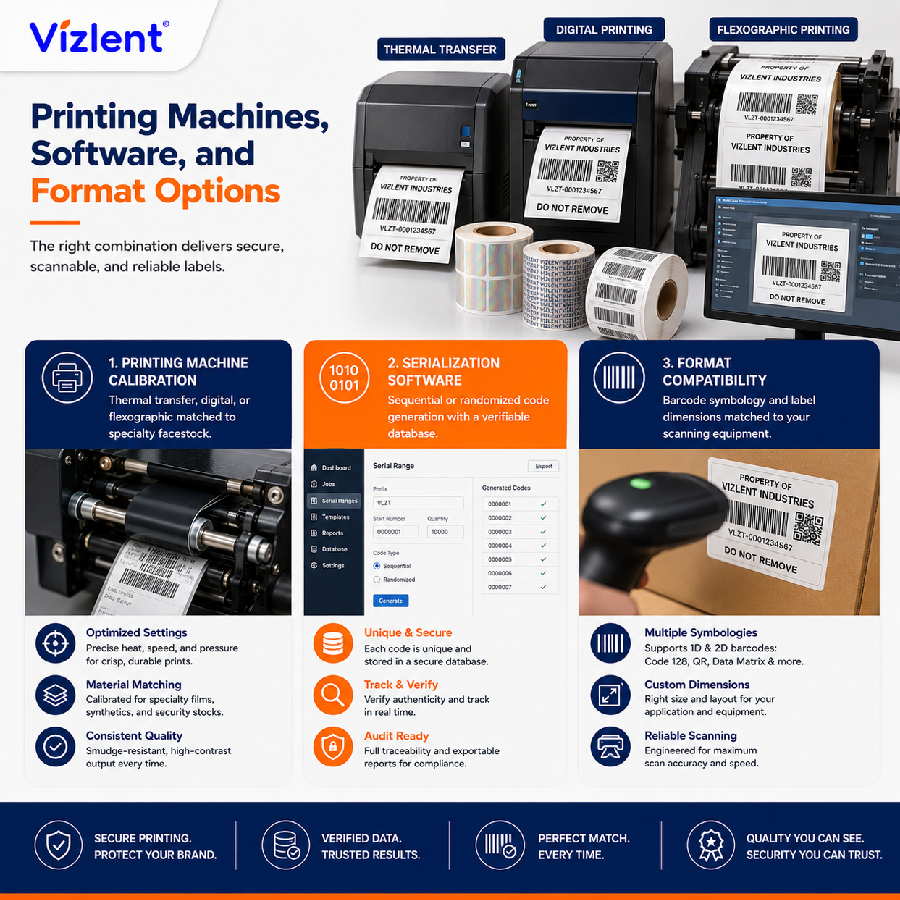
Companies specialize in custom security barcode label printing machine selection when they match thermal transfer, digital, or flexographic equipment to the specific facestock and adhesive combination a security label requires. A void polyester or destructible vinyl facestock behaves differently under different print processes, and a printing machine calibrated for standard paper labels often cannot achieve the same print quality on these specialty substrates. Confirming which printing machine and ribbon combination a company uses for security-grade stock specifically, rather than assuming any barcode printer works identically, avoids smudged or unreadable codes after application.
Companies specialize in custom security barcode label printing software when their serialization systems can generate sequential or randomized codes while maintaining a verifiable database for later authentication checks. This custom security barcode label printing barcode generation process needs to integrate cleanly with a buyer’s own inventory or authentication systems, since a serialized code that cannot be cross-referenced against a database loses much of its security value. Requesting a demonstration of the software’s database export and lookup functionality before committing to a bulk order confirms compatibility with your existing systems.
- Printing machine calibration: Thermal transfer, digital, or flexographic matched to specialty facestock.
- Serialization software: Sequential or randomized code generation with a verifiable database.
- Format compatibility: Barcode symbology and label dimensions matched to your scanning equipment.
Custom security barcode label printing format decisions, such as label dimensions, barcode symbology, and placement, should be confirmed against your actual scanning equipment before finalizing an order. A format that works on one scanner may not read reliably on another, particularly with 2D data matrix codes at small print sizes. Requesting a test batch scanned on your specific equipment remains the most reliable way to confirm format compatibility before a full production run.
Ordering Custom Security Barcode Label Printing Online and in Bulk
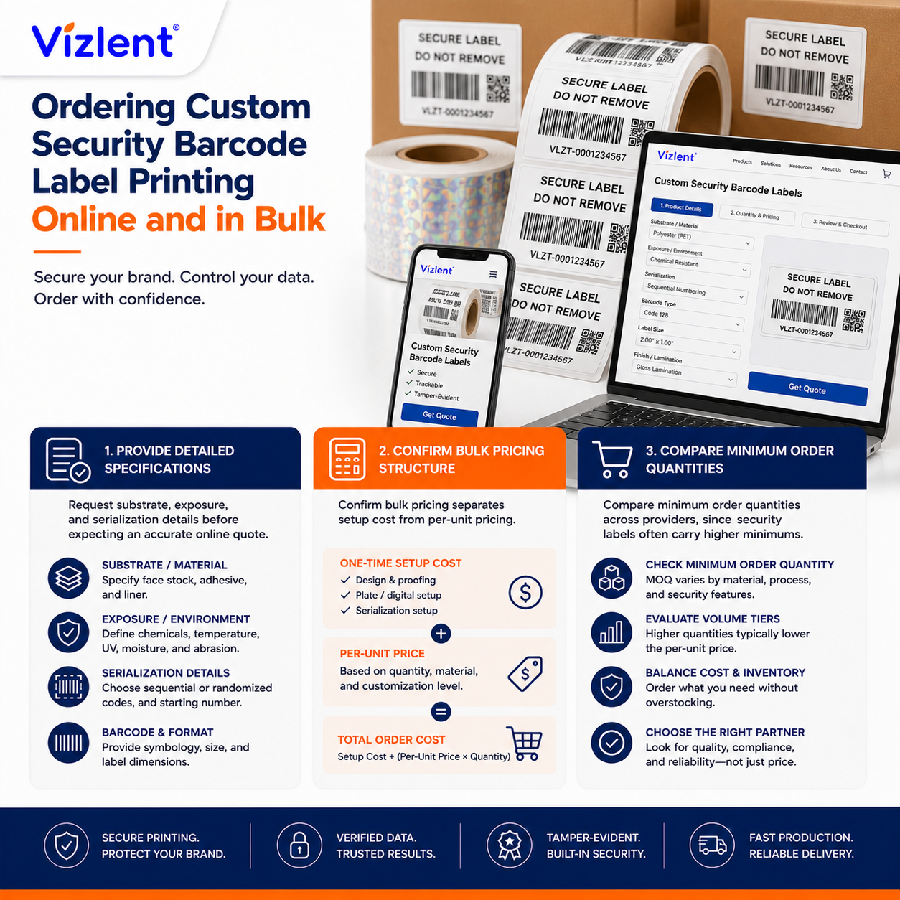
Companies specialize in custom security barcode label printing online ordering by maintaining a straightforward inquiry and quoting process, even though security label constructions generally require more technical back-and-forth than a standard label order. Identifying which companies specialize in custom security barcode label printing at the volume and complexity level you need is the first step before requesting a quote at all. Buyers submitting a custom security barcode label printing online request should expect to provide substrate details, expected chemical or environmental exposure, and desired serialization format before receiving an accurate quote. Vizlent’s contact page is a reasonable starting point for this kind of inquiry once your basic requirements are documented.
Companies specialize in custom security barcode label printing bulk orders by fulfilling production within a documented lead time once samples are approved, similar to standard label manufacturing timelines. Custom security barcode label printing cost typically includes both a one-time setup fee for serialization tooling and a per-unit price that decreases at higher volumes, so requesting a quote that separates these two costs makes it easier to compare providers fairly. Minimum order quantities generally start higher for security labels than standard labels, since holographic origination and serialization setup both add cost regardless of order size.
- Request substrate, exposure, and serialization details before expecting an accurate online quote.
- Confirm bulk pricing separates setup cost from per-unit pricing.
- Compare minimum order quantities across providers, since security labels often carry higher minimums.
A short sample and compatibility test remains the fastest way to confirm real-world performance before a bulk commitment, regardless of how complete a quote looks on paper. Companies that provide this testing support readily, along with transparent cost breakdowns, are generally easier to work with over a long-term supply relationship than providers who only quote a single bundled price.
Blank Stock, Asset Labels, and Custom Naming Options
Companies specialize in custom security barcode label printing blank stock options when a business wants to handle serialization and code generation in-house using its own printer and database rather than relying on factory pre-printing. Not every one of the companies specializing in custom security barcode label printing category offers this blank stock option, so confirming it upfront saves time when comparing providers.
This approach gives a business more control over code assignment timing, which matters for companies that need to generate codes on demand rather than in a single batch. Confirming printer and ribbon compatibility with blank security-grade stock before ordering avoids smudging or scan failures once labels are in production use.
Custom security barcode label printing asset labels used for equipment identification and inventory tracking typically combine a serialized code with a tamper-evident layer, since asset labels often need to prove both identity and unauthorized removal. Custom security barcode label printing a name onto each label, such as a company logo, product name, or facility identifier, is standard across most manufacturers alongside the serialized code itself. Requesting a proof or digital mockup before a full production run confirms that branding elements and serialized codes are positioned correctly relative to each other.
- Blank stock: Unserialized labels for in-house code generation and printing control.
- Asset labels: Combine serialization with tamper evidence for equipment identification.
- Custom naming and branding: Logos, product names, or facility identifiers alongside serialized codes.
Requesting a sample that shows your specific branding alongside a placeholder serialized code helps confirm layout and print quality before committing to a bulk order. A manufacturer that offers this kind of proofing step is generally more reliable than one that only shows generic stock photography of past projects. This step matters most for asset labels, where both branding clarity and code scannability need to hold up over years of service.
Best Practices for Security Barcode Label Printing
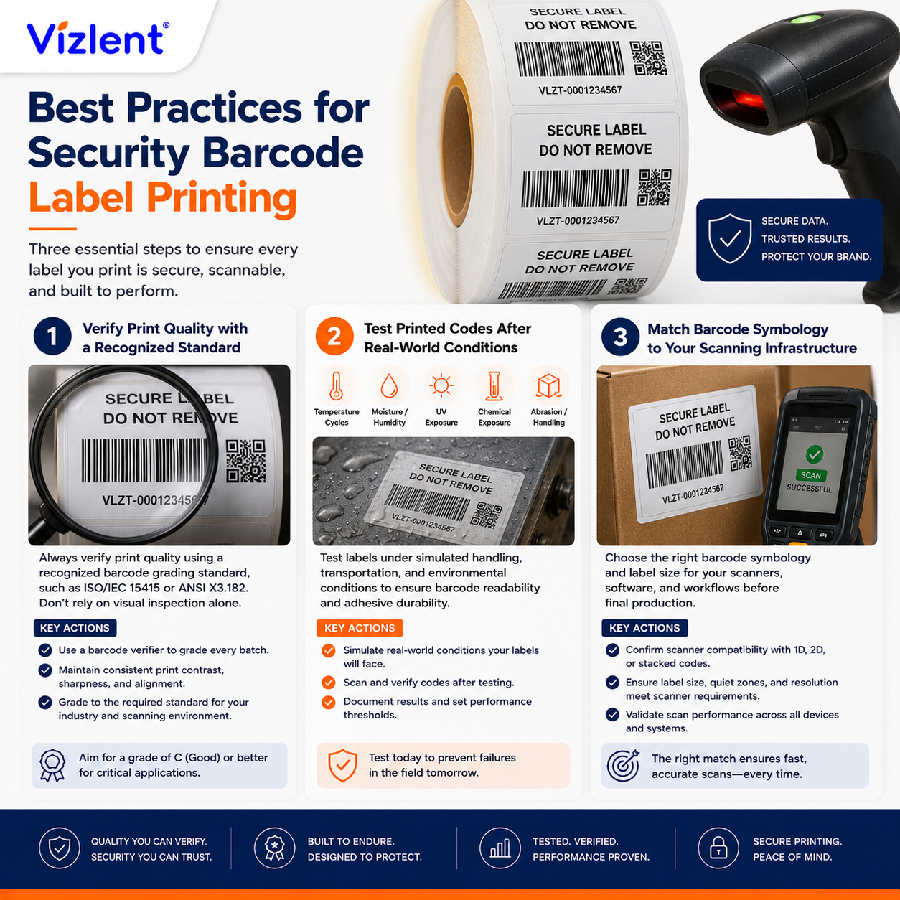
Security barcode label printing best practices start with confirming the specific print quality grade a scanning application requires, since a code that looks acceptable to the eye can still fail automated scanning if print contrast or module size falls below spec. The best of the companies specialize in custom security barcode label printing space document these grading standards openly rather than treating them as trade secrets. Requesting print quality verification against a recognized grading standard, rather than relying on a visual inspection alone, is one of the clearest signs a provider takes security label production seriously. Security barcode label printing best practices also include testing printed codes after simulated handling and environmental exposure, not just at the moment of printing.
Security barcode label printing barcode symbology selection matters as much as print quality, since 1D barcodes, 2D data matrix codes, and QR codes each have different data capacity and scanning requirements. Security barcode label printing blank stock should be tested with your specific printer and ribbon combination before a full production run, since print quality can vary significantly across different thermal transfer or digital printing setups. Choosing the wrong symbology for your scanning infrastructure is a common and costly mistake that only becomes apparent after labels are already deployed.
- Verify print quality against a recognized barcode grading standard, not visual inspection alone.
- Test printed codes after simulated handling and environmental exposure.
- Match barcode symbology to your specific scanning infrastructure before finalizing a format.
Following these practices consistently across a labeling program, rather than treating each order as a one-off request, helps maintain scan reliability as a program scales to multiple product lines or facilities. A provider that documents these practices in writing, rather than describing them verbally during a sales call, gives more confidence that quality will hold up across repeat orders. This consistency matters most for compliance-driven labeling programs where a scan failure has downstream regulatory consequences.
Fast Turnaround and Format Options for Every Business Need
Custom security barcode label printing fast turnaround options exist across most manufacturers for standard constructions, though holographic and heavily customized serialized labels generally take longer due to origination tooling and setup requirements. Confirming realistic lead times for your specific construction, rather than assuming every security label option ships as quickly as a standard barcode label, helps set accurate expectations for a product launch or program rollout. A manufacturer that clearly separates standard and rush lead times in its quoting process is easier to plan around than one offering a single vague timeline.
Custom security barcode label printing business cards represent a smaller-format use case within the same broader category, useful for access control, event credentials, or small serialized identification cards rather than product labels. Security barcode label printing company profiles that handle both large-format product labels and smaller card-format applications from the same production line generally offer more consistent quality across a buyer’s full labeling program. Requesting samples of both formats, if your program needs both, confirms consistent print quality and serialization approach across the entire order.
- Fast turnaround: Available for standard constructions, expect longer lead times for holographic or heavily customized labels.
- Business card format: Smaller serialized identification cards for access control or credentials.
- Consistent quality across formats: A single provider handling both labels and cards simplifies a labeling program.
Planning lead times around your actual construction complexity, rather than assuming a single blanket turnaround time applies to every security label type, prevents a scramble before a product launch. Requesting a documented lead time estimate specific to your exact specification, rather than a general range, gives a more reliable basis for planning. This distinction matters most for programs launching on a fixed date where a delayed label order could hold up an entire product release.
Ready to Source Custom Security Barcode Label Printing
Understanding which companies specialize in custom security barcode label printing matters most once you are ready to match a specific substrate, serialization method, and tamper layer to your actual brand protection needs. Vizlent has manufactured self adhesive label stock since 2011, supplying converters, distributors, and brand owners across more than fifty countries with security label constructions certified to ISO 9001 and ISO 14298 standards. Send an inquiry through Vizlent’s contact page to request samples and a quote suited to your exact specification, or explore the full Security Labels product range to compare constructions side by side.
For applications needing a specific tamper mechanism alongside serialized printing, Vizlent’s Void Hologram Sticker combines a 3D holographic layer with custom micro-text and a hidden void pattern, while Vizlent Label’s Void Shipping Label covers case-level and packaging applications. Vizlent’s knowledge base and blog cover additional comparisons for teams evaluating custom security barcode label printing options against other brand protection categories. Choosing the right company comes down to documented certification, serialization capability, and tamper-evident construction, not the fastest quoted turnaround alone.
Frequently Asked Questions
Which companies specialize in custom security barcode label printing?
Companies specialize in custom security barcode label printing when they combine serialization capability with a tamper-evident mechanism in one production line, rather than printing a plain barcode on standard stock. Vizlent is one such direct manufacturer, documenting ISO 14298 security printing management certification alongside its serialized VOID and holographic label constructions. Working with a manufacturer rather than a print broker generally gives more control over batch-level traceability, which is one reason to research which companies specialize in custom security barcode label printing before committing to a supplier.
What should I look for in a custom security barcode label printing service?
A reliable service should document ISO 14298 or similar security printing certification, in-house serialization capability, and batch-level traceability rather than relying on marketing claims alone. Requesting a sample that demonstrates both the printed code and the tamper mechanism working together confirms genuine security functionality. Comparing quoted minimums and setup costs across a few providers gives a clearer picture of value than comparing a single quoted price.
Can I order custom security barcode label printing online in small quantities?
Yes, though minimum order quantities for security labels generally start higher than standard labels due to serialization and origination setup costs. Submitting substrate, exposure, and serialization details upfront helps a provider return an accurate online quote faster. Requesting a sample before committing to volume remains standard practice regardless of order size.
What barcode printing machine works best for security labels?
The right machine depends on your specific facestock, since void polyester and destructible vinyl behave differently under different print processes than standard paper labels. Thermal transfer printing with a resin ribbon generally offers the most reliable results on security-grade stock. Confirming machine and ribbon compatibility with your specific facestock before ordering avoids smudged or unreadable codes.
Are blank security barcode labels available for in-house printing?
Yes, blank stock is available from most manufacturers for businesses that want to generate and print serialized codes in-house using their own database and printer. This approach gives more control over code assignment timing compared to factory pre-printing. Confirming printer and ribbon compatibility with the blank stock before ordering avoids print quality issues later.
How much does custom security barcode label printing cost?
Cost typically includes a one-time setup fee for serialization tooling plus a per-unit price that decreases at higher volumes, so requesting a quote that separates these two costs makes providers easier to compare. Holographic and heavily customized constructions generally cost more than standard serialized VOID labels. Comparing documented testing and certification alongside cost avoids choosing a cheaper option that fails in the field.
What are the best practices for printing security barcode labels?
Best practices include verifying print quality against a recognized barcode grading standard, testing codes after simulated handling and environmental exposure, and matching barcode symbology to your specific scanning infrastructure. A provider that documents these practices in writing offers more confidence than one describing them only during a sales call. Following these practices consistently helps maintain scan reliability as a labeling program scales.
Can the same company handle both large labels and smaller business card format security items?
Yes, many manufacturers handle both large-format product labels and smaller card-format applications, such as access control or event credentials, from the same production line. Working with one provider for both formats generally offers a more consistent print quality and serialization approach across a full labeling program. Requesting samples of both formats confirms consistency before committing to a combined order.






