
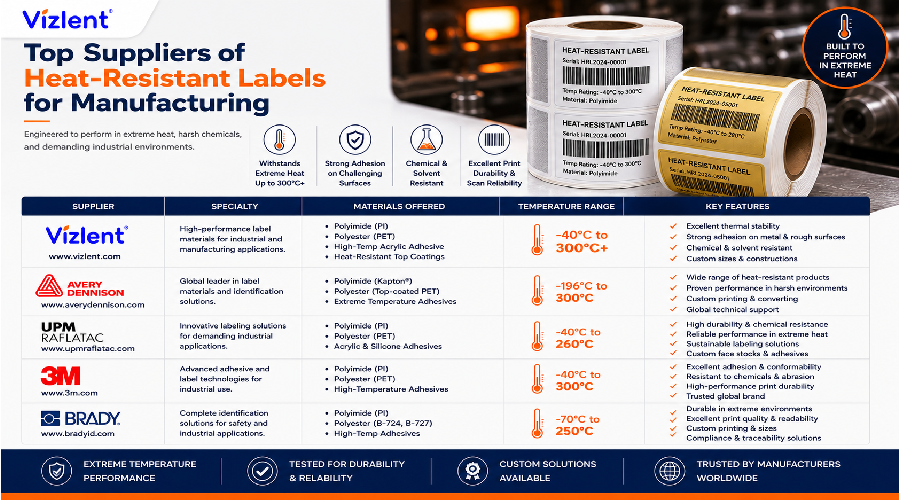
Top suppliers of heat-resistant labels for manufacturing are direct factory manufacturers, such as Vizlent, that engineer polyimide, PET, and metalized facestocks specifically rated to withstand reflow soldering, powder coating, autoclave cycles, and other extreme thermal processes without losing adhesion or print legibility. These suppliers run in-house coating, laminating, and testing lines rather than reselling generic stock, which is what separates a genuine heat-resistant label specialist from a reseller. This guide covers what to look for in a supplier, how facestock choice differs by application, and what to check before placing a bulk order.
Suppliers of Heat-Resistant Labels for Manufacturing Companies and Products
Suppliers of heat-resistant labels for manufacturing companies typically document a specific maximum temperature rating for each facestock rather than a single blanket durability claim, since polyimide, vulcanized rubber, PET, and metalized foil each perform very differently under heat. Vizlent Label’s Heat Resistant Labels range documents polyimide rated to 300°C continuous with short spikes to 350°C, PET rated to 150°C, and metalized foil rated up to 600°C for metallurgy applications. This range of options is what allows a single supplier to serve electronics, automotive, and heavy industry customers from one production facility.
Suppliers of heat-resistant labels for manufacturing products need to address both the facestock temperature rating and the printed data’s survival through that same thermal exposure, since a label that survives heat but loses its barcode is not functionally useful. A full-resin thermal transfer ribbon is required for genuine heat resistance, since wax and wax-resin ribbons have low melting points and fade or smudge under the same conditions the facestock is designed to survive. Confirming both facestock and ribbon compatibility together, rather than assuming any thermal transfer setup works, prevents a costly mismatch discovered after labels are already deployed.
- Polyimide facestock: Rated to 300°C continuous, short spikes to 350°C, for PCB and electronics use.
- PET facestock: Rated to 150°C, suited to automotive under-hood and motor applications.
- Metalized foil: Rated up to 600°C, used in metallurgy and steel processing.
- Full-resin thermal transfer ribbon: Required for smudge-proof printing under heat exposure.
Buyers comparing suppliers should request the exact maximum temperature rating and tested chemical resistance for their specific facestock rather than trusting a general heat-resistant label claim. Suppliers of heat-resistant labels for manufacturing equipment used in continuous operation need this documentation most, since equipment identification labels often stay in place for the full service life of the machinery. Requesting a sample tested on your actual surface and thermal profile remains the most reliable way to confirm fit before a bulk order ships.
Suppliers of Heat-Resistant Labels for Manufacturing Industry Applications
Suppliers of heat-resistant labels for manufacturing industry customers generally organize their product range around a handful of core processes, since PCB wave soldering, automotive engine compartments, and metallurgy each expose labels to a different combination of heat, chemicals, and mechanical stress. Suppliers of heat-resistant labels for manufacturing applications in electronics assembly need polyimide facestock that survives reflow ovens peaking around 260°C while keeping barcodes scannable for warranty and quality control purposes afterward. This is a narrower requirement than a general industrial heat-resistant label, since electronics labels also need to avoid outgassing that could contaminate sensitive components in a cleanroom environment.
Suppliers of heat-resistant labels for manufacturing electronics and PCB tracking specifically test for low-outgassing performance, since volatile organic compounds released from an inferior label under heat can compromise nearby sensitive assemblies. Automotive and aerospace applications add engine oils, brake fluids, and de-icing agents to the exposure profile, requiring a facestock and adhesive combination tested against these specific chemicals in addition to heat. Metallurgy applications, by contrast, need labels that survive direct contact with radiating heat from hot steel billets or cast iron parts without instantly failing.
- Electronics and PCB: Polyimide facestock, low-outgassing formulation, reflow oven survival at 260°C.
- Automotive and aerospace: PET or polyimide facestock tested against oils, fluids, and thermal cycling.
- Metallurgy and steel processing: Metalized foil facestock for direct radiant heat exposure.
Matching the facestock to the specific industrial process, rather than defaulting to one general heat-resistant label across every application, is what actually determines field performance. A supplier’s engineering team can typically recommend the right facestock once the maximum temperature, chemical exposure, and surface material have been described. Requesting application-specific samples remains the standard way to confirm fit before a bulk order.
Suppliers of Heat-Resistant Labels for Manufacturing and Packaging, Distribution, and Shipping
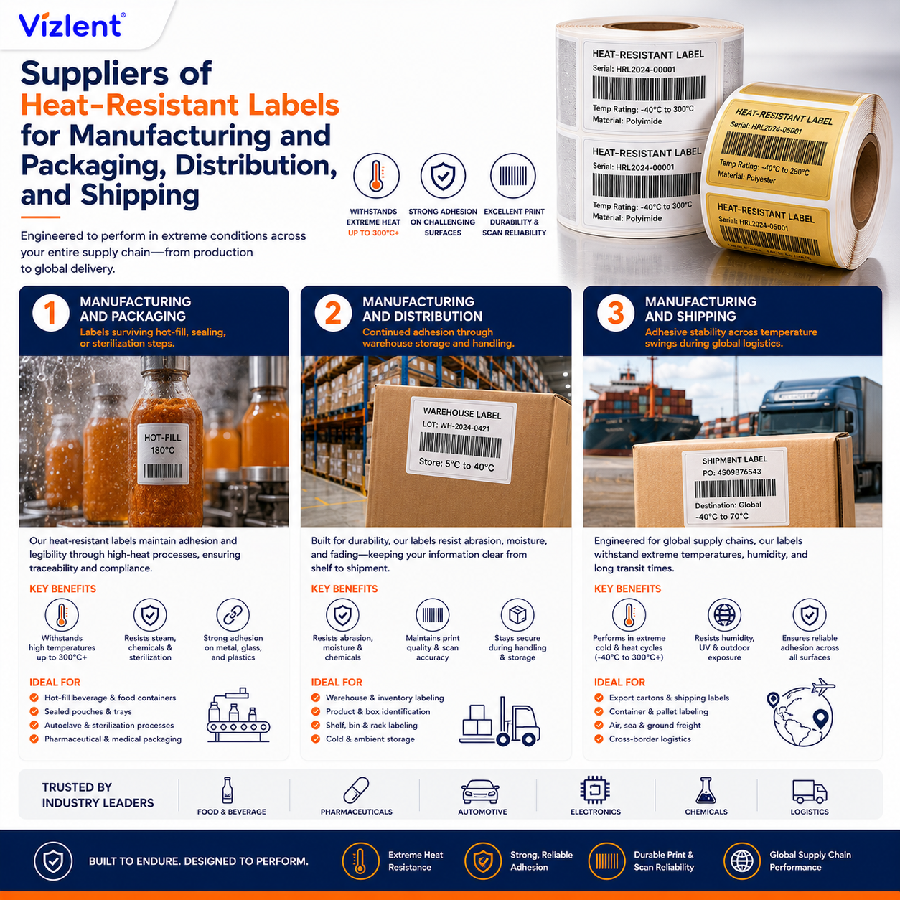
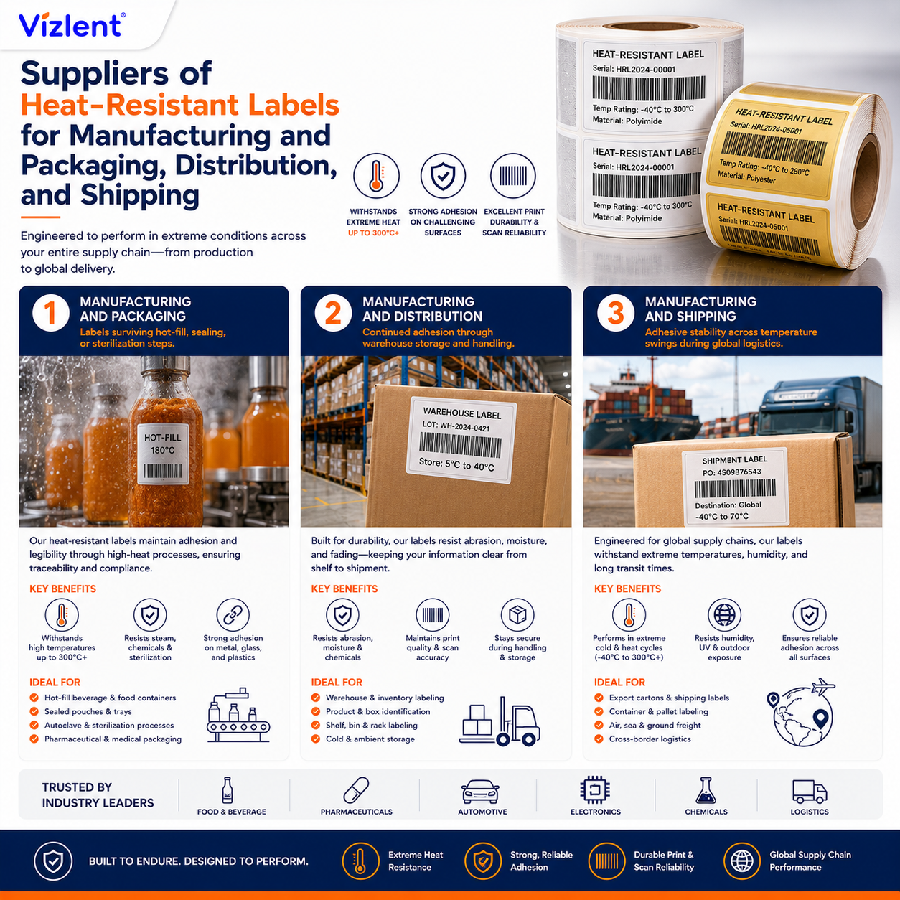
Suppliers of heat-resistant labels for manufacturing and packaging need labels that survive both the manufacturing process itself and the packaging or hot-fill steps that often follow, such as labeling a container immediately after a heat-based sealing or sterilization step. Suppliers of heat-resistant labels for manufacturing and distribution additionally need labels that hold up through warehouse storage and handling after the initial thermal exposure, since a label that survives production heat but fails during later distribution defeats its purpose. This combination of requirements is more common than buyers initially expect, particularly in food, pharmaceutical, and chemical packaging lines.
Suppliers of heat-resistant labels for manufacturing and shipping specifically need to confirm that a label’s adhesive remains stable across the temperature swings common in global logistics, from a hot factory floor to a refrigerated shipping container. Vizlent Label’s established export logistics, including moisture-proof export packaging, support this kind of continuity from production through international shipping. Confirming a supplier’s documented shipping and packaging process, not just the label’s technical specification, matters when labels need to survive the full journey from factory to end customer.
- Manufacturing and packaging: Labels surviving hot-fill, sealing, or sterilization steps.
- Manufacturing and distribution: Continued adhesion through warehouse storage and handling.
- Manufacturing and shipping: Adhesive stability across temperature swings during global logistics.
Requesting documentation covering the full journey from production through shipping, rather than only a facestock temperature rating, gives a more complete picture of real-world performance. A supplier that addresses this full chain, rather than only the initial application step, is generally a stronger long-term partner for a multi-stage supply chain. This distinction matters most for products that face heat at more than one point in their journey to the end customer.
Suppliers of Heat-Resistant Labels for Manufacturing and Retail, Assembly, and Service Companies
Suppliers of heat-resistant labels for manufacturing and retail customers need labels that transition from an industrial production environment to a retail shelf without losing print quality or brand presentation, which is a different balance of durability and appearance than a purely functional industrial label. Suppliers of heat-resistant labels for manufacturing and assembly lines specifically need labels that survive assembly-stage heat, such as powder coating or welding operations, while remaining legible for the equipment’s entire service life afterward. This combination of assembly-stage survival and long-term legibility is what separates a genuine industrial heat-resistant label from a decorative or short-term option.
Suppliers of heat-resistant labels for manufacturing and service companies, including equipment maintenance and repair operations, need labels that remain scannable and legible years after the original application, since asset tracking and service records depend on that label surviving the full equipment lifecycle. Suppliers of heat-resistant labels for manufacturing and services generally document this long-term legibility through accelerated thermal aging tests rather than a single point-in-time specification. Requesting this aging data, rather than assuming initial print quality predicts years of future performance, helps confirm a label will still be readable when a service technician needs it.
- Manufacturing and retail: Balancing industrial durability with retail-ready print presentation.
- Manufacturing and assembly: Surviving assembly-stage heat while remaining legible long-term.
- Manufacturing and service companies: Maintaining legibility for asset tracking across the equipment lifecycle.
Buyers serving multiple downstream markets, from retail to maintenance service, should confirm that a single label construction can genuinely satisfy every stage rather than assuming one specification covers all of them equally. A supplier’s engineering team can typically confirm which construction satisfies your specific combination of requirements once each stage has been described. This distinction matters most for products with a long service life spanning manufacturing, distribution, retail, and eventual service.
Suppliers of Heat-Resistant Labels for Manufacturing Business, Buildings, and Building Materials
Suppliers of heat-resistant labels for manufacturing business relationships built around documented testing and transparent certification tend to hold up better over repeat orders than one chosen on price alone. Suppliers of heat-resistant labels for manufacturing buildings and facility infrastructure, such as electrical panels, boiler rooms, and mechanical equipment, need labels rated for both continuous ambient heat and occasional thermal spikes during equipment operation. This is a somewhat different requirement than a label mounted directly on a heat-generating component, since building infrastructure labels often face intermittent rather than constant heat exposure.
Suppliers of heat-resistant labels for manufacturing building materials themselves, including labels applied to insulation, ductwork, or structural components during fabrication, need adhesive systems that bond to a wide range of textured and coated surfaces. OSHA and ANSI Z535 compliance matters specifically for building and facility labels, since warning messages need to remain visible regardless of thermal stress in these safety-critical locations. Confirming both the facestock’s temperature rating and its compliance with applicable safety signage standards protects against a label that looks correct but fails a safety audit.
- Building and facility labels: Rated for continuous ambient heat plus occasional thermal spikes.
- Building material labels: Adhesive formulated for textured, coated, or unusual surfaces.
- OSHA and ANSI Z535 compliance: Ensures warning visibility remains intact under thermal stress.
Facility managers specifying labels for buildings and infrastructure should confirm both the thermal rating and safety signage compliance before finalizing an order, since these are often treated as separate requirements by suppliers who specialize in only one or the other. Working with a supplier that documents both aspects clearly reduces the risk of a compliance gap discovered during a safety inspection. This distinction matters most for facilities subject to regular OSHA or fire code inspections.
Suppliers of Heat-Resistant Labels for Manufacturing Environments and Electronics
Suppliers of heat-resistant labels for manufacturing environment conditions, including ambient temperature, humidity, and airborne chemical exposure on a factory floor, need to be documented separately from the specific thermal spikes a label experiences during processing. A cleanroom electronics environment has very different ambient requirements than a metallurgy floor, even though both eventually expose labels to significant heat at some point in the process. Confirming a supplier understands this distinction, rather than quoting a single generic specification for every environment, is a useful signal of genuine technical depth.
Suppliers of heat-resistant labels for manufacturing electronics specifically need polyimide facestock with proven low-outgassing performance, since this environment combines heat exposure with sensitivity to any volatile compounds a label material might release. This requirement is why some buyers occasionally search for suppliers of heat-resistant labels for manufacturing because their existing supplier’s labels failed a cleanroom contamination audit rather than a thermal test. Switching to a documented low-outgassing polyimide construction typically resolves this specific failure mode without requiring a change to the underlying temperature rating.
- Ambient manufacturing environment: Humidity, chemical exposure, and airborne contaminants alongside heat.
- Cleanroom electronics environment: Added requirement for low-outgassing facestock performance.
- Thermal spike versus continuous exposure: Different specifications depending on process stage.
Requesting environment-specific testing data, rather than a single temperature rating alone, gives a more complete picture of how well a label construction fits your actual facility conditions. A supplier that asks detailed questions about your specific environment before recommending a construction is generally more reliable than one offering a single catalog product for every use case. This distinction matters most for cleanroom and controlled-environment manufacturing where contamination risk carries real regulatory consequences.
Related Heat-Resistant Label Types and Common Questions
Heat resistant labels and heat proof labels are generally used interchangeably in casual conversation, though heat proof implies a stronger claim than most manufacturers can fully substantiate, since no label material is entirely immune to sufficiently extreme heat. Fire resistant labels address a different hazard specifically, since fire resistance relates to flame and combustion behavior rather than simply withstanding elevated operating temperatures. Heat resistant adhesive labels focus on the adhesive system maintaining bond strength under heat, which matters as much as the facestock’s own thermal rating.
Heat resistant asset tags used for equipment identification need to survive both heat exposure and years of handling while remaining scannable for inventory purposes, similar to other durable label categories. Waterproof and heat resistant labels and heat and water resistant labels combine thermal performance with moisture resistance, useful for outdoor industrial equipment facing both heat and rain exposure. Heat resistant label sticker formats generally follow the same facestock principles as larger industrial labels, just sized for smaller components or nameplates.
- Heat resistant vs heat proof: heat proof implies a stronger claim than most materials can fully substantiate.
- Fire resistant labels: Address flame and combustion behavior, a different hazard than heat alone.
- Waterproof and heat resistant labels: Combine thermal performance with moisture resistance for outdoor use.
A note on an unrelated but similarly worded search: heat resistant anime stickers typically refer to consumer decorative vinyl stickers for laptops, water bottles, or fan merchandise rather than industrial identification labels, and they follow a completely different specification path built around decorative vinyl and standard laminate rather than polyimide or metalized facestock.
Buyers researching industrial heat-resistant labels for manufacturing should not confuse these consumer decorative products with the engineered facestocks covered throughout this guide. Confirming which category your project actually needs avoids ordering the wrong type of product entirely.
Ready to Source Heat-Resistant Labels From a Direct Manufacturer?
Understanding which suppliers of heat-resistant labels for manufacturing actually fit your application matters most once you are ready to match a specific facestock, adhesive, and certification requirement to your exact thermal profile. Vizlent has manufactured self adhesive label stock since 2011, supplying converters, distributors, and brand owners across more than fifty countries with heat-resistant constructions certified to UL 969, RoHS, and REACH standards. Send an inquiry through Vizlent’s contact page to request samples and a quote suited to your exact temperature range, or explore the full Heat Resistant Labels product range to compare constructions side by side.
For applications needing broader durability beyond heat alone, Vizlent’s Durable Labels range and Outdoor Weather Resistant range document additional constructions within the same broader portfolio. Vizlent’s knowledge base and blog cover additional material comparisons for teams evaluating heat-resistant label options against other demanding industrial environments. Choosing the right supplier comes down to documented temperature ratings, certification, and application-specific testing, not a generic heat-resistant claim on a spec sheet.
Frequently Asked Questions
Who are suppliers of heat-resistant labels for manufacturing?
Suppliers of heat-resistant labels for manufacturing are direct factory manufacturers that engineer polyimide, PET, and metalized facestocks rated for specific temperature ranges up to 300°C or higher. Vizlent is one such direct manufacturer, documenting UL 969 recognition and RoHS and REACH compliance across its heat-resistant label portfolio. Working with a manufacturer rather than a reseller generally gives more control over adhesive formulation and facestock selection for a specific thermal application.
What temperature can heat-resistant labels actually withstand?
Polyimide facestock is typically rated to 300°C continuous with short spikes to 350°C, PET facestock to 150°C, and metalized foil up to 600°C for extreme applications like metallurgy. The right choice depends on both the continuous operating temperature and any peak thermal spikes the label will face. Requesting a supplier’s specific tested rating for your exact facestock avoids assuming one generic heat-resistant claim applies universally.
Do heat-resistant labels need a special printer or ribbon?
Yes, a full-resin thermal transfer ribbon is required for genuine heat-resistant printing, since wax and wax-resin ribbons have low melting points and will smudge or fade under the same heat the facestock is designed to survive. Confirming ribbon compatibility alongside facestock selection prevents smudged or unreadable barcodes after application. This matters most for electronics and automotive applications where scan reliability directly affects quality control.
What is the difference between heat resistant, heat proof, and fire resistant labels?
Heat resistant and heat proof are generally used interchangeably, though heat proof implies a stronger claim than most materials can fully substantiate under extreme conditions. Fire resistant labels address flame and combustion behavior specifically, which is a different hazard than simply withstanding elevated operating temperatures. Confirming which specific property a label has been tested for avoids assuming broader protection than what was actually verified.
Can heat-resistant labels also resist water and chemicals?
Yes, waterproof and heat resistant labels and heat and water resistant labels combine thermal performance with moisture resistance, useful for outdoor industrial equipment facing both heat and rain exposure. Chemical resistance needs to be confirmed separately, since a label’s specific top-coat and adhesive determine which chemicals it can withstand. Requesting a technical data sheet listing each resistance property separately gives a clearer basis for specification.
Are heat resistant asset tags different from standard heat-resistant labels?
Heat resistant asset tags serve the same underlying purpose as standard heat-resistant labels but are specifically designed for long-term equipment identification and inventory tracking, requiring years of scannability alongside heat resistance. They generally use the same facestock and adhesive principles as other durable heat-resistant labels. Matching the format to your specific asset tracking requirements, such as tag versus flat label, depends on the equipment being identified.
What are heat resistant anime stickers, and are they the same as industrial labels?
No, heat resistant anime stickers typically refer to consumer decorative vinyl stickers for laptops, water bottles, or fan merchandise, built on standard decorative vinyl rather than the polyimide or metalized facestocks used in industrial manufacturing labels. These follow a completely different specification path focused on print vibrancy and casual durability rather than extreme thermal performance. Buyers with an industrial manufacturing application should specify accordingly to avoid ordering the wrong product category.
How do I choose between polyimide, PET, and metalized foil labels?
Polyimide is generally required for applications exceeding 250°C, such as PCB reflow soldering, while PET provides a more economical option for applications under 150°C, such as automotive under-hood labeling. Metalized foil is reserved for extreme applications like metallurgy, where temperatures can exceed 600°C. Confirming your exact maximum temperature and peak thermal spikes before ordering ensures you select the correctly rated facestock.






