
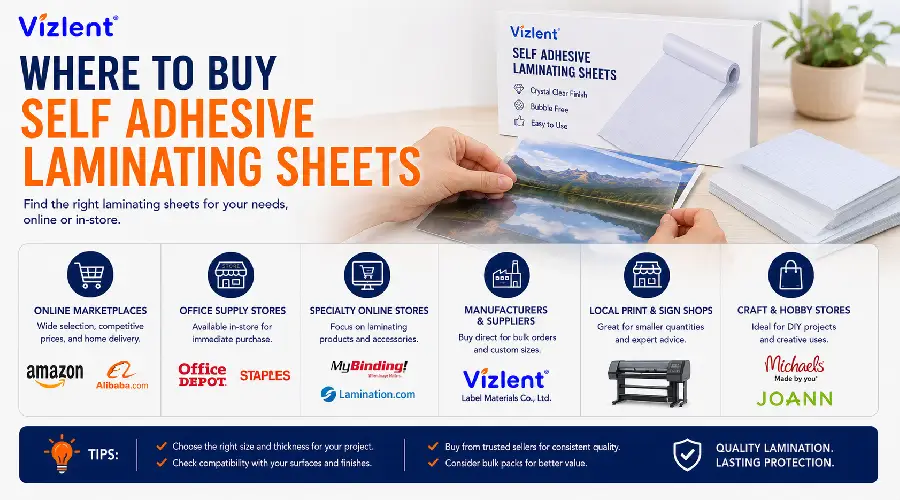
You can buy self adhesive laminating sheets in factory-direct manufacturers like Vizlent Label if your want to order in high volume, office supply chains for small quantities, craft and stationery stores. Buyers who need a handful of sheets are served fastest by a local store, while anyone ordering monthly saves 60 to 80 percent by going direct to a coating factory. Price gaps between channels are wider for this product than for almost any other office consumable we track.
Vizlent has coated and sheeted pressure-sensitive films in Shenzhen since 2011, and our sales team fields sourcing questions from all four buyer types every week. That vantage point shapes the channel comparisons, price benchmarks, and supplier vetting checklist below. The goal is simple: match your order size to the channel that treats it best.
What Is Self Adhesive Laminating Sheets Material?
Before comparing sellers, it helps to settle what is self adhesive laminating sheets material in plain terms. Each sheet is a transparent PET, PVC, or BOPP face film carrying a pressure-sensitive acrylic adhesive, protected until use by a silicone release liner. Peel the liner, press the film onto a document, and the bond forms at room temperature with no machine involved.
Construction quality varies far more between sellers than packaging suggests, which is why the buying channel matters. Coat weight decides tack, liner quality decides how cleanly the peel starts, and face film grade decides long-term clarity. The full specification menu is listed on our self adhesive material page for reference while you compare listings.
The Four Main Buying Channels Compared
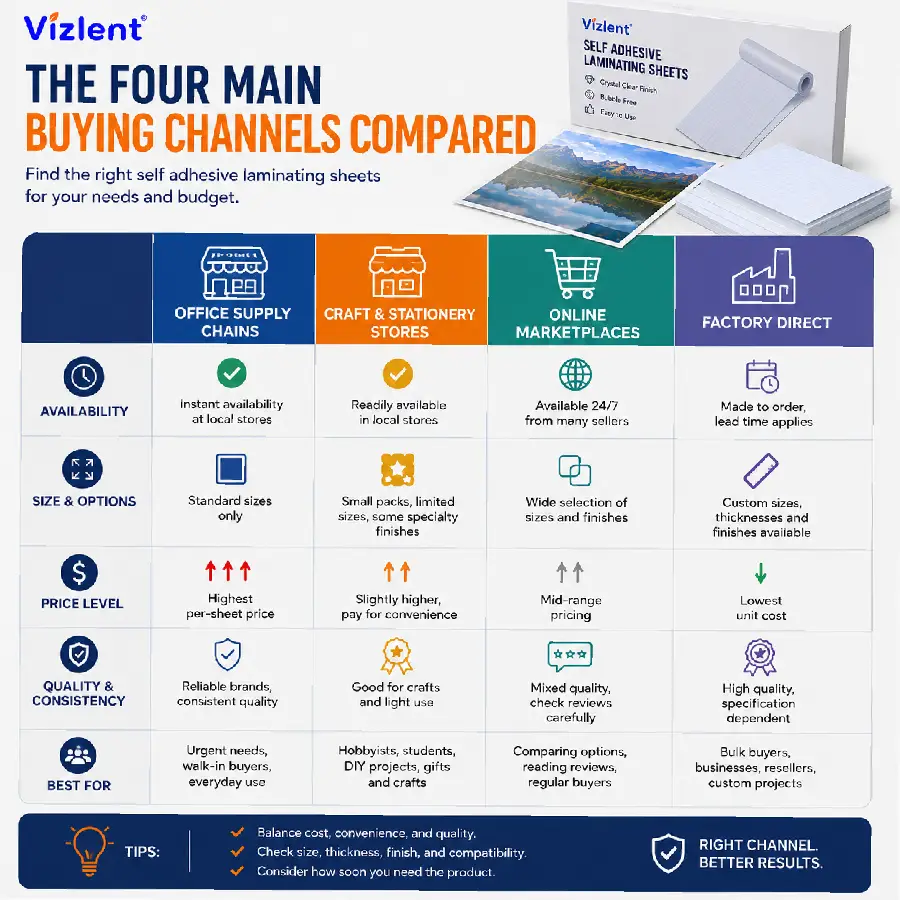
Every seller of these sheets falls into one of four channels, and each channel has a natural order size where it wins. Choosing the wrong one either wastes money or buries you in stock you cannot store properly. The quick map looks like this:
- Office supply chains: instant availability, standard sizes only, highest per-sheet price.
- Craft and stationery stores: small packs aimed at hobbyists, occasional specialty finishes.
- Online marketplaces: wide selection and reviews, mixed quality, mid-range pricing.
- Factory direct: lowest unit cost, custom sizes and finishes, minimum order applies.
A teacher laminating twenty flashcards belongs in the first two channels without question. A print shop, sticker business, or distributor belongs in the last one just as clearly. The marketplace channel sits in the middle and suits buyers testing a new product line before committing to volume.
Buying Local: The Self-Adhesive Laminating Sheets Near Me Search
A self-adhesive laminating sheets near me search returns office superstores, big-box retailers, dollar stores, and independent stationers within driving distance. Local buying wins on speed, since the sheets are in your hands the same afternoon with no shipping risk. It also lets you inspect pack condition, because sheets stored under hot retail lighting for months can show liner curl before you ever open the box.
The trade-off is a narrow range, with most stores carrying only gloss finish in letter or A4 size. Anyone typing self adhesive laminating sheets near me for a specialty need, such as matte finish or photo sizes, usually leaves empty-handed. Local stock works best as a bridge supply while a larger online or factory order ships.
Buying Online: Marketplaces and Brand Stores
Online marketplaces list hundreds of sheet packs, which solves the selection problem local stores create. Reviews, ratings, and question threads give real application feedback that no retail shelf offers. Prices typically land 20 to 40 percent below office superstore rates for comparable packs.
Quality consistency is the weak point, since many marketplace brands rotate between coating factories chasing the lowest quote. Two packs under the same label can carry different adhesives, and buyers only discover the change when bubbles or edge lift appear. Checking the country of manufacture and the material specification, when listed, filters out most of the risk.
Buying Factory Direct: When Volume Changes the Math
Factory-direct sourcing becomes the answer to where to buy self adhesive laminating sheets once consumption passes roughly one carton per month. Buying from the coating source removes two or three margin layers, which is where the 60 to 80 percent saving comes from. It also brings custom sheet sizes, finish choices, adhesive grades, and private label packaging within reach, options no retail channel offers.
The commitment is a minimum order quantity, though ours sits lower than most first-time importers expect. Production lead times run 7 to 15 days plus transit, so direct buyers plan a small local buffer stock. Converters who also run machines often consolidate sheets with roll goods from our laminating films range in one shipment to cut freight cost per unit.
Want factory-direct pricing on your exact specification? Send your sizes, finish, and monthly volume through the Vizlent contact page, and our team will quote with samples within 24 hours.
How to Vet a Supplier Before You Order
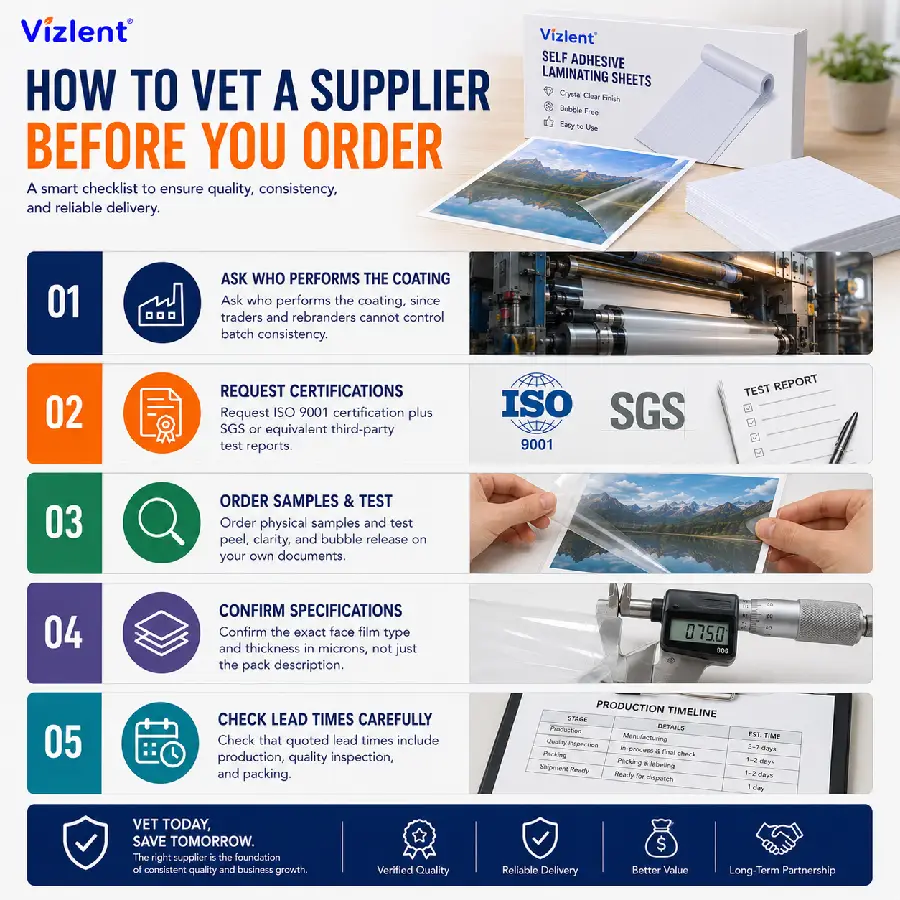
Sheet packs look identical in photos, so vetting has to happen through documents and samples rather than images. We encourage every prospective customer to run the same checklist on us that they run on our competitors. Five checks separate reliable suppliers from repackagers:
- Ask who performs the coating, since traders and rebranders cannot control batch consistency.
- Request ISO 9001 certification plus SGS or equivalent third-party test reports.
- Order physical samples and test peel, clarity, and bubble release on your own documents.
- Confirm the exact face film type and thickness in microns, not just the pack description.
- Check that quoted lead times include production, quality inspection, and packing.
A supplier who hesitates on any of these five points is telling you something useful. Sample testing matters most of all, because adhesive behavior on your specific paper stock cannot be predicted from a datasheet alone. Free samples cost a supplier very little, so reluctance to send them is itself a red flag.
Price Benchmarks by Channel
Per-sheet pricing for a standard 80 micron gloss A4 sheet varies by a factor of five across channels. The numbers below reflect what our customers report paying across markets in 2025 and 2026. Treat them as planning figures rather than quotes:
- Office supply chains: Roughly 0.60 to 1.20 USD per sheet in small packs.
- Craft and stationery stores: Roughly 0.50 to 1.00 USD per sheet.
- Online marketplaces: Roughly 0.30 to 0.60 USD per sheet in 50-packs.
- Factory direct: Roughly 0.10 to 0.25 USD per sheet at carton volume.
Freight, duties, and payment fees add to the direct-import figure, yet the landed cost still undercuts retail by a wide margin at volume. Matte, soft-touch, and thicker films carry a premium in every channel. Buyers comparing quotes should always convert to a landed cost per sheet before deciding.
The Hybrid Strategy Most Volume Buyers Land On
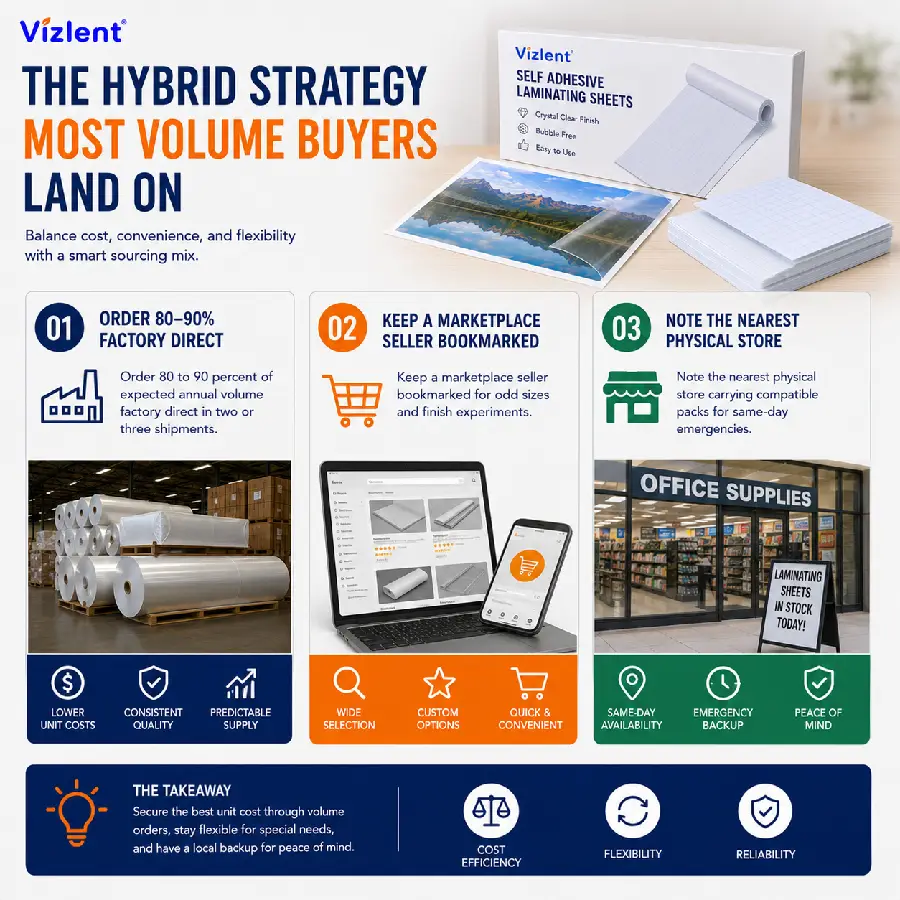
Regular users rarely stay loyal to one channel, and the pattern that emerges is worth copying from day one. They hold a bulk factory order as their working stock and keep one local retail source mapped for emergencies. Shipping delays, sudden rush jobs, and stock counting errors stop being crises under that arrangement.
The playbook breaks down into three moves:
- Order 80 to 90 percent of expected annual volume factory direct in two or three shipments.
- Keep a marketplace seller bookmarked for odd sizes and finish experiments.
- Note the nearest physical store carrying compatible packs for same-day emergencies.
The blended cost per sheet stays close to the factory rate because the expensive channels only cover exceptions. Buyers running this pattern also negotiate better, since a stocked shelf removes any pressure to accept a weak quote. Supply security and low cost stop being a trade-off once the channels are layered this way.
Sizes to Shop For: A4 Packs and Custom Formats
Most retail listings are labeled self adhesive laminating sheets A4, covering the 210 by 297 millimeter documents that dominate offices outside North America. Letter, legal, photo, card, and badge sizes fill out the standard retail lineup. Slightly oversized variants exist for buyers who want a sealed border without trimming.
Factory buyers are not limited to that list, since coating plants sheet master rolls up to 1300 millimeters wide into any rectangle a guillotine can cut. Print shops running one fixed product size order exact-fit sheets and eliminate trim labor entirely. Custom sheeting adds little to unit cost once quantities reach carton level.
Finish Options: Gloss, Matte, and Soft-Touch
Gloss remains the default finish in every retail channel because it photographs well on packaging and deepens print color. A self adhesive laminating sheets matte option is harder to find locally, even though matte handles glare, fingerprints, and pen annotation far better for working documents. Soft-touch, the velvet-feel premium finish, rarely appears outside factory-direct catalogs at all.
Finish availability is therefore a genuine reason to change buying channels, not just a preference. All three surfaces apply identically because the adhesive system underneath does not change. Requesting a mixed sample pack lets you judge each finish on your own printed work before committing.
Buying Self Adhesive Laminating Sheets for Stickers
Self adhesive laminating sheets for stickers are the same construction sold for documents, applied as an overlaminate across a printed page before cutting. Sticker makers should prioritize optical clarity, bubble-free application, and UV resistance over sheer thickness. Films in the 25 to 80 micron range conform best around die-cut edges.
Craft channels sell suitable packs, though sellers rarely label them for sticker use, so shop by specification instead of pack name. Growing sticker businesses eventually shift to overlaminate rolls for cost reasons, using the sheet format only for short runs. Demand for self adhesive laminating sheets for stickers keeps rising with the print-on-demand economy, and several of our fastest-growing customers started with a single retail pack.
A Quick Primer Before Your First Pack Arrives
New buyers asking how do you use self adhesive laminating sheets can relax, since the technique takes two minutes and a plastic card. The whole skill is peeling the liner gradually instead of stripping it off in one pull. Basic self laminating sheets directions run as follows:
- Lay the document face up on a clean, flat, dust-free surface.
- Fold back a two centimeter strip of liner along the top edge of the sheet.
- Press the exposed adhesive strip onto the document top and check alignment.
- Peel the remaining liner slowly while smoothing the film down with a card.
- Sweep from the center to the edges to chase out any trapped air.
Guides covering how to use self-adhesive laminating sheets on posters, textured cards, and curved objects are collected in our knowledge base with step photos. Search traffic for self adhesive laminating sheets shows how to use peaks every back-to-school season, and the liner-peel technique answers nearly all of it. Buy two or three spare sheets with a first order so the practice run costs nothing.
One Compatibility Mistake to Avoid at Checkout
The most expensive buying error is grabbing pressure-sensitive sheets for use in a heated pouch machine, since the adhesive melts onto the rollers at around 90°C. A related search we track, how to fix self adhesive laminating sheets in a laminator back together after a jam, has no happy answer because fused acrylic layers cannot be separated. Machine owners need thermal pouches instead, which carry a heat-activated glue built for exactly that process.
Check the pack for the words cold, self-adhesive, or no machine needed before assuming compatibility. Roll-fed cold laminators are the one machine family that pairs with pressure-sensitive film, using stock from our cold lamination films range. High-volume heat users should compare our thermal lamination films instead of forcing the wrong product through their equipment.
Red Flags When Ordering From Overseas Factories
Direct importing rewards preparation, and a few warning signs predict most bad experiences. Our team has audited enough competitor samples over 15 years to know where corners get cut. Watch for these signals during quoting:
- Prices far below every other factory quote, which usually means recycled film or thin coat weight.
- No physical address, factory photos, or video call access to the production floor.
- Refusal to send free or low-cost samples before a bulk order.
- Specifications that change between the quote sheet and the sales contract.
- No third-party certification such as ISO 9001, FSC, or SGS test reports.
A trial order of one or two cartons limits exposure while the relationship proves itself. Payment terms through traceable channels protect both sides during that first transaction. Good factories welcome small first orders because repeat volume is where the relationship pays off for everyone.
Comparing quotes right now? Send any competitor specification to our engineers through the contact page and receive a like-for-like Vizlent quote plus free samples so you can test both side by side.
Why Buyers Specify the Vizlent Label Self-Adhesive Laminating Sheet
Every Vizlent Label self-adhesive laminating sheet comes off our own coating, siliconizing, and sheeting lines in Shenzhen, never bought in from a third party and rebranded. Owning the process means coat weight, release force, and optical clarity get measured on each batch before it ships. ISO 9001, FSC, and SGS documentation travels with the goods for customers running their own audits.
More than 1,000 distributors, converters, and print houses across 50-plus countries have sourced from us since 2011, a track record covered on our about us page. Free samples ship before any commitment, so every claim above can be tested on your own bench first. Sourcing and application guides are added regularly to the Vizlent blog.
Buy Direct From the Coating Source
The right buying channel is the one that matches your volume, and once that volume reaches cartons, the factory is where the savings live. Vizlent supplies gloss, matte, and soft-touch self-adhesive laminating sheets in A4, letter, and fully custom formats, backed by batch-level quality records from an ISO 9001, FSC, and SGS certified plant. Custom sizes, private label packaging, and mixed shipments with roll goods are all standard requests here.
Get your free sample pack and factory quote today. Share your sizes, finish, and monthly volume through the Vizlent contact page, and our engineers will respond with tailored pricing and samples within 24 hours.
Frequently Asked Questions
Where to buy self adhesive laminating sheets in bulk?
Bulk buyers get the lowest landed cost by purchasing factory direct from a coating manufacturer rather than through retail or marketplace channels. Direct pricing at carton volume runs 0.10 to 0.25 USD per standard A4 sheet, against 0.60 or more at office retailers. Minimum order quantities apply but sit lower than most first-time importers assume. Request quotes from two or three factories and compare landed cost per sheet, not just unit price. Factories also consolidate sheet and roll products in one shipment, which spreads freight across the whole order and drops the landed figure further.
Are self-adhesive laminating sheets cheaper online or in stores?
Online packs cost 20 to 40 percent less than identical store packs in most markets. Marketplaces avoid retail shelf costs and compete openly on price, which keeps listings sharp. Stores win only on urgency, when the sheets are needed the same day. For any planned purchase, online or direct channels beat local pricing every time.
What is the minimum order for factory-direct sheets?
Typical factory minimums start around one to five cartons per size and finish, far below the container loads many buyers fear. A carton of A4 sheets usually holds 500 to 1,000 pieces depending on thickness. Trial orders below standard minimums are often accepted for new customers testing quality. Vizlent welcomes small first orders because repeat business is the goal of every quote we send.
Do retail packs and factory sheets use the same materials?
Not reliably, since many retail brands rotate between coating factories and specifications drift between production runs. A factory-direct relationship locks the face film, adhesive, and liner to a written specification that stays constant. Batch records then prove each shipment matches the last one. Consistency, more than price, is why converters move direct once volume grows.
Can I get free samples before buying in volume?
Yes, reputable manufacturers ship free sample packs so peel strength, clarity, and print compatibility can be tested before any commitment. Vizlent sends gloss, matte, and soft-touch samples in standard sizes on request. Testing on your own paper stock and printer reveals more than any datasheet. Treat a supplier’s reluctance to sample as a reason to look elsewhere. A sample that arrives well packed, labeled, and matching its stated specification also previews how full cartons will be handled.
What thickness of self-adhesive sheet should I buy?
Sheets of 75 to 100 microns handle everyday documents while keeping pages flexible enough to file. Step up to 125 or 150 microns for menus, ID cards, and pieces handled daily. Thin films of 25 to 50 microns wrap curved or die-cut shapes best, which suits sticker work. Buy one mixed-thickness sample pack first and let the finished pieces decide.
How should unused laminating sheets be stored?
Store unused sheets flat, in their original packaging, between 10°C and 30°C, and away from direct sunlight. Heat slowly softens the adhesive and sunlight can yellow unstabilized face films over months. Properly stored stock keeps full performance for at least two years. Standing packs on edge causes liner curl, so flat storage matters more than most buyers realize.
Do self-adhesive sheets work in a heated laminator?
No, heated machines melt the pressure-sensitive adhesive onto the rollers and usually jam mid-feed. These sheets are engineered for hand application or for cold roll laminators with no heating element. Machine owners should buy thermal pouches or thermal roll film instead. Matching the product to the process at checkout prevents the single most common damage claim in this category.






