

Self adhesive laminating sheets work through a pressure sensitive acrylic adhesive that flows into paper fibers when pressed by hand, forming a permanent optical bond without heat, electricity, or machinery. The adhesive is factory coated onto a clear film and shielded by a release liner, so the sheet stays inert until the liner comes off. Firm pressure from a squeegee does the rest.
That one paragraph answers the question, yet the chemistry underneath it decides why some laminated pieces stay glass clear for a decade while others cloud, bubble, or peel within weeks. Adhesive rheology, coat weight, and film chemistry all play measurable roles. The sections below break down each layer, each bonding stage, and each buying decision in plain language.
The Three Layers Inside Every Self Adhesive Laminating Sheet
Every peel and stick laminating sheet is a sandwich of three engineered layers, and each one is manufactured in a separate coating or converting step. The construction looks simple in the hand yet demands tight tolerances on the production line. A variation of a few grams per square meter in adhesive coating shows up later as bubbles or weak edges.
- Clear film facestock. A PVC, PET, or BOPP layer between 1.5 and 10 mil thick that provides scratch resistance, UV filtering, and the glossy or matte finish you see.
- Pressure sensitive adhesive. A viscoelastic acrylic coating, typically 15 to 25 gsm, engineered to be soft enough to flow yet strong enough to hold permanently.
- Silicone release liner. A coated paper or PET backing that protects the adhesive and peels away with a controlled, consistent force.
The facestock determines what the laminate looks like, the adhesive determines how it bonds, and the liner determines how pleasant it is to apply. All three come together on slitting machines that cut jumbo rolls down to sheet sizes. This layered construction is shared across the wider laminating films family, from photo protection film to industrial overlaminates.
How Do Self Adhesive Laminating Sheets Work Without Heat?
Pressure sensitive adhesives bond through surface wetting rather than melting, which is the core reason no machine is required. The acrylic layer behaves like an extremely thick liquid that flows under pressure and grips through molecular attraction once it settles into the paper surface. Chemists call this viscoelasticity, and it is the defining property of every cold lamination film on the market.
When your squeegee presses the film down, the adhesive deforms and spreads into the microscopic peaks and valleys of the paper. Contact area multiplies, and weak intermolecular forces across that huge contact area add up to a bond stronger than the paper itself. Thermal films reach a similar end state by melting glue with heat, but pressure sensitive chemistry gets there at room temperature.
Curious how a premium adhesive feels compared to a bargain one? Vizlent ships free A4 samples worldwide so you can run your own hands-on test. Request samples here.
The Bonding Process from First Touch to Full Cure
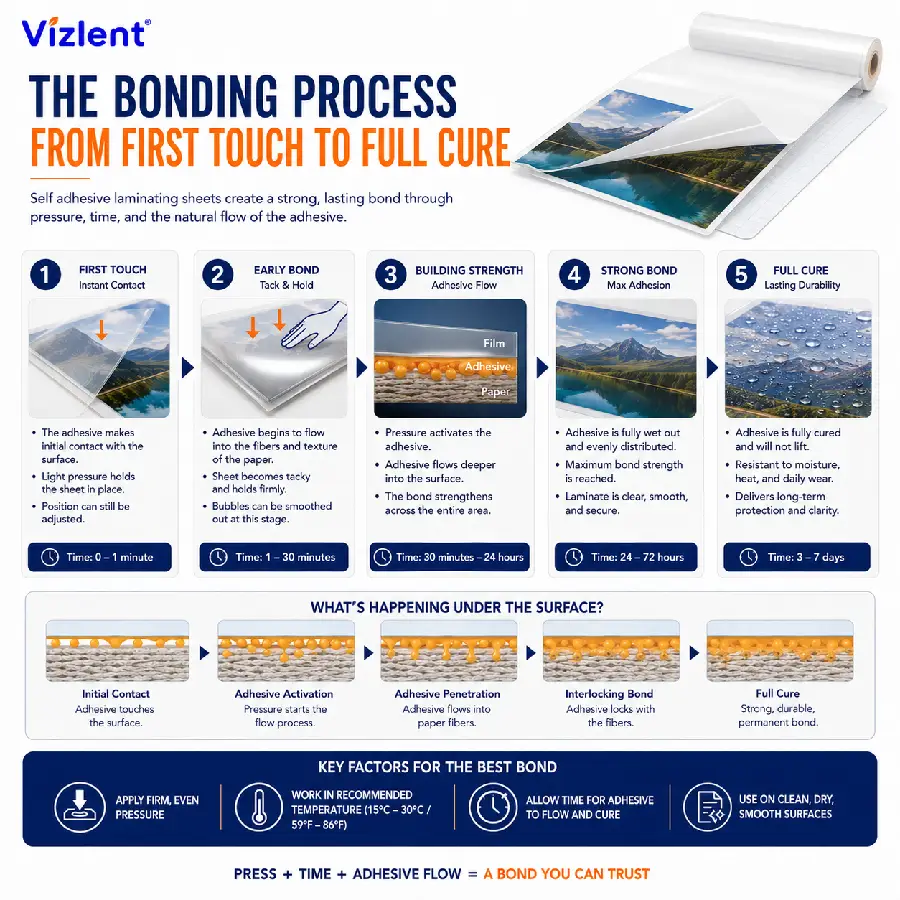
The bond you feel one second after pressing is not the bond you have one day later. Pressure sensitive adhesion develops in stages, and understanding the timeline explains several behaviors that confuse first time users. Silvery patches that fade overnight and edges that resist peeling more each hour are both signs of a bond still building.
The process moves through three distinct phases:
- Initial tack (0 to 5 seconds). The adhesive grabs on contact, holding the film in place with 30 to 50 percent of final strength.
- Wet out (5 minutes to 2 hours). The acrylic continues flowing into paper fibers and around ink deposits, clearing micro bubbles and raising clarity.
- Full cure (24 to 72 hours). Molecular contact reaches its maximum and the bond becomes permanent, often exceeding the internal strength of the paper.
This staged behavior is also why quality films offer a short repositioning window at the start. During initial tack, a careful hand can lift and reset a self adhesive cold lamination film before wet out locks it down. After full cure, removal attempts tear the document, so alignment mistakes must be caught within the first few seconds.
How Do You Use Self Adhesive Laminating Sheets Correctly?
Application technique matters because the adhesive only bonds where pressure actually reaches. People searching for how do you use self adhesive laminating sheets usually want a short answer, and the short answer is: peel a little, press a lot, and move in one direction. Anyone comparing self adhesive laminating sheets and how to use tutorials online will find the same core sequence repeated everywhere.
Here are the basic self adhesive laminating sheets instructions in five moves:
- Place the sheet over the trimmed document and check for an even film margin on all sides.
- Peel back roughly 2 cm of liner along one edge and press that exposed strip down firmly.
- Pull the liner out from underneath while sweeping a squeegee across the film in overlapping strokes.
- Push any trapped air toward the nearest open edge instead of sealing it in the center.
- Burnish the whole surface hard, then trim the sealed border to 3 to 5 mm.
Anyone learning how to use self-adhesive laminating sheets should practice once on scrap paper before touching an irreplaceable document. The muscle memory transfers immediately. For a full walkthrough with sizing charts and project ideas, our step by step application guide on the Vizlent blog goes deeper into technique.
Cold Bonding vs Thermal Melting: Two Paths to the Same Seal
Thermal lamination reaches a bonded state by melting an EVA glue layer at 100 to 140 degrees Celsius inside a machine, while cold lamination reaches it through pressure alone. Both methods end with adhesive locked into paper fiber, so the finished pieces can look identical. The differences show up in equipment cost, speed, and what the document itself can survive.
Heat is the deciding factor for sensitive media. Inkjet photos blister, thermal receipt paper turns black, and vinyl warps inside a hot laminator, yet all three take pressure sensitive film without complaint. Offices running hundreds of standard pages often prefer thermal lamination films for throughput, while crafters, archivists, and sticker makers stay cold for safety.
What Makes Self Adhesive Laminating Sheets Work Best
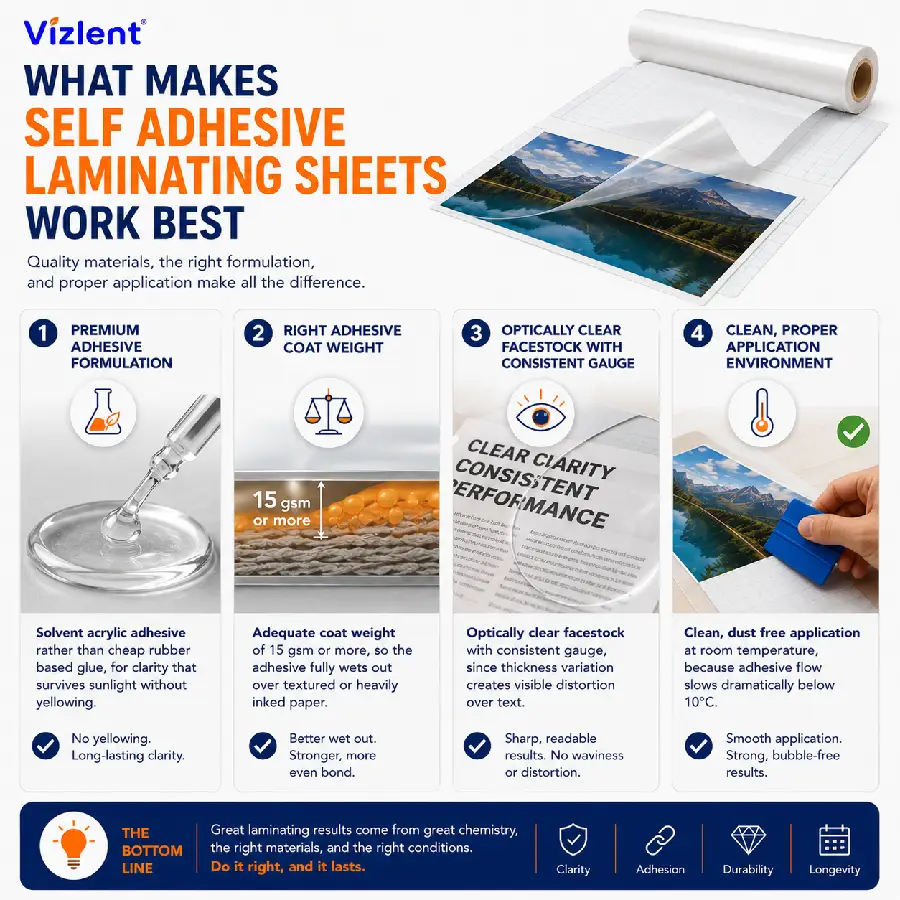
Film specifications decide performance long before technique enters the picture. Two sheets that look identical on the shelf can behave completely differently on paper, because the meaningful variables are invisible: adhesive chemistry, coat weight, and facestock clarity. Knowing the specs to check turns a confusing purchase into a quick one.
Self adhesive laminating sheets work best when four conditions line up:
- Solvent acrylic adhesive rather than cheap rubber based glue, for clarity that survives sunlight without yellowing.
- Adequate coat weight of 15 gsm or more, so the adhesive fully wets out over textured or heavily inked paper.
- Optically clear facestock with consistent gauge, since thickness variation creates visible distortion over text.
- Clean, dust free application at room temperature, because adhesive flow slows dramatically below 10 degrees Celsius.
Premium packs give self adhesive laminating sheets the works treatment: thicker film, gridded liners for straight alignment, and pre rounded corners that resist edge lifting. Those extras cost little at the factory yet save real frustration on the table. A self adhesive material supplier can match all four specs to your exact substrate if you describe the job.
Temperature, Humidity, and Storage: The Hidden Variables
Adhesive performance is a moving target that shifts with the room around it. The same sheet that bonds beautifully at 22 degrees Celsius can feel weak and reluctant at 8 degrees, because acrylic viscosity rises sharply as temperature drops. Humidity plays its own quiet role by loading paper fibers with moisture that the adhesive must displace.
Keep these environmental rules in mind:
- Apply between 15 and 30 degrees Celsius, where acrylic adhesives flow at their designed rate.
- Let cold shipped film acclimate for a few hours indoors before opening the pack.
- Avoid application above 60 percent relative humidity, since damp paper weakens initial tack and slows wet out.
- Store sheets flat, liner side protected, away from direct sunlight and heat sources.
- Use stock within its shelf life, typically one to two years, before liner release force drifts.
Storage abuse explains a surprising share of complaints that get blamed on product quality. Film left in a hot car, a humid garage, or direct window light arrives at the table already compromised. Treat unused sheets like the precision coated product they are and the adhesive will behave exactly as the datasheet promises.
Projects Where Cold Lamination Outperforms Everything Else
The no heat bond opens up applications that thermal pouches physically cannot handle. Anything printed with water based inkjet ink, anything already mounted, and anything larger than a laminator throat all default to peel and stick film. Small businesses discover this the first time a hot pouch ruins a batch of custom decals.
The most common cold first projects include:
- Self adhesive laminating sheets for stickers, where the film overlays printable vinyl so decals survive dishwashers, water bottles, and weather.
- Self adhesive laminating sheets a4 documents like certificates, checklists, menus, and classroom visual aids.
- Self adhesive laminating sheets holographic finishes that add rainbow security and decorative effects to badges, planner covers, and packaging seals, using a holographic cold lamination film.
- Photo preservation, where a pH neutral photo cold lamination film protects prints that heat would destroy.
- Glare control, where a matte cold lamination film suppresses reflections on menus and display graphics.
Sticker makers deserve a special note because they push the material hardest. A decal lives on curved, flexed, washed surfaces, so film thickness of 3 mil or more and an aggressive adhesive are non negotiable. Laminate the full printed sheet first, then cut individual stickers, so every decal carries sealed film from edge to edge.
Scaling Up: From Single Sheets to Production Volume
Volume changes both the buying math and the workflow. A hobbyist uses a pack of 10 sheets per month, while a print shop or school district can consume thousands, and hand application stops making sense somewhere in between. Cold roll laminators apply the same pressure sensitive film at 3 to 10 meters per minute with almost zero bubbles.
Large jobs run smoother with light planning, and a simple self adhesive laminating sheets work breakdown structure splits any big batch into prep, application, and trimming phases with one person owning each. On the purchasing side, understanding how self adhesive laminating sheets work bulk pricing into a budget matters just as much: factory direct roll stock typically costs 50 to 75 percent less per square meter than retail sheet packs. The crossover point where rolls beat sheets usually arrives around 500 sheets per month.
Troubleshooting: When the Bond Does Not Behave
The question of how do self adhesive laminating sheets work turns practical the moment a result looks wrong on the table. Nearly every visual defect maps to one specific stage of the bonding process described earlier. Diagnosing by symptom is faster than guessing, and most fixes require nothing more than a card and firm pressure.
Match the symptom to its cause:
- Large clear bubbles mean trapped air from removing too much liner at once. Prick with a pin at the edge and press flat.
- Silvery haze over dark ink signals incomplete wet out. Burnish firmly and wait 24 hours before judging.
- Lifting corners or edges point to a missing sealed border or a dusty surface. Leave 3 to 5 mm of film margin next time.
- Cloudy patches that never clear indicate skin oil or debris sealed under the film. Prevention is the only cure.
- Wrinkles running diagonally come from uneven liner pulling. Keep the liner tension straight and low.
A defect that appears across an entire pack, rather than one sheet, usually traces back to the film itself. Inconsistent coat weight and aged adhesive produce faults no technique can overcome. That distinction between application error and material error is worth learning, because it tells you when to adjust your hands and when to change your supplier.
Where to Find Self Adhesive Laminating Sheets Near Me
Typing self adhesive laminating sheets near me into a search engine surfaces three retail channels: office supply chains, big box stores, and craft retailers. The self adhesive laminating sheets staples stocks sit in the print aisle in packs of 10 to 50, sized for letter and A4 documents. Craft stores carry decorative and small format options that suit sticker and scrapbook projects.
Retail works well for urgent, low volume needs, since you walk out with film the same hour. The tradeoff is price and selection, because a self-adhesive laminating sheets near me search never surfaces custom thicknesses, jumbo widths, or specialty adhesives. Once monthly usage climbs past a few hundred sheets, a direct factory relationship beats every local shelf on cost, consistency, and spec control.
Why the Factory Decides How Well Your Film Performs
Every performance trait discussed above is locked in during coating and converting, long before the sheet reaches your hands. Adhesive coat weight is set at the coating head, liner release force at the siliconizing station, and optical clarity at film extrusion. No application technique can rescue film that left the factory out of spec.
Vizlent Label Materials Co., Ltd., has run its own coating, siliconizing, and slitting lines in Shenzhen since 2011, with every batch tested for tack, peel strength, and clarity under ISO 9001, FSC, and SGS certified systems. More than 1,000 distributors, converters, and print businesses across 50+ countries source cold lamination film, thermal film, and label stock from US factory direct, with custom sizes shipping in 7 to 15 days. You can read about our facility, testing lab, and quality process on our about page.
Need a spec matched to your exact project? Send your substrate, size, and volume to our engineering team for a factory direct quote within 24 hours. Start your inquiry.
Test the Science on Your Own Desk
Reading about adhesive rheology is useful, but pressing a quality film onto your own print settles the question in thirty seconds. Vizlent offers free A4 sample sheets from our cold lamination range so you can judge tack, clarity, and liner release before spending anything. Factory direct pricing, custom sizes from sheets to 1300 mm rolls, and 7 to 15 day lead times back every order.
Contact our team today for free samples and a quote within 24 hours.
Frequently Asked Questions
How do self adhesive laminating sheets work without a machine?
Self adhesive laminating sheets bond through a pressure sensitive acrylic adhesive that flows into paper when pressed by hand, so no machine, heat, or power is involved. The adhesive is pre coated at the factory and protected by a release liner until application. Squeegee pressure spreads the adhesive across the paper surface, and the bond strengthens over the following 24 to 72 hours.
How does self adhesive laminating sheets work compared to thermal lamination?
Cold self adhesive film bonds through pressure at room temperature, while thermal film bonds by melting an EVA glue layer inside a heated machine. Both reach a permanent seal, but cold application protects heat sensitive items like inkjet photos, thermal receipts, and vinyl. Thermal suits high volume office work where a laminator is already available.
How long does the adhesive take to fully bond?
The adhesive grabs within seconds, reaches most of its strength within a few hours, and cures completely in 24 to 72 hours. Initial tack holds the film in place immediately at roughly a third to half of final strength. Minor silvery patches over dark ink usually clear on their own during this cure period as the adhesive continues to flow.
Can a self adhesive laminating sheet be removed after application?
No, removal becomes impossible without damage once the adhesive wets out into the paper fibers. Quality films allow a brief repositioning window of a few seconds during initial tack. After the first minutes, pulling the film off delaminates the paper surface, so alignment must be checked before pressing down firmly.
Do self adhesive laminating sheets work on photos?
Yes, cold lamination is the preferred method for photographs precisely because no heat touches the print. A photo grade film with a pH neutral, acid free adhesive protects inkjet and lab prints from moisture, fingerprints, and UV fading. Thermal pouches, by contrast, can blister inkjet ink and warp resin coated photo paper.
What surfaces will the adhesive not stick to?
Pressure sensitive adhesive struggles on silicone, wax, oily, dusty, and heavily textured surfaces where it cannot achieve full contact. Standard paper, cardstock, photo paper, and printable vinyl all bond reliably. Wiping the surface clean and applying firm, even pressure solves the majority of adhesion complaints.
Why do bubbles appear under the film?
Bubbles form when air gets sealed in faster than it can escape, usually because the liner was removed all at once or smoothing started in the center. Peeling the liner progressively while pressing from one edge gives air a continuous escape path. Tiny silvered spots are incomplete wet out rather than trapped air, and firm burnishing clears most of them.
What thickness should I choose for stickers?
A film of 3 mil or thicker gives stickers real scratch and wash resistance, while thinner 1.5 mil film suits flat, indoor decals. Thicker facestocks resist edge lifting on curved surfaces like bottles and tumblers. Pair the thickness with an aggressive solvent acrylic adhesive when decals will face water or repeated handling.






