
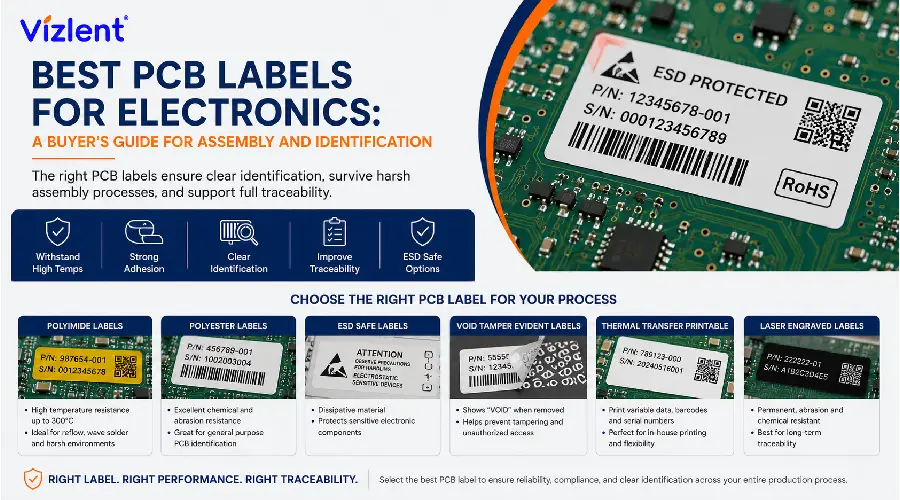
The best PCB labels for electronics are polyimide, polyester, and anti static constructions that survive reflow soldering, resist flux and cleaning chemistry, and keep a scannable barcode for the life of the board. Lead-free reflow ovens push board surfaces toward 260°C, and standard paper stickers char, curl, or drop off long before a product ships. Material choice decides if your traceability system works or fails.
Each construction on an assembly line has a distinct job, from durable labels rated for solder heat to static-safe films that protect sensitive components. At Vizlent, we have spent 15 years coating and testing pressure-sensitive materials for electronics producers in more than 50 countries. The sections below match the best PCB labels for electronics to your process, your printers, and your budget.
What Makes the Best PCB Labels for Electronics
The best PCB labels for electronics share four traits: heat resistance, chemical resistance, static safety, and print permanence. A board label passes through reflow ovens, wave soldering, flux application, and aqueous cleaning before the product ever leaves the factory. Any label that fails a single stage breaks the traceability chain for the whole batch.
Buyers comparing pcb labels for electronics companies should ask for test data, not just spec sheets. A reputable supplier documents peel strength after thermal cycling and barcode grades after chemical exposure. Vizlent validates every construction with Xenon Arc weathering and shear testing equipment before it reaches a customer line.
Evaluate any candidate material against these points:
- Temperature rating that covers your full solder profile, including peak reflow
- Adhesive anchorage on FR4, solder mask, and conformal coated surfaces
- Static dissipation per ANSI/ESD S20.20 where components demand it
- Compatibility with thermal transfer or laser printing on your equipment
- Barcode grade retention to ISO/IEC 15415 Grade B or better after processing
Polyimide Labels for High Temperature Reflow
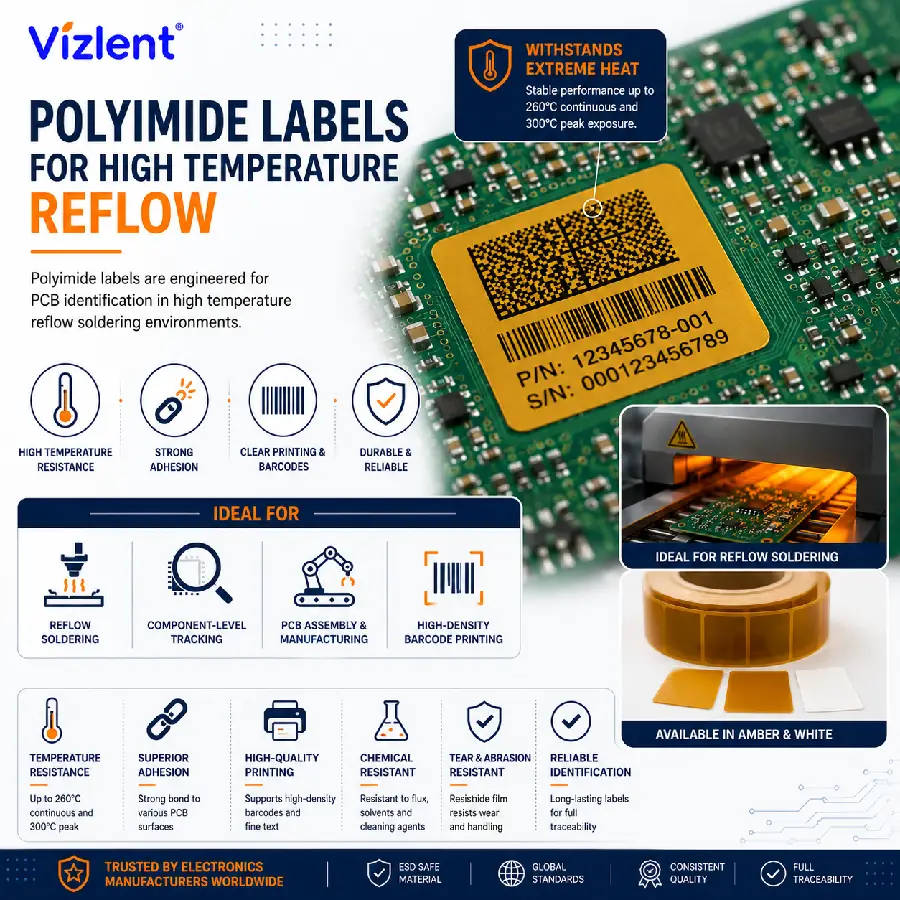
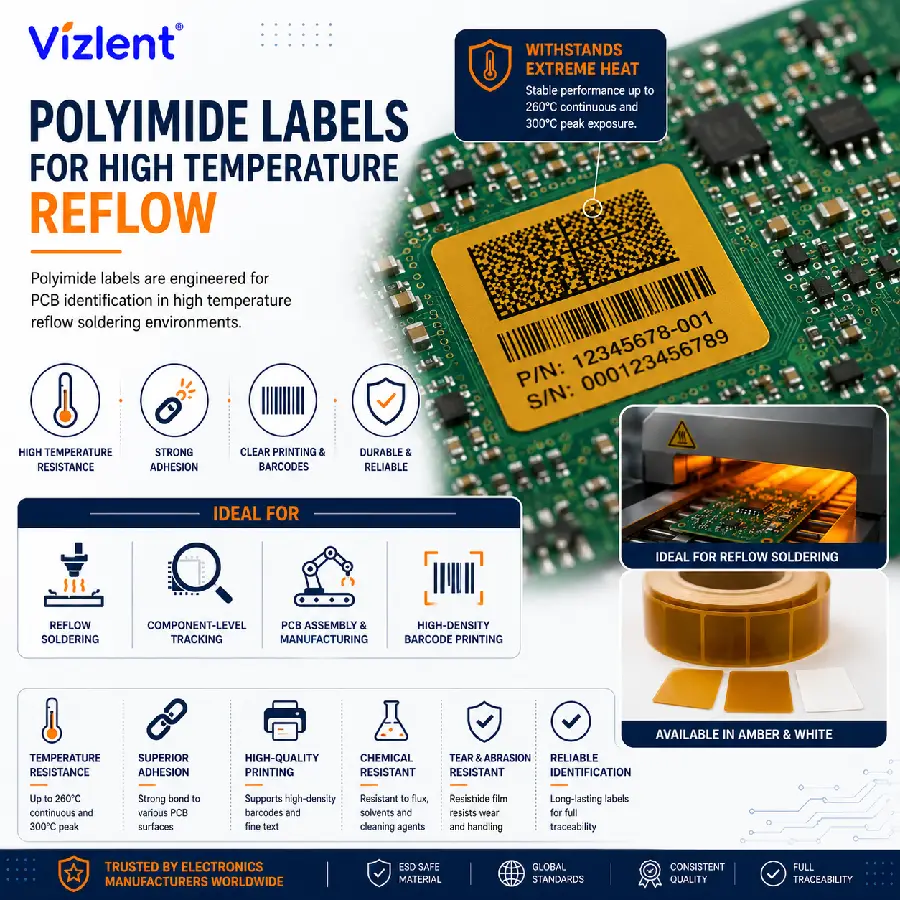
Polyimide is the standard electronics pcb labels material for boards that pass through reflow soldering. The film tolerates continuous exposure near 260°C and short peaks close to 300°C without shrinking, curling, or discoloring. Amber and white top-coated grades both accept high-density barcodes small enough for component-level tracking.
Pair polyimide facestock with a high-tack acrylic adhesive so the label stays anchored through multiple oven passes. Our heat resistant labels use this exact construction for SMT lines running lead-free profiles. Labels applied before reflow scan perfectly after it, which makes polyimide the best PCB labels for electronics devices built under strict traceability rules.
Anti Static Labels for ESD Sensitive Assemblies
Static discharge damages MOSFETs, microcontrollers, and memory chips at voltages far below what a person can feel. Anti static labels use PE or polyester face stocks engineered to dissipate electrostatic charge safely away from components. These constructions meet ANSI/ESD S20.20 for PCB, semiconductor, and electronics packaging work.
Peeling a standard label from its release liner generates a static spike, and that alone can kill a sensitive part. Static-safe stock removes the risk at the point of application, which matters on pcb labels for electronics control boards and precision instrumentation. The best PCB labels for electronics in any ESD protected area also double as electronics pcb labels and stickers for totes, trays, and shielding bags.
Polyester Labels for Components, Devices, and Enclosures
Polyester (PET) is the workhorse choice for pcb labels for electronics components that never face reflow heat. It resists isopropyl alcohol, flux residue, and board-wash chemistry while costing noticeably less than polyimide. Our custom polyester label materials hold sharp print through years of service inside enclosures and equipment racks.
PET covers most pcb labels for electronics component labeling jobs: serial plates, compliance marks, rating labels, and QR codes on finished devices. Matte white, gloss white, silver, and transparent grades handle branding and identification needs alike. For electronics PCB labels for components applied after soldering, PET delivers the strongest cost-to-durability ratio you can buy, and often the best PCB labels for electronics at consumer price points.
Flame Retardant Labels for Circuit and Power Assemblies
Power supplies, battery packs, and high-voltage sections need labels rated to the same flammability standard as the board itself. Flame retardant labels use UL 94 V-0 rated face stocks with halogen-free construction to meet IEC 62368 requirements. That rating keeps pcb labels for electronics circuit protection zones from becoming an ignition path.
Halogen-free chemistry matters because burning halogenated films releases corrosive, toxic gases. Certification paperwork should cover the full construction, adhesive included, not the facestock alone. Ask for the UL yellow card before approving any material for production, since the best PCB labels for electronics carry documentation to match their ratings.
Barcode and Serialization Standards for Board Tracking
Board-level traceability runs on GS1 DataMatrix and QR codes graded to ISO/IEC 15415. Grade B or better at print time leaves enough margin for the grade loss that reflow heat and cleaning chemistry cause. Consistent facestock caliper and surface smoothness protect that grade as production volumes scale.
Serialization programs in automotive and medical electronics reference AIAG B-3, VDA 4902, and FDA UDI frameworks. The label material has to carry those codes without ink spread, voids, or contrast loss across an entire run. Vizlent Label constructions are specified for code quality retention, so verification audits pass on the first scan.
Adhesive Systems That Hold Through Assembly
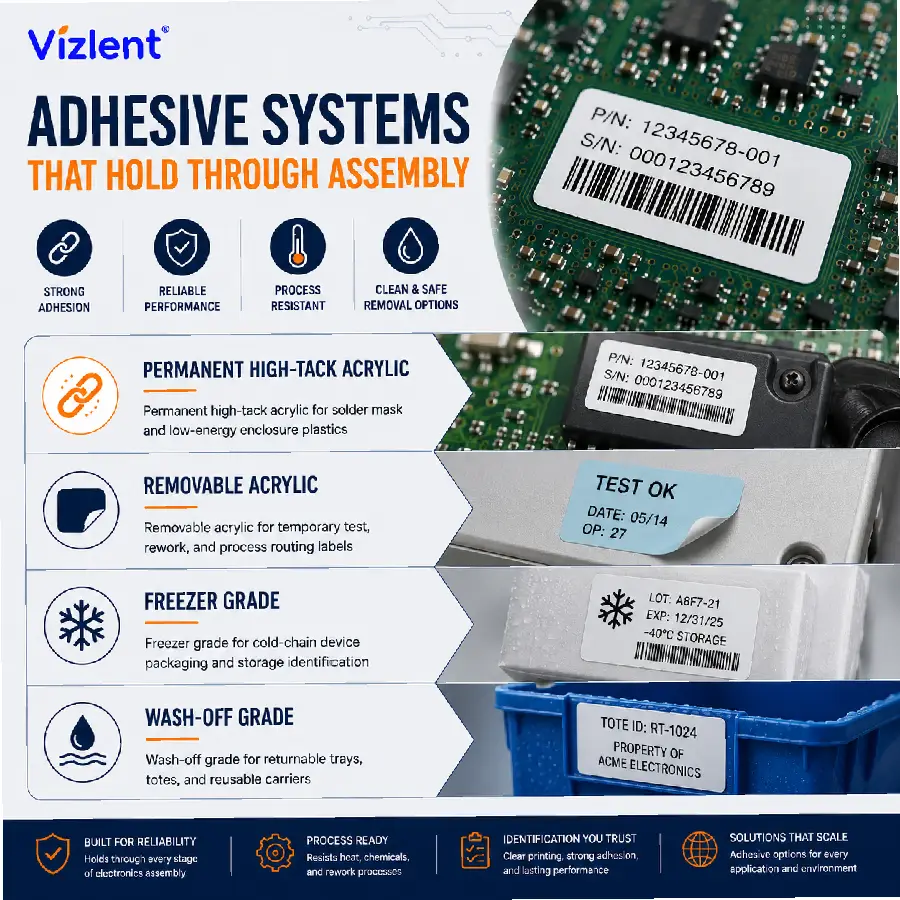
Adhesive selection matters as much as facestock on solder mask, conformal coating, and textured enclosure plastics. High-tack acrylics anchor to low-energy surfaces and build bond strength through thermal cycles instead of losing it. Removable grades exist for temporary process labels that must peel clean after the test.
Vizlent formulates 8 adhesive grades in-house, covering permanent, removable, freezer, and wash-off performance. Application temperature, surface energy, and dwell time before reflow all shape the recommendation our engineers give. Send your board finish details with an inquiry and receive a matched construction instead of a generic one.
Grades commonly specified for electronics work include:
- Permanent high-tack acrylic for solder mask and low-energy enclosure plastics
- Removable acrylic for temporary test, rework, and process routing labels
- Freezer grade for cold-chain device packaging and storage identification
- Wash-off grade for returnable trays, totes, and reusable carriers
Tamper Evident and Security Options for Boards
Warranty enforcement and anti-counterfeiting add a second layer of labeling on many assemblies. VOID sticker constructions transfer a permanent VOID pattern to the substrate on removal, exposing any tampering attempt instantly. Eggshell and destructible films fragment into irremovable pieces for the same purpose.
Laser etched labels go a step further by burning the identifier into the material itself, with no ink to fade or wipe away. Serialized 2D codes on these constructions support chain-of-custody tracking from factory to field. Repair centers rely on them to confirm a returned board was never opened by a third party.
Printing Methods for Labels on PCB Assemblies
Thermal transfer printing produces the most durable labels on pcb surfaces because resin ink bonds to the label top coat under heat and pressure. Pair polyimide or PET stock with a resin-grade ribbon from our thermal transfer ribbons range for scratch-proof, solvent-proof print. Wax-resin blends suit lower-exposure jobs at a lower cost per label.
Laser marking and direct thermal play narrower roles in electronics work. Direct thermal print darkens with heat, so it fails immediately in any reflow or hot-service setting. Match the print method to the process first, then pick the best PCB labels for electronics to run through it.
Common ribbon and stock pairings on electronics lines:
- Resin ribbon with polyimide stock for board serials applied before reflow
- Resin ribbon with PET stock for device labels exposed to solvents
- Wax-resin ribbon with PET or coated paper for enclosure and rating labels
- Wax ribbon with paper stock for shipping cartons only, never for boards
Application Tips That Prevent Label Failures
Most field failures trace back to application conditions, not the label material itself. Boards should be clean, dry, and above 10°C at the moment of labeling, since flux residue and condensation block adhesive wet-out. Firm, even pressure across the full label face sets the initial bond that thermal cycling will later test.
Placement decisions matter as much as technique on dense assemblies. Keep labels clear of test points, connector footprints, and components that run hotter than the material rating. A short checklist stops the most common problems before they start:
- Allow adhesive dwell time before reflow so the bond anchors fully
- Avoid stretching film labels during application, since tension causes edge lift
- Store rolls sealed at room temperature, away from UV light and humidity
- Verify barcode scans immediately after printing, not after final assembly
- Trial one production batch before changing any material or adhesive grade
How to Buy PCB Labels for Electronics Bulk Orders
Ordering pcb labels for electronics bulk quantities direct from a pcb labels for electronics factory removes converter markups and shortens the supply chain. Factory-direct programs supply jumbo rolls, custom slit rolls, or finished stock cut to your specification. Vizlent runs automated coating and slitting lines with 7 to 15 day lead times on custom OEM and ODM orders.
Most listings for pcb labels for electronics for sale online are pre-converted stock in fixed sizes, and those rarely match automated applicator requirements. A direct manufacturer instead engineers the self adhesive material construction around your dispenser, printer, and board layout. Free sample rolls and A4 sheets let you verify peel strength and print quality before committing to electronics pcb labels bulk volume.
Include these details in your first inquiry for the fastest quotation:
- Facestock and adhesive grade, or the application if you need a recommendation
- Roll width, core size, and wind direction for your applicator or printer
- Print method and ribbon type currently running on your equipment
- Monthly volume, delivery destination, and target lead time
- Compliance requirements such as UL 94 V-0 or ANSI/ESD S20.20
Choosing an Electronics PCB Labels Manufacturer
A qualified electronics pcb labels manufacturer holds ISO 9001 certification, publishes test data, and controls coating in-house rather than reselling third-party stock. Vizlent has manufactured pressure-sensitive label stock since 2011 and supplies more than 1,000 customers across 50+ countries. Every batch passes coat weight, release force, and dimensional tolerance checks before dispatch.
The right partner also protects your pcb labels for electronics business from lot-to-lot variation that shuts down applicator lines. Consistent caliper and adhesive coat weight keep automated equipment running without jams or misfeeds. That reliability separates dependable suppliers of the best PCB labels for electronics from commodity resellers.
Get the Best PCB Labels for Electronics Factory Direct
Vizlent supplies polyimide, polyester, anti static, and flame retardant label stock to electronics producers, converters, and distributors worldwide. Send your specifications through the Vizlent contact page and receive engineering feedback within 24 hours. Free sample rolls and A4 sheets are available so you can verify peel strength, print compatibility, and barcode grade on your own equipment first. Custom OEM and ODM orders ship worldwide with moisture-proof export packaging and full documentation. Your boards deserve labels that outlast the products they track.
Frequently Asked Questions
What are the best PCB labels for electronics assembly lines?
The best PCB labels for electronics assembly lines are polyimide labels with high-tack acrylic adhesive and a thermal transfer printable top coat. This construction survives lead-free reflow near 260°C, resists flux and aqueous cleaning, and keeps barcodes scannable through every process stage. Polyester takes over for post-solder identification where heat exposure is lower. Anti static grades protect ESD sensitive components at the point of application.
What material works best for labels for pcb identification?
Polyimide is the right labels for pcb identification material when boards pass through reflow soldering. Polyester suits identification applied after soldering, since it resists solvents and abrasion at a lower cost. Anti static PE and polyester grades cover boards with ESD sensitive components. Your solder profile and chemical exposure decide the choice, not the label size or shape. When in doubt, send both conditions to a supplier and request matched samples of each material.
Can a label stay on a PCB during reflow soldering?
Yes, a polyimide label with a high-temperature acrylic adhesive stays bonded through reflow soldering. The film handles peak temperatures close to 300°C without shrinking or releasing from the board. Standard paper and vinyl labels fail in the first oven pass. Always request reflow test data from your supplier before running a new material on live production. A single trial batch through your own oven profile confirms performance faster than any spec sheet.
Are anti static labels necessary for PCB work?
Anti static labels are necessary any time a label gets applied to or near ESD sensitive components. Liner removal on standard stock generates a static spike strong enough to damage MOSFETs and memory chips. Static-dissipative face stocks meeting ANSI/ESD S20.20 remove that risk. Facilities with certified EPA zones typically mandate them across all board handling steps. The small price difference over standard stock is trivial next to the cost of one failed component.
Do PCB labels need to be flame retardant?
PCB labels need a flame retardant rating when the assembly falls under IEC 62368 or a UL flammability requirement. UL 94 V-0 rated label stock matches the rating of the board substrate itself. Power electronics, battery systems, and high-voltage sections are the usual triggers. Confirm the rating applies to the complete construction, adhesive included.
What sizes do PCB labels come in?
PCB labels commonly run from 4mm x 4mm micro formats up to 25mm x 50mm serial plates. Small 2D DataMatrix codes fit component-level tracking on dense boards. Factory-direct suppliers slit rolls and die-cut sizes to your applicator specification instead of forcing fixed catalog sizes. Custom sizing usually costs less at volume than adapting your process to stock dimensions. Share your board layout and available label area to get sizing guidance with your quotation.
How do I order electronics pcb labels bulk quantities?
Ordering electronics pcb labels bulk quantities starts with sending your material, adhesive, size, and print method requirements to a factory-direct supplier. Vizlent reviews specifications within 24 hours and returns a quotation covering substrate, adhesive, liner, and packaging. Free samples ship for testing on your line before any bulk commitment. Custom OEM production then runs on a 7 to 15 day lead time.
How much do PCB labels cost?
PCB label cost depends on facestock type, adhesive grade, size, and order volume, with polyimide priced above polyester and paper. Factory-direct bulk pricing runs well below converted retail stock because no middleman margin applies. Small die-cut polyimide labels typically land between one and five cents each at production volume. Request a quotation with your exact specification for firm numbers. Volume commitments and repeat scheduling both pull unit prices down further.






