
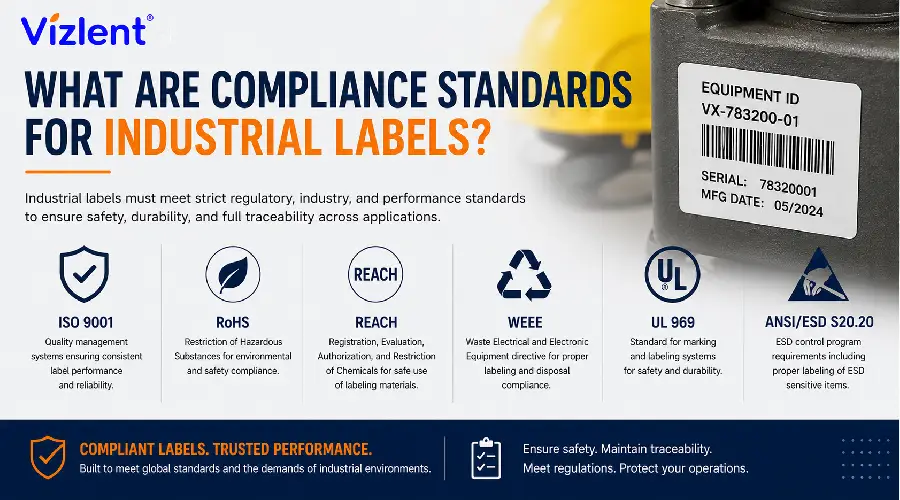
Compliance standards for industrial labels are the regulatory and technical rules that define what a label must say, how long it must last, and which materials it can be made from in a given application. These rules come from organizations such as UL, ANSI, OSHA, ISO, the FDA, and regional chemical regulators, and they cover adhesion, durability, legibility, and mandatory content. A label that fails even one requirement can stop a shipment at customs, void an equipment certification, or expose a manufacturer to regulatory penalties.
Factories, converters, and brand owners face different obligations depending on the product, the market, and the environment where the label will live. The material underneath the print matters as much as the words on it, which is why certified durable label stock sits at the center of every serious labeling program. Understanding the major standards, the testing behind them, and the documentation your supplier must provide keeps production moving and audits short.
Why Compliance Matters Before You Print a Single Label
Regulators treat a label as part of the product, not as decoration. When a warning label peels off a machine or a chemical drum loses its hazard panel, liability shifts to the party that specified the label. Inspectors rarely accept ink and adhesive failures as an excuse.
Non-compliance also carries commercial costs that arrive long before any fine does. Retail and industrial buyers audit supplier labeling as part of vendor qualification, and a failed audit can remove you from an approved vendor list overnight. Meeting these standards costs far less than winning back a lost account.
Core Compliance Standards for Industrial Labels by Industry
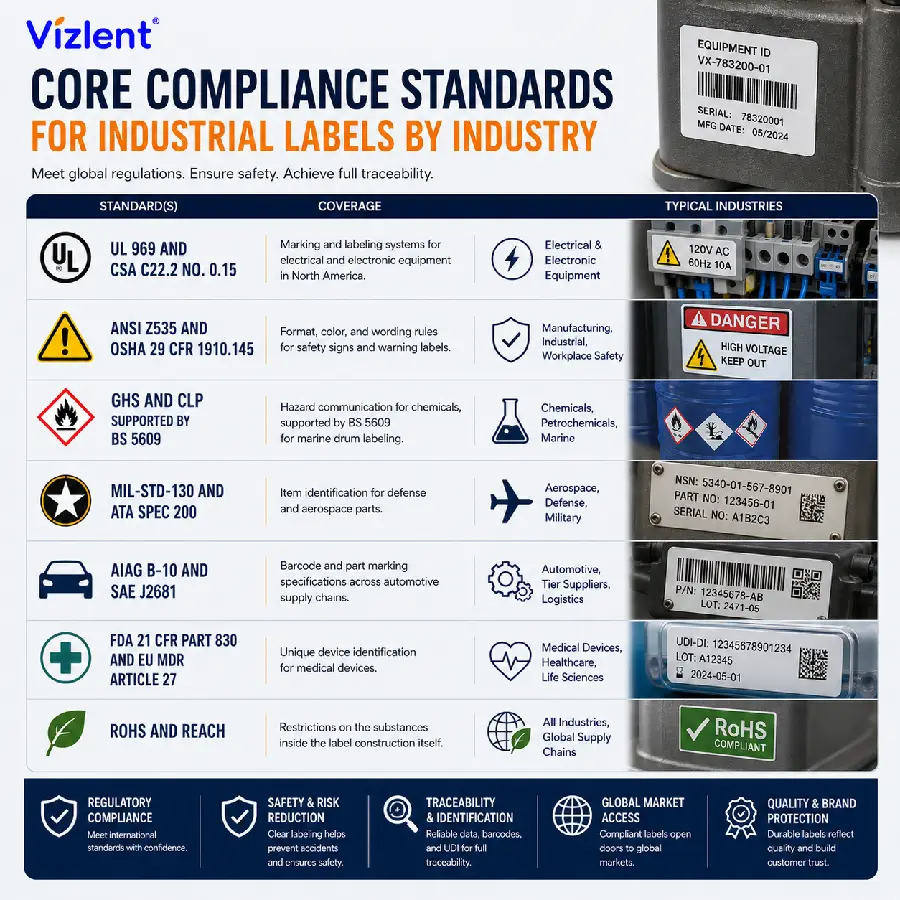
No single rulebook governs every label, so requirements shift with the sector. Electronics, chemicals, automotive, aerospace, and medical devices each answer to their own agencies and test methods. Sorting requirements by sector is the fastest way to find the rules that apply to your product.
- UL 969 and CSA C22.2 No. 0.15: marking and labeling systems for electrical and electronic equipment in North America
- ANSI Z535 and OSHA 29 CFR 1910.145: format, color, and wording rules for safety signs and warning labels
- GHS and CLP: hazard communication for chemicals, supported by BS 5609 for marine drum labeling
- MIL-STD-130 and ATA Spec 200: item identification for defense and aerospace parts
- AIAG B-10 and SAE J2681: barcode and part marking specifications across automotive supply chains
- FDA 21 CFR Part 830 and EU MDR Article 27: unique device identification for medical devices
- RoHS and REACH: restrictions on the substances inside the label construction itself
Many products fall under several of these frameworks at the same time. A control panel exported to Europe may need UL recognized material, CE related documentation, and REACH conformity within a single label. Flame retardant labels rated UL 94 V-0 are a common answer where electrical and fire rules overlap.
Compliance Standards for Industrial Labels and Safety Marking
Safety labels answer to the strictest formatting rules in the entire category. ANSI Z535.4 dictates signal words, colors, and symbol panels, while OSHA enforces placement and visibility on machinery and inside facilities. Arc flash labels add NFPA 70E data fields that must stay legible for the full service life of the equipment.
- Signal words: DANGER, WARNING, and CAUTION each map to a defined hazard level and cannot be swapped for style reasons
- Color codes: Red, orange, and yellow header fields must match the exact ANSI color specifications
- Legibility: Text must remain readable at the stated safe viewing distance for the label’s service life
- Placement: OSHA requires hazard marking at the point of exposure, not somewhere nearby
Durability is the quiet half of every safety rule. A warning that fades under UV or lifts in heat is treated as a missing warning, so material choice carries real legal weight. Heat resistant labels and outdoor weather resistant stocks exist because industrial labels compliance standards and safety obligations run for years, not months.
Compliance Standards for Industrial Labels and Packaging
Packaging labels carry a layer of transport and hazard rules on top of ordinary product marking requirements. GHS pictograms, UN numbers, and orientation marks must survive handling, weather, and in some cases immersion in seawater. BS 5609 certification is the benchmark for drum labels shipped by sea, and it tests the printed label rather than the blank stock alone.
These packaging rules also govern the data carriers on the outside of a carton. GS1 barcode grades, ISO/IEC 15415 print quality scores, and retailer routing label specifications all depend on smooth, stable facestock. Materials built for petrochemical and drum service handle the harshest end of this range.
Rules for Tags, Nameplates, and Asset Identification
Compliance standards for industrial labels and tags reach beyond adhesive stock to hang tags, valve tags, and inspection tags used in maintenance programs. OSHA lockout tagout rules require tags that withstand fifty pounds of pull force and stay legible in wet or corrosive areas. Asset tracking programs then add barcode grading and serialization requirements from GS1 and internal audit policies.
Compliance standards for industrial labels and nameplates follow a similar logic for the rating plates on motors, panels, and machinery. UL and CSA both expect nameplate data to remain permanent at rated operating temperatures. Laser etched labels and metalized polyester constructions are the usual route to that level of permanence.
Industrial Labels Compliance Standards and Testing
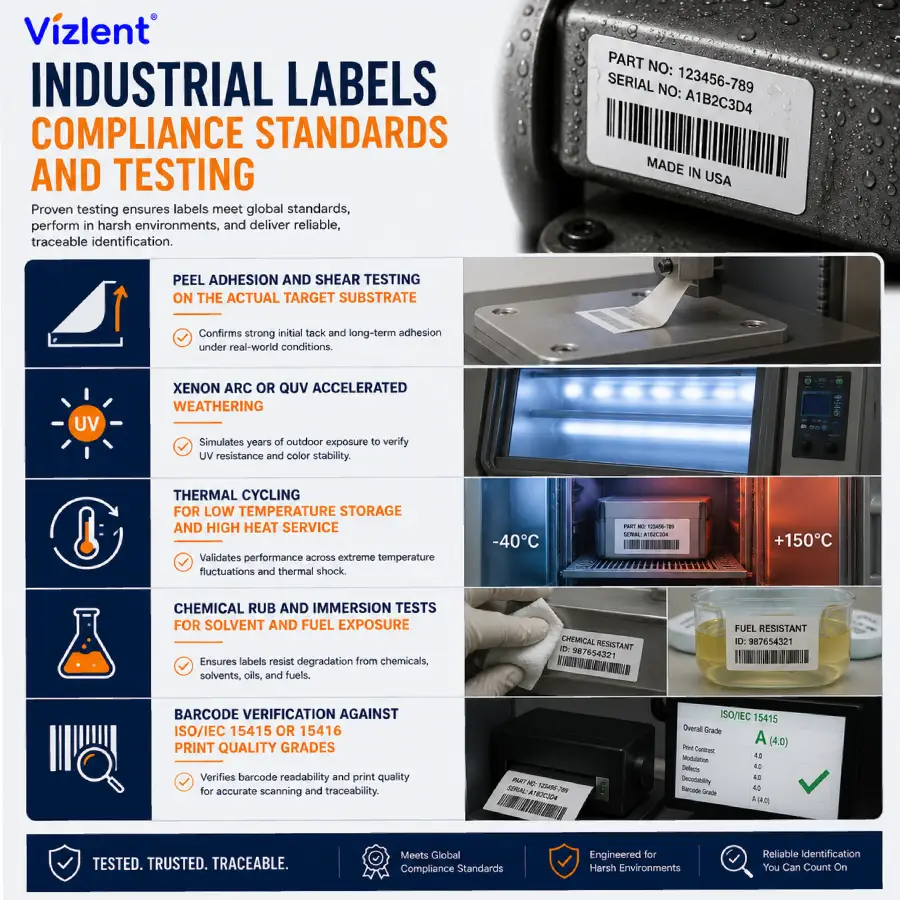
Industrial labels compliance standards and indicators of conformity rest on documented laboratory testing, never on supplier promises. UL 969 alone requires adhesion, legibility, and exposure tests across defined temperature, humidity, and chemical conditions. Accelerated weathering in xenon arc chambers compresses years of sunlight into weeks of measurable data.
- Peel adhesion and shear testing on the actual target substrate
- Xenon arc or QUV accelerated weathering for any outdoor durability claim
- Thermal cycling for low temperature storage and high heat service
- Chemical rub and immersion tests for solvent and fuel exposure
- Barcode verification against ISO/IEC 15415 or 15416 print quality grades
Some search results mention an industrial labels compliance standards and testing examination, though no formal exam by that name exists anywhere in the labeling industry. What buyers actually review are third party test reports, certificates of conformity, and SGS or ISO 9001 audit records. Ask for those documents by name and you will get much further than any generic certificate request.
Documentation Every Compliant Order Should Include
Paperwork is the proof layer of the entire compliance system, and auditors judge you on it before they ever touch a label. A certified roll with no traceable documents behind it fails an audit just as fast as an uncertified one. Building a document habit into purchasing takes little effort once the required list is clear.
- Certificate of conformity naming the standard and the exact material grade
- Lot specific test report covering adhesion, release force, and coat weight
- RoHS and REACH material declarations with current issue dates
- ISO 9001 certificate for the manufacturing site, not a trading office
- SGS or equivalent third party test summary where the application demands it
- Retained sample policy confirming the factory keeps reference material from each lot
Store these records against the purchase order number so any lot can be traced back within minutes. Digital copies work for most auditors, provided the files show issue dates and the certifying body. A supplier that hesitates when you ask for any item on this list is telling you something important.
Compliance Standards for Industrial Labels in China and Global Sourcing
The industrial labels compliance standards China buyers deal with most are GB standards at home and the rules of each export market abroad. A roll leaving Shenzhen for Rotterdam must satisfy REACH and CLP, while the same material bound for Chicago answers to UL and OSHA instead. Serious Chinese manufacturers hold ISO 9001 certification and submit materials for SGS testing so overseas customers can verify every claim independently.
A dependable compliance standard for industrial label service pairs coated material with full documentation. That means test reports with each production lot, material declarations for RoHS and REACH, and traceability from jumbo roll to slit roll. Vizlent structures its factory direct supply around exactly that paper trail for converters in more than 50 countries.
Serving Bulk Orders and Business Buyers
The compliance standards for industrial labels bulk orders must meet are identical to the rules for a single roll, but the risk multiplies with volume. A certification gap on a container load creates a container load of unsellable stock. Lot level test reports and retained samples are the standard defense for high volume programs.
In any compliance standards for industrial labels business cases, the math favors certified material even at a higher unit price. One rejected shipment, one failed audit, or one product recall erases years of savings from cheaper uncertified stock. Anti static labels for electronics lines show this clearly, since a single ESD event can destroy components worth more than the entire label order.
Industrial Labels Compliance Standards Checklist
A short checklist catches most compliance gaps before an order ever ships. Run through it at specification, again at sample approval, and once more at first article inspection. Five minutes of checking beats five weeks of rework.
- Confirm which regulations apply: Product category, industry, and every destination market
- Specify material by standard: UL 969 recognized, BS 5609 certified, or UL 94 V-0 rated as needed
- Verify supplier credentials: ISO 9001, FSC, and SGS test documentation
- Adhesive Selection: Match adhesive to the target substrate, surface energy, and full temperature range before approving samples.
- Print Validation: Test printed samples on your own equipment, since ribbons, inks, and lamination all change compliance results.
- Traceable Documentation: Request lot-traceable test reports with every bulk shipment.
- Quality Records: File all certificates where your quality team can easily access them for audits and compliance verification.
Treat the checklist as a living document that grows with each new market you enter. Add destination specific items such as language requirements or recycling marks as they appear. Your converting team and your material supplier should both hold the current version.
A Note on Two Search Phrases
Autocomplete produces a few phrases in this topic that carry no independent meaning, and it is worth saying so plainly. The query compliance standards for industrial labels and labels is a simple duplication, and it points to the same standards covered above. No separate rulebook exists under that name.
Treat any page that promises unique answers for duplicated phrases with caution. Reliable guidance always traces back to a named standard, a named regulator, or a published test method. When a claim has no citation behind it, keep searching.
Get Compliant Label Stock Direct from the Factory
Vizlent has manufactured certified self adhesive label stock since 2011, with ISO 9001, FSC, and SGS credentials behind every roll. Our engineering team matches facestock, adhesive, and liner to the compliance standards for industrial labels your market enforces, from UL recognized constructions to BS 5609 drum stock. Request free samples, run them on your own line, and review the test reports before committing to volume. Contact our team today for a factory direct quote, or explore more material guides on the Vizlent blog.
Frequently Asked Questions
What are compliance standards for industrial labels?
Compliance standards for industrial labels are the published rules that govern label content, durability, and materials in regulated applications. They come from bodies such as UL, ANSI, OSHA, ISO, the FDA, and chemical regulators like ECHA. Each standard defines both what the label must communicate and how long it must survive in service. Meeting them protects certifications, shipments, and end users.
What is UL 969 and why does it matter?
UL 969 is the North American standard for marking and labeling systems used on certified equipment. It tests adhesion, legibility, and exposure resistance across defined conditions such as heat, humidity, and chemical contact. Equipment carrying a UL mark generally requires labels made from UL recognized material. Using unrecognized stock can void the certification of the equipment itself.
Do chemical drums need BS 5609 certified labels?
BS 5609 certification is required for labels on hazardous chemical drums shipped by sea under the IMDG code. The standard includes a three month salt water immersion test on the base material and print permanence testing on the finished label. Both the material and the print method must pass for the label to qualify. Land only shipments follow GHS rules without the marine immersion requirement.
How are industrial labels tested for compliance?
Industrial labels are tested through documented laboratory methods covering adhesion, weathering, temperature, and chemical exposure. Common procedures include peel and shear testing, xenon arc accelerated weathering, thermal cycling, and solvent rub tests. Labels that carry barcodes add print quality verification against ISO/IEC 15415 or 15416. Results are recorded in test reports that travel with certified material.
Can label materials made in China meet Western compliance standards?
Label materials manufactured in China can meet Western standards when the factory holds recognized certifications and submits to third party testing. ISO 9001 quality systems, SGS test reports, and FSC chain of custody are the credentials worth verifying. Destination rules such as UL, REACH, and RoHS apply to the material no matter where it was coated. Ask for lot specific documentation rather than a generic certificate.
What is the difference between compliant material and a compliant label?
Compliant material is stock that has passed the relevant standard, while a compliant label is the finished printed product that must also pass. Printing introduces new variables, since ribbon chemistry, ink adhesion, and lamination all change test outcomes. Standards such as UL 969 and BS 5609 evaluate the printed combination, not the blank roll alone. Always test the exact material, ribbon, and print method you plan to run in production.
What documents prove label compliance during an audit?
The documents that prove label compliance are certificates of conformity, lot specific test reports, and current material declarations for RoHS and REACH. Auditors also expect the manufacturing site to hold a valid ISO 9001 certificate and, in many industries, third party test records from a body such as SGS. Each document should name the standard, the material grade, and the production lot it covers. Generic certificates without a lot of traceability rarely satisfy a serious audit.
How often do label compliance standards change?
Label compliance standards typically update every few years, and chemical regulations change fastest of all. REACH substance lists expand on a rolling basis, GHS moves through numbered revisions, and UL standards publish periodic amendments. A supplier with active certifications will flag changes that affect your material. Reviewing label specifications once a year keeps most programs ahead of revisions.






