
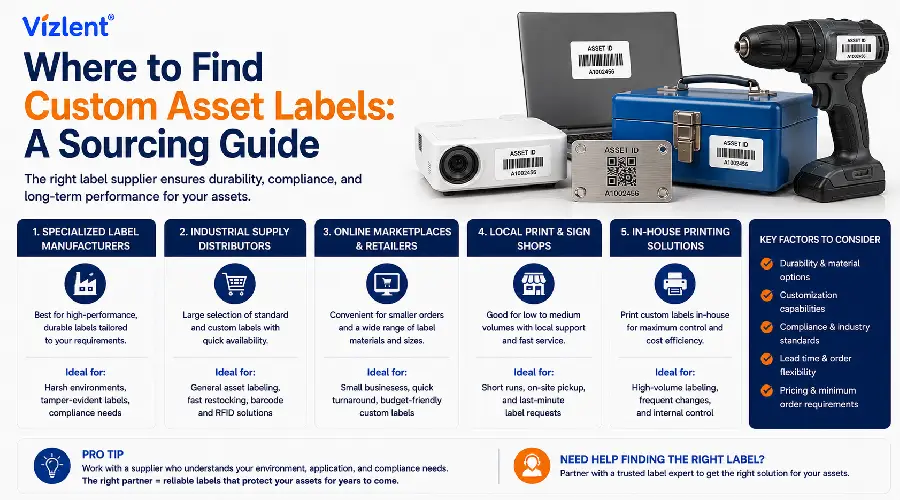
Custom asset labels are available from three main channels: local print shops and office suppliers for small one-off batches, online label converters for mid-size custom orders, and factory-direct manufacturers for bulk, specification-driven programs. The right channel depends on facestock durability requirements, barcode or serial numbering needs, and order volume, since a label that only needs to survive an office desk has very different requirements than one bolted to outdoor machinery.
Material science, not just design and printing, separates a tag that lasts through years of handling from one that peels or fades within months. Sourcing channels, terminology, design options, and buying formats all shape which path actually gets the right label into production.
Where to Find Custom Asset Labels: Sourcing Channels Overview
Local print shops and office supply retailers can produce small batches quickly, which suits a business labeling a handful of items or testing a design before a larger commitment. Online label converters expand material and finish options considerably, supporting custom sizes, barcodes, and sequential numbering without the volume minimums a factory-direct manufacturer typically requires. Factory-direct manufacturers like Vizlent Label Materials Co., Ltd., sit at the far end of the spectrum, producing durable synthetic facestocks in bulk with full control over adhesive formulation, face film thickness, and liner selection.
Matching the sourcing channel to actual program size prevents both overpaying at retail for a large recurring order and waiting on factory minimum quantities for a one-time small batch. A business labeling ten laptops needs a completely different supplier relationship than one tagging thousands of pieces of industrial equipment across multiple facilities. Reviewing expected order frequency and total volume before selecting a supplier avoids switching channels midway through a labeling program.
Custom Asset Tags vs Custom Asset Stickers vs Custom Barcode Labels
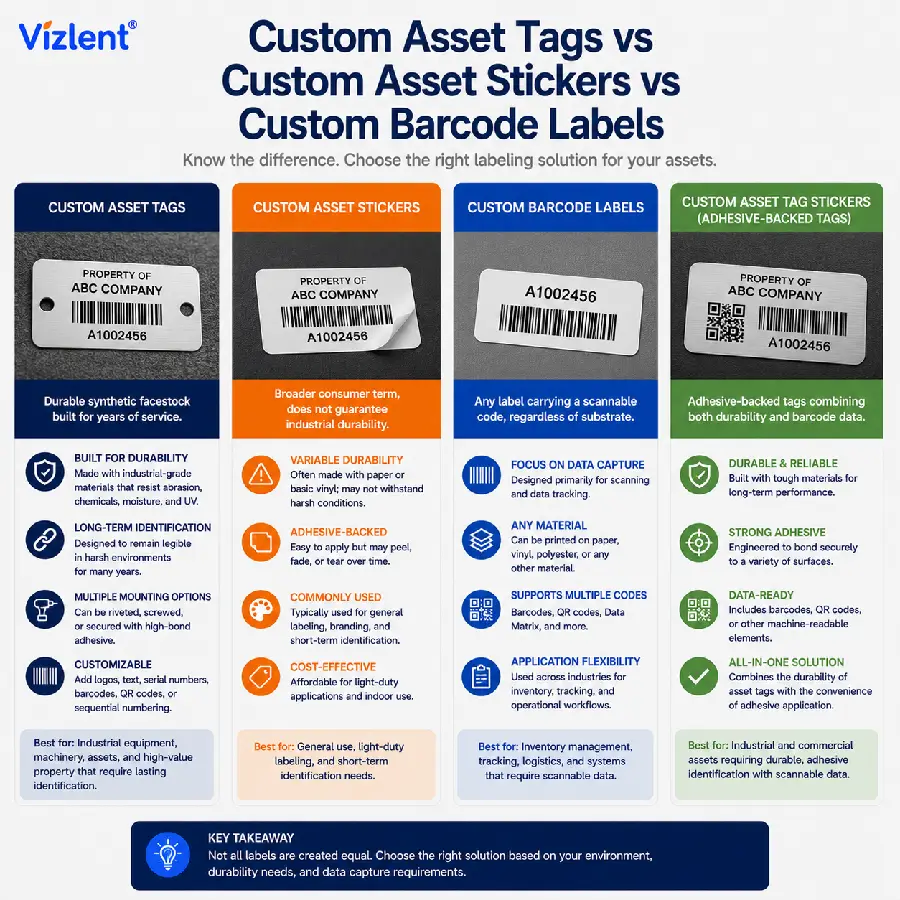
Custom asset tags typically refers to a durable, synthetic-facestock label built to survive years of handling, chemical exposure, or outdoor weather, distinct from a general adhesive sticker meant for short-term or indoor use. Custom asset stickers is a looser, more consumer-facing term that can describe anything from a paper sticker to a vinyl decal, and does not by itself guarantee the material will hold up under industrial conditions. Custom barcode labels specifically refers to any label carrying a scannable code, printed on paper for retail use or engraved into metal for permanent industrial identification.
Custom asset tags and labels are often used interchangeably in casual conversation, though buyers should treat these terms as describing different durability tiers rather than perfect synonyms, since ordering a “sticker” when the application actually requires a tag-grade facestock is one of the most common sourcing mistakes. A single asset can require all three concepts at once: a durable facestock, an adhesive-backed format, and a scannable code combined into one finished product. Clarifying which of these properties matters most for a given application narrows supplier options considerably faster than searching generically.
- Custom asset tags: Durable synthetic facestock built for years of service
- Custom asset stickers: Broader consumer term, does not guarantee industrial durability
- Custom barcode labels: Any label carrying a scannable code, regardless of substrate
- Custom asset tag stickers: Adhesive-backed tags combining both durability and barcode data
What Makes a Tag Scannable and Durable
A custom asset label with barcode needs print contrast and code density that survive the same conditions as the facestock itself, since a barcode that fades or distorts defeats the entire purpose of the tag regardless of how durable the underlying material is. Thermal transfer printing with resin ribbon is the standard method for printing barcodes onto synthetic tag facestocks, since resin ink bonds to polyester or polyimide surfaces in a way that direct thermal printing cannot replicate. Laser etching offers an alternative that engraves the code directly into a metal facestock, eliminating ink entirely and producing a mark that cannot smudge, fade, or wear off under abrasion.
Barcode grade, measured against ANSI or ISO scanning standards, matters as much as the physical durability of the tag, since a technically durable label with a low-contrast or distorted code still fails at the point of use. Buyers specifying a durable barcode tag should request a sample scanned under real warehouse or field lighting conditions rather than relying on a printed proof alone. Matching print method to facestock, and confirming barcode grade before a bulk order ships, prevents a costly reprint after tags are already applied to equipment.
Custom Asset Tags for Equipment, Computers, and Industrial Use

Custom asset tags for equipment used outdoors or in industrial environments typically require anodized aluminum or stainless steel facestock with a laser-engraved barcode, since these substrates resist chemical exposure, abrasion, and UV degradation that would degrade a printed paper or vinyl label. Custom asset tags for computers and other IT equipment favor a laser-engraved polycarbonate or aluminum disc format, which resists smudging from repeated handling and survives the surface cleaning common in office and data center environments. Both categories share the same underlying requirement: a facestock and marking method that will not degrade before the equipment itself is retired.
Custom asset tag labels for lower-risk indoor equipment, such as office furniture or shelving, can often use a synthetic polyester facestock with thermal transfer printing rather than the more expensive laser-etched metal construction reserved for harsher environments. Custom asset number stickers applied to smaller components or tools follow the same material logic on a smaller scale, favoring compact, high-tack labels over full metal tags where space is limited. Reviewing the specific environment and consequence of tag failure for each equipment category, rather than applying one standard across the board, keeps a labeling program both durable and cost-effective.
Personalised Asset Labels: Logos, Numbering, and Design Options
Personalised asset labels typically include a company logo, consistent color scheme, and a standardized layout for serial numbers or barcodes, giving an organization’s equipment a recognizable, professional appearance across every labeled item. Custom asset tags with logo placement should confirm logo resolution and contrast against the chosen facestock color before a full production run, since a logo that looks correct in a design file can still print poorly on a reflective metal or dark polyester surface. Custom asset id tags combining a logo, sequential number, and barcode in one layout require more design coordination upfront but eliminate the need for multiple label types across an inventory.
Custom asset labels design decisions should account for how the label will actually be read in the field, since small text or a dense logo can become illegible at the distance a technician typically stands from labeled equipment during an inspection. A converter experienced in this kind of design work can advise on font size, code density, and logo placement based on the specific facestock and application rather than simply reproducing a submitted design file without technical review. Requesting a physical proof rather than approving a digital mockup alone catches legibility problems before an entire batch prints incorrectly.
Custom Asset Labels Best Practices for B2B Programs
Custom asset labels best practices start with standardizing facestock, adhesive, and layout across an entire organization before any labels are ordered, since retrofitting a new standard onto thousands of already-tagged assets is far more disruptive than establishing one from the outset. Custom asset labels b2b buyers, including converters and distributors who resell finished tags to end users, should confirm both minimum order quantities and lead times upfront, since production schedules for durable synthetic facestocks typically run longer than standard paper label orders. Documenting the chosen numbering scheme, facestock grade, and supplier contact in a written policy prevents the program from becoming inconsistent as staff turnover occurs.
Piloting a new label construction on a small representative sample before a full rollout is one of the most consistently cited practices among experienced procurement teams, since lab data sheets do not always predict real-world adhesion and legibility performance. Retiring old tag numbers rather than reissuing them, and keeping a central record linking each asset number to its physical location, protects both accounting and maintenance records over the life of the labeling program. Treating this as an ongoing program rather than a one-time purchase is the single biggest factor separating labeling programs that hold up for years from those that need replacing within one.
Buying Format: By the Sheet, Bulk Rolls, and Printer Options
Custom asset labels by the sheet, typically in A4 or letter format, suit small businesses or pilot programs that need a limited quantity without committing to a full production roll. Bulk roll formats become more economical once an organization needs hundreds or thousands of tags, since per-unit pricing drops significantly at volume and roll format integrates directly with an in-house or converter printing line. A custom asset tag printer needs to match both the facestock chosen and the expected print volume, since a desktop printer suited to occasional sheet printing will not reliably handle a high-volume roll-fed production run.
Organizations without an in-house tag printer often find it more economical to order pre-printed tags from a converter, complete with sequential numbering, barcodes, and logo already applied, rather than investing in printing equipment, ribbon stock, and staff time to operate it correctly. Vizlent supplies laser-etched and thermal-transfer-ready facestocks to converters who handle this finishing step for end users across industrial, healthcare, and IT sectors. Either approach, in-house printing or pre-printed converter supply, can work well provided the format matches actual order volume and printing capability.
Clarifying Search Confusion Around Custom Asset Labels
Search terms pairing an e-commerce platform name like BigCommerce with asset tagging occasionally surface alongside physical label sourcing searches, though BigCommerce is a platform for running online stores and has no direct connection to physical asset tag manufacturing. Buyers researching physical, durable asset tags should disregard results tied to e-commerce platform integrations, since no physical label manufacturer sells its products specifically through or for BigCommerce as a defining feature. Similarly, a custom barcode label generator or custom barcode label maker refers to software or an online tool that designs barcode artwork, not a physical label material or finished tag itself.
Genuine physical asset labeling searches are almost always tied to equipment identification, property tracking, or industrial compliance rather than e-commerce platforms or design software. If a search for a barcode label generator or maker was intended to design artwork for a physical custom order, most label converters can incorporate that finished design file during production without needing the buyer to source physical material from the same tool. Understanding what custom asset labels do in practice, meaning physically identifying and tracking equipment over its service life, helps clarify which search results are actually relevant to a physical sourcing need.
Source Custom Asset Labels Factory-Direct
Finding the right supplier starts with matching facestock durability and marking method to the actual environment the tag will face, not just comparing price per label. Vizlent manufactures laser etched barcode labels, metal asset tags with permanent barcodes, and laser etched metal labels factory-direct, backed by ISO 9001, FSC, and SGS certification. Send an inquiry to request free sample sheets and a technical data sheet for your specific equipment, computer, or property labeling requirement, or explore Vizlent’s full durable label range if your labeling program spans multiple facestock types.
Frequently Asked Questions
Where can I find custom asset labels for industrial equipment?
Custom asset labels for industrial equipment are best sourced from a durable label manufacturer offering synthetic facestocks such as polyester, polyimide, or anodized aluminum rather than a general print shop working primarily with paper stock. Factory-direct manufacturers typically offer the widest range of durable facestock and adhesive combinations for harsh environments. Requesting a technical data sheet and sample confirms real-world performance before committing to a bulk order.
What is the difference between custom asset tags and custom asset stickers?
Custom asset tags generally implies a durable, synthetic-facestock label built for years of service, while custom asset stickers is a broader term that can include less durable paper or vinyl formats meant for short-term use. Neither term guarantees a specific durability level on its own, so buyers should confirm facestock material and adhesive type directly. Clarifying these details prevents ordering a product that looks similar but performs very differently in the field.
Can I get a durable label with a barcode that survives outdoor exposure?
Yes, a barcode tag can be built for outdoor durability using a UV-stabilized synthetic facestock combined with resin thermal transfer printing or laser etching, depending on the required service life. Laser-etched metal facestocks generally offer the longest outdoor service life since the code is engraved rather than printed. Requesting an outdoor-rated sample confirms performance before committing to a full production run.
Is custom asset labels bigcommerce a real product category?
No, this search combination typically reflects confusion with e-commerce platform terminology rather than any real connection to physical label manufacturing. BigCommerce is a software platform for online stores, unrelated to durable label facestocks or barcode printing. Buyers should search using equipment or industry-specific terms to find relevant physical label suppliers.
What are the most important best practices for a labeling program?
The most important best practices include standardizing facestock and layout before ordering, piloting a new construction on a small batch before full rollout, and documenting the numbering scheme in writing. Retiring old asset numbers rather than reissuing them also prevents confusion in maintenance and audit records. Treating labeling as an ongoing program rather than a one-time purchase keeps the system consistent over time.
Can I order tags by the sheet instead of by the roll?
Yes, ordering by the sheet in A4 or letter format works well for small businesses, pilot programs, or occasional labeling needs without committing to a full production roll. Bulk roll formats become more economical once volume increases into the hundreds or thousands of tags. Confirming both format options with a supplier ensures the order matches actual current and near-term volume.
Do barcode label generator tools produce physical labels I can apply to equipment?
No, a barcode label generator or maker is typically software that designs barcode artwork rather than a source of physical, durable label material. The resulting design file still needs to be printed onto an actual facestock by a printer or label converter to become a usable physical tag. Most converters can accept a design file from these tools and apply it to the appropriate durable facestock during production.






