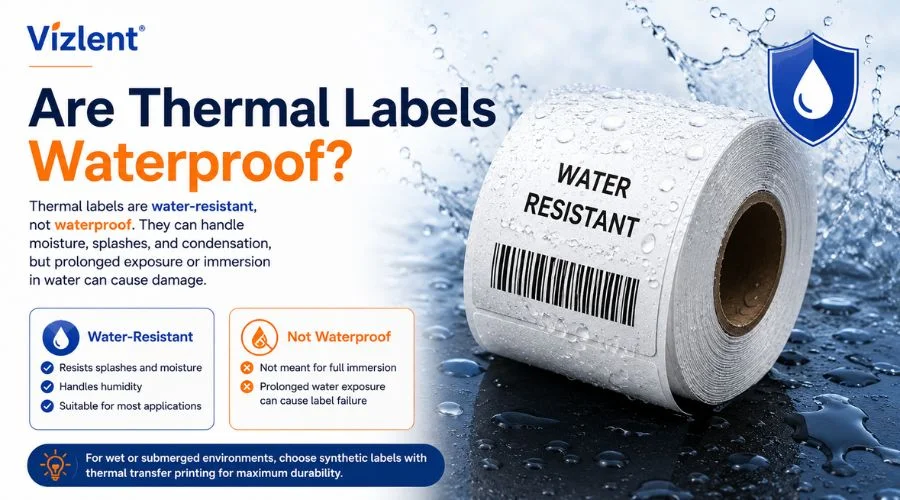
Not all thermal labels are water resistant. This depends entirely on which printing method and facestock a label uses, since thermal labels are not a single material but a category covering both direct thermal and thermal transfer printing. Direct thermal paper labels are never truly waterproof because heat alone creates the image on a chemically coated surface that moisture, humidity, and sunlight all degrade over time. Thermal transfer labels printed with resin ink onto synthetic facestock, by contrast, can achieve genuine water resistance because the ink bonds permanently to a film that does not absorb moisture the way paper does. Facestock composition, printer selection, and buying options all factor into which construction actually holds up in a wet, humid, or outdoor environment.
The Short Answer on Thermal Label Water Resistance
Are all thermal labels waterproof is the wrong question to ask, since thermal printing describes a method rather than a fixed material, and water resistance depends almost entirely on facestock choice. A plain paper direct thermal label left in standing water will smear, tear, and lose its image within minutes, while a resin-printed polyester label can survive a full washdown cycle without visible damage. Buyers who assume all thermal labels perform the same way in wet conditions frequently discover the difference only after a failed shipment or a faded compliance tag.
The honest short answer is that direct thermal paper labels are not waterproof, standard thermal transfer labels on paper facestock are only moderately water resistant, and thermal transfer labels on synthetic film with resin ink are the closest option to genuinely waterproof. Matching the label construction to the actual environment, rather than assuming any thermal label will do, is the single most important decision in this entire category. The remaining sections walk through each construction type in detail so buyers can specify with confidence.
Are Direct Thermal Labels Waterproof?
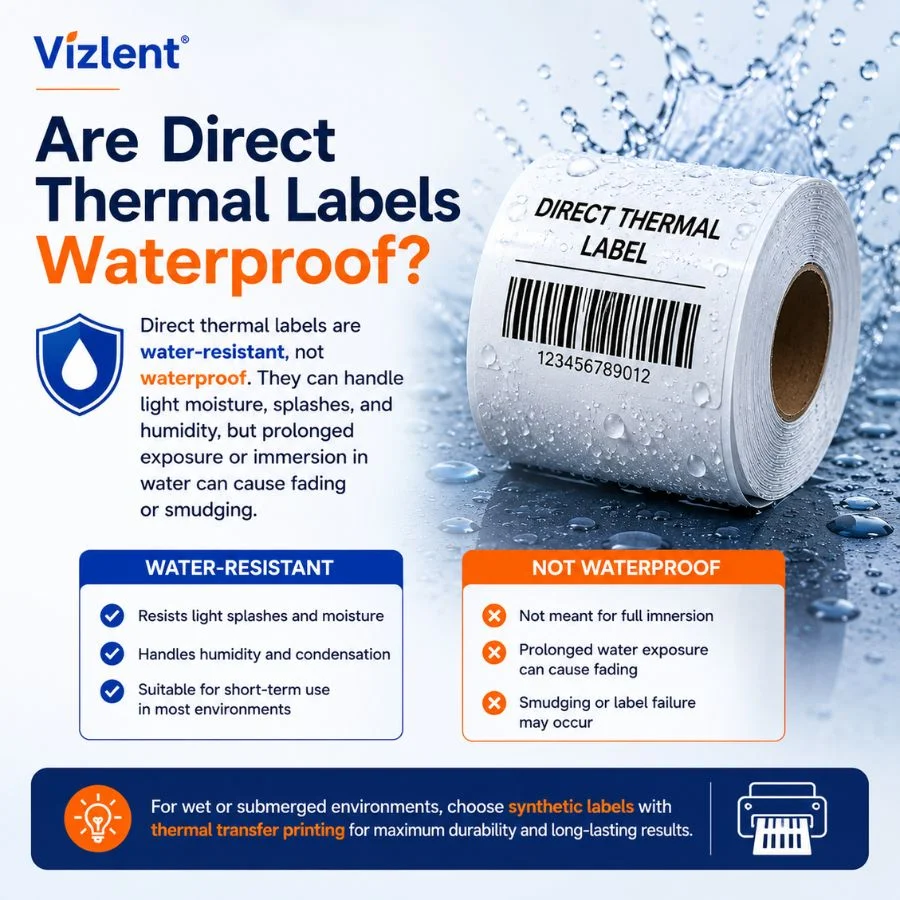
Direct thermal labels waterproof performance is limited because these labels rely on a heat-sensitive coating that darkens when a printhead applies heat directly to the paper, with no ink, ribbon, or toner involved. That same thermally reactive coating that makes the label easy to print also makes it vulnerable, since water, humidity, and even prolonged sunlight can trigger the coating to darken unevenly or fade entirely. A thermal printer waterproof claim on a direct thermal label almost always refers to the printer housing rather than the label material itself, which remains sensitive to moisture regardless of the printer used.
Some direct thermal labels use a polypropylene or synthetic facestock instead of coated paper, which improves moisture resistance significantly while keeping the no-ribbon printing method. These synthetic direct thermal constructions resist tearing and light splashing better than paper versions, though they still cannot match the chemical and full-immersion resistance of a resin thermal transfer label. Buyers needing genuine waterproofing for barcode or shipping labels should treat standard paper direct thermal as a short-term, indoor-only solution regardless of marketing claims.
- Standard paper direct thermal: Not water resistant, indoor use only
- Synthetic polypropylene direct thermal: Moisture and tear resistant, still not fully waterproof
- Typical service life in dry conditions: Weeks to a few months before fading
- Common failure triggers: Standing water, high humidity, direct sunlight, heat exposure
Print darkness settings also interact with moisture resistance on direct thermal labels, since a printhead running too hot can pre-stress the coating and make it more susceptible to premature fading even before water ever touches the label. Storage conditions matter just as much as the printing itself, since direct thermal rolls left in a humid warehouse can lose print quality before they are even applied. Buyers troubleshooting inconsistent print quality on direct thermal labels should check storage humidity and printhead temperature before assuming the label material itself is defective.
Are Thermal Transfer Labels Waterproof?
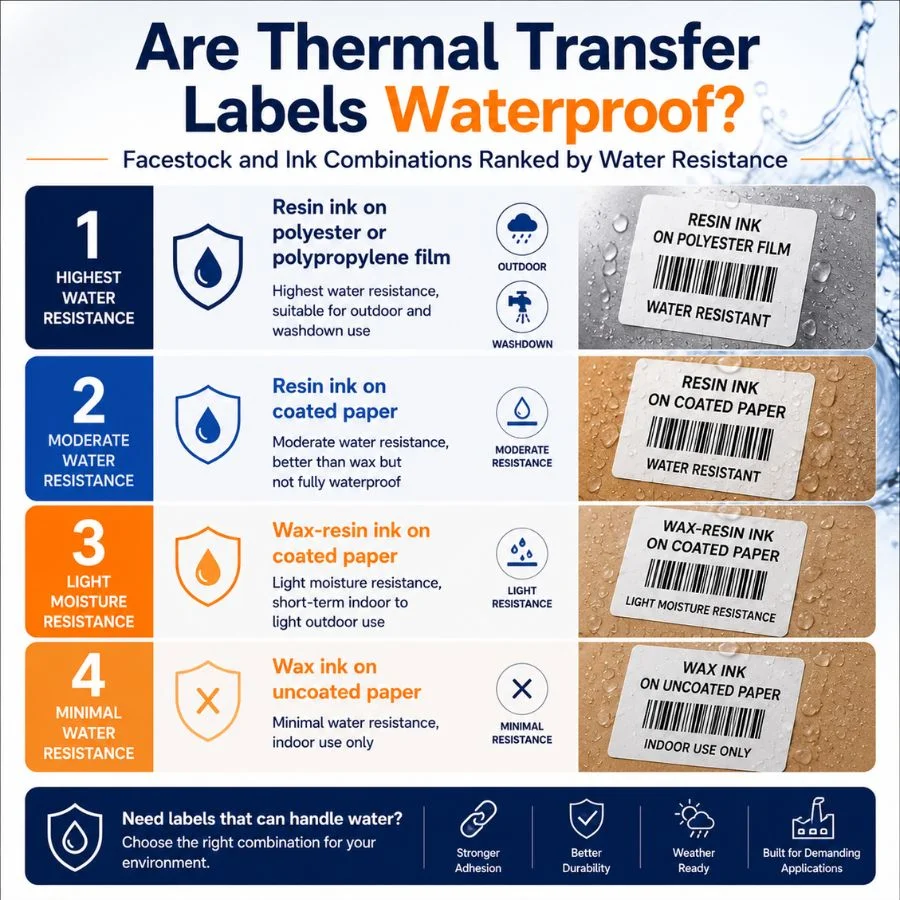
Thermal transfer labels waterproof performance depends on two separate choices working together: the ribbon ink formulation and the facestock material the ink is printed onto. A wax ribbon printed onto coated paper offers only modest water resistance, since the paper substrate itself can still absorb moisture even though the wax ink resists light smudging. A full resin ribbon printed onto polyester, polypropylene, or vinyl facestock produces a label where both the ink and the substrate resist water, giving it genuine waterproof performance suitable for outdoor and washdown environments.
This combination of resin ink and synthetic film is why thermal transfer labels dominate applications like drum labeling, outdoor asset tags, and automotive under-hood identification, where standing water, chemical exposure, or repeated washing is expected. Buyers shopping for thermal waterproof stickers rather than roll-fed industrial labels should look for the same resin-on-synthetic construction, since the underlying material science does not change between a small sticker format and a large industrial label. A resin-on-paper combination and a resin-on-polyester combination look similar on the roll but perform very differently once water gets involved.
Facestock and Ink Combinations Ranked by Water Resistance
- Resin ink on polyester or polypropylene film: Highest water resistance, suitable for outdoor and washdown use
- Resin ink on coated paper: Moderate water resistance, better than wax but not fully waterproof
- Wax-resin ink on coated paper: Light moisture resistance, short-term indoor to light outdoor use
- Wax ink on uncoated paper: Minimal water resistance, indoor use only
What Thermal Label Paper Is Made Of, Including BPA-Free Options
Thermal label paper used in direct thermal printing consists of a base paper coated with a thermally reactive layer containing a leuco dye and a color developer that reacts with heat to create the printed image. Older developer chemistries used bisphenol A, commonly abbreviated BPA, which raised health and regulatory concerns for labels used in food contact or frequent-handling applications. Most reputable manufacturers now offer thermal labels BPA free using phenol-free or bisphenol S alternative developer chemistries that meet current food safety and RoHS compliance expectations.
Buyers sourcing thermal labels BPA free should request a material safety data sheet or compliance certificate rather than relying on a supplier’s verbal assurance, since BPA-free claims vary in how strictly they are verified. Thermal transfer labels avoid this specific chemical question entirely, since the image comes from the ribbon ink rather than a heat-reactive paper coating. For applications with strict food safety or consumer handling requirements, confirming the exact developer chemistry in writing protects buyers from compliance gaps discovered after labels are already in circulation.
Choosing a Thermal Label Maker and Printer for Wet or Humid Environments
A thermal label maker or desktop thermal label printer for small business use typically supports direct thermal printing only, which limits waterproofing options to synthetic facestocks rather than ink formulation choices. Small business buyers printing shipping labels, product tags, or barcode labels in a dry indoor environment rarely need a fully waterproof label, making standard direct thermal paper a cost-effective default. Once labels face refrigeration, outdoor storage, or any splash risk, upgrading to a thermal transfer printer with resin ribbon capability becomes the more reliable choice.
A thermal printer waterproof rating, when a manufacturer offers one, typically describes IP-rated housing that protects the printer’s internal electronics from dust and moisture rather than describing the labels it prints. Buyers should not assume a waterproof-rated printer automatically produces waterproof labels, since printer housing and label material are entirely separate specifications. Confirming both the printer’s environmental rating and the label construction separately avoids a mismatch between a rugged printer and a paper label that still fails in the field.
Thermal Labels: Blank Stock, Bulk Orders, Colored, and Custom Options
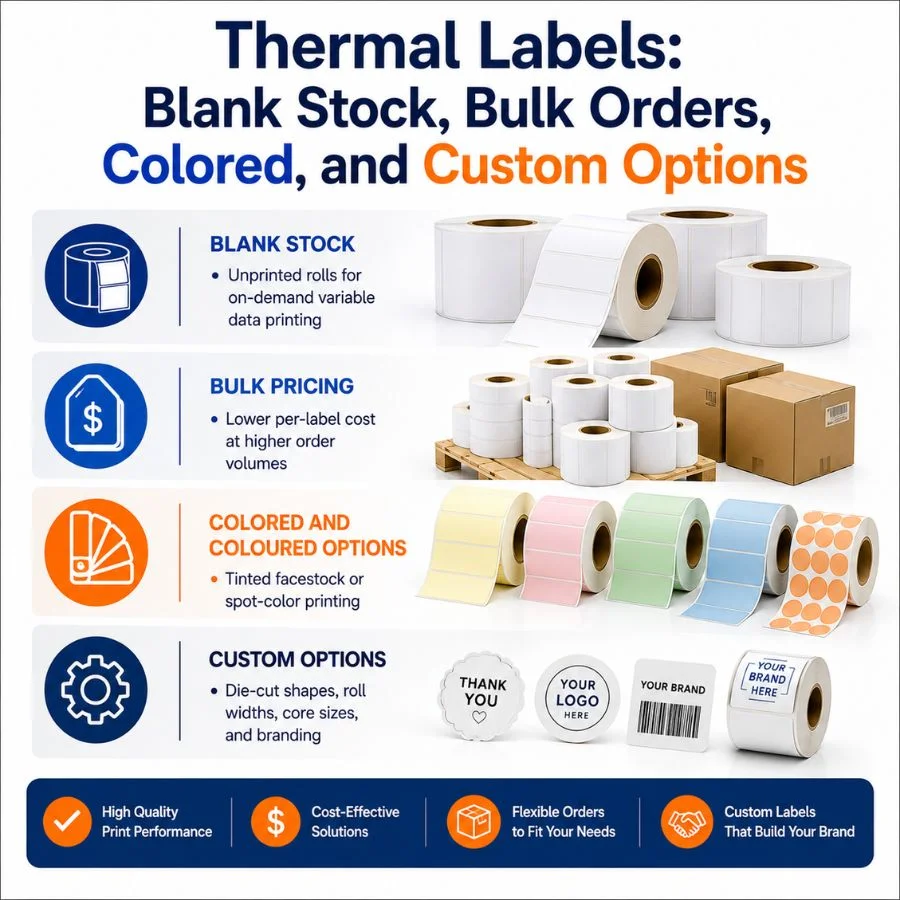
Thermal label blank stock, sold as unprinted rolls in standard sizes, gives buyers the flexibility to print variable data such as barcodes, lot numbers, and shipping addresses on demand rather than ordering pre-printed labels for every SKU. Thermal labels bulk purchasing reduces per-label cost significantly compared to small retail packs, which matters for logistics, retail, and manufacturing operations printing thousands of labels per week. Factory-direct sourcing typically offers the deepest bulk pricing tiers since it removes the distributor markup found in small-pack retail channels.
Thermal labels colored and thermal labels coloured, using either regional spelling, are available in tinted facestocks or spot-color printing for color-coded inventory systems, quality control tagging, or shift-based warehouse workflows. Thermal labels custom options extend beyond color to include die-cut shapes, specific roll widths, core sizes, and printed branding elements applied during the converting process. Buyers combining custom sizing with a waterproof facestock and resin ink should confirm both specifications together, since a converter quoting only on size may default to a standard paper facestock unless waterproofing is explicitly requested.
- Blank stock: Unprinted rolls for on-demand variable data printing
- Bulk pricing: Lower per-label cost at higher order volumes
- Colored and coloured options: tinted facestock or spot-color printing
- Custom options: Die-cut shapes, roll widths, core sizes, and branding
Finding Thermal Labels Near Me vs Sourcing Factory-Direct
Searches for thermal label printer nearby or thermal labels near me usually come from buyers who need a small quantity quickly, such as a single retail location replacing a printer ribbon or picking up a starter pack of labels the same day. Local office supply retailers and printer specialty stores can meet that immediate, small-volume need, though pricing per label runs considerably higher than factory-direct sourcing and material options are typically limited to a few standard sizes. For recurring or high-volume needs, a local retail purchase is rarely the most cost-effective long-term solution.
Buyers who need custom sizing, specific waterproof facestocks, or ongoing bulk supply are better served by sourcing factory-direct rather than searching for a local retail option. Vizlent manufactures waterproof and weather-resistant label stock directly, supplying converters and distributors with the custom facestock and adhesive combinations that local retail shelves simply do not carry. Establishing a factory-direct supply relationship also gives buyers consistent access to technical support and documentation that a local retail purchase cannot provide.
A hybrid approach works well for many operations: keep a small local or online retail stock on hand for emergency reorders while running the primary bulk supply through a factory-direct relationship. This protects against a stockout disrupting a production line while still capturing the cost savings and customization available through direct sourcing. Reviewing actual monthly label consumption alongside lead times from a factory-direct supplier usually reveals how much local retail buying can be phased out over time.
Get Waterproof Thermal Labels Backed by Factory-Direct Support
Specifying the right thermal label for a wet or humid environment starts with matching facestock and ink type to the actual conditions the label will face, not just the printer you already own. Vizlent manufactures outdoor weather resistant and waterproof label stock alongside thermal transfer ribbons in wax, wax-resin, and full resin formulations, factory-direct from an ISO 9001 certified facility. Send an inquiry to request free sample rolls and technical data sheets for your specific waterproofing requirement, or explore Vizlent’s low temperature labels for cold-chain and refrigerated applications that pair moisture resistance with freezer-grade adhesion.
Frequently Asked Questions
Are thermal labels waterproof?
The short answer depends on the printing method and facestock, with standard direct thermal paper labels offering no real water resistance and resin thermal transfer labels on synthetic film offering genuine waterproof performance. The printing method alone does not determine water resistance, since facestock material plays an equally important role. Buyers should always confirm both the ink or coating type and the facestock material before assuming any thermal label is waterproof.
Are all thermal labels waterproof?
No, are all thermal labels waterproof has a clear answer: they are not, and performance varies dramatically across direct thermal paper, direct thermal synthetic, wax thermal transfer, and resin thermal transfer constructions. Only resin ink printed onto polyester, polypropylene, or vinyl facestock reliably achieves full waterproof performance. Every other combination offers some level of moisture resistance short of true waterproofing.
Are thermal printed labels waterproof?
Are thermal printed labels waterproof comes down to the same facestock and ink question that applies to any thermal label, no matter if direct thermal or thermal transfer printing produced the image. A thermally printed label on coated paper will not survive sustained water exposure even if the print itself looks sharp when dry. Only synthetic facestock paired with resin ink delivers printed labels that hold up in genuinely wet conditions.
Are direct thermal labels waterproof enough for outdoor shipping?
Standard paper direct thermal labels are not suitable for outdoor shipping where rain or condensation is likely, since the heat-sensitive coating degrades with moisture exposure. Synthetic polypropylene direct thermal labels offer improved resistance and can handle light outdoor exposure for shorter shipping windows. For extended outdoor exposure or guaranteed legibility, a resin thermal transfer label on synthetic film remains the more reliable choice.
Are thermal transfer labels waterproof on any facestock?
No, thermal transfer labels waterproof performance depends heavily on facestock choice, since resin ink on paper still allows moisture to reach the substrate even though the ink itself resists smudging. Only resin ink combined with polyester, polypropylene, or vinyl facestock delivers full waterproof performance suitable for washdown or submersion-adjacent conditions. Wax and wax-resin ribbons on any facestock fall short of true waterproofing regardless of the substrate used.
Are thermal labels bpa free available for food contact use?
Yes, most established manufacturers now offer thermal labels bpa free using phenol-free or bisphenol S developer chemistries that avoid the regulatory concerns associated with older BPA-based coatings. Buyers should request written compliance documentation rather than relying on a general BPA-free claim alone. This is particularly important for food contact, healthcare, or frequently handled consumer-facing labels.
Where can I buy thermal labels blank, bulk, or custom sized?
Thermal label blank stock, bulk quantities, and custom sizing are all available directly from label manufacturers who convert jumbo rolls into finished, application-ready formats. Local retailers carry a narrow range of standard sizes at higher per-unit pricing, while factory-direct suppliers offer custom die-cutting, roll widths, and waterproof facestock options at bulk pricing tiers. Requesting a sample roll before committing to a bulk order remains the safest way to confirm both fit and water resistance performance.