
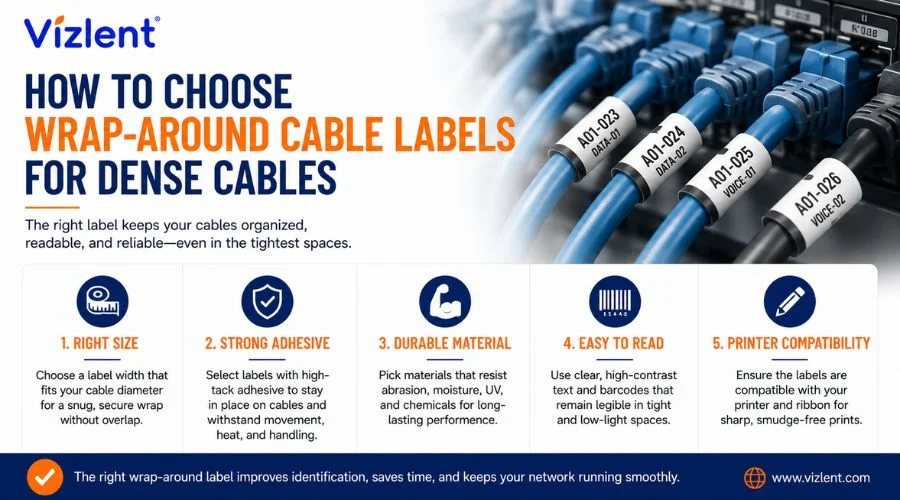
Choosing wrap-around cable labels for dense cables requires matching four factors to the environment: label material, wrap length relative to cable diameter, self-laminating protection, and print method. Crowded server racks, patch panels, and control cabinets force cables to press against each other constantly, so the right combination is what keeps identification legible under that pressure. A label that peels, smears, or flags out in a packed bundle defeats the purpose of labeling in the first place.
Selecting wrap-around cable labels for dense cables also means planning for how technicians will read, trace, and rework connections months after installation. Dense environments punish shortcuts, since a mislabeled or unreadable cable in a bundle of two hundred can turn a five-minute port change into an hour of manual tracing. The selection criteria below cover materials, sizing, lamination, printing, and application technique so installers and facility managers can specify labels that survive the environment they are going into. For material questions on any label stock construction, our engineering team reviews cable labeling specifications directly.
What Are Wrap-Around Cable Labels?
Wrap around cable labels are adhesive labels designed to wrap fully around a cable’s circumference, bonding to themselves so the printed area stays fixed against the jacket. The most common construction places a printable zone at the top of the label and a clear tail below it, so the transparent portion wraps over the print and seals it against abrasion. This self-sealing design separates wrap around cable markers from flag labels, which stick out from the cable, and from heat shrink sleeves, which require a disconnected cable end to install.
The wrap around cable format works on both terminated and unterminated cables, which matters in retrofit projects where disconnecting live network runs is not an option. Wrap around cable tags adhere to round, curved, and even slightly irregular jacket surfaces, holding print in place where flat labels would lift at the edges. For dense installations, this low-profile construction is the deciding advantage, since nothing protrudes into neighboring cables to snag or tear.
- Printable zone plus clear laminating tail in one label
- Applies to connected cables without disconnection
- Sits flush against the jacket with no protruding flag
- Compatible with thermal transfer, laser, and handheld printing
Why Dense Cable Environments Demand a Different Label Spec
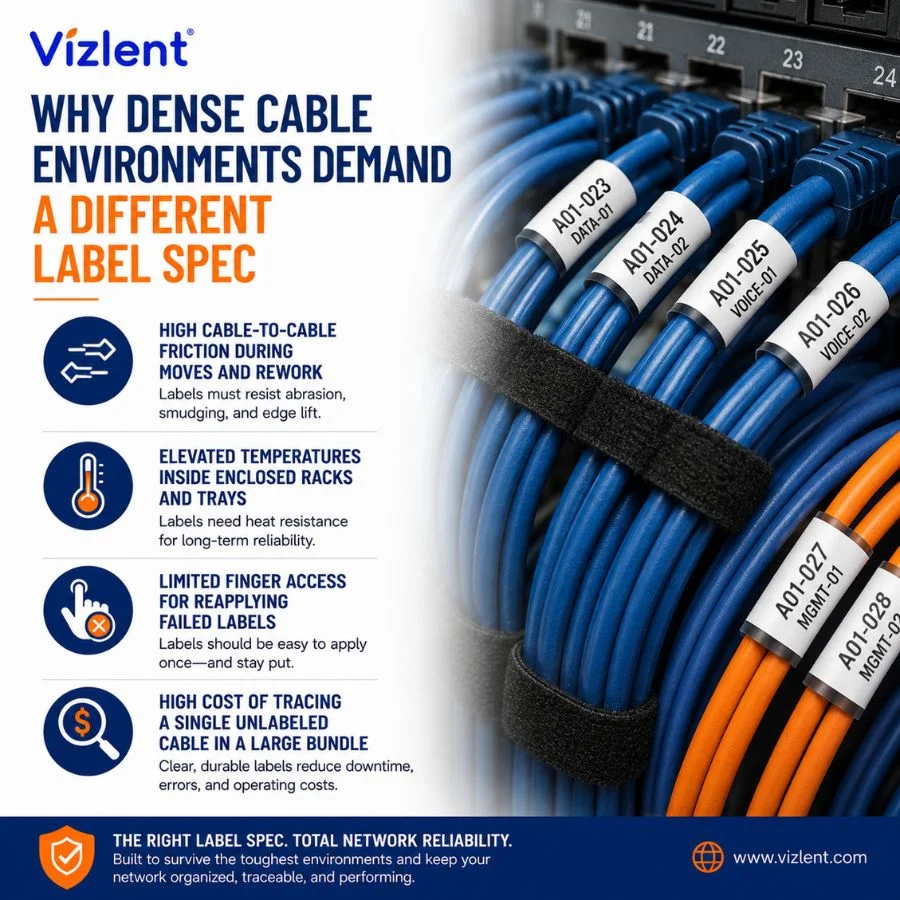
Dense cabling concentrates friction, heat, and handling stress in ways that open cable runs never experience. Every rack rework drags neighboring cables across each other, and a standard paper label in that environment scuffs into illegibility within months. Wrap-around cable labels for dense cables need synthetic facestocks, aggressive adhesives, and laminated print zones specifically because the environment attacks all three failure points at once.
Heat compounds the problem, since packed bundles inside enclosed racks run warmer than ambient room temperature and soften weak adhesives over time. Choosing wrap-around cable labels for dense cables with the wrong adhesive chemistry produces the familiar sight of curled, half-detached labels hanging off a patch panel two years after installation. Specifying for the worst point in the environment, usually the hottest and most frequently handled bundle, protects the entire labeling investment.
- High cable-to-cable friction during moves and rework
- Elevated temperatures inside enclosed racks and trays
- Limited finger access for reapplying failed labels
- High cost of tracing a single unlabeled cable in a large bundle
Label Material and Facestock Selection
Polyester and vinyl facestocks dominate cable labeling because both flex around small diameters without cracking and resist the oils, dust, and cleaning agents present in equipment rooms. Polyester holds print more sharply and suits data center and telecom work, while vinyl conforms better to very small or irregular cables in industrial settings. Paper facestocks have no place in dense installations, since paper absorbs moisture, tears during rework, and fails quickly under friction.
Adhesive selection matters as much as the facestock, because a label is only as durable as its bond to the cable jacket. Permanent acrylic adhesives bond well to PVC, LSZH, and polyethylene jackets, and they build adhesion strength over the first 24 to 72 hours after application. The most reliable wrap-around cable labels for dense cables pair a flexible synthetic facestock with a permanent acrylic adhesive rated for the temperature range of the installation environment.
Sizing Wrap-Around Cable Labels Correctly
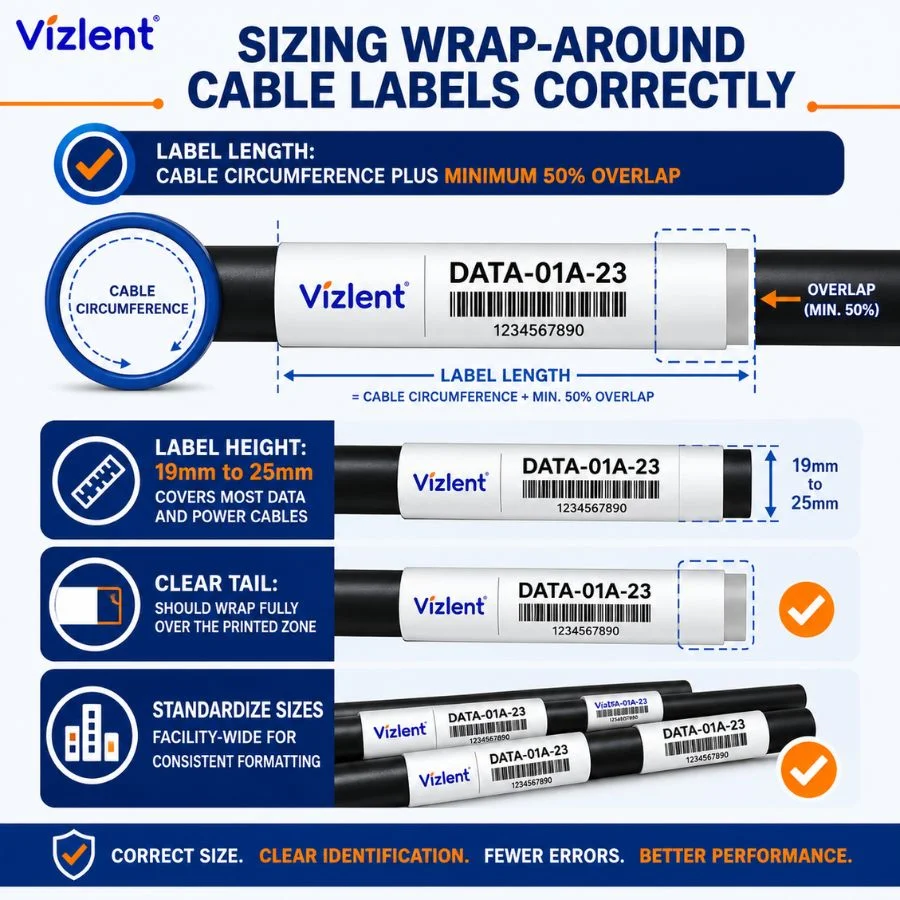
Correct sizing starts with cable diameter, since the label must wrap the full circumference at least once and ideally 1.5 times for a secure self-bond. A common sizing rule multiplies the cable diameter by pi to get the circumference, then adds at least 50 percent overlap for the label length. Undersized labels lift at the tail and catch on neighboring cables, which is exactly the failure mode dense bundles cannot tolerate.
Label height determines how much text fits and how easily a technician reads it inside a packed wrap around cable row at a patch panel. Wrap-around cable labels for dense cables generally work best in heights between 19mm and 25mm, tall enough for two lines of port and destination data without consuming vertical space between adjacent cables. Standardizing one or two label sizes across a facility simplifies reordering and keeps printed formats consistent across every rack.
- Label length: cable circumference plus minimum 50 percent overlap
- Label height: 19mm to 25mm covers most data and power cables
- Clear tail: should wrap fully over the printed zone
- Standardize sizes facility-wide for consistent formatting
Self-Laminating vs Standard Wrap-Around Labels
Self-laminating labels build wrap around cable protection into the label itself, using the clear tail to seal the printed area under a transparent layer as the label is applied. This construction protects thermal transfer or laser print from abrasion, moisture, and handling for the service life of the cable. Standard non-laminating wrap labels cost less per label but leave print exposed, which limits them to low-traffic runs that rarely see handling.
For dense installations, self-laminating construction is the correct default, since the abrasion that dense bundles generate wears exposed print quickly. The price difference per label is small compared to the labor cost of relabeling a rack after print wears away. Wrap-around cable labels for dense cables with self-laminating tails also resist the finger oils and repeated touching that come with frequent tracing work in crowded panels.
Choosing a Wrap Around Cable Label Printer
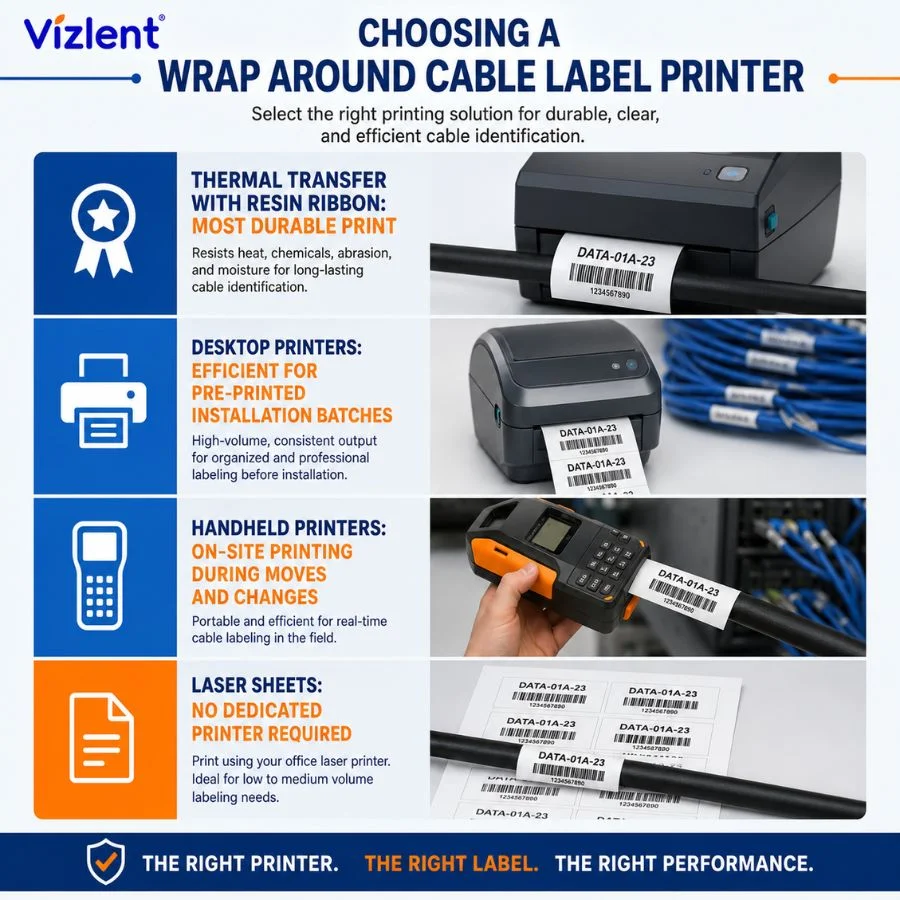
A wrap around cable label printer needs to produce durable, high-contrast print on synthetic facestocks, which points directly to thermal transfer printing over direct thermal or inkjet. Thermal transfer uses a thermal transfer ribbon to fuse ink onto the label surface, producing print that survives the friction and heat of dense bundles. Pairing polyester labels with a resin ribbon delivers the most durable print combination available for cable identification.
Desktop thermal printers suit high-volume pre-printing before installation day, while handheld units let technicians print wrap around cable labels at the rack during moves and changes. Laser-printable label sheets offer a third path for teams without dedicated label printers, running synthetic sheets through standard office laser printers. The print method should be decided together with the label material, since facestock, ribbon, and printer must be matched as a system for the print to last.
- Thermal transfer with resin ribbon: most durable print
- Desktop printers: efficient for pre-printed installation batches
- Handheld printers: on-site printing during moves and changes
- Laser sheets: no dedicated printer required
Labels vs Other Wrap Around Cable Accessories
Labeling is one part of a larger wrap around cable management system, and it works best alongside the right bundling and routing hardware. A wrap around cable sleeve or wrap around braided cable sleeving consolidates loose runs into a single protected bundle, while wrap around cable clips fix routed bundles to trays, desks, and walls. A wrap around cable tidy or wrap around cable organizer handles slack and keeps excess length coiled neatly instead of tangling behind equipment.
None of these accessories identifies individual cables, which is why labels remain necessary even in well-organized installations. Sleeving actually increases the need for labeling, since cables entering and exiting a braided sleeve become harder to trace visually along their length. The most maintainable dense installations combine bundling hardware for physical order with wrap-around cable labels for dense cables at every termination point for identification.
- Sleeves and braided sleeving: bundle protection, no identification
- Clips: routing and fixing, no identification
- Tidies and organizers: slack management, no identification
- Labels: the only component that identifies individual cables
How to Wrap Cables Correctly Before Labeling
Knowing how to wrap cables correctly makes labels easier to apply and easier to read for the life of the installation. Cables should be bundled with gentle, consistent tension using hook-and-loop wraps rather than tight zip ties, since overtightening deforms jackets and stresses conductors. Learning how to use cable wrap properly means leaving enough separation at termination points for labels to be applied flat and read without pulling cables apart.
Anyone working out how to wrap long cables for storage or slack management should follow the over-under coiling technique, which prevents the twist memory that makes cables fight against neat routing. Labels go on after bundling and routing are final, positioned 25mm to 50mm from the connector where technicians naturally look first. Applying wrap-around cable labels for dense cables at a consistent distance from every connector turns each rack into a predictable, scannable layout.
- Bundle with hook-and-loop, not overtightened zip ties
- Use over-under coiling for long cable storage
- Finalize routing before applying any labels
- Position labels 25mm to 50mm from connectors, consistently
Applying and Maintaining Labels Across Dense Racks
Application technique decides how long a label lasts, starting with a clean jacket surface wiped free of dust and oils before the adhesive touches it. The label should be wrapped with firm, even pressure so the clear tail seals over the print without trapped air bubbles or wrinkles. Adhesive bonds strengthen over the first days after application, so cables should not be aggressively reworked immediately after labeling.
Maintenance in dense environments means auditing labels during every moves-and-changes cycle rather than waiting for failures to accumulate. Replacing individual worn labels during routine work costs seconds, while relabeling an undocumented rack after years of neglect costs days. Facilities that standardize wrap-around cable labels for dense cables and audit them on a schedule keep tracing time low across the entire lifecycle of the installation.
- Clean the jacket with isopropyl alcohol before application
- Apply with firm pressure to avoid air bubbles under the clear tail
- Allow 24 to 72 hours for full adhesive bond before heavy rework
- Replace worn labels during routine moves and changes, not after failures pile up
Source the Right Label Stock for Your Cable Labeling Program
Getting wrap-around cable labels for dense cables right starts with the raw material, since facestock, adhesive, and liner determine every downstream property of the finished label. Our factory produces polyester and vinyl label stock engineered for cable identification, supplied to converters and distributors at factory-direct prices. Contact our team to request material specifications matched to your cable labeling application.
Free samples are available so converters can verify wrap performance, adhesive bond, and print quality on their own equipment before committing to volume orders. Pair the right facestock with the correct thermal transfer ribbon grade and the finished label will outlast the installation it identifies. Send your inquiry today for a factory-direct quotation on cable label stock in jumbo rolls, slit rolls, or sheeted formats.
Frequently Asked Questions
What are wrap-around cable labels for dense cables?
Wrap-around cable labels for dense cables are self-adhesive synthetic labels that wrap fully around a cable jacket and seal their printed area under a clear laminating tail. The design keeps identification flush against the cable so nothing protrudes into tightly packed neighboring runs. Polyester or vinyl facestocks with permanent acrylic adhesive give these labels the durability that crowded racks and trays require.
What size should a wrap-around cable label be?
A wrap-around label should be long enough to cover the cable circumference plus at least 50 percent overlap so the label bonds securely to itself. Height between 19mm and 25mm fits two lines of text on most data and power cables without crowding adjacent runs. Measuring cable diameter and multiplying by pi gives the circumference figure that sizing starts from. Standardizing one or two sizes across a facility keeps ordering and print formatting simple.
Are self-laminating labels worth the extra cost for dense installations?
Self-laminating labels are worth the cost in dense installations because the clear over-wrap protects print from the constant abrasion packed bundles generate. Exposed print on standard labels wears illegible under friction, which forces costly relabeling work later. The small per-label premium is minor compared to the labor of tracing and relabeling worn cables.
What printer works best for wrap around cable labels?
A thermal transfer printer paired with a resin ribbon produces the most durable print for wrap around cable labels on synthetic facestocks. Desktop thermal units handle high-volume pre-printing, while handheld printers support on-site printing during rack changes. Laser-printable synthetic sheets are a workable alternative for teams without dedicated label printers.
Can wrap-around labels be applied to connected cables?
Wrap-around labels apply cleanly to connected cables because they need only enough clearance to pass the label around the jacket. This separates them from heat shrink markers, which require a free cable end to slide into place. Retrofit and live-environment labeling projects rely on the wrap-around format for exactly this reason. Application on a connected cable takes seconds and causes no disruption to the circuit.
Do cable sleeves and organizers replace the need for labels?
Sleeves, organizers, clips, and tidies manage the physical routing of cables but identify nothing, so labels remain necessary in every organized installation. Braided sleeving actually increases labeling needs, since cables inside a sleeve cannot be traced visually. Bundling hardware and identification labels solve two different problems and work best together.
How far from the connector should a cable label sit?
Cable labels should sit 25mm to 50mm from the connector, close enough to read at the termination point without interfering with the connector boot. Consistency matters more than the exact distance, since technicians trace faster when every label sits in the same position. Standardizing placement across a facility turns every rack into a predictable layout.
Why do cable labels fail in dense racks?
Cable labels fail in dense racks because friction, heat, and handling attack the facestock, the print, and the adhesive simultaneously. Paper labels tear, exposed print scuffs away, and weak adhesives soften in the higher operating temperatures inside enclosed racks. Specifying synthetic self-laminating labels with permanent acrylic adhesive addresses all three failure points at once.






