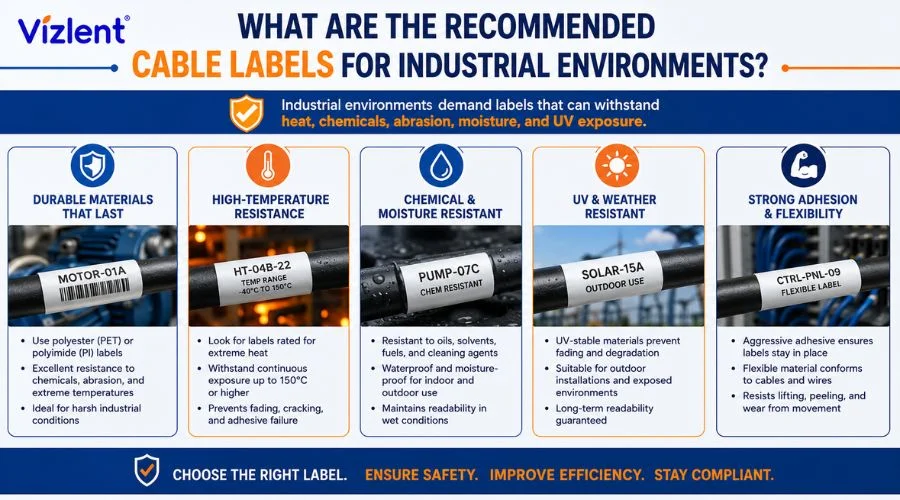
The best cable labels recommended for industrial environments are based on applications, safety, compliance and environmental and material conisderations. In most cases, a synthetic self-laminating or heat shrink label printed by thermal transfer with a resin ribbon. Polyester, vinyl, and polyolefin constructions survive the oil, heat, abrasion, and chemical exposure that destroy paper labels within weeks on a plant floor. The right choice among these formats depends on the cable type, the ambient conditions, and how often technicians handle the marked runs.
Specifying a cable label for industrial environments correctly protects traceability across the full service life of machinery wiring, control panels, and power distribution. Industrial cable marking failures cost real money, since an unreadable marker on a motor feed or sensor line turns routine maintenance into slow, risky conductor tracing. The recommendations below cover label formats, materials, printing equipment, compliance factors, and purchasing guidance drawn from how converters and plant maintenance teams actually specify these products. For questions on the raw label stock behind any construction, our engineering team reviews industrial specifications directly.
Why Industrial Settings Destroy Standard Labels
Plant floors combine heat, vibration, lubricants, solvents, UV exposure, and constant mechanical contact in a way no office or retail environment approaches. A standard paper label absorbs oil within days, and its exposed print scuffs away wherever cables rub against trays, conduit, or each other. Any cable label for industrial environments has to be specified against this full set of stresses rather than against clean-room assumptions.
Temperature swings add a second layer of attack, since adhesives that hold firmly at 20 degrees Celsius can creep and release near hot machinery or embrittle in cold storage zones. Washdown areas in food and beverage plants introduce high-pressure water and caustic cleaning agents that strip weak facestocks completely. Matching the label construction to the worst measured condition on the route, not the average condition, is the first rule of industrial cable marking.
- Oils, coolants, and solvents attack facestock and adhesive
- Heat near motors and drives softens weak adhesives
- Vibration and abrasion wear away exposed print
- Washdown chemicals strip non-rated label constructions
Recommended Cable Labels for Industrial Environments
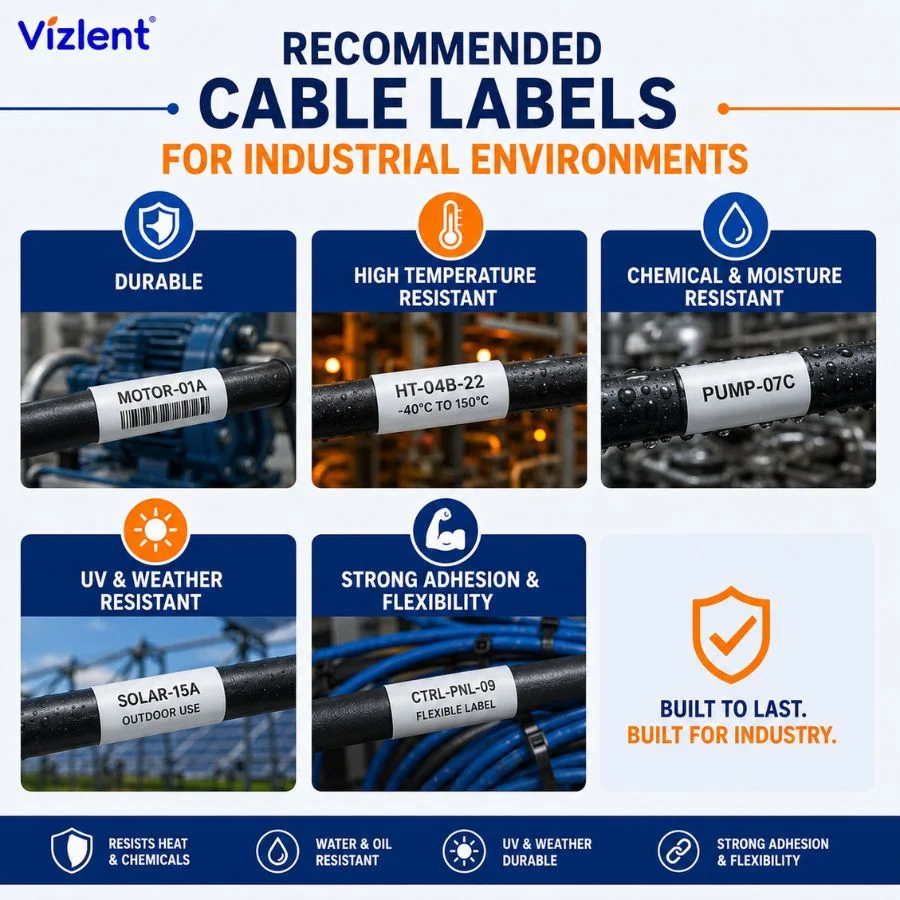
Three formats cover nearly all industrial cable marking needs: self-laminating wrap labels, heat shrink sleeves, and tie-on industrial cable tags. Self-laminating wraps seal their print under a clear tail and apply to connected cables, which makes them the default for retrofit and maintenance work. Heat shrink sleeves slide over a free cable end before termination and shrink into a permanent, rotation-proof marker that suits new builds and panel shops.
Tie-on industrial cable tags attach with cable ties rather than adhesive, which makes them the right cable label for industrial environments where jackets are too dirty, textured, or hot for adhesive bonding. An industrial cable marker in tag form also suits very large diameter power cables that exceed practical wrap label lengths. Most plants end up standardizing two formats, typically self-laminating wraps for data and control wiring plus tags or heat shrink for power distribution.
- Self-laminating wraps: retrofit-friendly, print sealed under clear laminate
- Heat shrink sleeves: permanent, applied before termination
- Tie-on tags: no adhesive needed, suits dirty or oversized cables
- Two formats: Standardize two formats per facility for simpler stocking
Material Selection: Polyester, Vinyl, and Polyolefin
Polyester facestocks deliver the best print sharpness and chemical resistance, which makes them the leading choice for control cabinets, machine wiring, and instrumentation. Vinyl flexes more readily around small diameters and conforms to irregular jacket surfaces, making it the better pick for tight bends and cramped junction boxes. Polyolefin is the standard heat shrink material, offering permanent, solvent-resistant identification once shrunk onto the conductor.
Adhesive chemistry decides how any industrial label performs after the first week, since initial tack means little if the bond creeps under heat. Permanent acrylic adhesives rated for the plant’s full temperature range hold through thermal cycling, and high-tack variants exist for low-surface-energy jackets like polyethylene. For fire-sensitive installations, UL 94 V-0 rated halogen-free facestocks add flame performance that standard constructions lack.
- Polyester: sharpest print, best chemical resistance
- Vinyl: highest flexibility for small and irregular cables
- Polyolefin: permanent heat shrink identification
- Halogen-free UL 94 V-0 stocks for fire-rated installations
Printing Equipment: Industrial Cable Label Printers
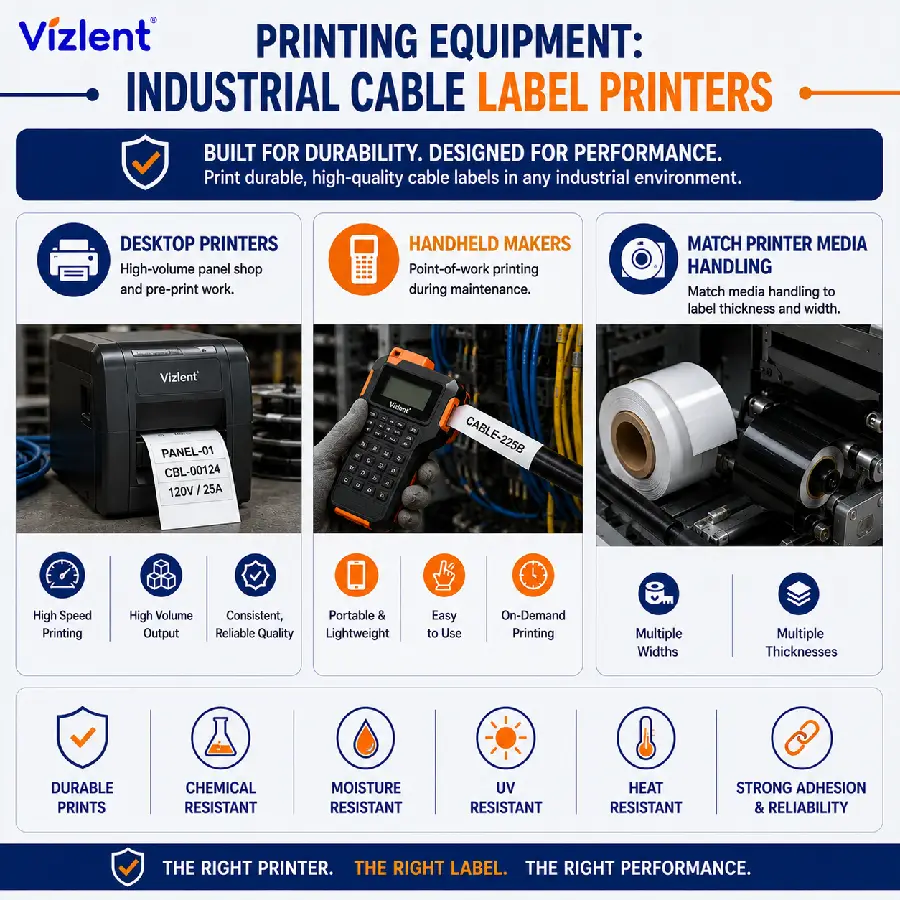
An industrial cable label printer needs to fuse durable print onto synthetic facestocks, which points to thermal transfer as the only method worth specifying for plant use. Pairing the printer with a resin ribbon produces print that resists the solvents and abrasion that erase direct thermal and inkjet output. Desktop thermal units serve panel shops and maintenance departments printing in volume, while a handheld industrial cable label maker lets technicians print at the point of work.
An industrial wire label printer for fine-gauge control wiring should handle narrow label formats and small text without losing barcode scannability. Teams comparing an industrial wire label maker against full-size printers should weigh print volume, since handhelds win on portability but lose on ribbon and label capacity. An industrial cable tag printer for tie-on formats typically needs thicker media handling, so confirming media thickness range before purchase avoids an expensive mismatch.
- Thermal transfer with resin ribbon: the industrial standard
- Desktop printers: high-volume panel shop and pre-print work
- Handheld makers: point-of-work printing during maintenance
- Match printer media handling to label thickness and width
Design and Legend Standards That Hold Up
Good industrial wire labels carry a legend that identifies source, destination, and circuit in a format every technician on site reads the same way. The ANSI/TIA-606 standard gives structured cabling a ready-made identifier scheme, and plants without a formal standard should still fix one legend format before printing the first label. Consistent legend design turns cable label for industrial environments design and manufacturing decisions into a repeatable specification rather than a per-project improvisation.
Text size matters more in industrial settings than in offices, since technicians read markers in poor light, at awkward angles, and sometimes through face shields. A minimum 3mm character height keeps legends readable at arm’s length, and high-contrast black print on white or yellow stock reads fastest. Barcodes and QR codes extend the legend into maintenance systems, letting a scan pull up circuit documentation that would never fit on the label itself.
- Fix one legend format facility-wide before printing anything
- Minimum 3mm character height for arm’s-length readability
- Black print on white or yellow stock for fastest reading
- Add barcodes or QR codes to link markers to documentation
Best Practices for Application and Placement

Cable label for industrial environments best practices start with surface preparation, because no adhesive bonds reliably to a jacket coated in oil or dust. Wiping the application zone with isopropyl alcohol takes seconds and prevents the majority of adhesion failures seen in plant audits. Labels should be applied with firm pressure and given 24 to 72 hours to build full bond strength before cables are pulled or rerouted.
Placement should be consistent across the entire facility, with markers positioned at both ends of every run and at intermediate points on long routes through trays and conduit. In a cable label for industrial environments assembly context, labeling during harness build rather than after installation produces straighter, more readable markers. Auditing marker condition during scheduled maintenance keeps the identification system alive instead of letting failures accumulate silently.
- Clean jackets with isopropyl alcohol before application
- Label both ends of every run plus intermediate points
- Apply during assembly where possible, not after installation
- Audit and replace worn markers during planned maintenance
Labeling on Assembly and Production Lines
Cable label for industrial environments assembly production workflows benefit from pre-printed marker batches sequenced to match the build order of each harness or panel. Printing in batch from a wire list eliminates the transcription errors that creep in when operators type legends one at a time at the bench. Heat shrink sleeves fit naturally into this workflow, sliding onto conductors during prep and shrinking in place during termination.
High-volume cable label for industrial environments and manufacturing operations should treat label stock as a controlled material with the same lot tracking applied to wire and terminals. Consistent stock from a single supplier keeps print settings stable across shifts, since facestock changes force recalibration of darkness and speed settings. Feeding verified, consistent media into the line is one of the simplest yields improvements available in harness production.
Compliance and Traceability Requirements
Regulated industries attach documentation requirements to cable identification, from NEC and IEC wiring rules to sector-specific standards in energy, marine, and rail. Fire performance ratings matter wherever cables route through plenums or enclosed public spaces, which is where halogen-free, low-smoke label constructions earn their specification. A cable label for industrial environments in these sectors is part of the compliance record, not just a maintenance convenience.
Traceability programs increasingly expect scannable identification, with barcoded markers linking each cable to test results, installation dates, and circuit documentation. Print permanence becomes a compliance issue in this context, since a faded barcode breaks the digital thread the program depends on. Resin-printed synthetic labels preserve scannability for the life of the installation, which is why auditors in regulated plants expect to see them.
- NEC and IEC wiring rules set baseline identification requirements
- Halogen-free, low-smoke constructions for plenums and public spaces
- Barcoded markers link cables to test and installation records
- Print permanence protects the digital traceability thread
Purchasing: Bulk Sourcing and Supplier Selection
Sourcing cable label for industrial environments bulk quantities directly from a materials manufacturer removes distributor markup and stabilizes the facestock quality that print settings depend on. Converters running a cable label for industrial environments business should qualify suppliers on adhesive consistency, liner release behavior, and caliper tolerance rather than on price alone. A single out-of-spec lot costs more in press downtime and reprints than years of per-roll savings.
Buyers evaluating cable label for industrial environments for sale listings should request datasheets covering temperature range, chemical resistance, and applicable ratings before ordering samples. Free sample rolls let a plant verify adhesion on its actual cable jackets and print quality on its actual printers, which no datasheet replaces. Matching the label stock to the correct thermal transfer ribbon grade completes the specification, since facestock and ribbon perform as a system.
- Qualify suppliers on tolerance and consistency, not price alone
- Request full datasheets before sampling
- Test samples on your own jackets and printers
- Specify facestock and ribbon together as one system
Specify the Right Label Stock for Your Industrial Program
Every durable industrial cable marker starts as raw material, and the facestock, adhesive, and liner chosen at that stage set the ceiling on field performance. Our factory supplies polyester, vinyl, and specialty label stock engineered for harsh-environment identification, delivered to converters and distributors at factory-direct prices. Contact our team for material recommendations matched to your cable marking application.
Free samples are available so your team can verify adhesion, wrap behavior, and print durability on your own cables and printers before placing a volume order. Pairing the stock with the correct resin ribbon grade completes a print system built to outlast the machinery it identifies. Send your inquiry today for a factory-direct quotation on industrial label stock in jumbo rolls, slit rolls, or sheeted formats.
Frequently Asked Questions
What is the recommended cable label for industrial environments?
The recommended cable label for industrial environments is a synthetic construction, typically self-laminating polyester or vinyl wraps, polyolefin heat shrink sleeves, or tie-on tags, printed by thermal transfer with a resin ribbon. These formats resist the oil, heat, abrasion, and chemicals that destroy paper labels on plant floors. The right format among the three depends on cable type, ambient conditions, and how the cables are handled.
Why do paper labels fail in industrial settings?
Paper labels fail because they absorb oils and moisture, tear under handling, and carry exposed print that abrasion wears away quickly. Adhesives on general-purpose paper labels also soften near hot machinery and release from dirty or textured jackets. Synthetic facestocks with permanent acrylic adhesives address every one of these failure points.
What printer should a maintenance team buy for cable labeling?
A thermal transfer printer paired with a resin ribbon is the correct choice for industrial cable labels, since it fuses print that survives solvents and friction. Desktop units suit high-volume pre-printing in panel shops, while handheld units support printing at the point of work during maintenance. Confirming the printer accepts the chosen label thickness and width prevents a costly equipment mismatch.
When should heat shrink markers be used instead of wrap labels?
Heat shrink markers suit new builds and panel shop work where cable ends are free before termination, producing a permanent marker that cannot rotate or peel. Wrap labels are the retrofit option, since they apply to connected cables without disconnection. Many facilities run both, using heat shrink on new construction and wraps for maintenance changes. Standardizing on both formats keeps stocking simple while covering every job type.
What text size keeps industrial cable markers readable?
A minimum character height of 3mm keeps legends readable at arm’s length in typical plant lighting conditions. High-contrast black print on white or yellow stock reads fastest, particularly in dim or awkward viewing positions. Adding a barcode or QR code extends the marker into maintenance software without crowding the printed legend.
Are there fire-rated options for cable labels?
UL 94 V-0 rated, halogen-free facestocks provide flame performance for electrical panels, wire harnesses, and installations with fire safety requirements. These constructions limit flame spread and avoid halogenated smoke emissions in enclosed or public-facing spaces. Regulated sectors such as rail, marine, and energy commonly specify them as standard. Confirming the rating on the supplier datasheet, rather than assuming it, keeps the installation audit-ready.
How many labels does a typical cable run need?
Every run needs a marker at both ends as a minimum, with intermediate markers added on long routes through trays, conduit, or wall penetrations. Consistent placement distance from connectors and terminations speeds up tracing across the whole facility. Standardizing placement rules matters as much as the label construction itself.
Should plants buy cable labels in bulk?
Bulk purchasing from a materials manufacturer stabilizes quality and cost, since consistent facestock keeps printer settings valid across every lot. Plants and converters should qualify suppliers on caliper tolerance, adhesive consistency, and liner behavior before committing to volume. Sample rolls tested on actual jackets and printers remain the only reliable pre-purchase verification. Once a stock qualifies, locking the specification protects print settings across every future lot.