
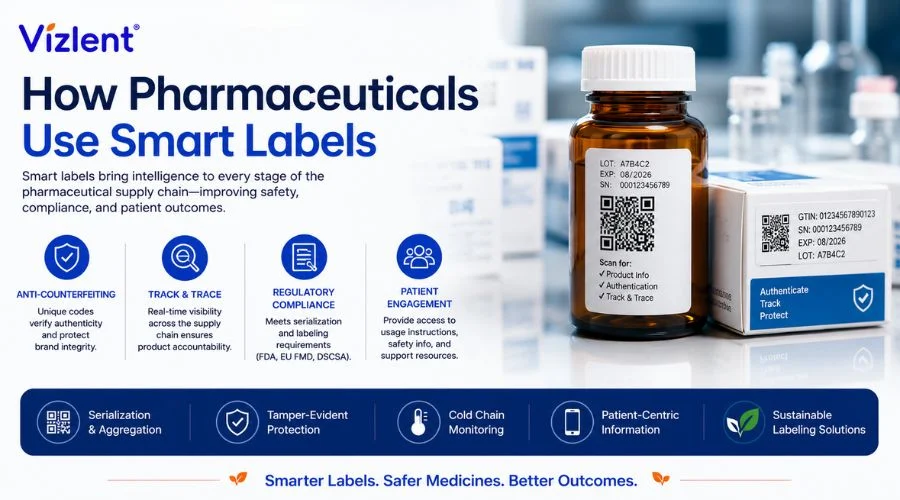
Pharmaceutical companies use smart labels to encode a unique digital identity on every unit of medicine, linking a physical pack to serialization databases, patient information, and supply-chain records through scannable codes. These labels combine a durable printed facestock with a 2D DataMatrix, QR code, or NFC element that a scanner reads to verify authenticity, track location, and confirm expiry. The result is safer dispensing, faster recalls, and compliance with regulations such as the US DSCSA and the EU Falsified Medicines Directive.
Understanding how pharmaceuticals use smart labels matters because the label is the point where regulatory data, patient safety, and material science meet. A code that fails to scan after sterilization or cold storage can trigger a recall or a medication error rather than a minor quality issue. Below, Vizlent’s engineering team explains the technology, the material demands, and how manufacturers deploy these labels across real pharmaceutical packaging.
What Smart Labels Are in Pharmaceutical Companies Context
A smart label carries machine-readable digital data alongside the printed information a person reads, turning an ordinary label into a data carrier. In pharmaceutical packaging, this usually means a serialized 2D DataMatrix or smart labels qr code that encodes a product code, serial number, lot, and expiry date. The physical construction still has to survive the same autoclave, cold-chain, and chemical exposures that any pharmaceutical label endures.
The difference between a conventional and a smart label lies in what the code connects to rather than how it looks. A traditional barcode identifies a product type, while a serialized smart code identifies one specific unit and ties it to a live database record. This unit-level identity is what enables authentication, track-and-trace, and targeted recalls across the supply chain.
Common smart label formats used in pharma include:
- 2D DataMatrix codes that meet ISO/IEC 15415 quality grades at symbol sizes of 5mm or smaller for unit-of-use packs
- QR code and smart labels qr code stickers that let patients or pharmacists scan for verification and product information
- NFC and RFID inlays on higher-value biologics where tap-to-verify or bulk scanning adds supply-chain visibility
Serialization, Track-and-Trace, and Regulatory Drivers
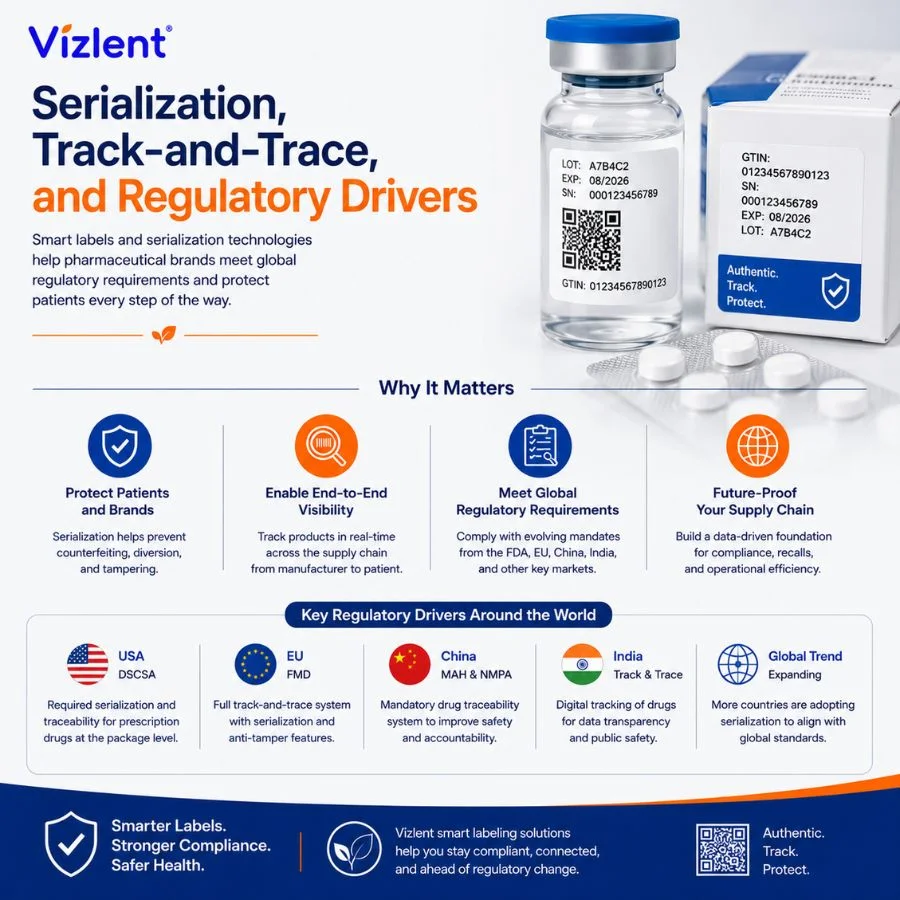
Serialization is the core reason pharmaceuticals use smart labels at scale, since regulators now require a unique identifier on each saleable unit. Under the US Drug Supply Chain Security Act and the EU Falsified Medicines Directive, every prescription pack must carry a 2D code encoding a product code, serial number, lot, and expiry. This is where pharmaceutical smart labels move from a convenience to a legal obligation.
Track-and-trace builds on serialization by recording each scan as a unit moves from manufacturer to wholesaler to pharmacy. This creates an auditable chain that makes counterfeit insertion far harder and allows a recall to target specific lots rather than entire product lines. A well-designed pharmaceutical smart labels and packaging program treats the code, the facestock, and the database integration as one validated system.
Key compliance functions these labels serve include:
- Unit-level authentication so a pharmacist can verify a pack against a legitimate serial-number database
- Aggregation and traceability that links individual packs to cases and pallets for supply-chain visibility
- Accurate smart expiry labels that encode expiration data for automated checks at dispensing and inventory points
Talk to a Vizlent engineer about serialization-ready label stock validated for your printing and scanning workflow.
Why Smart Label Materials Must Survive Harsh Conditions
A smart label is only as reliable as the material carrying it, because a code that degrades becomes unreadable and useless. Pharmaceutical labels routinely face steam autoclave temperatures of 121°C to 134°C, gamma irradiation, and cold storage down to −80°C or lower. If the facestock deforms or the print smears, the encoded data fails exactly when a scanner needs it most.
This is why material selection sits at the center of how pharmaceuticals use smart labels effectively across their product range. Synthetic facestocks such as polyester resist solvents and sterilization, while specialized adhesives hold bond strength through freeze-thaw cycling. Vizlent supplies low-temperature resistant labels for biopharmaceuticals engineered to keep codes scannable at cryogenic temperatures.
Material properties that protect code readability include:
- Sterilization compatibility so the facestock and print survive steam, EtO, or gamma without distortion
- Cryogenic adhesion that maintains bond strength on vials stored at −80°C to −196°C
- Chemical resistance against IPA wipe-downs and disinfectants that would smear an unprotected code
The stakes are higher than in most labeling applications because a single unreadable code can halt a shipment or force a batch rejection. A serialized pack that cannot be scanned at the wholesaler breaks the chain of custody the regulation requires, so the material has to guarantee readability for the full product lifecycle. This is why leading manufacturers validate every construction against the specific sterilization and storage profile it will meet rather than assuming a general-purpose stock will hold. Testing the actual facestock, adhesive, and code together on the real container is the only reliable way to confirm performance.
How Smart Labels Appear Across Pharmaceutical Packaging
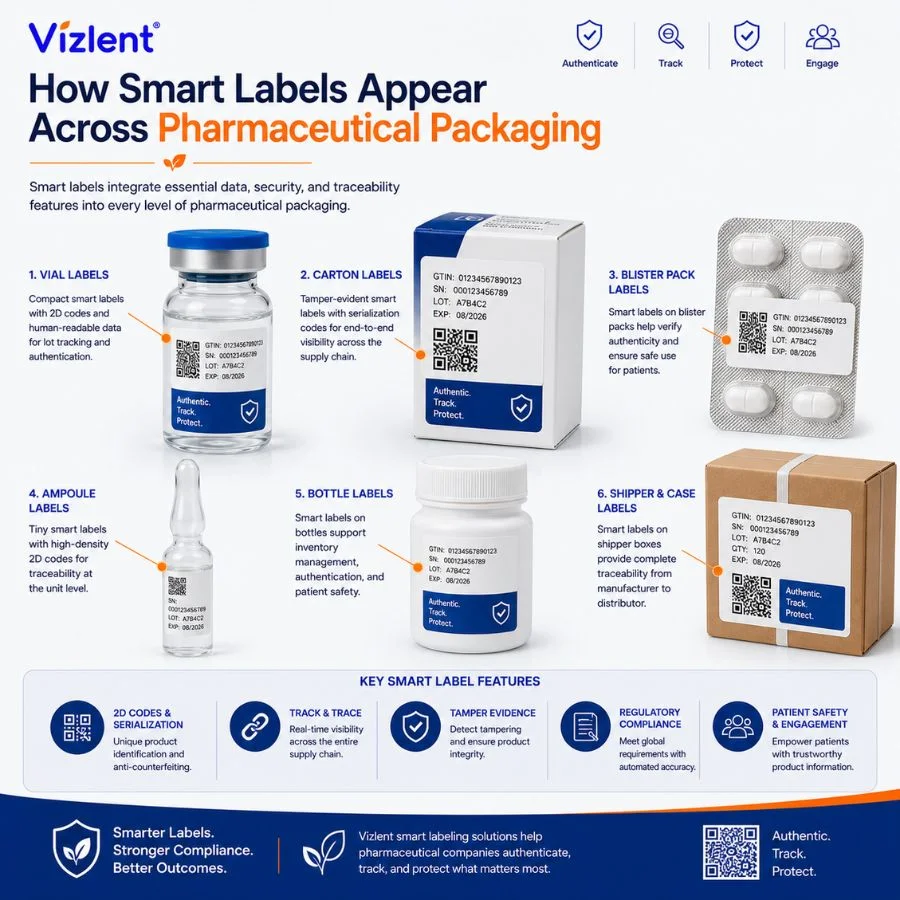
Smart labels are applied across every level of pharmaceutical packaging, from the primary container to the outer carton. On primary packs, pharmaceutical smart labels bottles carry serialized codes directly on the medicine container for dispensing accuracy. Each packaging level places different demands on adhesion, curvature, and code size.
Different container types call for purpose-built constructions rather than a single universal stock. A serialized code on a pharmaceutical smart labels box or carton supports aggregation, while syringe and vial labels demand small, high-contrast codes. Matching format to container is what keeps scan rates high across the line.
Typical smart-label applications by packaging level include:
- Pharmaceutical smart labels barcodes on syringes and vials, where small symbol size and high contrast are critical
- Medical device and UDI labels that carry unique device identifiers for track-and-trace under regulatory mandates
- Outer carton and case labels that aggregate unit-level codes for warehouse and distribution scanning
Getting the format right at each level protects scan rates once the product is in the field. A code sized for a flat carton will not perform on a curved 2mL vial, and a facestock chosen for a rigid bottle may lift on a flexible IV bag. Manufacturers that map every container surface, curvature, and exposure before specifying the label avoid the costly rework of a code that scans in the plant but fails downstream. This container-first approach is a hallmark of how experienced pharmaceutical packaging teams deploy serialized labels.
Printing, Automation, and Best Practices for Deployment
Deploying smart labels at production speed depends on aligning the facestock, print engine, and verification system as one workflow. Thermal transfer and inkjet printing must be matched to the facestock topcoat so DataMatrix codes hit compliant scan grades. Building pharmaceutical smart labels automation into the line means printing, applying, and verifying each code inline without slowing throughput.
Sound deployment also depends on validation and vendor discipline rather than optimizing any single variable alone. Following pharmaceutical smart labels best practices means testing the complete system on the actual label construction before locking a specification. A change to the facestock or ribbon, even from the same supplier, can shift code quality and should pass change control first.
Best practices for reliable smart-label deployment include:
- Validate the full print system (printer, ribbon or ink, and facestock) on the real construction, not a surrogate
- Verify code quality inline against ISO/IEC 15415 grades so unreadable codes are caught before shipment
- Control material changes through documented change control to protect serialization compliance
Request serialization-ready samples to validate print and scan performance on your own equipment before committing to volume.
Sourcing Smart Label Stock From a Specialized Manufacturer
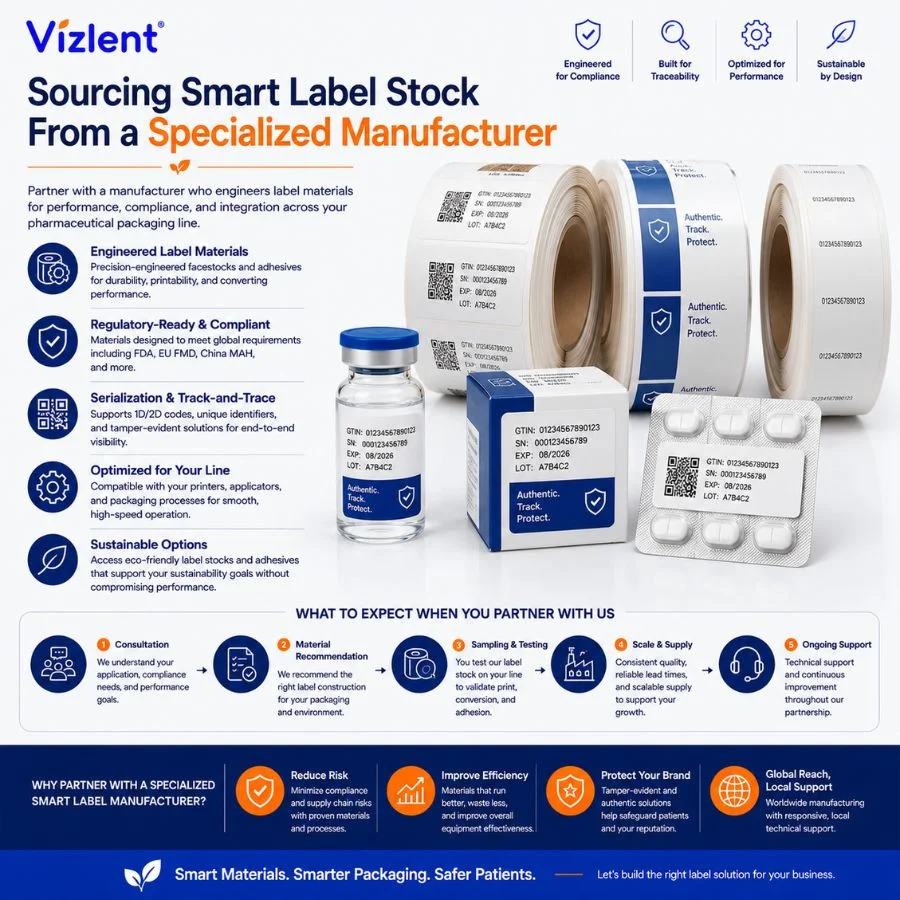
Choosing the right supplier is decisive, because pharmaceutical labels carry patient-safety and regulatory weight that generic stock cannot support. A dedicated pharmaceutical smart labels manufacturer controls facestock, adhesive, and topcoat as a system validated for sterilization and cold-chain use. Buying from a factory rather than a reseller keeps specification and certification under one roof.
Sourcing directly also gives procurement teams the flexibility and documentation that audits demand. A capable pharmaceutical smart labels company supplies free samples, test data, and format options from jumbo rolls to sheets. Whether you run a large fill-finish line or a growing pharmaceutical smart labels business, factory-direct supply improves both price and traceability.
What to look for in a smart-label supplier:
- Order flexibility from pharmaceutical smart labels bulk jumbo rolls down to pharmaceutical smart labels by the sheet for short digital runs
- Validated constructions with sterilization, cold-chain, and chemical-resistance test data on request
- Certification and traceability including ISO 9001, FSC, and SGS with advance notice of any material change
For teams sourcing pharmaceutical smart labels for packaging, Vizlent supplies validated, serialization-ready stock direct from its own coating lines.
Source Serialization-Ready Smart Label Stock From Vizlent
Understanding how pharmaceuticals use smart labels comes down to pairing a compliant serialized code with a material engineered to keep that code readable through every stress it will face. Vizlent’s in-house coating, formulation, and lab-testing capability lets pharmaceutical packaging teams source validated stock for sterilization, cold-chain, and serialization applications. Whether your priority is autoclave survival, cryogenic adhesion, or small-symbol DataMatrix quality, the right specification starts with your real application.
Vizlent supplies factory-direct, ISO 9001, FSC, and SGS-certified label stock to over 1,000 customers across 50+ countries, with free samples and roughly 15-day lead times on bulk orders. The engineering team reviews your container, sterilization, and printing requirements and recommends the optimal construction. Move from uncertainty to a verified, serialization-ready label built for your exact packaging line.
- Explore pharmaceutical and healthcare labels for serialization, cold-chain, and sterilization-grade constructions
- Send your specifications for a tailored recommendation and free sample
- Learn more about Vizlent and our 15 years of self-adhesive manufacturing expertise
Frequently Asked Questions
How do pharmaceuticals use smart labels?
Pharmaceuticals use smart labels to give every unit of medicine a unique digital identity through a serialized 2D DataMatrix, QR code, or NFC element. This links each pack to serialization databases for authentication, track-and-trace, and expiry verification across the supply chain. The labels support compliance with the US DSCSA and EU Falsified Medicines Directive. They also enable targeted recalls and safer dispensing at the pharmacy level.
What is the difference between a smart label and a regular pharmaceutical label?
A regular label identifies a product type, while a smart label carries a serialized code that identifies one specific unit and ties it to a live database. This unit-level identity enables authentication, aggregation, and traceability that a standard barcode cannot provide. Smart labels still require durable facestocks and adhesives to survive sterilization and cold storage. The added value lies in the digital record the code connects to.
What regulations require pharmaceutical smart labels?
The US Drug Supply Chain Security Act and the EU Falsified Medicines Directive both require a unique 2D code on each saleable prescription unit. These mandates specify serialization data including product code, serial number, lot, and expiry date. The code must meet ISO/IEC 15415 scan-grade quality at small symbol sizes. Compliance depends on both the encoded data and the physical label quality.
Can smart labels survive sterilization and cold storage?
Yes, when built from the right materials, smart labels remain readable through autoclave, gamma irradiation, and cryogenic storage. Synthetic facestocks such as polyester resist solvents and heat, while specialized adhesives hold bond strength at temperatures down to −196°C. The print process must also be matched to the facestock so codes do not smear or fade. Validation on the actual construction is essential before deployment.
What printing methods produce pharmaceutical smart labels?
Thermal transfer and inkjet printing are the most common methods for producing serialized DataMatrix and QR codes on pharmaceutical labels. The facestock surface, ribbon or ink chemistry, and print resolution must be matched to achieve compliant scan grades. Inline verification checks each code against ISO/IEC 15415 quality thresholds. The full print system should be validated together rather than optimizing any single element.
How small can a pharmaceutical DataMatrix code be?
On unit-of-use packaging, DataMatrix symbols are often constrained to 5mm to 8mm square or smaller. Achieving a readable code at that size depends on facestock surface finish, print resolution, and ink or ribbon quality working together. Semi-gloss and gloss facestocks generally support higher-contrast small codes than matte surfaces. Each combination should be validated before production.
Where can I source pharmaceutical smart label materials?
You can source validated smart label stock directly from a specialized manufacturer such as Vizlent, which controls facestock, adhesive, and topcoat as one system. Factory-direct sourcing provides certification, test data, and format flexibility from jumbo rolls to sheets. Free samples let you validate print and scan performance before committing to volume. Buying direct also keeps serialization compliance and traceability under one roof.
Do smart labels help with pharmaceutical recalls?
Yes, serialized smart labels allow recalls to target specific lots or units rather than entire product lines. Because each pack is tied to a database record, manufacturers can trace exactly where affected units entered the supply chain. This precision reduces waste, cost, and patient risk during a recall event. It is one of the clearest safety benefits of unit-level serialization.






