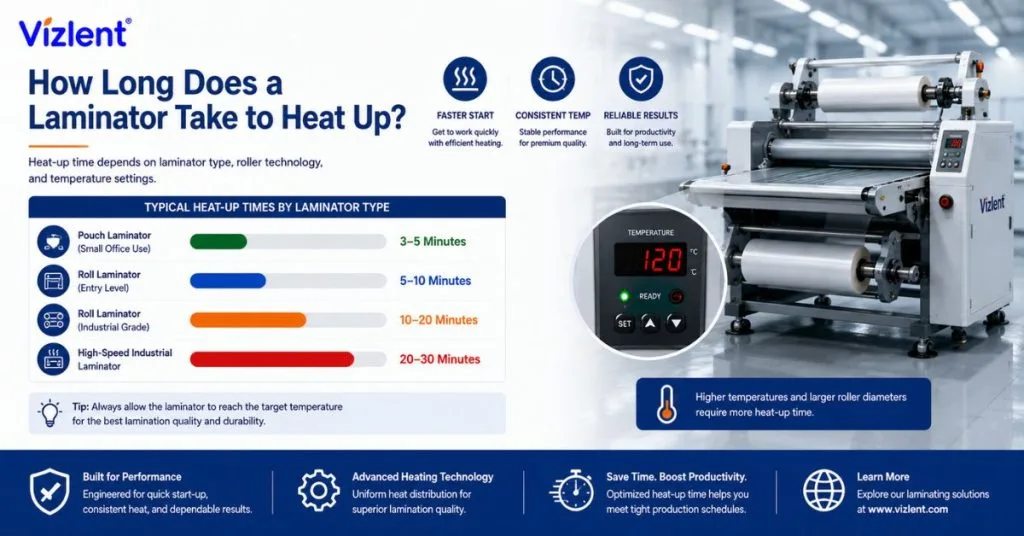
Most laminators take 1 to 5 minutes to heat up, with consumer pouch units ready in 30 seconds to 3 minutes and industrial wide-format machines requiring up to 20 minutes. The exact time depends on roller mass, target temperature, ambient room conditions, and whether the unit uses direct-contact heating or convection. Cold laminators eliminate the wait entirely by bonding film through pressure-sensitive adhesive instead of heat.
How Long Does a Laminator Take to Heat Up?
How long does a laminator take to heat up depends on the model class, with consumer pouch units ranging from 30 seconds to 5 minutes and professional roll laminators ranging from 5 to 20 minutes. A typical desktop laminator machine designed for offices reaches operating temperature within 1 to 3 minutes for thin pouches and 3 to 5 minutes for thicker carrier loads. Industrial roll and wide-format units that handle high-volume work need 10 to 20 minutes to fully heat the steel rollers.
The warm-up window matters because it determines whether you can run a quick lamination during a break or must schedule jobs around equipment readiness. Faster heat-up models often use heated shoes or direct-contact heating elements, while slower industrial models rely on heavy steel rollers that store thermal mass for consistent temperature across long runs. Vizlent supplies the thermal lamination film and cold lamination film materials that work across both categories.
What Affects Laminator Heat-Up Time?

Multiple factors influence how quickly a unit reaches operating temperature, including roller mass, target temperature, ambient conditions, and heating element type. Heavier steel rollers used in industrial machines store more thermal energy, which translates to longer warm-up but more stable temperature once running. Higher target temperatures (often 250 to 350°F for thick pouches and films) naturally take longer to reach than lower targets (180 to 220°F for thin office sheets).
Ambient room temperature also plays a measurable role, since a cold office in winter can add 30 to 90 seconds to warm-up compared to a heated workspace. The heating method matters too, with direct-contact ceramic heaters reaching temperature faster than convection or infrared systems. Operators preparing for a long production run should plan warm-up time into their daily schedule rather than treating it as an inconvenience.
Heat-Up Times by Laminator Machine Type
Different laminator machine categories serve different volumes and budget tiers, which directly affects warm-up speed expectations. Consumer pouch laminators sit at the fastest end of the spectrum because their light internal rollers and small heated zones reach temperature quickly. Professional and industrial laminators take longer to warm up but compensate with sustained heat consistency, faster running speeds, and broader material compatibility.
The question of how long does a laminator take to heat up has a different answer for each tier, which buyers should understand before purchase. Heat-up time is one of the four core specs alongside max thickness, throughput speed, and material width. Typical warm-up windows by category are as follows:
- Consumer pouch laminators: 30 seconds to 2 minutes
- Office desktop pouch laminators: 1 to 3 minutes
- Professional pouch laminators: 3 to 5 minutes
- Roll laminators (entry-level): 5 to 10 minutes
- Wide-format roll laminators: 8 to 15 minutes
- Industrial production laminators: 10 to 20 minutes
Need bulk lamination film for a production laminator? Request a free sample pack from Vizlent.
Cold vs Thermal Laminators: Heat-Up Differences
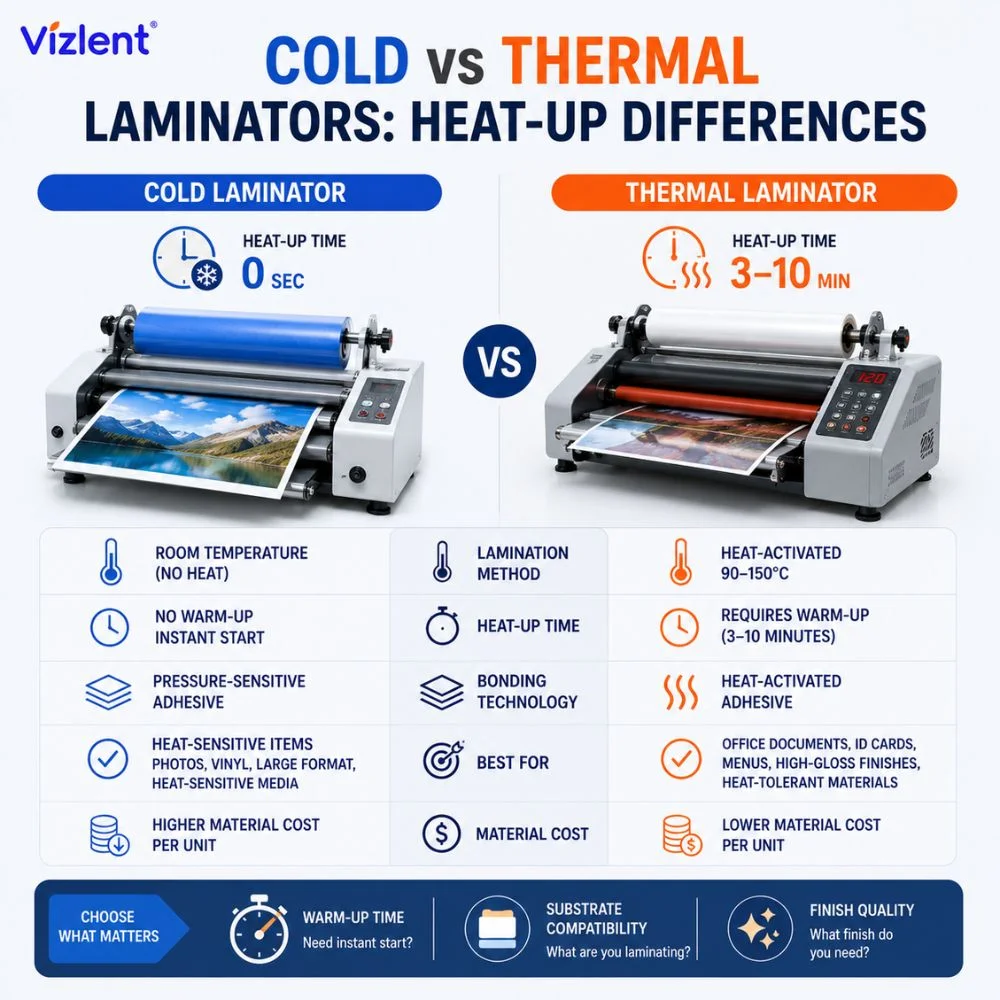
The most direct way to eliminate heat-up time is to use a cold laminator, which requires no warm-up because the process relies on pressure-sensitive adhesive instead of heat. Thermal laminators bond film through heat-activated adhesive applied at 90 to 150°C, while cold laminators bond at room temperature using mechanical pressure alone. The trade-off comes down to substrate range, finish options, and per-unit material cost.
Thermal lamination is the default for office documents, ID cards, menus, and high-gloss finishes where the underlying material can tolerate heat. Cold lamination wins for heat-sensitive photo prints, vinyl decals, large-format graphics, and any project where heat damage is a concern. Buyers weighing equipment choices should think about which factor matters more for their typical job mix: warm-up time, substrate compatibility, or finish quality.
Laminator Sheets and Pouches: Impact on Warm-Up
Laminator sheets and pouches come in different thicknesses measured in mils, with common ranges from 1.5 mil for light document protection up to 10 mil for heavy-duty IDs and menus. Thicker pouches require higher temperatures and longer dwell time, which extends the effective warm-up period before the first job. Thinner pouches reach usable temperatures faster, which is why office workflows often default to 3 to 5 mil for routine document work.
Material composition also matters because polyester (PET) face stocks tolerate higher temperatures than polypropylene (BOPP), allowing for a sharper finish without melting. Premium laminator sheets include adhesive layers engineered for fast wet-out, which helps maintain throughput on borderline temperature settings. Selecting the right thickness reduces warm-up time and the risk of clouding, bubbling, or curling during finishing.
Laminator Cost: From Budget to Industrial Tiers
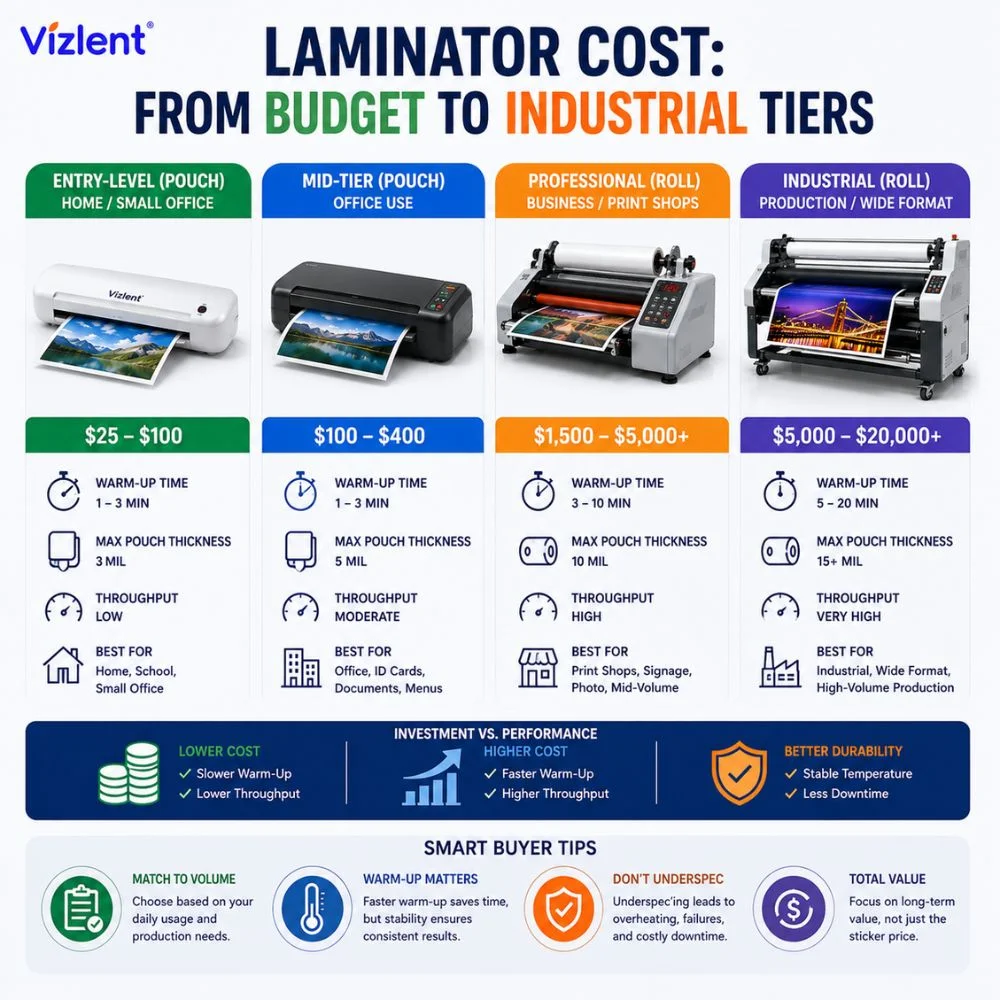
Laminator cost varies widely based on warm-up speed, throughput capacity, roll vs pouch design, and feature set. Entry-level pouch units suitable for home or small office use sit between $25 and $100, with warm-up times in the 1 to 3 minute range. Mid-tier office laminators that handle up to 5 mil pouches run from $100 to $400, while professional roll laminators start around $1,500 and climb past $20,000 for industrial wide-format systems.
Higher-cost equipment generally trades warm-up speed for production durability and consistent temperature across long runs. A $300 office unit may warm up in 90 seconds, but cannot match the day-long thermal stability of a $5,000 production laminator. Buyers should match the laminator cost to the expected volume rather than chasing the lowest sticker price, since underspeccing a unit leads to overheating, premature failure, and downtime.
Laminator Brands and Heat-Up Benchmarks
Several laminator brands dominate the consumer and professional markets, each with characteristic warm-up profiles and reliability records. Consumer names include Fellowes, Scotch, GBC, Royal Sovereign, AmazonBasics, Crenova, Swingline, and Texet. Professional and industrial buyers commonly source from Ledco, USI, Banner American, Drytac, and Royal Sovereign Pro across roll-fed and wide-format categories.
Heat-up performance varies meaningfully across laminator brands even within similar price tiers, which is why buyer reviews and technical spec sheets matter at purchase. Industrial Vizlent customers pair these machines with thermal lamination film supplied in custom widths for converting lines. Procurement teams sourcing for high-volume production should request warm-up benchmarks alongside roller speed and maximum thickness specifications.
Laminator Different Sizes: From A6 to Wide-Format
Laminator different sizes serve distinct workflows, from small A6 ID badges to oversized engineering drawings and trade show graphics. Pouch laminator sizes are usually defined by the maximum sheet width they can process, which corresponds to common paper formats. Roll laminators are categorized by maximum web width and accommodate larger formats that pouch machines cannot handle.
Larger sizes typically come with longer warm-up windows because more roller surface needs to reach operating temperature. Buyers should match the machine size to their largest expected job rather than buying the widest unit available. The size categories commonly available include:
- A6 / 4 inch: Pocket ID cards and photo wallet prints
- A5 / 6 inch: Small documents and recipe cards
- A4 / 9 to 13 inch: Standard office documents and certificates
- A3 / 12 to 18 inch: Large posters, menus, and training charts
- A2 / 19 to 25 inch: Architectural drawings and wide-format prints
- A1 / 27 inch and above: Engineering plans, retail signage, and exhibition panels
Laminator Carrier Sheet and Laminator Carrier Sleeve
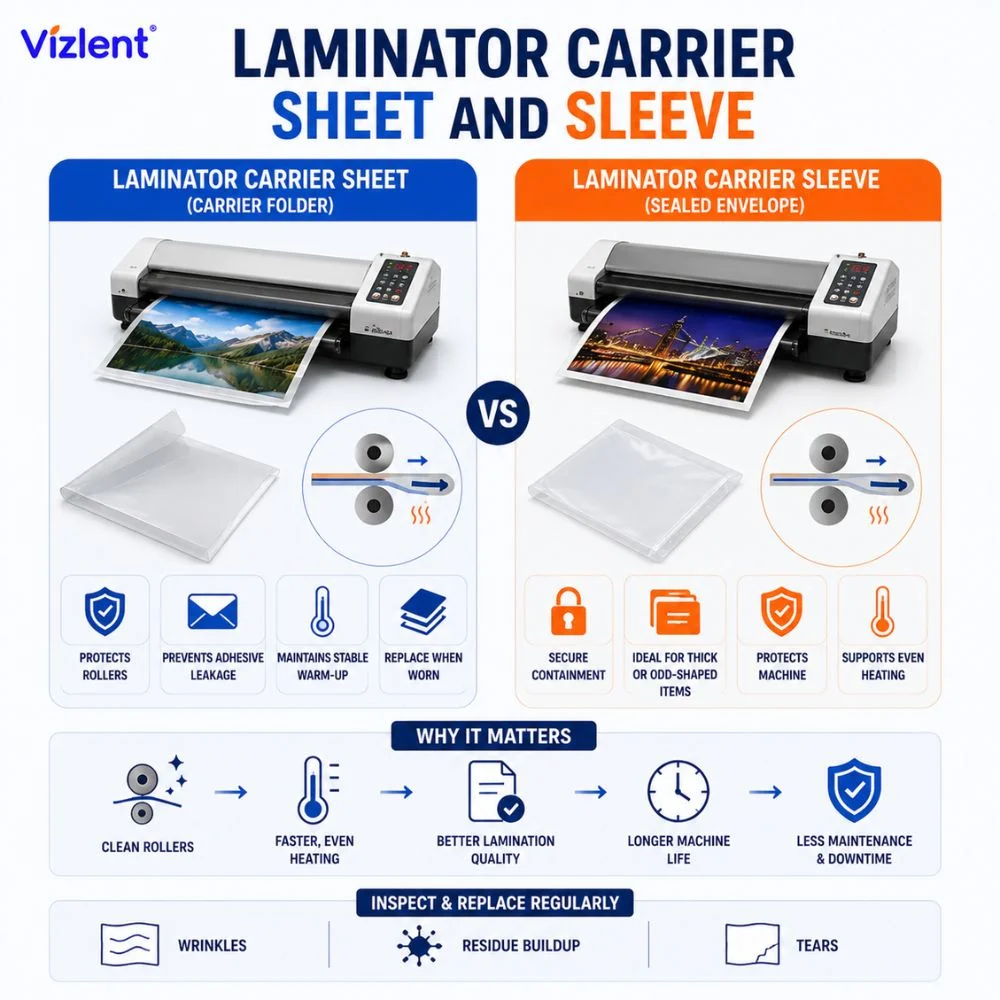
A laminator carrier sheet (sometimes called a carrier folder) is a thin, foldable protective envelope used to guide pouches through the rollers without leaving adhesive residue. It prevents melted adhesive from escaping the pouch edges and contaminating the rollers, which would otherwise damage the heated surface over time. Most office laminators ship with one or two carrier sheets, though replacements are widely sold by laminator brands and supply distributors.
A laminator carrier sleeve serves a similar function but uses a sealed envelope design rather than a folded sheet, providing more secure containment for thicker or non-standard items. Both accessories extend the working life of the machine and help maintain stable warm-up performance because clean rollers reach the target temperature more evenly. Operators should inspect carrier sheets and sleeves regularly and replace them when they show wrinkles, residue buildup, or tearing.
Laminator Cleaning Sheets for Reliable Heat-Up
Laminator cleaning sheets are specialized sacrificial sheets that pass through the heated rollers to remove adhesive residue, dust, and toner deposits. Regular cleaning is essential because adhesive buildup creates uneven contact between rollers and pouches, which slows heat transfer and extends apparent warm-up time. Cleaning sheets should be run once every 20 to 50 pouches in a typical office workflow, or daily in high-volume production environments.
The process is simple: warm the laminator to its standard operating temperature, then feed the cleaning sheet through twice with no carrier. Operators who skip this routine often find that warm-up takes longer over time because dirty rollers struggle to maintain even heat distribution. A pack of 10 laminator cleaning sheets typically costs $10 to $20 and pays back quickly through improved throughput and extended machine life.
Laminator Cutter and Post-Lamination Finishing
A laminator cutter is a guillotine or rotary trimmer used to remove excess film border around laminated pouches and sheets, creating clean professional edges. Most office laminator workstations include an integrated cutter or pair the machine with a standalone trimmer rated for 3 to 10 mil thickness. The cutter should be sharp enough to slice through both film layers cleanly without dragging or fraying the edge.
Corner rounders are a related finishing tool that removes the sharp 90-degree corners left after trimming, which prevents the film from catching, peeling, or causing minor cuts. Both accessories are practical investments for shops producing IDs, menus, certificates, or decorative laminated pieces where the appearance of the final piece matters. A basic laminator cutter starts at $20; professional-grade trimmers with self-sharpening blades run $80 to $250.
Sourcing film and finishing supplies for a high-volume operation? Contact the Vizlent team for factory-direct pricing.
Using a Laminator for Stickers
A laminator for stickers is a common tool for craft sellers, small print businesses, and DIY designers who want to give their decals scratch and water resistance. The process works by placing printed sticker sheets between thin laminating pouches and running them through a standard office machine, then die-cutting individual stickers from the laminated sheet. Both cold and thermal laminators can produce sticker work, with thermal being the more common choice for paper-based designs.
Cold lamination wins for vinyl sticker work because vinyl tolerates pressure better than heat, while thermal lamination delivers a high-gloss finish on paper. Operators using a laminator for stickers should select pouches matched to the substrate and avoid running adhesive-backed materials through hot rollers without a carrier sheet. Cold lamination film from Vizlent provides a heat-free alternative that works well for vinyl and photo paper sticker production.
Laminator DIY Setups for Small Shops
Laminator DIY setups are popular among hobbyists, craft sellers, and small print shops working with a tight budget. A simple laminator DIY workflow can include a basic pouch unit, a manual paper cutter, a corner rounder, and a stockpile of standard A4 and A5 pouches. Some makers build their own carrier sheets from extra pouch material to extend equipment life without buying replacements.
Laminator DIY users often experiment with mixed media projects like custom photo cards, gift tags, bookmarks, and laminated planner pages. The setup remains affordable because pouch units start under $50 and standard pouches cost less than 30 cents per A4 sheet. The trade-off is volume, since DIY workflows handle dozens of pieces per session, not hundreds.
Laminator Duties and Responsibilities: The Operator Role
Laminator duties and responsibilities in a professional print finishing role cover machine operation, quality control, maintenance, and safety compliance. Operators set up the laminator, load film rolls or pouches, monitor heat-up status, run production, and check finished output for bubbles, wrinkles, or curling. They also coordinate with print production teams so the laminator is warmed up and ready when batches arrive.
Beyond active production, laminator duties and responsibilities include daily cleaning with laminator cleaning sheets, weekly inspection of rollers and belts, and quarterly preventive maintenance. Operators must follow PPE protocols around heated components and report unusual smells, smoke, or jamming behavior immediately. Strong record-keeping on material consumption, downtime, and output quality helps the broader production team plan jobs realistically.
Finding a Laminator Near Me: Sourcing Options
A search for a laminator near me typically reflects three different goals: buying a unit, finding a service location, or sourcing materials and accessories. Office supply chains like Staples, Office Depot, Best Buy, and Walmart carry consumer laminators in-store, while online retailers like Amazon offer the widest selection with home delivery. Small office and copy shops in most cities also offer pay-per-page laminating service for one-off jobs.
For converters and high-volume producers, the laminator near me question shifts from “where can I borrow one” to “where can I source film and accessories at scale.” Vizlent serves this audience directly with laminating film shipped to 50+ countries from Shenzhen. Buyers needing bulk materials can contact the Vizlent team for samples and quotations.
Source Lamination Film and Supplies from Vizlent
Vizlent has manufactured pressure-sensitive label stock and laminating films since 2011 from a 10,000 sqm Shenzhen facility holding ISO 9001, FSC, and SGS certifications. In-house coating, slitting, and rewinding capabilities support standard orders and custom OEM/ODM specifications across 50+ countries. Free samples, technical support, and 7 to 15-day lead times apply across the full portfolio.
Procurement teams ready to evaluate film for high-throughput laminators can request a sample pack through the Vizlent inquiry channel. The engineering team reviews substrate compatibility, adhesive formulation, and finish selection within 24 hours. Reach out today for a factory-direct quote tailored to your application.
Ready to source factory-direct lamination film for your operation? Contact Vizlent for a free sample pack and technical compatibility review.
Frequently Asked Questions
How long does a laminator take to heat up on average?
How long does a laminator take to heat up on average ranges from 1 to 5 minutes for office units, 5 to 10 minutes for entry-level roll laminators, and 10 to 20 minutes for industrial production machines. Cold laminators require no warm-up at all because they bond film through pressure-sensitive adhesive rather than heat. The exact time depends on the model, target temperature, and ambient conditions.
Why is my laminator taking longer than usual to heat up?
Slower warm-up usually points to adhesive buildup on the rollers, a failing heating element, low ambient room temperature, or a misaligned thermostat sensor. Running laminator cleaning sheets through the machine is the first troubleshooting step. Persistent issues warrant a service call.
Can I use any pouch with any laminator machine?
No, pouches must match the rated thickness and width capacity of your laminator machine. Forcing thicker pouches than the machine supports causes jams, overheating, and damaged rollers. Always check the pouch mil rating and your machine maximum spec before loading.
What is the fastest type of laminator to warm up?
Cold laminators are the fastest because they require no warm-up at all, but among thermal models, light-duty consumer pouch units reach operating temperature in 30 seconds to 1 minute. Professional roll units typically need 5 to 15 minutes.
How often should I run laminator cleaning sheets?
Run laminator cleaning sheets every 20 to 50 pouches in a typical office workflow, or daily in high-volume production environments. Regular cleaning maintains consistent heat-up time and extends roller life.