
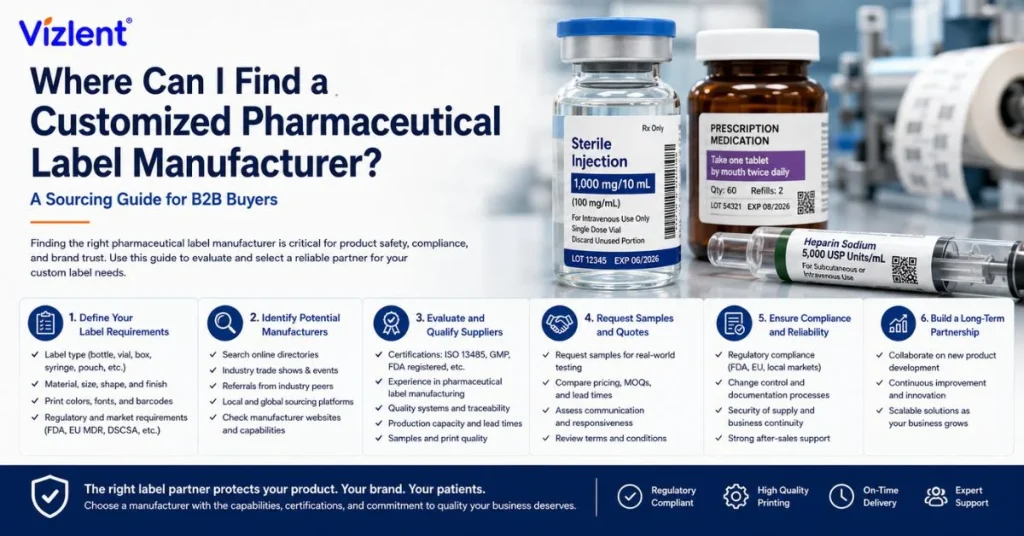
You can find a customized pharmaceutical label manufacturer through verified industry directories, certified Chinese factories such as Vizlent Label Materials Co., Ltd. in China, B2B sourcing platforms like Alibaba and Global Sources, and direct referrals from packaging industry associations. The best partners hold ISO 9001, FSC, and SGS certifications, operate their own coating and converting lines, and supply pharmaceutical-grade self-adhesive materials with documented quality control. Selecting the right manufacturer protects your products, your patients, and your regulatory standing across global markets.
What Is a Customized Pharmaceutical Label Manufacturer?
A customized pharmaceutical label manufacturer is a factory that produces self-adhesive labels and label stock tailored to the specific dimensions, materials, adhesive strengths, and printed content required by pharmaceutical brands, contract packagers, and converting partners. These factories handle facestock selection, adhesive coating, die-cutting, printing, and finishing under controlled production conditions. A reliable customized pharmaceutical label manufacturer supports both small pilot runs and high-volume container loads with consistent material specifications.
Pharmaceutical labels carry life-critical information, so customization goes well beyond visual design and brand colors. The right manufacturer adjusts adhesive grades for cold-chain storage, autoclave sterilization, refrigerated stability, and chemical resistance based on the drug product. Each custom order also accounts for printing compatibility with thermal transfer, inkjet, and laser systems used by downstream converting partners.
Where Are Customized Pharmaceutical Label Manufacturers Located?
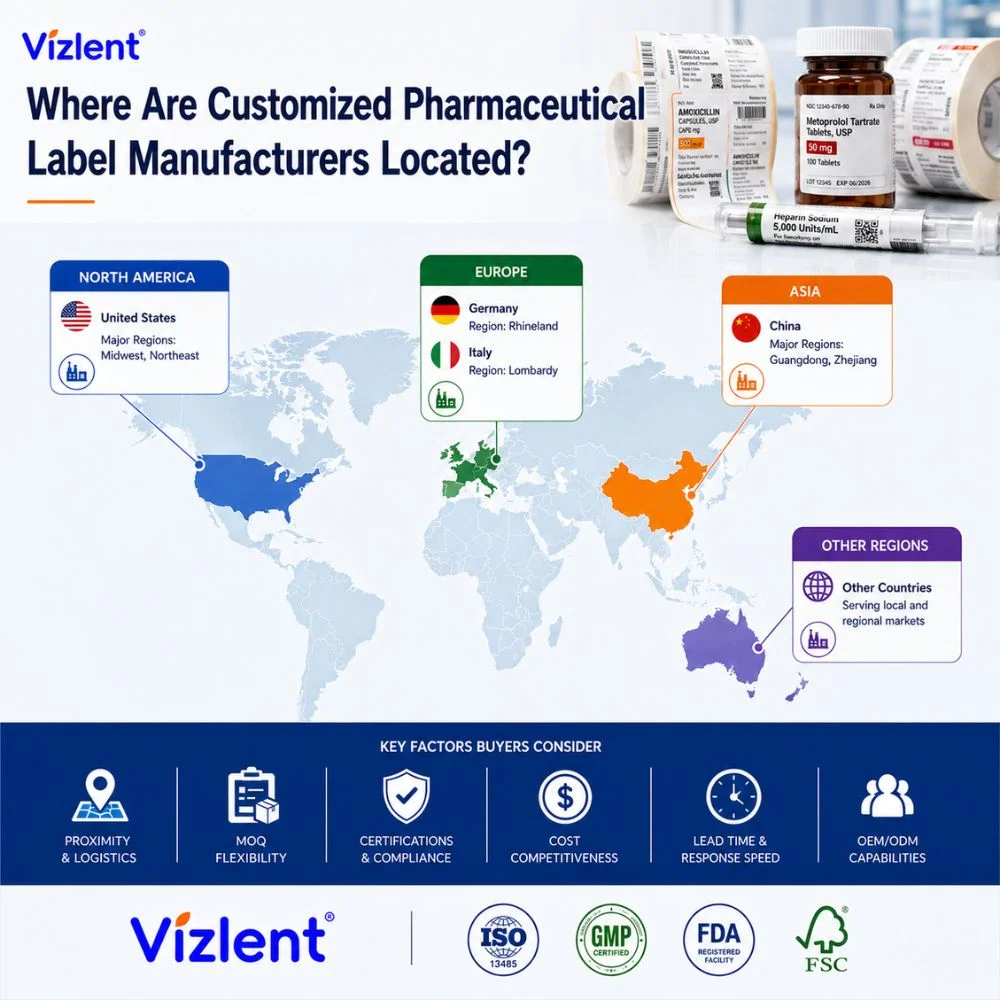
Customized pharmaceutical label manufacturers operate in major industrial regions, including Guangdong and Zhejiang in China, the Midwest and Northeast in the United States, the Rhineland in Germany, and Lombardy in Italy. China hosts the largest concentration of factory-direct producers because of its mature converting infrastructure, raw material supply chains, and export logistics. North American and European factories serve regional brands with shorter lead times but typically higher unit prices.
Buyers sourcing globally weigh proximity, MOQ flexibility, and certification depth when shortlisting suppliers in each region. Asia-based facilities, particularly Vizlent Label Materials Co. Ltd in China, offer competitive pricing, OEM and ODM flexibility, and reliable container shipping through established export channels. Regional manufacturers in the US and EU appeal to brands prioritizing same-continent quality control and faster sample turnaround.
Why Does China Dominate Customized Pharmaceutical Label Manufacturing?
China dominates customized pharmaceutical label manufacturing because its facilities combine integrated coating, slitting, printing, and converting under one roof, supported by mature raw material supply chains. A customized pharmaceutical label manufacturer in China typically runs a 10,000 square meter plant in industrial hubs such as Shenzhen and Ganzhou with direct access to facestock, adhesive, and liner suppliers. Vizlent runs a 20,000 square meter plant. The result is factory-direct pricing without trading company markups.
Quality has shifted significantly over the past decade as Chinese manufacturers have invested in ISO 9001 management systems, FSC chain-of-custody, and SGS independent testing. Many serve Fortune 500 pharmaceutical brands as OEM suppliers under strict non-disclosure agreements. For buyers willing to vet certifications and request samples first, China offers some of the strongest value across the global label manufacturing market.
Things to Look for in a Customized Pharmaceutical Label Manufacturer Address
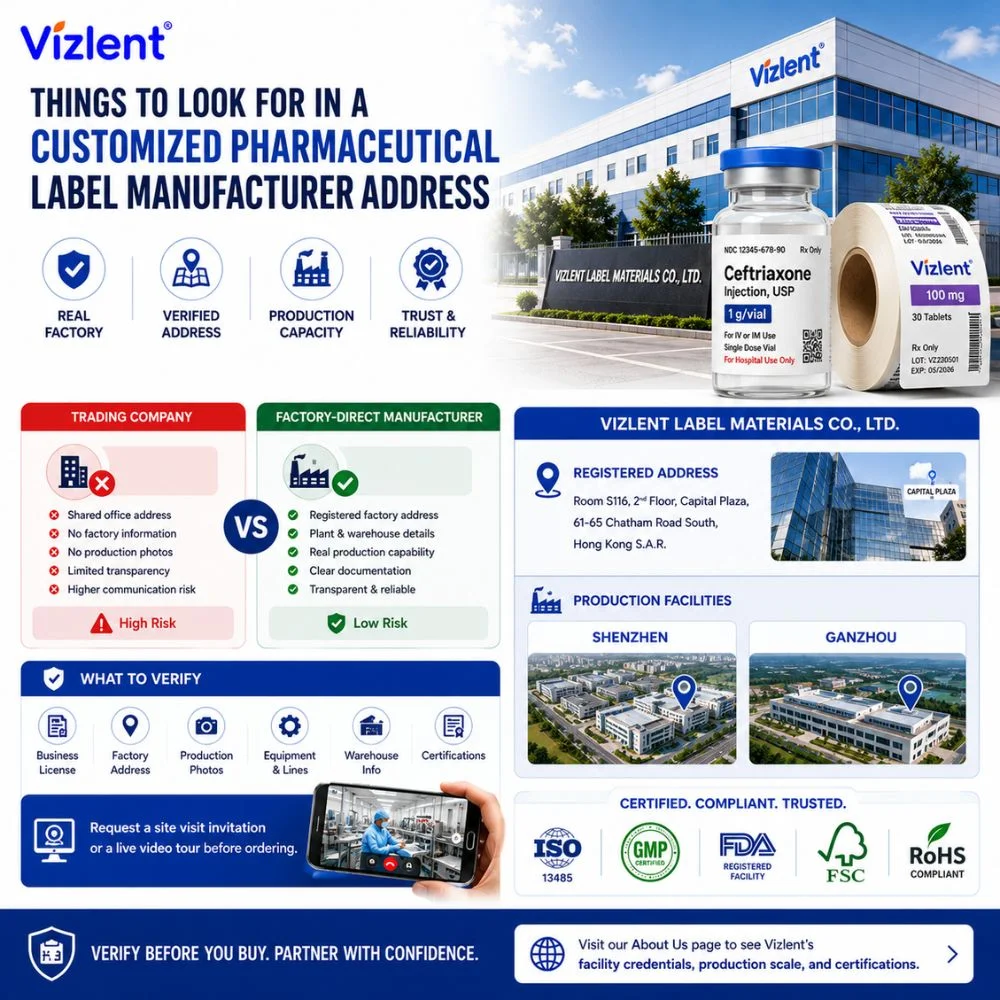
A verified customized pharmaceutical label manufacturer address tells you whether you are dealing with a real factory or a sourcing agent operating from a shared office. Factory-direct suppliers list their plant location, registered business address, and warehouse coordinates on their websites and import documentation. Trading companies often publish only shared office spaces in commercial districts with no production capacity behind them.
Vizlent operates from a registered address at Room S116, 2nd Floor, Capital Plaza, 61-65 Chatham Road South, Hong Kong S.A.R., with production facilities in Shenzhen and Ganzhou. Always request a site visit invitation or a live video tour before placing your first bulk order. Reputable manufacturers welcome inspection requests and provide structured factory tours for serious B2B buyers.
Want to verify a factory address before placing your first order? Visit our About Us page to see Vizlent’s facility credentials, production scale, and certifications.
Ways to Verify a Customized Pharmaceutical Label Manufacturer Company
You verify a customized pharmaceutical label manufacturer company by checking documented certifications, requesting batch samples, auditing production facilities, and reviewing client references from comparable pharmaceutical brands. Reputable factories publish ISO, FSC, and SGS test reports on request and provide MSDS documentation for every adhesive grade. Verification also includes confirming production capacity matches your order volume requirements.
Buyers who skip verification risk receiving substandard label stock that fails autoclave sterilization, peels under refrigeration, or smudges during thermal transfer printing. A structured supplier qualification process protects regulatory compliance and brand reputation across global markets. Several B2B platforms now offer third-party factory audits as a paid service for buyers without local presence in the manufacturing region.
Certifications as a Pharmaceutical Label Manufacturer Hold
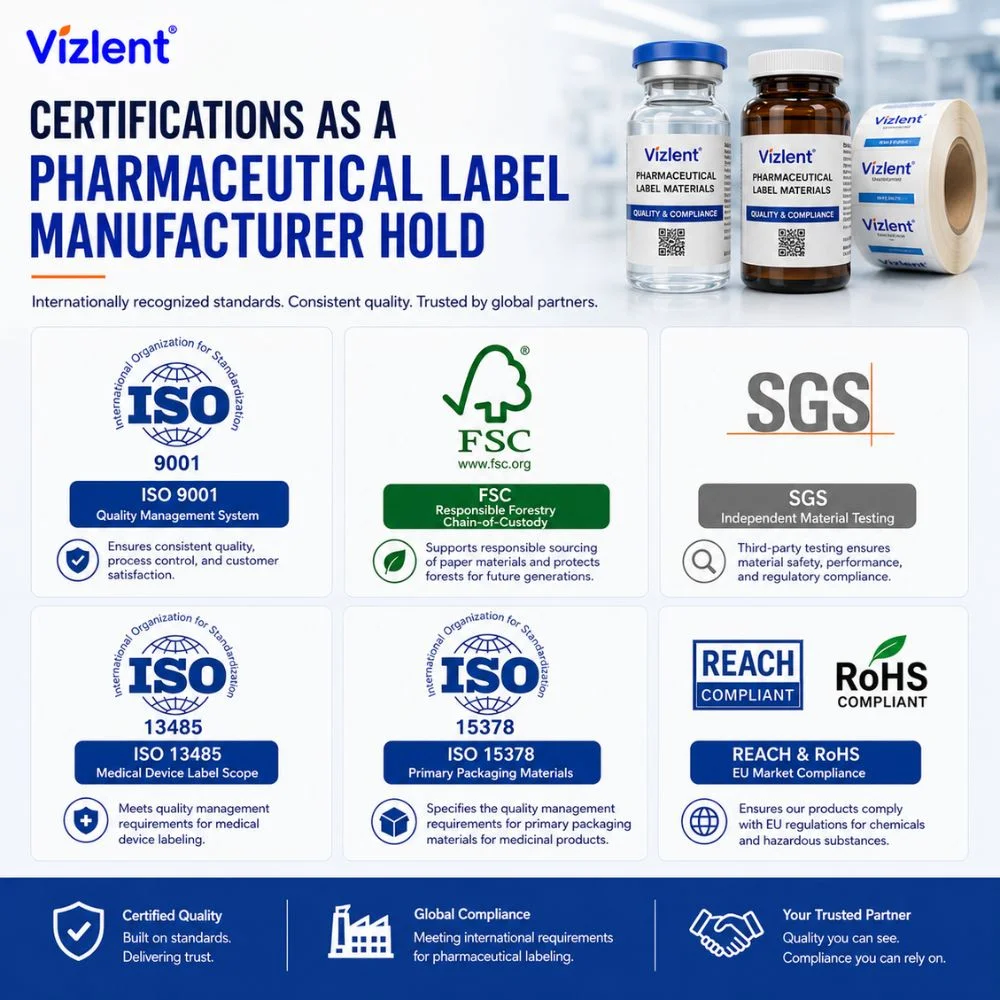
Pharmaceutical label manufacturers should hold a combination of quality management, sustainability, and product safety certifications relevant to medical packaging. ISO 9001 governs the quality management system, while FSC certification covers responsible paper sourcing. SGS testing verifies material performance through independent laboratory analysis.
Buyers serving regulated pharmaceutical markets often require additional credentials, such as ISO 13485 for medical device labels or ISO 15378 for primary packaging materials. Vizlent maintains ISO 9001, FSC, and SGS credentials backed by 15 years of factory-direct supply experience. Always request certificate copies and verify validity dates with the issuing body before signing supply agreements.
- ISO 9001 (quality management system)
- FSC (responsible forestry chain-of-custody)
- SGS (independent material testing)
- ISO 13485 (medical device label scope)
- ISO 15378 (primary packaging materials)
- REACH and RoHS (EU market compliance)
Things a Customized Pharmaceutical Label Manufacturers Association Verifies
A customized pharmaceutical label manufacturers association is an industry body that develops standards, certifies member factories, and publishes best-practice guidelines for label production. Examples include the Tag and Label Manufacturers Institute (TLMI) in the United States, FINAT in Europe, and the China Adhesive Industry Association in Asia. Membership signals professional accountability and ongoing compliance with industry quality standards.
Verifying association membership helps you separate established manufacturers from short-lived suppliers without industry standing. Most associations maintain online directories where you can confirm member status, certifications, and reported production capacity. Buyers can also use these directories as a starting point when building a sourcing shortlist for pharmaceutical packaging projects.
Ways to Build a Customized Pharmaceutical Label Manufacturers List?
You build a customized pharmaceutical label manufacturers list by combining industry association directories, certified supplier platforms, trade show exhibitor records, and direct referrals from converting partners. Start with the verified rosters published by TLMI, FINAT, and equivalent regional bodies. Cross-reference these lists with B2B platforms such as Alibaba, Global Sources, and Made-in-China for capability comparisons.
A practical list includes between five and ten shortlisted manufacturers covering different price tiers, geographic regions, and material specializations. Each entry should record certifications, production capacity, MOQ, lead time, and verified contact details. Updating the list annually keeps your sourcing pipeline current as factory capabilities, ownership, and certifications change over time.
What Sourcing Channels Help You Find Trusted Suppliers?
Reliable sourcing channels for pharmaceutical label suppliers include industry trade shows such as Labelexpo Americas, Labelexpo Europe, and All in Print China. These events bring factory representatives, sample books, and technical engineers into one venue for in-person evaluation. Trade publications such as Label and Narrow Web also publish annual buyer guides with verified manufacturer profiles.
Direct factory websites, when paired with reverse image searches on certifications and facility photos, help confirm whether a supplier operates a real plant. LinkedIn profiles of company executives, factory tour videos on YouTube, and signed customer testimonials add further credibility signals. Combining multiple sourcing channels gives you a clearer picture than relying on a single platform listing.
How Do You Compare Private vs Public Pharmaceutical Label Manufacturers?
A customized pharmaceutical label manufacturer’s private structure is a privately held factory typically owned by the founding family or a limited investor group. Private manufacturers often offer faster decision-making, flexible OEM terms, and a closer working relationship with engineering staff. Public manufacturers, listed on stock exchanges, bring scale and audited financial transparency but slower contractual processes.
For pharmaceutical packaging buyers, the choice depends on order volume, payment terms, and the level of customization required. Private factories such as Vizlent suit brands that need rapid R&D collaboration, sample iterations, and small to mid-batch production runs. Public suppliers fit large pharmaceutical groups, placing multi-year, container-load contracts with rigorous procurement processes.
Looking for a private, factory-direct, customized pharmaceutical label manufacturer with global export experience? Explore our pharmaceutical and healthcare label solutions backed by 15 years of production expertise.
What Makes Vizlent Label Materials Co., Ltd. in China a Trusted Partner?
Vizlent Label Materials Co. Ltd in China is a trusted customized pharmaceutical label manufacturer co. Ltd because it operates as a direct factory rather than a trading company, holds ISO 9001, FSC, and SGS certifications, and serves more than 1,000 customers across 50 countries. The customized pharmaceutical label manufacturer co was founded in 2011 and operates a 10,000 square meter coating facility in Shenzhen, supported by additional production in Ganzhou. This integrated structure removes layers of middlemen between buyers and the production line.
The company’s pharmaceutical-grade label stock supports cold-chain shipping, autoclave sterilization, gamma radiation, and EtO gas sterilization without losing barcode integrity or adhesive performance. Vizlent’s catalog spans heat-resistant labels, security labels, tamper-evident VOID stickers, biodegradable label stock, and thermal transfer ribbons engineered for medical device and pharmaceutical applications. Customers benefit from the free sample program
Final Takeaway: Choosing the Right Customized Pharmaceutical Label Manufacturer
Finding the right customized pharmaceutical label manufacturer comes down to verification, sample testing, and direct communication with factory engineering teams. Buyers who invest time in qualification protect their downstream production, regulatory compliance, and brand reputation in highly competitive pharmaceutical markets. The best partnerships start with a single sample request and grow into long-term supply agreements built on trust.
China remains a leading source for factory-direct customized pharmaceutical label production, with Vizlent Label Materials Co. Ltd as one of the established names serving global pharmaceutical clients since 2011. The combination of ISO-certified production, free sample programs, and direct engineering support gives buyers a reliable starting point for new sourcing projects. Take the next step by reaching out to a verified manufacturer and requesting samples relevant to your application.
Ready to partner with a verified pharmaceutical label manufacturer? Email [email protected] or contact the Vizlent team to request free samples and start your sourcing project today, with flexible MOQ policies and direct engineering support for spec sheets.
Frequently Asked Questions
What Pharmaceutical Label Materials Does Vizlent Manufacture?
Vizlent manufactures a full range of pharmaceutical-grade label materials, including paper, PET, BOPP, PVC, and PI facestocks, paired with eight custom adhesive formulations. The product range covers permanent, removable, freezer-grade, autoclave-safe, and wash-off adhesive systems. Each material category supports inkjet, laser, and thermal transfer printing for downstream converters.
Pharmaceutical buyers can specify face stock caliper, adhesive coat weight, liner type, and roll dimensions from 30 millimeters to 1300 millimeters wide. The catalog also covers:
- Security labels
- VOID stickers
- Heat-resistant labels
- Biodegradable label stock
- Thermal transfer ribbons.
Custom development is available for unique application requirements such as cryogenic storage labels and tamper-evident pharmaceutical seals.
How Do You Contact Vizlent for Custom Pharmaceutical Labels?
You can reach Vizlent’s customized pharmaceutical label manufacturer email at [email protected] to request samples, technical data sheets, and factory-direct quotations. The sales team responds to specification inquiries within 24 hours and routes technical questions to engineering for material recommendations. WhatsApp and WeChat contacts are also published on the website for buyers in different time zones.
For larger procurement projects, Vizlent welcomes scheduled video factory tours and structured supplier qualification audits. Buyers can verify production capacity, view live coating line operations, and discuss long-term supply agreements with company leadership. Submitting a written inquiry through the contact form starts the qualification process and creates a documented project record from the first conversation.
Send your specification sheet directly to [email protected] or contact our team to request free samples and a factory-direct quotation.
What Should You Ask a Customized Pharmaceutical Label Manufacturer Before Ordering?
Before placing an order with a customized pharmaceutical label manufacturer, ask about certifications, sample availability, MOQ flexibility, lead times, packaging standards, and after-sales technical support. Each answer reveals whether the supplier matches your operational and compliance needs. Document responses in writing to build a comparable evaluation across multiple shortlisted suppliers.
Use a structured checklist during the inquiry phase to keep responses consistent and comparable across suppliers. Skip factories that hedge on basic compliance questions or refuse to send free material samples for testing. Reliable manufacturers welcome detailed scrutiny because their production records support every claim they make.
- Which certifications do you currently hold, and when do they expire?
- Can I receive free A4 sheets or trial rolls for testing?
- What is your standard MOQ for custom adhesive formulations?
- How many days from the purchase order to production completion?
- What packaging do you use for moisture protection during sea freight?
- Do you provide MSDS and technical data sheets for every adhesive grade?
- Can your sales engineers review my specification sheet before quoting?
How Do You Avoid Common Risks When Sourcing Pharmaceutical Labels?
You avoid common sourcing risks by requesting free samples before bulk orders, using escrow or letter of credit payment terms, and confirming third-party laboratory verification of material specifications. Pharmaceutical buyers face additional scrutiny because failed labels can trigger product recalls, regulatory citations, and patient safety incidents. Building risk mitigation into the sourcing process protects both your supply chain and your brand reputation.
Other common risks include incorrect facestock caliper, adhesive that hardens during cold-chain transit, and printing surfaces that smudge under thermal transfer ribbons. Run sample rolls on your actual converting line before signing supply agreements. Document every test result in your supplier qualification file for future audits and replenishment decisions.
What Lead Times and Minimum Order Quantity (MOQs) Do Customized Pharmaceutical Label Manufacturers Offer?
Customized pharmaceutical label manufacturers typically offer lead times of 7 to 15 business days for standard custom orders and MOQs starting from 1,000 square meters of label stock for trial materials. Lead times extend when custom adhesive formulations require fresh coating runs or specialty facestocks must be sourced from secondary suppliers. Established factories such as Vizlent maintain inventory buffers on common pharmaceutical-grade materials to shorten turnaround for repeat orders.
MOQ flexibility separates pharma-friendly suppliers from generic label converters that demand multi-container minimums. Buyers running clinical trial supplies, small-batch compounded products, or pilot production rely on suppliers willing to fulfill orders below standard MOQ thresholds. Always confirm MOQ in writing, along with sample availability, before locking in your supplier choice for a pharmaceutical project.
How Do You Negotiate Better Lead Times and MOQs?
You negotiate better lead times and MOQs by presenting a clear annual volume forecast, sharing a multi-batch order plan, and agreeing to consistent payment terms with the manufacturer. Factories prioritize buyers who provide predictable demand because production planning becomes easier and raw material purchasing is more efficient. A signed yearly supply agreement often qualifies you for lower MOQs and reserved capacity slots.
Smaller buyers can pool orders through their converting partner or a regional distributor to reach MOQ thresholds collectively. This pooled-order approach works well for pharmaceutical brands launching new SKUs that have not yet hit commercial volume. Ask your shortlisted manufacturers whether they support this structure during the initial qualification conversation.






