
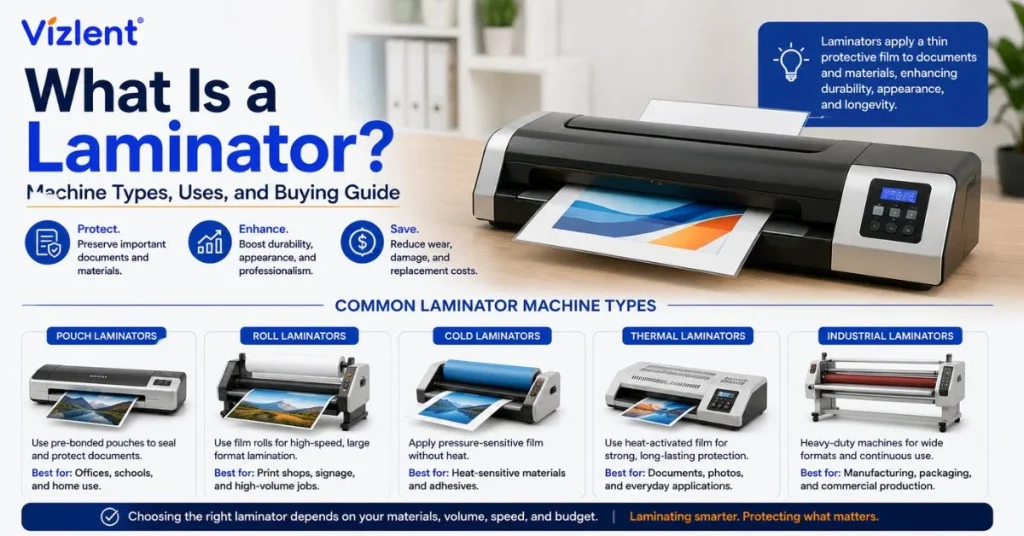
The laminator is quiet everywhere. School ID badges, restaurant menus, retail price cards, hospital wristbands, and millions of pharmaceutical labels all pass through one before they reach the people who use them. It is one of the most underappreciated machines in the printing supply chain.
Vizlent Label Materials Co has manufactured pressure-sensitive laminating film and label stock since 2011, with shipments to converters and packaging engineers in more than 50 countries. That field experience shapes the breakdown ahead: a working definition, the types of laminators in current use, the films that feed them, and how self-adhesive lamination shifts the workflow. Buyers sourcing for business or bulk are covered too.
Browse Vizlent’s laminating film range →
What Is a Laminator Machine?
A laminator machine is a device that applies a thin transparent film to printed material. The film bonds to the surface through heat, pressure, adhesive chemistry, or some combination of the three, sealing the print between two protective plastic layers that block moisture, UV light, scuffing, and routine handling damage. The result is a durable laminated sheet that resists tear and time.
The technology is not new. Industrial lamination dates back to the early 20th century, but desktop laminators built for offices, schools, and small businesses became standard equipment only in the 1980s. Today, a laminator machine sits in nearly every print shop, school, label converter, and packaging plant worldwide.
Most laminators share the same core components:
- Feed tray that guides the document into the rollers
- Heating element or pressure plate, depending on the machine type
- Roller assembly that bonds the film to the printed surface
- Cooling section that sets the bond before exit
- Exit tray that catches the finished laminated sheet
What Is the Purpose of Laminating?
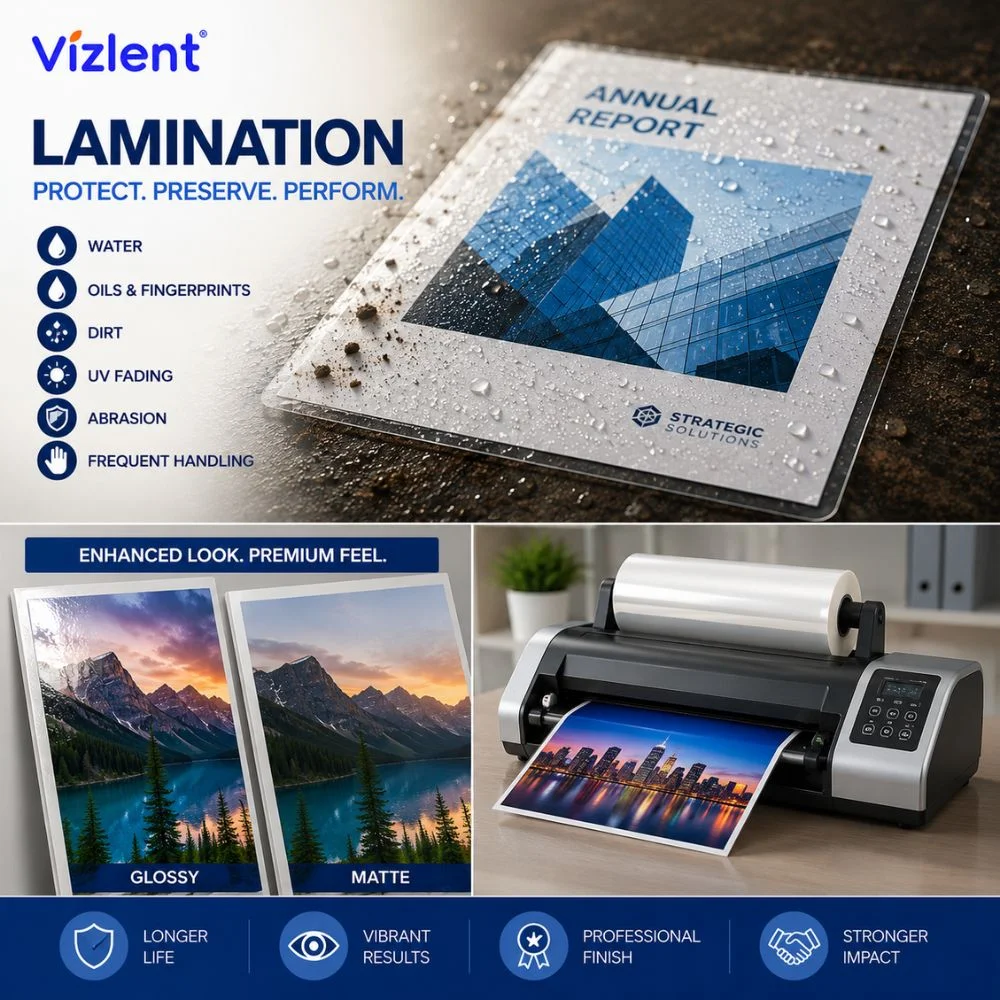
The purpose of laminating is straightforward: to protect the printed surface. A laminate layer extends the working life of a document by shielding it from water, oils, fingerprints, dirt, UV fading, abrasion, and the cumulative wear of frequent handling. Print survives longer with less damage.
Lamination also changes how the printed surface looks and feels to the end user. A glossy laminate intensifies colors and adds a wet-look depth to photography, while a matte laminate softens reflections and feels smoother under the fingertips. The finished product reads as more polished and more professional.
Core benefits across industries:
- Water and moisture resistance for menus, signage, and outdoor labels
- Scratch and abrasion resistance for ID cards and badges handled daily
- UV protection that slows color fading on retail and pharmaceutical labels
- Tear and crease resistance that extends document working life by 5 to 10 times
- Premium visual finish through gloss, matte, or satin laminate options
- Wipe-clean surface that supports sanitation in food service and healthcare environments
Types of Laminators and How They Differ
Laminators fall into two broad families: hot lamination and cold lamination. A hot laminator melts a thermal adhesive on the film and bonds it to the document with heated rollers. A cold laminator relies on pressure-sensitive adhesive that activates without any heat at all.
Within those two families sit multiple machine sizes and feed configurations. A small pouch laminator handles A4 documents one at a time, a roll laminator handles long banners and posters, and an industrial roll-to-roll machine processes thousands of meters of film per shift. The right choice depends on production volume, substrate sensitivity, and the format size in use.
Common machine classes in commercial production:
- Pouch laminator: small desktop unit using pre-sealed laminating pouches
- Roll laminator: a larger machine feeding film from a continuous roll
- Cold roll laminator: pressure-only machine for heat-sensitive substrates
- Self-adhesive laminating machine: uses pressure-sensitive film with no heat
- Industrial roll-to-roll laminator: continuous-flow unit for label converters and packaging plants
See Vizlent’s industrial laminating film options →
Laminator Sheets and Films Explained
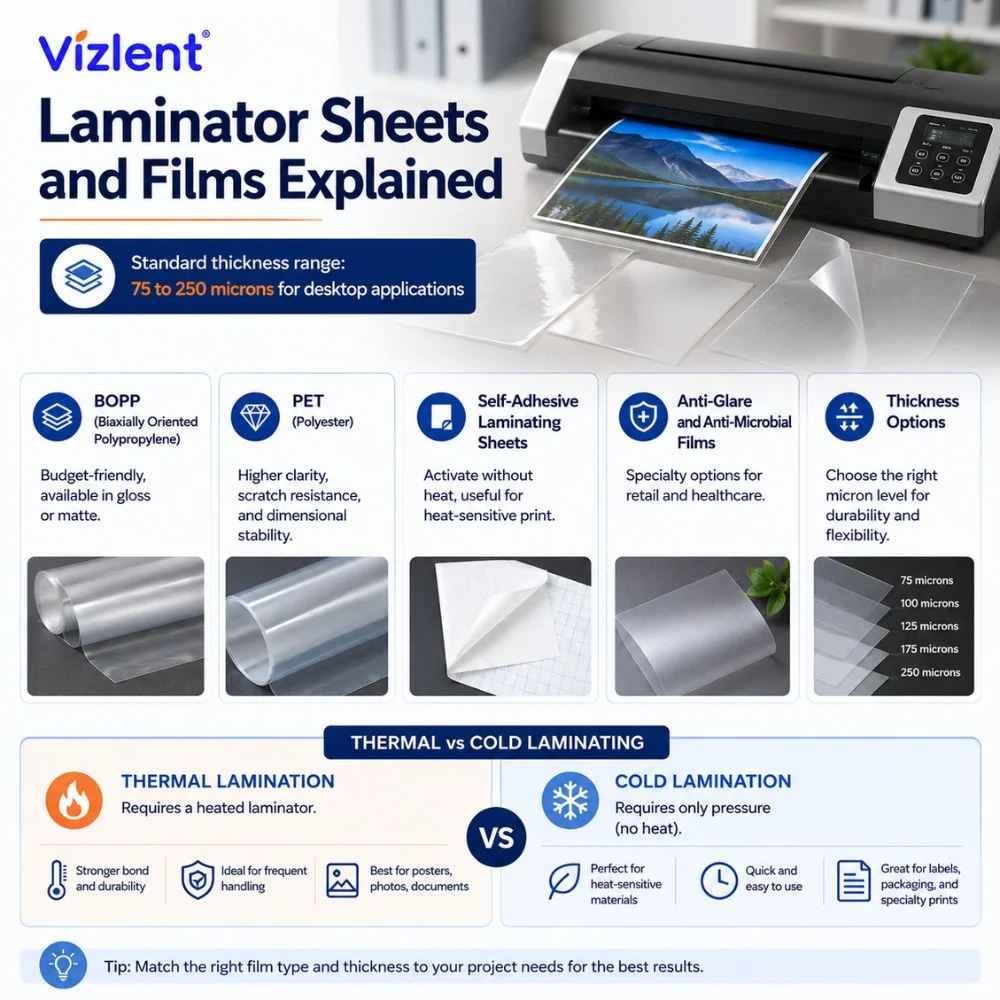
The film is half of the system. Laminator sheets come in standardized sizes, common gauges measured in microns, and a short list of base materials, including BOPP, PET, polyester, and polyethylene. The thicker the film, the more rigid and protective the finished laminated document becomes.
Film choice has performance consequences beyond appearance. A 75-micron BOPP film offers economical surface protection for paper documents, a 250-micron PET film withstands repeated handling on ID cards and menus, and specialty films add anti-counterfeit, anti-microbial, or anti-glare properties. Industrial converters often run thicker grades.
Common laminator sheet specifications:
- Standard thickness range: 75 to 250 microns for desktop applications
- BOPP (biaxially oriented polypropylene): budget-friendly, available in gloss or matte
- PET (polyester): higher clarity, scratch resistance, and dimensional stability
- Self-adhesive laminating sheets: activate without heat, useful for heat-sensitive print
- Anti-glare and anti-microbial films: specialty options for retail and healthcare
- Thermal vs cold: thermal needs a heated machine, cold needs only pressure
Self-Adhesive Lamination, Self-Laminating Labels, and Adhesive Stickers
Self-adhesive lamination changes the workflow because the film carries its own adhesive. A self-adhesive laminator presses pre-coated film onto a substrate without heat, releasing the silicone liner and bonding the protective layer in one continuous pass. Self-adhesive laminating stickers and self-laminating labels work the same way at smaller scales.
For procurement teams asking what self-adhesive labels in practical use, the answer involves three product families. Self-laminating labels carry an over-laminate built into the same construction, self-adhesive laminating stickers carry a clear protective film on a peelable liner, and self-adhesive laminating sheets provide larger-format coverage for documents or signs. All three skip the heat step entirely.
Where each format earns its place:
- Self-laminating labels: built-in over-laminate, used for cable and asset marking
- Self-adhesive laminating stickers: clear film stickers applied over finished prints
- Self-adhesive laminating sheets: larger-format protection without a powered machine
- Field-applied lamination: for environments where powered equipment is impractical
- Heat-sensitive substrates: for materials that would deform under thermal lamination
- Sourcing self-adhesive laminating sheets near me: office supply chains, label distributors, online marketplaces, and direct-from-manufacturer suppliers like Vizlent
Choosing a Self-Adhesive Labels Laminator for Business and Bulk Use
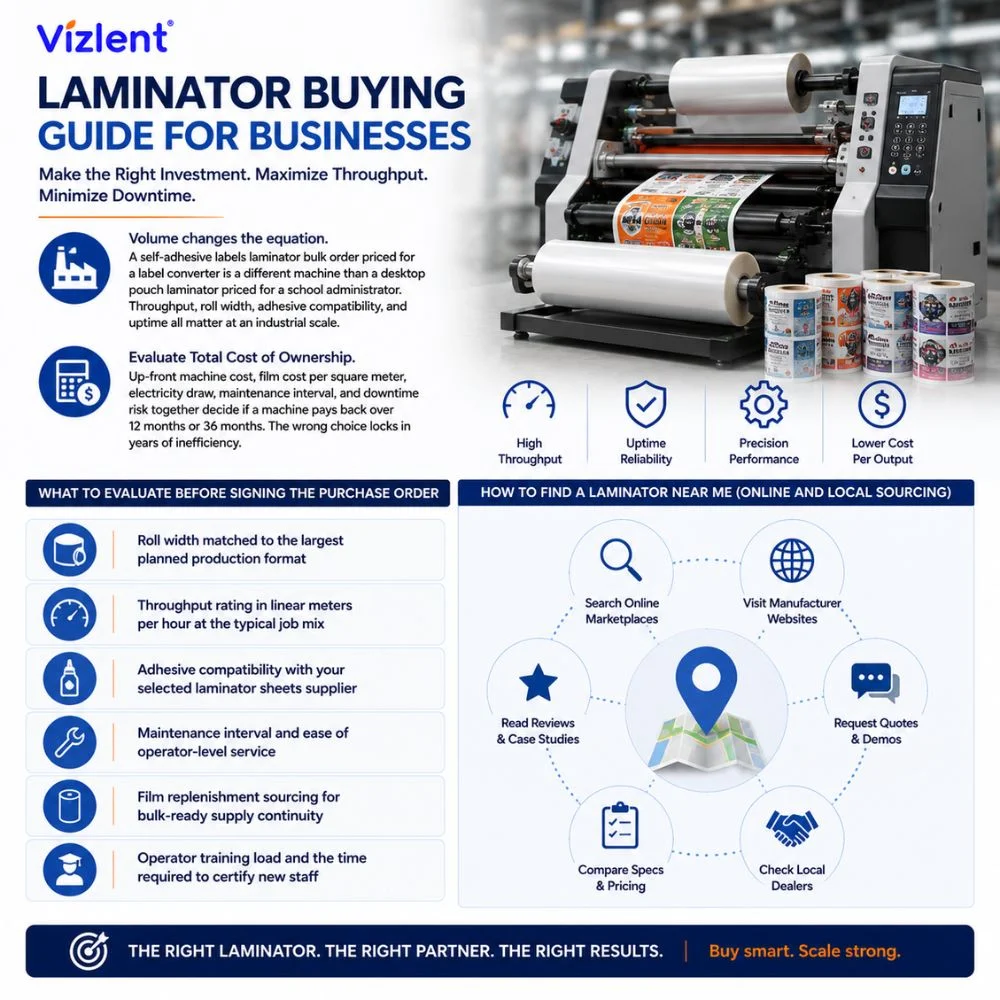
Volume changes the equation. A self-adhesive labels laminator bulk order priced for a label converter is a different machine than a desktop pouch laminator priced for a school administrator. Throughput, roll width, adhesive compatibility, and uptime all matter at an industrial scale.
A self-adhesive label laminator business buyer evaluates the total cost of ownership rather than the headline price. Up-front machine cost, film cost per square meter, electricity draw, maintenance interval, and downtime risk together decide if a machine pays back over 12 months or 36 months. The wrong choice locks in years of inefficiency.
What to evaluate before signing the purchase order:
- Roll width matched to the largest planned production format
- Throughput rating in linear meters per hour at the typical job mix
- Adhesive compatibility with your selected laminator sheets supplier
- Maintenance interval and ease of operator-level service
- Film replenishment sourcing for bulk-ready supply continuity
- Operator training load and the time required to certify new staff
How to Find a Laminator Near Me (Online and Local Sourcing)
Sourcing starts with the use case. A small office search for laminators near me usually lands at an office supply chain such as Staples, Office Depot, or Argos in the UK. A label converter or packaging plant sources directly from manufacturers and industrial distributors.
The price gap between consumer and industrial machines is wide. Desktop laminators retail between USD 40 and USD 400, while a self-adhesive laminating machine built for label converters can run from USD 5,000 to over USD 100,000. The film supply chain matters just as much as the hardware purchase.
Channels that match different buyer profiles:
- Office supply retailers: for occasional and desktop use
- Industrial machinery distributors: for converter-grade equipment
- Online marketplaces: wide selection, mixed quality, longer due diligence
- Direct from manufacturer: for bulk film supply and OEM equipment partnerships
- Vizlent’s laminating film range: for converters and packaging plants sourcing pressure-sensitive laminate stock at volume
Laminator Maintenance and Operational Best Practices
A laminator machine that runs clean and runs cool for years. Routine maintenance is mostly about keeping the rollers free of adhesive residue, replacing the silicone wipe pads, and confirming the temperature sensors stay calibrated within manufacturer’s tolerance. Neglected machines fail in expensive ways.
Operators matter as much as the hardware does. A well-trained operator catches misfeeds early, swaps out film rolls without web tension errors, and recognizes the warning signs of a worn drive belt or a failing thermal element before the issue takes the line down. Documentation and routine training pay back fast on any commercial laminator.
Core maintenance habits worth standardizing:
- Roller cleaning after every shift or every 8 hours of continuous run
- Silicone wipe pads replaced quarterly or per the manufacturer’s interval
- Temperature calibration is verified monthly against a known reference
- Drive belt and chain inspection at the recommended service interval
- Film roll storage in temperature-controlled conditions to prevent adhesive cure issues
- Operator certification is documented for every machine in the production fleet
Hot Lamination vs Cold Lamination: When to Use Each
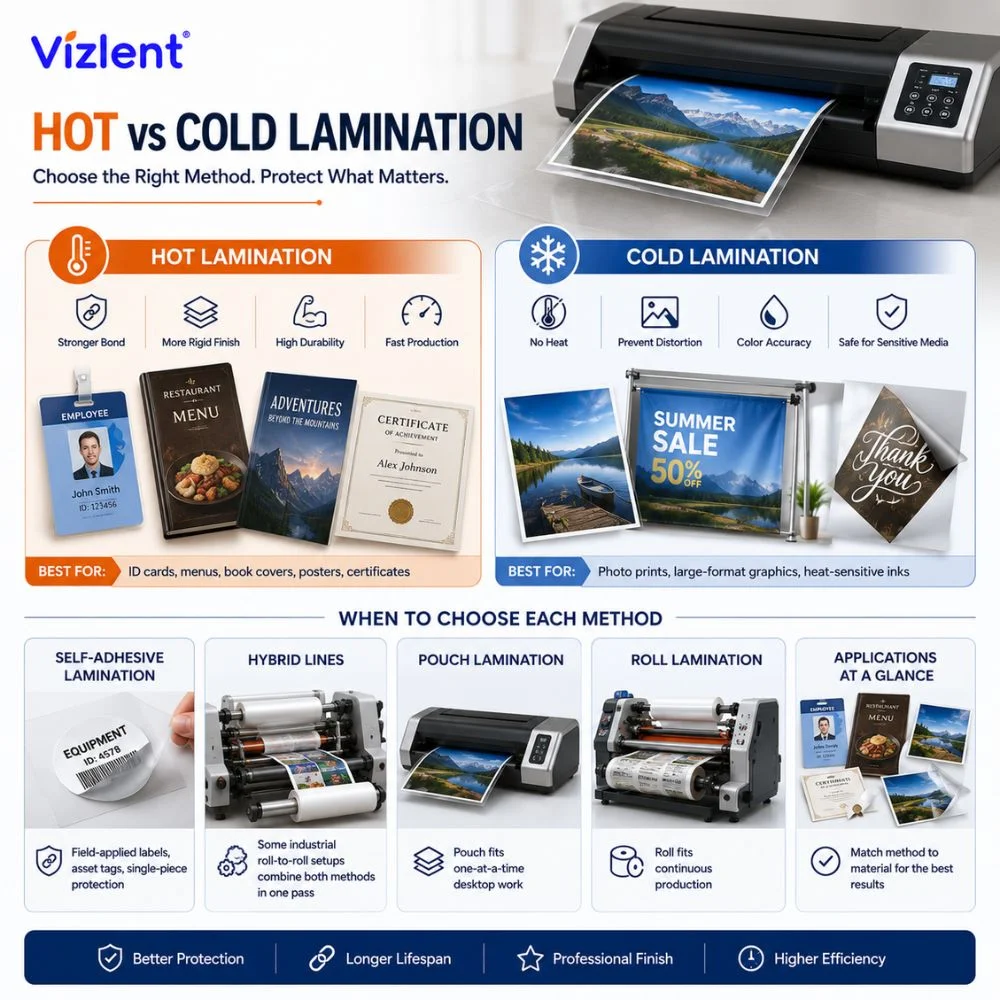
The choice between hot and cold lamination usually comes down to substrate sensitivity and production speed. Hot lamination produces a tighter bond and a more rigid finished sheet, which is why it remains the default for ID cards, menus, book covers, and most desktop laminator machines. Cold lamination earns its place elsewhere.
Cold lamination is the go-to method for heat-sensitive media. Inkjet prints on premium photo paper, certain self-adhesive laminating stickers, large-format banners with thermochromic inks, and any document containing wax-based pigments all risk distortion or color shift inside a hot laminator. A self-adhesive laminator avoids those failure modes entirely.
When to choose each method:
- Hot lamination: ID cards, menus, book covers, posters, certificates
- Cold lamination: photo prints, large-format graphics, heat-sensitive inks
- Self-adhesive lamination: field-applied labels, asset tags, single-piece protection
- Hybrid lines: some industrial roll-to-roll setups combine both methods in one pass
- Pouch vs roll: pouch fits one-at-a-time desktop work, roll fits continuous production
Industries That Rely on Laminator Machines and Self-Adhesive Lamination
A laminator machine sits inside more workflows than most buyers realize. Schools laminate student records and reference posters, restaurants laminate menus and table tents, hospitals laminate patient identification wristbands and equipment instructions, and pharmaceutical packaging plants laminate label faces to protect against alcohol wipe-downs and sterilization cycles. The pattern repeats across every sector that depends on durable printed information.
Self-adhesive lamination expands the reach into use cases where heat is impractical. Field service teams apply self-adhesive laminating sheets to outdoor signage, electricians use self-laminating labels for cable identification inside live panels, and warehouse operators apply self-adhesive laminating stickers to barcode tags that survive forklift abrasion. The lamination layer always earns its keep over the working life of the asset.
Representative industries and their typical use cases:
- Education: reference charts, student ID cards, library spine labels
- Food service: menus, allergen notices, table-side promotional cards
- Healthcare: wristbands, IV labels, equipment instruction guides
- Pharma manufacturing: primary container labels, carton overlamination, vial faces
- Retail: shelf-edge tickets, promotional displays, gondola end-cap signs
- Industrial: asset tags, wire markers, equipment nameplates, valve identification
Vizlent Label Materials Co., Ltd Supplies the Laminating Film That Feeds Your Machine
A laminator is a finishing tool, but the film and the substrate decide if the finished job lasts. Vizlent Label Materials Co., Ltd supplies pressure-sensitive laminating film and label stock to converters and packaging engineers in more than 50 countries, with formats ranging from desktop-compatible sheets to industrial roll-to-roll BOPP and PET films. Free sample rolls ship before any bulk commitment, sized to match your converting line.
Bulk orders typically leave the Shenzhen facility within 7 to 15 business days, with full ISO 9001, FSC, and SGS documentation included on every delivery. The materials engineering desk works directly with print shops, label converters, and packaging plants to match face stock, adhesive, and topcoat to specific machine and application requirements.
See Vizlent’s full laminating film range →
Talk to a Vizlent label specialist →
Editorial disclosure: Machine price ranges and film specification ranges cited above reflect general industry figures and may vary by region, manufacturer, and configuration. Buyers should validate machine and film selection through direct sample testing and manufacturer consultation, such as with Vizlent Label Materials Co, before committing to bulk procurement.
Frequently Asked Questions
What is a laminator machine?
A laminator machine applies a thin transparent film to printed material to protect it from water, abrasion, UV light, and handling damage. The film bonds through heat, pressure, or adhesive chemistry, depending on the machine class. Common formats include pouch laminators for desktop use, roll laminators for wide-format work, and industrial roll-to-roll machines used by label converters and packaging plants.
What is the purpose of laminating?
The purpose of laminating is to extend the working life of printed material and improve its appearance. The film delivers resistance to moisture, scratches, fingerprints, UV fading, and tearing. Gloss laminates intensify colors and add depth, while matte laminates soften reflections. Lamination is widely applied to signage, ID cards, menus, retail labels, and pharmaceutical packaging.
How do self-adhesive laminating stickers differ from traditional laminator sheets?
Self-adhesive laminating stickers carry pressure-sensitive adhesive on the back that releases from a silicone liner when peeled, allowing application without heat or a powered machine. Traditional laminator sheets require a heated unit to melt thermal adhesive and bond the film. Self-adhesive options suit heat-sensitive substrates and field-application work where powered equipment is impractical.
Where can I source self-adhesive laminating sheets near me?
Self-adhesive laminating sheets are sold by office supply chains, label distributors, online marketplaces, and directly from manufacturers. Small-quantity buyers usually start at retail. Businesses ordering in bulk benefit from sourcing directly from a manufacturer such as Vizlent, which supplies converters across more than 50 countries and ships free sample rolls before any bulk commitment.
What should a business look for in a self-adhesive label laminator?
A self-adhesive label laminator business purchase should match roll width to the production format, throughput rating to job volume, and adhesive compatibility to the chosen film supplier. Evaluate maintenance interval, film replenishment sourcing, and operator training load. Total cost of ownership over 24 to 36 months matters more than the up-front machine price alone.
What are self-laminating labels used for?
Self-laminating labels carry a built-in clear over-laminate flap that folds over the printed area after application. They are widely used for cable identification, asset tagging, wire markers, and laboratory specimen labeling. The construction protects printed text from solvents, abrasion, and handling without requiring a separate lamination step or a powered laminator machine.






