
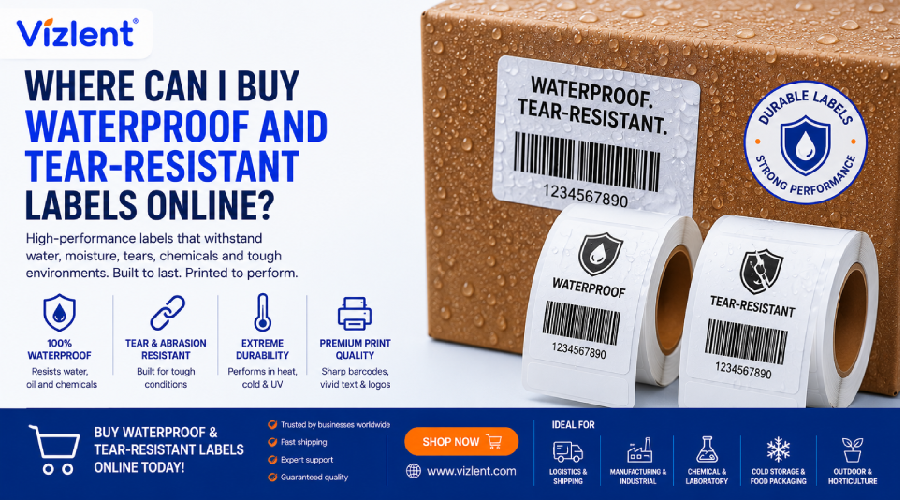
You can buy waterproof and tear resistant labels online throughb a firect factory manufacturers such as Vizlent Label, industrial label distributors, and specialty packaging suppliers. A direct manufacturer relationship generally giving the most control over substrate, adhesive, and compliance documentation.
Buyers searching for waterproof and tear-resistant labels manufacturer relationships usually want to compare a factory-direct order against a distributor or marketplace listing, since each route affects price, minimum order quantity, and access to technical testing data differently. This guide covers where to buy, what makes a label genuinely waterproof and tear-resistant, and what to check before placing a bulk order.
Comparing Direct Manufacturers, Distributors, and Marketplaces
Where can I buy waterproof and tear-resistant labels online? This is one of the most common questions from procurement teams switching suppliers after a labeling failure in the field. Waterproof and tear-resistant labels online buy options generally fall into three channels: direct factory manufacturers, industrial label distributors, and general e-commerce marketplaces, each suited to a different order size and technical requirement. A waterproof and tear-resistant labels online store run by a distributor often carries stock from a handful of manufacturers, useful for smaller trial orders before committing to a full factory run.
Vizlent’s Outdoor Weather Resistant range documents UV-stabilized polyester and polypropylene constructions with waterproof adhesives, rated from -40°C to 150°C and UL 969 recognized for outdoor use. A waterproof and tear-resistant labels online order placed directly with a manufacturer typically includes access to this kind of technical data sheet, which a marketplace listing rarely provides. Confirming a supplier’s manufacturing certification, such as ISO 9001, is one of the fastest ways to separate a direct factory from a reseller repackaging generic stock.
- Direct factory manufacturers: custom formulation, testing data, and compliance documentation.
- Industrial label distributors: smaller trial orders and multi-brand stock availability.
- General marketplaces: fastest checkout, but limited technical documentation and customization.
Many buyers also look for a waterproof and tear-resistant labels online free sample program before committing to volume, since a specification sheet cannot fully convey how a label resists moisture, tearing, or abrasion in practice. A waterproof and tear-resistant labels online company that offers free samples and covers only courier freight is generally easier to evaluate fairly. Comparing a handful of suppliers side by side, using the same substrate and application, gives a more reliable picture of value than comparing listed prices alone.
What Makes a Label Waterproof and Tear-Resistant
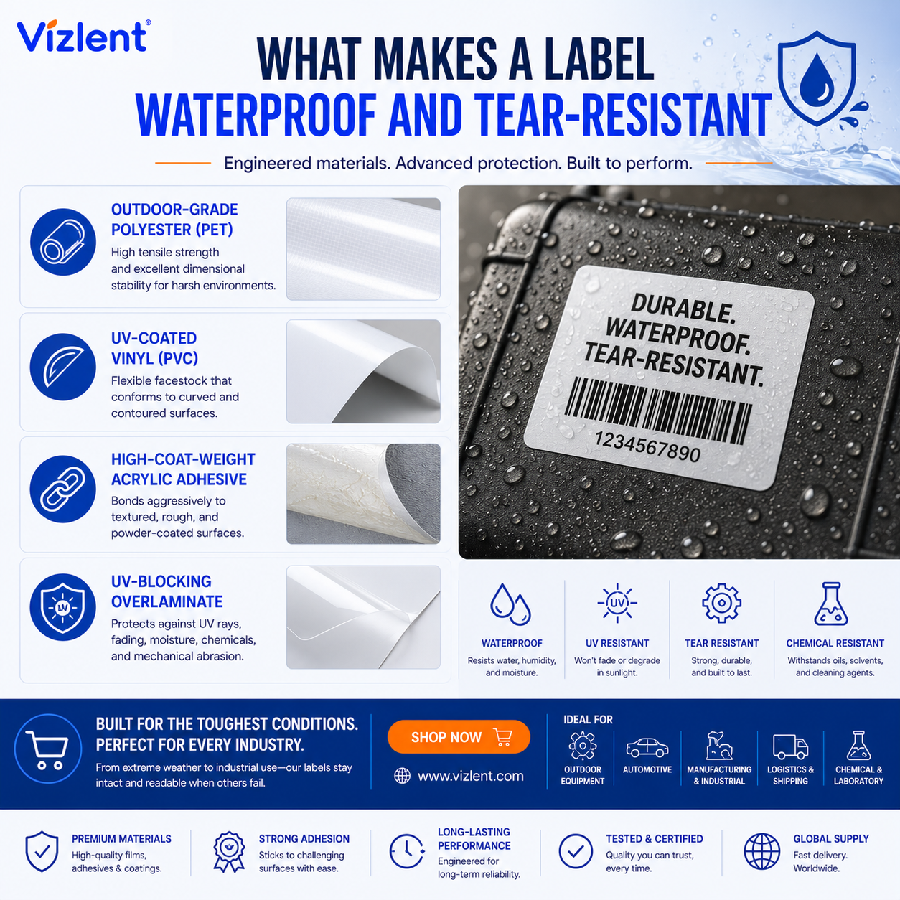
A label earns the waterproof and tear resistant designation through a combination of facestock choice and adhesive formulation, not through printing or coating alone. Outdoor-grade polyester (PET) and UV-coated vinyl (PVC) are the two primary substrates used for this purpose, since both resist water penetration and physical tearing far better than standard paper. A high-coat-weight, cross-linked permanent acrylic adhesive backs these facestocks, bonding aggressively even to textured or powder-coated surfaces.
Heavy-duty waterproofing on a genuine waterproof and tear resistant label is paired with abrasion and tear resistance, since industrial environments routinely expose labels to pressure washing, blowing sand, and accidental tool impacts. A UV-blocking clear overlaminate adds a further protective layer, preventing both fading and physical damage to the printed data underneath. Manufacturers validate this combination through QUV accelerated weathering tests, which simulate years of outdoor exposure in a matter of weeks.
- Outdoor-grade polyester (PET): High tensile strength, excellent dimensional stability.
- UV-coated vinyl (PVC): Flexible facestock for curved or contoured surfaces.
- High-coat-weight acrylic adhesive: Bonds aggressively to textured and powder-coated surfaces.
- UV-blocking overlaminate: Protects against fading and mechanical abrasion.
Buyers evaluating tear resistant label options should request the manufacturer’s testing data rather than relying on marketing claims alone, since two labels marketed as waterproof and tear resistant can perform very differently on the same substrate. A construction rated for -40°C to 150°C and UL 969 recognized for outdoor use has been independently verified against water immersion, thermal cycling, and UV exposure. Requesting a sample and running your own peel and tear test remains the most reliable way to confirm performance before a bulk order ships.
Waterproof and Tear-Resistant Labels for Different Applications
Waterproof and tear-resistant labels for clothing rely on a different construction than industrial equipment labels, since polyester garment label stock needs to survive repeated washing, dry cleaning, and high-temperature ironing rather than outdoor UV exposure. Vizlent Label’s Polyester Label Material line uses fray-resistant edges and chemical-resistant coatings to withstand bleach, enzymes, and dry-cleaning solvents while keeping care instructions legible for the life of the garment. This is a very different threat profile from a label mounted on a shipping container or piece of heavy machinery.
Waterproof and tear-resistant labels for bottles and waterproof and tear-resistant labels for food both need to survive condensation, refrigeration, and repeated handling without smearing barcodes or lifting at the edges. Vizlen Label’s Beer & Beverage solutions address this exact combination of moisture and handling stress for bottled and canned products. Waterproof and tear-resistant labels for chemical products face an additional challenge, since Vizlent’s Petrochemical & Drums solutions must resist solvent exposure and drum handling on top of standard waterproofing and tear resistance.
- Clothing and textiles: Fray-resistant polyester, wash and dry-clean resistant.
- Bottles and beverages: Condensation and refrigeration resistant, scannable through handling.
- Food packaging: Moisture and repeated handling resistant, legible through cold storage.
- Chemical products and drums: Solvent-resistant on top of standard waterproofing.
Matching the label to its actual end use, rather than defaulting to a single general-purpose construction, is what actually determines field performance across these different applications. A manufacturer’s technical team can usually recommend the right facestock and adhesive combination once the substrate, environment, and handling conditions have been described. Requesting application-specific samples remains the standard way to confirm fit before a bulk order.
Heat Resistant, Oil Resistant, and Other Related Label Types
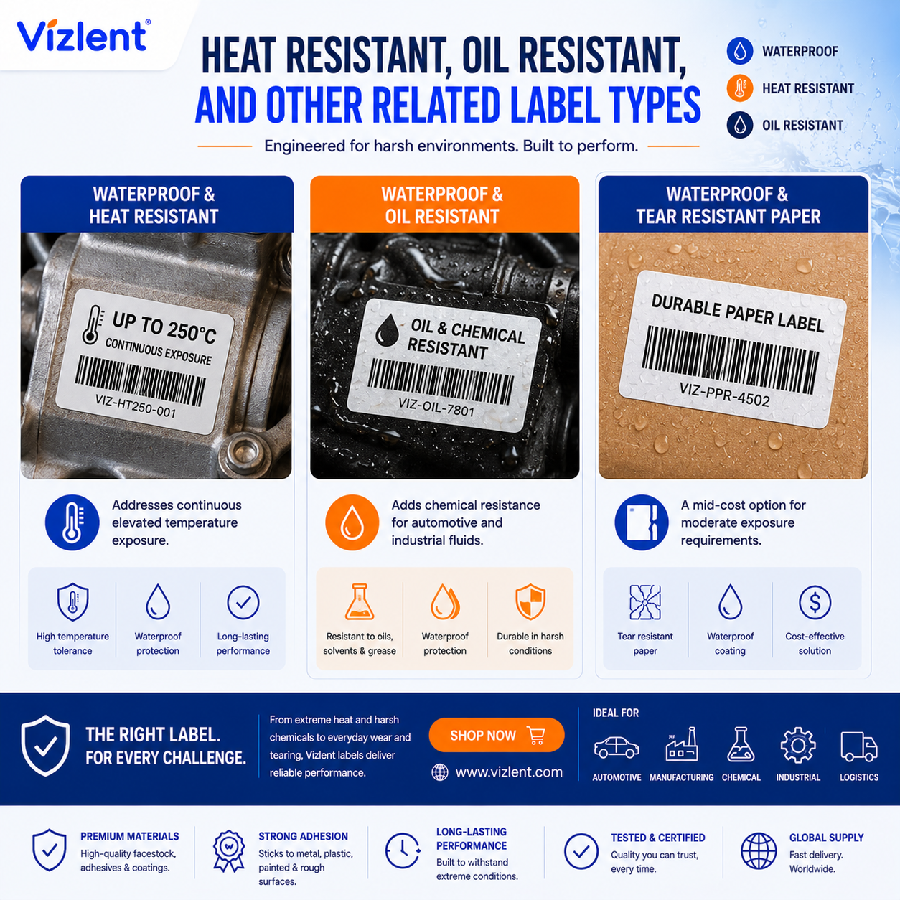
Waterproof and heat resistant labels solve a different problem than standard waterproofing alone, since heat resistance specifically addresses continuous exposure to elevated operating temperatures rather than moisture or physical tearing. Waterproof and oil resistant labels add a further layer of chemical resistance, useful in automotive and industrial settings where engine oils, hydraulic fluids, and lubricants routinely contact labeled surfaces. A tear resistant label built only for physical durability may still fail quickly if the application also involves sustained heat or oil exposure.
Waterproof and tear resistant paper occupies a middle ground between synthetic film and standard paper stock, using specialty coatings to resist moisture and tearing at a lower cost than full PET or PVC constructions. This option suits applications with moderate exposure requirements, where the cost premium of a fully synthetic facestock is not justified by the actual environmental demands. A tear resistant label specification should always state the expected temperature range, chemical exposure, and moisture level so a manufacturer can recommend the correct facestock tier.
- Waterproof and heat resistant: Addresses continuous elevated temperature exposure.
- Waterproof and oil resistant: Adds chemical resistance for automotive and industrial fluids.
- Waterproof and tear resistant paper: A mid-cost option for moderate exposure requirements.
Buyers should avoid assuming that any single waterproof and tear resistant construction automatically covers heat, oil, and chemical resistance as well, since each of these properties depends on a different aspect of the facestock and adhesive formulation. Requesting a technical data sheet that lists each resistance property separately, rather than a single generic durability claim, gives a clearer basis for comparison. This distinction matters most for industrial buyers combining several environmental stressors in one application.
Formats, Design, and Custom Options
Waterproof and tear-resistant labels design options typically include standard sizes such as 2 by 4 inches and 4 by 6 inches, alongside custom die-cut singles for specific equipment geometries. Waterproof and tear-resistant labels roll formats suit automated dispensing on production lines, while waterproof and tear resistant labels sticker and waterproof and tear resistant labels sticker paper options in sheet form suit manual application in smaller facilities. Standard ANSI Z535 safety colors, including waterproof and tear-resistant labels red for warning and hazard use, are common across industrial applications.
Waterproof and tear-resistant labels online bulk orders and waterproof and tear-resistant labels online custom requests should both confirm minimum order quantities and lead time early, since custom die-cut shapes and specific color formulations add production steps compared to standard stock sizes. Businesses ordering waterproof and tear-resistant labels in bulk for the first time should request a detailed quote that separates setup cost from per-unit pricing.
Waterproof and tear-resistant labels heavy duty constructions, built for the most physically demanding environments, generally use thicker facestocks and higher-coat-weight adhesives than a standard-duty version. Confirming which duty rating applies to your specific application avoids either overpaying for unnecessary durability or underspecifying a label that will fail in the field.
- Standard sizes: 2 by 4 inches, 3 by 5 inches, 4 by 6 inches, with custom die-cut available.
- Roll formats: Suited to automated, high-speed dispensing lines.
- Sheet and sticker formats: Suited to manual application in smaller facilities.
Requesting a physical sample of the exact format, color, and duty rating under consideration remains the most reliable way to confirm a design choice before a full production run ships. A label that looks correct in a product rendering can still underperform if the adhesive formulation does not match the actual substrate and environment in use. Physical testing on the real application surface is the standard first step across the industry.
How to Use Waterproof and Tear-Resistant Labels
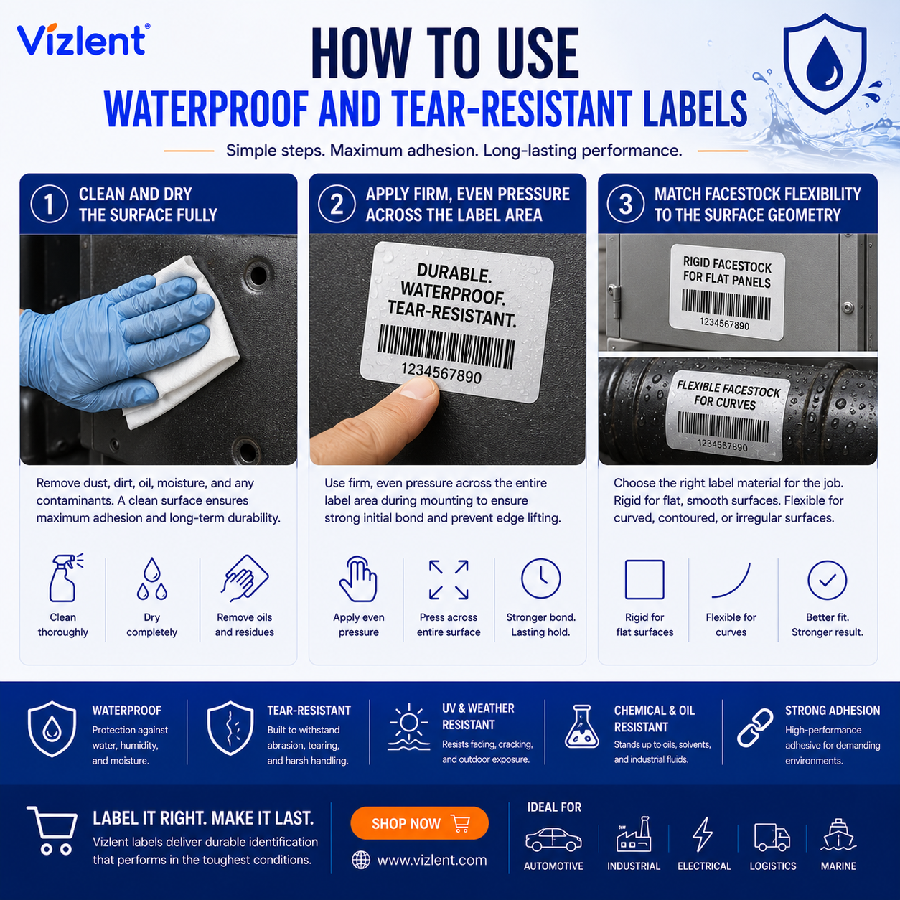
Waterproof and tear-resistant labels how to use guidance generally starts with surface preparation, since dust, oil residue, or moisture on the application surface can interfere with adhesion regardless of how durable the label itself is. Manufacturers publishing waterproof and tear-resistant labels online application guidance typically recommend cleaning and drying the mounting surface fully before application, then applying firm pressure across the entire label area, which helps the high-coat-weight adhesive bond evenly into any surface texture. Skipping this step is one of the most common causes of early label failure, even when the label construction itself is correctly specified.
Textured, curved, or powder-coated surfaces benefit from choosing a flexible facestock, such as UV-coated vinyl, over a rigid polyester film that may lift at the edges on a contoured surface. Waterproof and tear-resistant labels heavy duty applications on construction equipment or utility infrastructure should be inspected periodically for edge lifting or abrasion damage, particularly after pressure washing or heavy handling. Following the manufacturer’s documented application instructions, rather than assuming any waterproof label performs identically on every surface, helps avoid early replacement costs.
- Clean and dry the surface fully before application.
- Apply firm, even pressure across the entire label area during mounting.
- Match facestock flexibility to the surface geometry, rigid for flat panels, flexible for curves.
Manufacturers that provide detailed application guidance alongside their technical data sheets are generally easier to work with when a labeling program spans multiple surface types and environments. Requesting this guidance directly, rather than assuming general best practices apply to every specific product, helps confirm expectations before a large-scale rollout.
Waterproof and Tear-Resistant Labels vs Waterproof Labels
Waterproof and tear-resistant labels vs waterproof labels is a common comparison question, since the two terms are not interchangeable despite sounding similar. A waterproof label resists moisture penetration and water damage but says nothing about its resistance to physical tearing, abrasion, or impact. A waterproof and tear resistant label combines both properties in one construction, which matters for any application facing both wet conditions and physical handling stress at the same time.
Buyers comparing waterproof and tear-resistant labels vs waterproof labels should request the tensile strength and tear propagation values from a manufacturer’s data sheet, not just the water resistance rating. A label that survives full water immersion but still tears easily under mechanical stress is not a suitable substitute for a genuinely tear resistant label on equipment subject to physical impacts. Understanding this distinction before ordering prevents a costly mismatch between the specified label and its actual field performance.
- Waterproof labels: Resist moisture, but say nothing about tear or impact resistance.
- Tear resistant labels: Resist physical tearing, but may not address moisture at all.
- Waterproof and tear resistant labels: Combine both properties for wet, physically demanding environments.
Specifying both properties explicitly in a purchase order, rather than assuming one term implies the other, is the clearest way to avoid confusion between a buyer and a supplier. A manufacturer’s technical team can confirm which construction satisfies both requirements for a specific application before a bulk order is placed.
Cost, Quality, and Region When Buying Online
Waterproof and tear-resistant labels online cheap listings should be reviewed carefully, since a lower price often reflects a thinner facestock, a lower-coat-weight adhesive, or the absence of a UV-blocking overlaminate rather than genuine cost efficiency. Waterproof and tear-resistant labels high quality options generally come with documented testing data covering UV fade resistance, water immersion, and tear propagation, which a cut-rate listing rarely includes. Requesting this documentation before ordering is the clearest way to confirm that a lower price is not hiding a weaker construction.
Buyers outside North America, including those searching waterproof and tear-resistant labels online australia, should confirm that a supplier’s export packaging and shipping process protects rolls from moisture and edge damage during international transit. Vizlent Label’s contact page is a reasonable place to request a volume-based quote and confirm shipping logistics once your product, region, and compliance requirements are mapped out. A waterproof and tear-resistant labels online business relationship built on documented testing and transparent pricing tends to hold up better over repeat orders than one chosen on price alone.
- Request testing data covering UV fade resistance, water immersion, and tear propagation.
- Confirm export packaging and shipping protection for international orders.
- Compare documented quality claims, not just listed price per unit.
A short sample and compatibility test remains the fastest way to confirm real-world performance before a bulk commitment, regardless of how complete a listing description looks online. Manufacturers that provide this testing support readily are generally easier to work with over a long-term supply relationship than sellers who only quote price per thousand.
Ready to Order These Labels Online
Where can I buy waterproof and tear-resistant labels online? The answer comes down to matching a specific facestock, adhesive, and compliance requirement to your actual application, not simply choosing the first listing that appears. Vizlent has manufactured self adhesive label stock since 2011, supplying converters, distributors, and brand owners across more than fifty countries with constructions certified to ISO 9001, FSC, and SGS standards. Send an inquiry through Vizlent’s contact page to request samples and a quote suited to your exact environment, or explore the full Outdoor Weather Resistant product range to compare constructions side by side.
For applications outside standard outdoor use, Vizlent’s Durable Labels range covers additional facestock and adhesive combinations for heat, chemical, and low-temperature environments. Vizlent’s knowledge base and blog cover additional comparisons for teams evaluating these constructions against other durable label categories. Buying the right construction comes down to matching facestock, adhesive, and testing documentation to your actual product, not choosing based on price alone.
Frequently Asked Questions
Where can I buy waterproof and tear-resistant labels online?
These constructions are available directly from manufacturers, through industrial label distributors, and from general e-commerce marketplaces, with each channel offering different levels of customization and documentation. Buying directly from a manufacturer typically gives access to compliance documentation, custom formulation, and substrate testing data. Requesting samples before committing to volume is standard practice regardless of which channel you choose.
What makes a label both waterproof and tear-resistant?
A label becomes waterproof and tear resistant through the combination of a synthetic facestock, such as polyester or vinyl, and a high-coat-weight permanent acrylic adhesive, often finished with a UV-blocking overlaminate. This combination resists water penetration, physical tearing, and abrasion in ways that standard paper labels cannot. Manufacturers validate this through accelerated weathering and tear propagation testing.
Are waterproof and tear-resistant labels the same as waterproof labels?
No, waterproof and tear-resistant labels vs waterproof labels is an important distinction, since a waterproof label only addresses moisture resistance and says nothing about tear or impact resistance. A genuinely tear resistant label additionally resists physical tearing and abrasion under mechanical stress. Specifying both properties explicitly avoids a mismatch between the label ordered and its actual field performance.
Can I get a free sample before ordering these labels?
Yes, a free sample program is standard practice across most manufacturers, typically covering only the courier freight cost. This lets a buyer test peel strength, tear resistance, and print compatibility before committing to a bulk order. Requesting samples of the exact facestock and adhesive combination under consideration is the most reliable way to confirm fit.
Do waterproof and tear-resistant labels also resist heat and oil?
Not automatically. Waterproof and heat resistant labels and waterproof and oil resistant labels address separate properties that need to be specified individually, since a standard waterproof and tear resistant construction does not automatically include elevated temperature or chemical resistance. A technical data sheet listing each resistance property separately gives a clearer basis for specifying the correct construction.
What sizes and formats are available for these labels?
Waterproof and tear-resistant labels roll formats suit automated dispensing lines, while sheet and sticker formats suit manual application in smaller facilities. Standard sizes commonly include 2 by 4 inches and 4 by 6 inches, with custom die-cut singles available for specific equipment geometries. Confirming format and size against your actual application before ordering avoids a costly mismatch.
How much do waterproof and tear-resistant labels cost when ordering online?
Pricing varies significantly based on facestock, adhesive formulation, and the presence or absence of a UV-blocking overlaminate, so a cheap listing often reflects a thinner or less protected construction. Requesting documented testing data alongside pricing is the clearest way to compare genuine value across suppliers. Bulk ordering typically brings the per-unit price down at higher volumes, though setup costs for custom formats still apply.
Can international buyers, including those in Australia, order these labels online?
Yes, international buyers in Australia and other regions can generally order directly from manufacturers that maintain established export logistics. Confirming moisture-proof export packaging and documented shipping timelines protects against damage during international transit. Requesting a region-specific quote confirms both cost and delivery expectations before committing to an order.






