
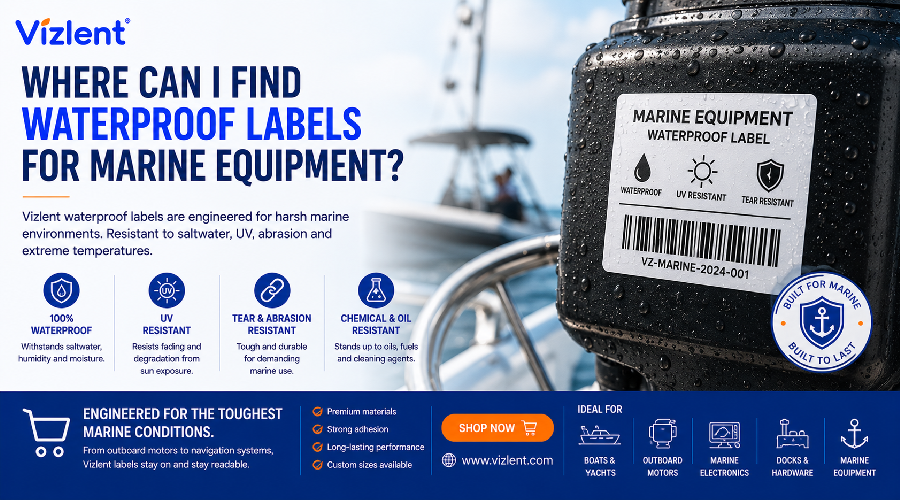
You can find waterproof labels for marine equipment directly from label material manufacturers such as Vizlent. They build UV-stabilized polyester and polypropylene constructions with waterproof adhesives specifically rated for salt spray, rain, and constant humidity exposure. Boat builders, marine electronics suppliers, and dockside equipment manufacturers all rely on the same underlying construction principles, even though the specific parts being labeled vary widely.
Marinas, charter fleets, and individual boat owners searching for replacement labels face a similar sourcing decision, needing either a single replacement decal or a full production run for a manufacturing line. This guide covers where to source waterproof labels for marine equipment, what makes a label genuinely marine grade, and how to specify the right construction for engines, electronics, gear, and packaging.
Where to Find Waterproof Labels for Marine Equipment
Waterproof labels for marine equipment labels are sold through three main channels: direct factory manufacturers, industrial label distributors, and general marketplaces, each suited to a different order size and technical requirement. A waterproof label for marine equipment and supply company relationships built directly with a manufacturer typically gives access to substrate testing data and compliance documentation that a general marketplace rarely provides. Distributors sit in between, often carrying stock from a handful of manufacturers and useful for smaller trial orders before committing to a full factory run.
Vizlent Label’s Outdoor Weather Resistant range documents UV-stabilized polyester and polypropylene constructions rated from -40°C to 150°C, UL 969 recognized for outdoor use, and built to withstand rain, salt spray, and thermal cycling. A waterproof label for marine equipment order placed directly with a manufacturer generally includes this kind of technical data sheet, which helps confirm performance before a bulk commitment. Occasionally buyers also check waterproof labels for marine equipment auctions or surplus listings for used equipment, though these rarely include compliance documentation for the labels already applied.
- Direct factory manufacturers: custom formulation, testing data, and compliance documentation.
- Industrial label distributors: smaller trial orders and multi-brand stock availability.
- General marketplaces: fastest checkout, but limited technical documentation and customization.
Requesting physical samples before committing to a bulk order remains standard practice regardless of which channel a buyer chooses, since a specification sheet cannot fully convey how a label resists moisture, salt exposure, or UV fading in practice. Comparing a handful of suppliers side by side, using the same substrate and marine application, gives a more reliable picture of value than comparing listed prices alone. A short sample and compatibility test is the fastest way to confirm real-world performance before a full production run ships.
What Makes a Label Marine Grade and Waterproof
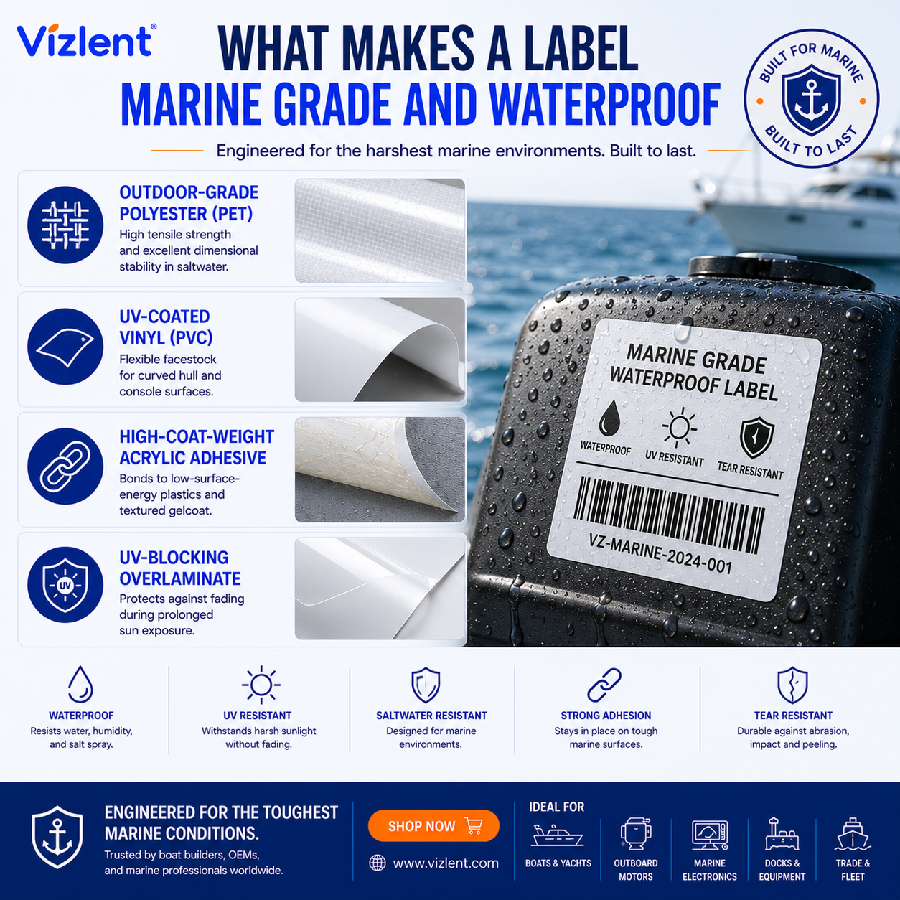
Genuine waterproof labels for marine equipment grade construction combines a synthetic facestock, such as outdoor-grade polyester or UV-coated vinyl, with a high-coat-weight permanent acrylic adhesive rated for continuous moisture exposure. Standard paper labels absorb water and delaminate quickly in a marine environment, while PET and PVC facestocks resist water penetration and maintain dimensional stability even after prolonged saltwater exposure. A UV-blocking clear overlaminate adds a further protective layer against fading, which matters since marine equipment often sits in direct sun for years at a time.
Waterproof labels for marine equipment plastic components, such as helm panels, control housings, and instrument clusters, need an adhesive formulated for low-surface-energy plastics rather than the acrylic used on metal or glass. Waterproof labels for marine equipment protection also depend on tear and abrasion resistance, since dock lines, fenders, and boarding traffic routinely create physical contact with labeled surfaces. Manufacturers validate these properties through accelerated weathering and salt fog testing, simulating years of marine exposure in a matter of weeks.
- Outdoor-grade polyester (PET): High tensile strength, excellent dimensional stability in saltwater.
- UV-coated vinyl (PVC): Flexible facestock for curved hull and console surfaces.
- High-coat-weight acrylic adhesive: Bonds to low-surface-energy plastics and textured gelcoat.
- UV-blocking overlaminate: Protects against fading during prolonged sun exposure.
Buyers evaluating waterproof labels for marine equipment grade options should request salt fog and UV testing data rather than relying on a general waterproof claim alone, since standard outdoor labels are not always tested against sustained saltwater exposure specifically. A construction independently verified through salt spray testing offers more confidence for marine use than one only tested against fresh water or general humidity.
Corrosion around fasteners, hardware, and metal fittings is a related concern on any vessel, and a label’s edge sealing matters as much as its facestock, since moisture that creeps under a poorly sealed edge can eventually lift the entire label regardless of how durable the facestock itself is. Requesting a sample and running your own exposure test on the actual equipment surface remains the most reliable way to confirm performance before ordering in volume.
Waterproof Labels for Marine Equipment Parts and Accessories
Waterproof labels for marine equipment parts cover a wide range of applications, from engine compartment identification to navigation electronics and safety equipment markings. Waterproof labels for marine equipment and parts used in engine compartments need to resist oil, fuel, and elevated operating temperatures in addition to standard waterproofing, since these compartments combine heat, moisture, and chemical exposure in one location.
Waterproof labels for marine equipment and marker applications, such as depth gauges, fuel level indicators, and control panel markings, need to stay legible through years of UV and moisture exposure without fading or lifting. Serial number plates and compliance markings required by regulatory bodies add a further layer of complexity, since these often need to remain legible and attached for the entire service life of the vessel under maritime inspection requirements.
Waterproof labels for marine equipment accessories, including electronics housings, GPS units, and radio equipment, generally require a different adhesive formulation than hull-mounted labels, since these surfaces are often smooth plastic or coated metal rather than gelcoat or fiberglass. Waterproof labels for marine equipment and equipment used across an entire vessel, from the helm to the engine room, should ideally come from a single manufacturer to keep compliance documentation and testing data consistent across every application. Standardizing on one supplier for all onboard labeling reduces the risk of a mismatched label failing in one specific location while others perform correctly.
- Engine compartment labels: Oil, fuel, and elevated temperature resistance in addition to waterproofing.
- Electronics and navigation labels: Smooth plastic and coated metal adhesion compatibility.
- Safety and control panel markings: Long-term UV and moisture resistance for legibility.
Matching the label construction to its specific onboard location, rather than defaulting to one general-purpose label across the entire vessel, is what actually determines long-term performance. A manufacturer’s technical team can usually recommend the right facestock and adhesive combination once the surface material and exposure conditions have been described. Requesting application-specific samples for each distinct onboard location remains the standard way to confirm fit before a bulk order.
Waterproof Labels for Marine Gear, Clothing, and Camp Equipment
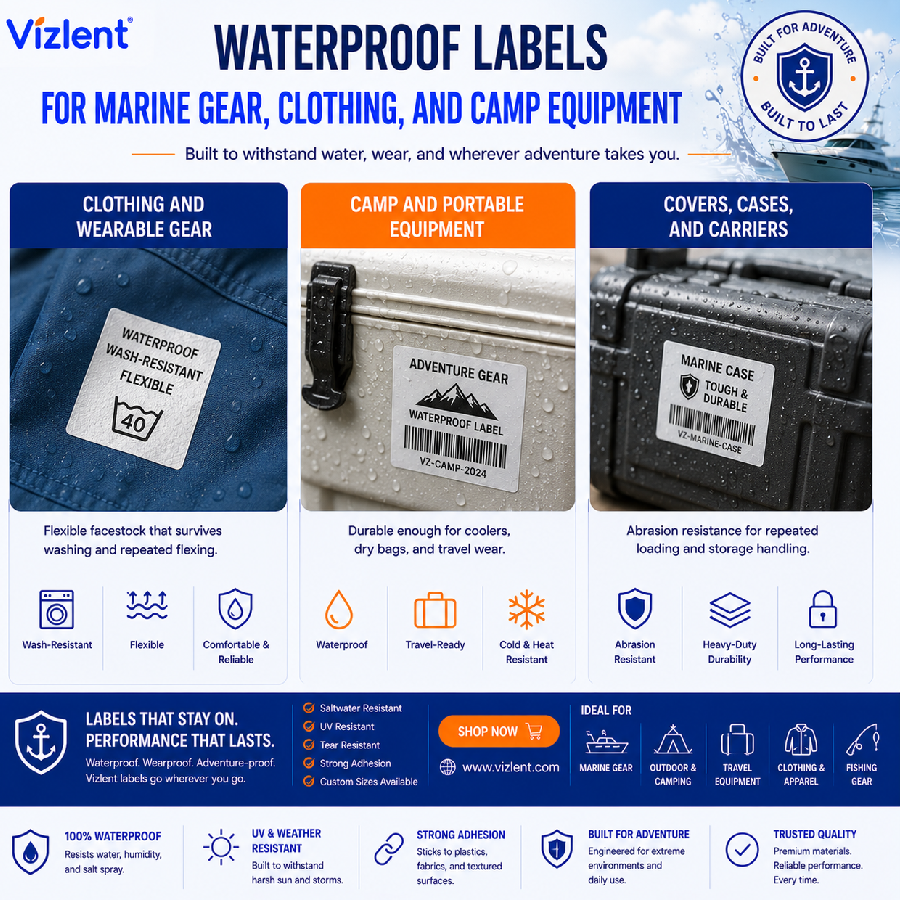
Waterproof labels for marine equipment clothing, such as foul weather gear, life jackets, and wetsuits, need a flexible facestock that can flex and stretch with fabric without cracking or lifting at the edges. This is a different construction from a rigid label mounted on a fiberglass hull or aluminum console, since garment labels also need to survive repeated washing and folding in addition to water exposure. Waterproof labels for marine equipment camp applications, covering coolers, dry bags, and portable gear used on extended trips, share some of these same flexibility and durability requirements.
Waterproof labels for marine equipment covers, waterproof labels for marine equipment cases, and waterproof labels for marine equipment carriers used for storage and transport between trips need to resist abrasion from repeated loading, unloading, and stacking. Waterproof labels for marine equipment decals applied to boat hulls, trailers, and storage covers for branding or identification purposes need the same UV and salt resistance as functional labels, even though their primary purpose is cosmetic rather than informational. Choosing a decal-grade facestock with the same environmental rating as a functional label prevents premature fading that would otherwise undermine a brand’s presentation on the water.
- Clothing and wearable gear: Flexible facestock that survives washing and repeated flexing.
- Camp and portable equipment: Durable enough for coolers, dry bags, and travel wear.
- Covers, cases, and carriers: Abrasion resistance for repeated loading and storage handling.
Buyers sourcing labels across both functional and cosmetic applications should confirm that decal-grade and label-grade constructions share the same base environmental rating, since a beautiful decal that fades within a season undermines the same brand image a durable functional label is meant to protect. Requesting samples of both categories side by side helps confirm this consistency before a combined order ships.
Formats: Decals, Packaging, and Products
Waterproof labels for marine equipment packaging need to survive warehouse storage, shipping, and point-of-sale display in addition to eventual use on the water, since the label often needs to look presentable on a retail shelf before it is ever applied to equipment. Waterproof labels for marine equipment products sold through retail or wholesale channels typically specify a slightly different facestock than a label intended purely for direct application, prioritizing print clarity and shelf appeal alongside baseline waterproofing. Custom sizes, shapes, and finishes are standard across most manufacturers for both packaging labels and functional equipment labels. Barcode and serialization printing on packaging labels also needs to remain scannable through humid warehouse conditions, which is a related but distinct requirement from the waterproofing needed once the product reaches the water.
Format selection also depends on how a business plans to apply the labels during manufacturing or assembly. Roll formats suit automated dispensing on production lines building marine electronics or hardware at scale, while sheet formats suit smaller manufacturers applying labels by hand. Confirming print compatibility, such as thermal transfer, digital, or factory pre-printing, should happen before finalizing a format decision for any waterproof labels for marine equipment product line.
- Roll formats: Suited to automated, high-speed production line dispensing.
- Sheet formats: Suited to manual application in smaller manufacturing operations.
- Custom die-cut shapes: Sized for control panels, curved surfaces, or irregular equipment geometry.
Requesting a physical sample of the exact format and finish under consideration remains the most reliable way to confirm a design choice before a full production run ships. A label that looks correct in a product rendering can still underperform if the adhesive formulation does not match the actual surface material and marine environment in use. Physical testing on the real application surface is the standard first step across the industry.
Sourcing Waterproof Labels for Marine Equipment: Business, Company, and Bulk Ordering
Waterproof labels for marine equipment business relationships built on documented testing and transparent pricing tend to hold up better over repeat orders than one chosen on price alone. A waterproof label for a marine equipment company should be able to provide salt fog testing data, UV fade resistance ratings, and adhesive compatibility information for the specific surfaces you plan to label, not just a general waterproofing claim. Comparing this documentation across several suppliers, rather than comparing listed prices alone, gives a clearer picture of actual value.
Vizlent Label’s contact page is a reasonable place to request a volume-based quote once your specific parts, surfaces, and exposure conditions are mapped out. Bulk orders typically bring the per-unit price down significantly compared to small trial runs, though setup costs for custom die-cut shapes or specific adhesive formulations still apply regardless of volume. Requesting a quote that separates setup cost from per-unit pricing makes it easier to compare suppliers fairly across a large order.
- Request salt fog and UV testing data before committing to a supplier relationship.
- Confirm minimum order quantities and lead time for custom shapes or formulations.
- Compare documented performance claims, not just listed price per unit.
A short sample and compatibility test remains the fastest way to confirm real-world performance before a bulk commitment, regardless of how complete a specification sheet looks on paper. Manufacturers that provide this testing support readily are generally easier to work with over a long-term supply relationship than sellers who only quote price per thousand. Seasonal ordering patterns are also worth planning around, since many marine equipment manufacturers see demand spike ahead of spring launch season, and placing a bulk order early in the off-season often secures better lead times than waiting until the rush begins.
Ready to Source Waterproof Labels for Marine Equipment
Understanding where to find waterproof labels for marine equipment matters most once you are ready to match a specific facestock, adhesive, and testing requirement to your actual vessel, parts, and exposure conditions. Vizlent has manufactured self adhesive label stock since 2011, supplying converters, distributors, and brand owners across more than fifty countries with constructions certified to ISO 9001, FSC, and SGS standards. Send an inquiry through Vizlent Label’s contact page to request samples and a quote suited to your exact marine environment, or explore the full Outdoor Weather Resistant product range to compare constructions side by side.
For applications needing additional protective layers, Vizlent’s Laminating Films range covers overlaminate options that add UV and abrasion protection on top of a base label construction. Vizlent’s Durable Labels range and knowledge base cover additional material comparisons for teams evaluating marine labeling options against other demanding environments. Fleet operators managing labeling across multiple vessels, or manufacturers building marine equipment at scale, generally benefit from consolidating their labeling program with a single supplier once initial samples have confirmed performance across every application. Sourcing the right waterproof labels for marine equipment comes down to matching facestock, adhesive, and testing documentation to your actual application, not choosing based on price alone.
Frequently Asked Questions
Where can I find waterproof labels for marine equipment?
Waterproof labels for marine equipment are available directly from manufacturers, through industrial label distributors, and from general marketplaces, with each channel offering different levels of customization and documentation. Buying directly from a manufacturer typically gives access to salt fog testing data, compliance documentation, and custom formulation options. Requesting samples before committing to volume is standard practice regardless of which channel you choose.
What makes a label suitable for marine equipment specifically?
A marine grade waterproof label combines a synthetic facestock, such as polyester or vinyl, with a high-coat-weight acrylic adhesive rated for continuous moisture and salt exposure, often finished with a UV-blocking overlaminate. Standard outdoor labels are not always tested specifically against sustained saltwater exposure, so requesting salt fog testing data is important for marine applications. Edge sealing is another detail worth confirming, since moisture that creeps under a poorly sealed edge can eventually lift even a well-formulated facestock. This combination resists water penetration, UV fading, and physical abrasion in ways that standard paper labels cannot.
Do marine equipment labels need different adhesives for different parts?
Yes, engine compartment labels need oil, fuel, and heat resistance in addition to waterproofing, while labels for smooth plastic electronics housings need an adhesive formulated for low-surface-energy surfaces. Console and hull-mounted labels applied to gelcoat or fiberglass may need a different adhesive than one applied to painted aluminum. Matching the adhesive to the specific surface material is one of the most important steps in specifying marine labels correctly.
Are waterproof labels for marine clothing and gear different from equipment labels?
Yes, labels for foul weather gear, life jackets, and wetsuits need a flexible facestock that survives repeated washing, folding, and fabric stretching, unlike a rigid label mounted on a hull or console. Camp and portable gear used on extended trips share some of these flexibility requirements. Requesting samples specific to garment or fabric applications, rather than assuming a general marine label works everywhere, avoids early failure.
What formats are available for waterproof labels for marine equipment?
Roll formats suit automated production line dispensing, while sheet formats suit manual application in smaller manufacturing operations. Custom die-cut shapes are available for control panels, curved surfaces, and irregular equipment geometry. Confirming print compatibility with your specific printing method should happen before finalizing a format decision.
How much do waterproof labels for marine equipment cost in bulk?
Bulk orders typically bring the per-unit price down significantly compared to small trial runs, though setup costs for custom die-cut shapes or specific adhesive formulations still apply regardless of volume. Requesting a quote that separates setup cost from per-unit pricing makes it easier to compare suppliers fairly. Comparing documented testing data alongside pricing helps confirm that a lower price is not hiding a weaker construction.
Should I buy marine equipment labels from auctions or surplus listings?
Auctions and surplus listings can work for used equipment that already has labels applied, but they rarely include compliance documentation or testing data for those existing labels. For new labeling needs, ordering directly from a manufacturer or authorized distributor gives more reliable access to salt fog testing data and adhesive compatibility information. Requesting fresh samples remains the standard way to confirm performance regardless of sourcing channel.
Can decals and branding labels for boats use the same construction as functional labels?
Yes, decal-grade facestocks should carry the same UV and salt resistance rating as functional equipment labels, even though decals serve a cosmetic rather than informational purpose. A decal that fades within a season undermines brand presentation just as much as a functional label failing prematurely would undermine safety information. Requesting matched environmental ratings across both categories keeps a vessel’s overall presentation consistent over time.






