
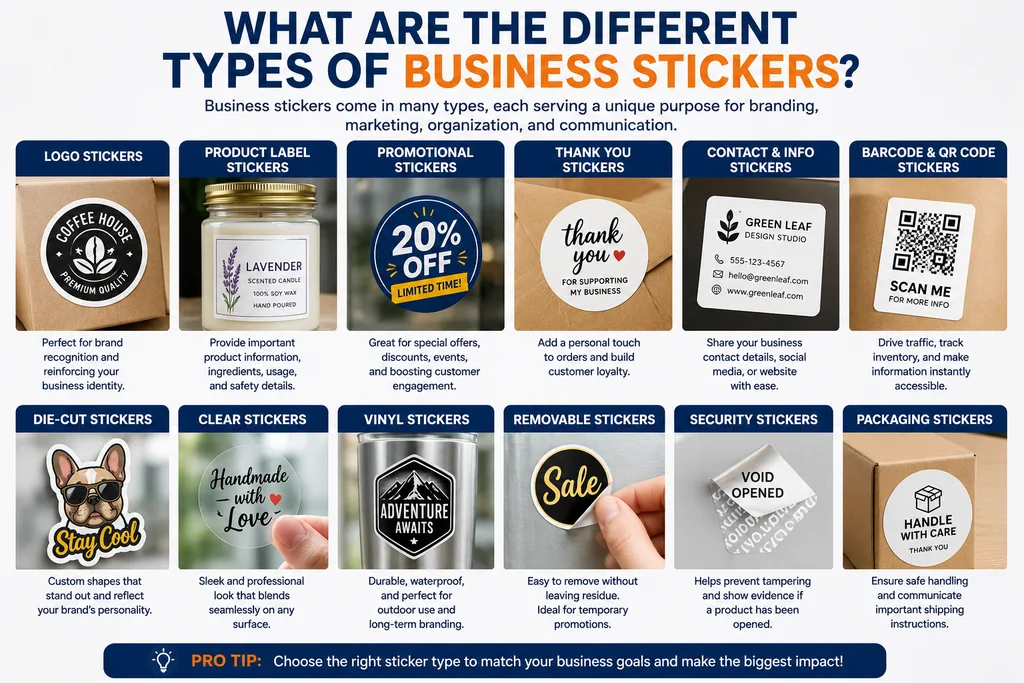
Business stickers are pressure sensitive printed graphics supplied on a release liner and applied to products, packaging, equipment, or promotional items. The different types of business stickers fall into six working groups: promotional, product and packaging, barcode and logistics, safety and hazard, security and tamper evident, and durable stickers for harsh environments. Format, facestock material, and adhesive grade decide which one survives its application.
Ask what the types of business stickers are and you usually get a shape list back. Circles, squares, rounded rectangles. Shape is the cheapest variable in the construction, and it explains none of the failures we get asked to diagnose.
Vizlent has coated and slit self-adhesive material since 2011 and supplies converters in 50+ countries. Almost none of those failures are design failures. They are material and adhesive mismatches, so what follows is organized around construction and end use.
Reading the claims below: Regulatory requirement comes from a cited rule or statute. Classification reference comes from a published classification system, which is not the same as a legal obligation. Industry convention is common practice, not law. Vizlent product data comes from our published product information, and current certificates or documentation are available on request.
What Actually Counts as a Business Sticker
A business sticker is any self adhesive graphic applied for commercial purposes. That covers a logo sticker on a coffee cup and a serialized asset tag on a switchgear cabinet equally. Pressure sensitive stickers, which account for most of them, typically use three core layers.
Change any layer and the sticker behaves differently, even with identical artwork. Marketing teams say stickers when the graphic is decorative and label when it carries required information. Buyers get better results specifying the self adhesive material instead.
- Facestock. The printable top layer: paper, BOPP, PET, PVC, vinyl, or specialty stock.
- Adhesive. Permanent, removable, repositionable, high tack, freezer grade, or wash off.
- Release liner. Glassine, CCK, or PET. It controls how the sticker runs through a die cutter.
How the Different Types of Business Stickers Are Grouped
Accept the three layer model and the categories sort along three axes, not one. Format governs how a sticker is applied. Material and adhesive govern whether it stays applied.
Buyers who specify only format reorder within a quarter. A die cut vinyl sticker and a die cut paper sticker look identical in a proof and behave nothing alike on a chilled bottle. Specify all three axes on the quote request and the failure rate drops before production starts.
Format and Cut Types
Format maps to how the sticker arrives. Roll labels feed applicators and thermal printers. Sheet and kiss cut formats suit hand application and low volume runs.
Die cut stickers are cut through facestock and liner, so each piece is separate. Kiss cut stickers are cut through the facestock only, leaving a backing border that makes peeling easier. Transfer stickers use application tape to move multi piece lettering onto glass in one pass, a related construction rather than a standard pressure sensitive label.
- Roll labels. Wound on a core for print and apply lines and inline converting.
- Sheet labels. For laser printing and inkjet printing stock.
- Die cut stickers. Cut to the artwork outline, supplied loose or on a carrier.
- Kiss cut stickers. Easiest for hand application and sticker packs.
- Window decals and clings. Static or adhesive backed film for storefront glass.
Shrink sleeves and in-mould labels are related decoration formats, but they are not pressure sensitive stickers and are specified differently.
Facestock Material Types
Material selects itself once you know the surface, temperature range, and exposure. Coated paper often offers a low relative cost with good print quality, but it darkens and tears when wet. Films cost more and tolerate moisture, oils, abrasion, and UV.
Four workhorse films cover most applications. BOPP constructions can perform well on squeeze bottles and condensation prone packaging when paired with a compatible adhesive, while polyester constructions are usual where heat, solvents, or long service life are involved. PVC and vinyl bridge outdoor durability with conformability, and converters buying unconverted stock work from the raw material label range.
| Facestock | Typical use | Strength | Watch out for |
|---|---|---|---|
| Coated paper | Promotional and shipping labels | Low relative cost, sharp print | Moisture, oils, tearing |
| BOPP | Bottles, food, cosmetics | Water resistant, conformable | Limited heat range |
| PET / polyester | Asset tags, warranty seals | Stability, chemical resistance | Cost, stiffness on curves |
| PVC / vinyl | Decals, vehicle graphics | Conformability, weathering | Regulatory scrutiny in some markets |
| Eggshell paper | Tamper evident seals | Fractures when peeled | Single use by design |
Indicative only. Confirm every construction against the applicable technical data sheet.
Adhesive Grades
Adhesive decides whether the sticker is still there next year. Permanent acrylics build bond strength over time. Removable adhesives release cleanly within a defined window, which is not the same as forever.
Vizlent publishes eight adhesive formulations across hot melt and water based acrylic chemistries, covering permanent, removable, freezer, and wash off grades (Vizlent product data). Surface energy matters as much as temperature. Textured totes, powder coated steel, and recycled corrugate need more tack than smooth glass, which is what super sticky low energy constructions exist for.
Branding and Promotional Stickers
Promotional stickers are the least demanding group technically. Logo stickers, packaging seals, laptop stickers, and event giveaways mostly live indoors on clean surfaces. Coated paper or BOPP with a permanent acrylic covers most of them.
The exception is anything handled, washed, or left in a car. Those need film facestock and often an overlaminate, which is where laminating film enters the specification. Among the different types of business stickers, this group shows the widest gap between what buyers order and what the application requires.
Common examples of business stickers here:
- Kiss cut logo sheets for order inserts and trade show handouts
- Die cut vinyl stickers for hard hats, toolboxes, and laptops
- Foil or hologram accented seals for premium packaging closure
- Reusable flexible magnetic stickers for fleet signage
Sourcing a promotional run? Request free A4 samples and run them on your own press first. Contact the Vizlent technical team with your print method and substrate.
Product and Packaging Label Stickers
Product label stickers carry what a buyer or regulator expects on the pack. The Fair Packaging and Labeling Act establishes disclosure requirements for covered consumer commodities, including identity of the commodity, net quantity of contents, and the name and place of business of the manufacturer, packer, or distributor, subject to its scope and exemptions (regulatory requirement). Products such as food, drugs, medical devices, and cosmetics are also subject to product specific federal requirements, including the FDA food labeling rules.
Adhesive selection carries a compliance dimension that surprises first time buyers. Where the adhesive can become the food contact surface of a label, 21 CFR 175.125 is the relevant section, while 21 CFR 175.105 addresses adhesives separated from food by a functional barrier (regulatory requirement). Citing a section does not by itself establish compliance: applicability depends on the adhesive formulation, construction, intended use, and conditions of use, so ask your supplier for current compliance documentation covering the specific grade.
- Semi gloss coated paper for dry goods and shelf stable packaging
- BOPP for beer and beverage containers exposed to condensation
- Wash off adhesives for returnable glass bottling
- Freezer grade stock from the low temperature label range
Barcode, Shipping, and Logistics Stickers
Logistics stickers are judged on one thing: first pass scan rate. Print quality is graded against ISO/IEC 15416 for linear symbols. A barcode that grades acceptably on smooth white facestock can fall out of specification on a textured or reflective one.
Ribbon pairing is the other half. Wax ribbons are commonly used with coated paper, while wax resin and resin grades are often selected for synthetic films and for applications needing greater abrasion or chemical resistance, so the thermal transfer ribbon gets specified alongside the facestock rather than after it. Of every group covered here, this one has the tightest tolerance for material substitution.
- Shipping and carrier labels for automated sortation
- Pallet and carton identification for warehouse scanning
- Inventory, bin location, and reverse logistics labels
- Serialized asset tags on durable label stock
High volume fulfilment buyers should start with the logistics and e-commerce range, built around print speed and scan reliability rather than shelf appeal.
Safety, Hazard, and Compliance Stickers
Safety stickers are where the wrong material has consequences beyond reorder cost. Under OSHA’s Hazard Communication Standard at 29 CFR 1910.1200, shipped containers of hazardous chemicals must carry a label showing the product identifier, signal word, hazard statements, pictograms, precautionary statements, and the responsible party’s name, address, and telephone number (regulatory requirement). A label that becomes illegible, detaches, or otherwise fails to communicate the required information can create a compliance problem.
Chemical drums, solvent exposure, and outdoor storage push the specification toward films with resistant topcoats. Electrical and appliance work adds flame retardancy, addressed by flame retardant label constructions. Acceptance thresholds should defer to the applicable customer or industry specification, not a generic category claim.
Security and Tamper Evident Stickers
Security stickers are engineered to fail on purpose. Eggshell paper is an ultra brittle facestock that fractures into fragments when peeled, so the seal cannot be lifted intact and reapplied. VOID constructions work differently, transferring a permanent VOID pattern to the substrate on removal.
Warranty seals, asset protection, and anti counterfeiting all draw from this group. Layered constructions combine holographic overlaminates with covert UV inks and serialized 2D codes, the approach documented across the brand protection and security range (Vizlent product data). Of all the sticker constructions covered here, this group is the most substrate sensitive: an adhesive that voids reliably on painted steel may not void at all on textured HDPE.
- VOID sticker stock for warranty and electronics seals
- Eggshell paper for destructible seals and asset labels
- Water sensitive paper constructions that produce an irreversible colour change on moisture contact (Vizlent product data)
- Water soluble paper for returnable containers and clean removal
Durable Stickers for Harsh Environments
Durable stickers are defined by environment, not industry. Heat, cold, UV, solvents, static, and abrasion each drive a different facestock and adhesive pairing. One construction rarely covers two extremes at once.
Published service temperatures for specified Vizlent constructions show the spread: PP to -196°C, PET to -80°C, PVC to -40°C, and coated paper to -20°C (Vizlent product data). These are figures for named constructions, not universal temperature ratings for PP, PET, PVC, or paper as material categories. Specify from the data sheet outward rather than from the artwork inward, or the sample round is wasted.
| Environment | Where it shows up |
|---|---|
| Heat resistant | Under hood, powder coat lines, electronics |
| Outdoor weather resistant | Signage, agriculture, utilities |
| Anti static | ESD sensitive assembly and packaging |
| Vulcanized rubber | Green tire marking through curing |
| Petrochemical and drums | Solvent and hydrocarbon exposure |
Indicative and construction specific. Confirm against the data sheet for the grade quoted.
Specialty Formats Most Buyers Miss
Some formats solve one problem well and get overlooked. Laser markable stock can create a permanent mark without conventional ink or thermal transfer ribbon consumables, though the laser system itself still needs equipment, power, and maintenance. Cable flag labels fold back on themselves so the printed area stays readable on thin wire.
These are often cheaper than the workaround they replace. A laser marking label material can remove ribbon inventory from a marking cell, and cable labels replace the handwritten tags that fail an audit. Some biodegradable label constructions can be certified to compostability standards such as EN 13432 or ASTM D6400, but certification is construction specific and applies to the tested product rather than to a material category (industry convention).
What Type of Business Is a Sticker Business?
Sticker businesses can fall into different NAICS classifications depending on their primary manufacturing, printing, or wholesale activity. Under the system maintained by the US Census Bureau, printing stickers and labels on purchased stock on a job order basis sits in 323111, Commercial Printing (except Screen and Books), while screen printed work sits in 323113 (classification reference). Manufacturing the paper stock itself falls in subsector 322, and a business that mainly resells finished stock may classify under wholesale trade instead.
Classification follows the primary activity rather than the product name, which is why two sticker companies can legitimately carry different codes. The same logic maps the supply chain: printers buy converted stock, converters buy jumbo rolls, and material manufacturers coat the adhesive and liner. Vizlent sits at the material end of that chain.
How to Choose Between Different Sticker Types
Choosing between different sticker types is four questions in a fixed order. Surface first, environment second, dwell time third, print method last. Reverse that order and you get a beautiful sticker that curls off a chilled bottle in a week.
Different types of business labels are quoted against the same four inputs, so having them ready shortens the sample cycle. Vizlent supplies free sample rolls and A4 sheets, so you verify peel strength, print compatibility, and die cutting on your own equipment before any bulk commitment (Vizlent product data). Published guidance minimums start around 1,000 sqm depending on material, with trial quantities supported case by case and the exact figure confirmed at quotation (Vizlent product data).
- What surface? Glass, HDPE, corrugate, powder coated metal, textured plastic.
- What environment? Temperature range, moisture, UV, chemicals, abrasion, static.
- How long must it stay, and how must it come off? Permanent, removable, wash off, or destructible.
- What print method? Thermal transfer, inkjet, laser, flexo, or digital.
Checkpoint: if you cannot answer question two with a number, send an application photo and the storage conditions to your supplier before requesting a quote. It saves a full sample round.
Send Us Your Specification
Vizlent manufactures the self adhesive material behind every one of the different types of business stickers described above, with 12+ facestocks and 8 adhesive formulations published across our range (Vizlent product data). Our materials are manufactured under an ISO 9001 quality system, with FSC and SGS certified constructions available on specified grades, and we supply current certificates or declarations of conformity for the grade you are buying. Free samples ship before any bulk commitment, so your line validates the construction instead of trusting a data sheet.
Send the following with your inquiry so our engineering team can specify accurately on the first pass:
- Surface and finish. Material, texture, painted, coated, or bare.
- Temperature range. Application and service temperature, stated separately.
- Exposure conditions. Moisture, UV, chemicals, abrasion, static, sterilization.
- Service life and removal. Permanent, removable, wash off, or destructible.
- Print method. Press or printer model, ribbon type if applicable.
- Format and dimensions. Roll or sheet, slit width, core size, die line.
- Volume and packaging. Annual usage, order quantity, export packing needs.
Request your free sample and quote, or browse the knowledge library for material selection guides by application.
Frequently Asked Questions
How many different types of business stickers are there?
There is no fixed count, because these are classified by construction rather than a closed list. The practical answer is six functional groups: promotional, product and packaging, logistics, safety, security, and durable. Within each group, format, facestock, and adhesive combine into dozens of distinct constructions.
What are the types of stickers used most often by small businesses?
Small businesses use promotional and product label stickers most heavily, usually kiss cut sheets or roll labels on coated paper or BOPP. Sheet formats suit desktop laser and inkjet printers, while roll formats suit thermal printers. The upgrade point arrives when a product moves into refrigeration or outdoor use and paper stops performing.
What is the difference between business stickers and business labels?
The difference is intent rather than construction, since both are pressure sensitive materials with a facestock, adhesive, and liner. Stickers usually carry branding, while labels carry required information such as ingredients, barcodes, or hazard statements. Labels are more likely to be governed by a regulation, which raises the bar on legibility and durability.
Are vinyl stickers always more durable than paper stickers?
Films generally outperform paper on moisture, abrasion, oils, and UV, so they are the outdoor default. Durability still depends on the full construction, because a film facestock with the wrong adhesive lifts from a low energy surface as fast as paper would. Confirm expected service life against the technical data sheet rather than assuming the facestock decides it.
What sticker material works best on frozen or refrigerated products?
Freezer constructions use adhesives formulated to bond at reduced application temperatures and hold through thermal cycling. Application temperature matters more than storage temperature, because most adhesives will not wet out onto an already frozen surface. Verify both the minimum application temperature and the service temperature before specifying.
Do tamper evident stickers work on every surface?
No, and this is the most common failure in the security category. Void and destructible constructions rely on a balance between adhesive strength and facestock cohesion, and that balance shifts with the substrate. Run a destructive test on the exact substrate and finish you will use in production.
Can I print business stickers on a normal office printer?
Yes, provided you buy sheet stock rated for your printer type. Laser stock uses a topcoat and adhesive stable at fuser temperatures, while inkjet stock uses a receptive coating that anchors water based ink without feathering. Using the wrong one causes adhesive ooze in a fuser or smearing on an inkjet.






