
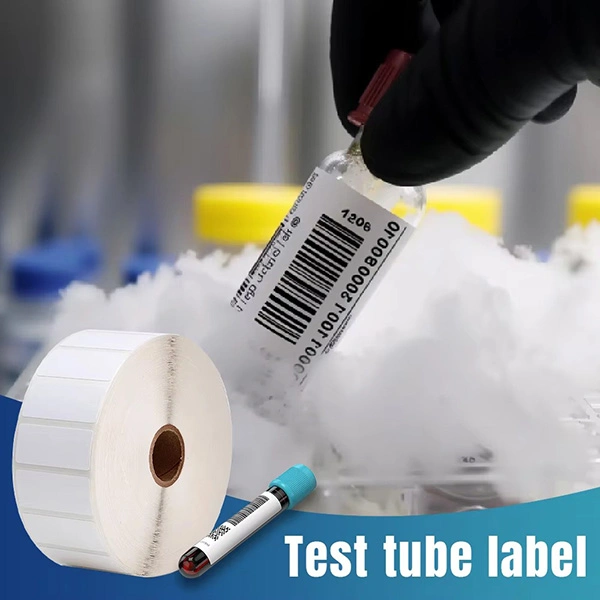
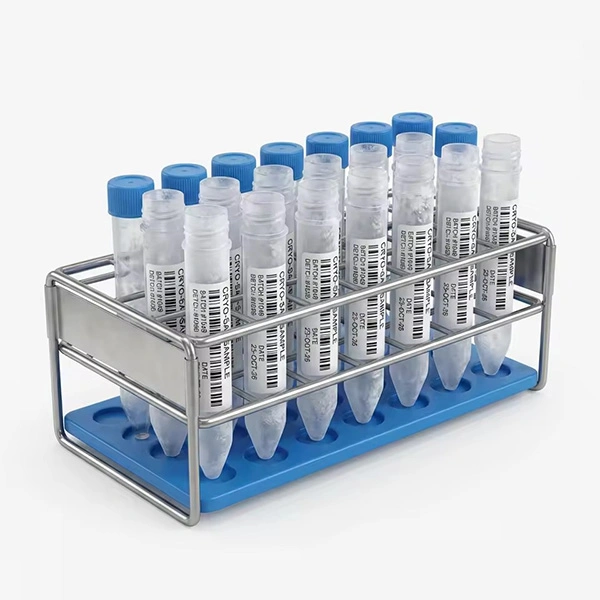
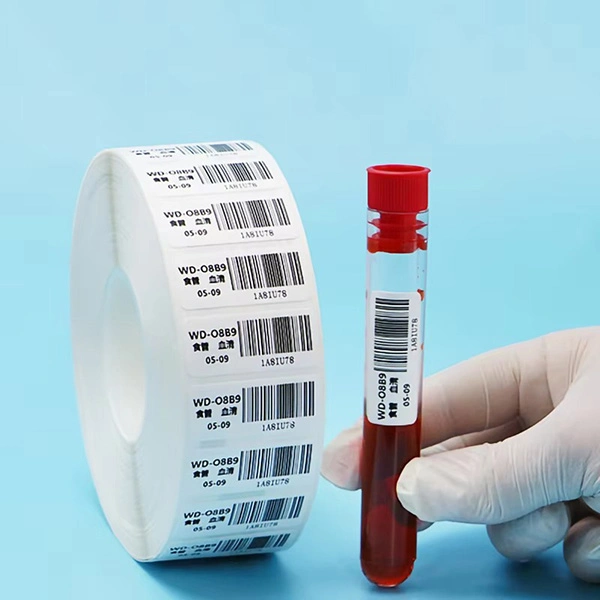
Cryo Laboratory Labels for Liquid Nitrogen Storage
- Survives direct immersion in liquid nitrogen at -196 °C without bond failure
- Cryogenic adhesive formulated for polypropylene cryovial bond strength at LN₂ temperature
- Frost-resistant face — barcodes and text remain scannable through surface ice
- Available for liquid-phase immersion and vapour-phase LN₂ storage systems
- Resistant to DMSO, ethanol, and glycerol cryoprotectant contact
Frost-Proof Cryo Labels That Survive Direct Liquid Nitrogen Immersion
Cryo Laboratory Labels for Liquid Nitrogen Storage are engineered specifically for the most demanding cryogenic labelling application: direct immersion of labelled sample tubes in liquid nitrogen at -196 °C, the standard storage modality for long-term preservation of cell lines, tissue, plasma, and other biological materials in liquid-phase LN₂ cryostorage tanks.
Liquid-phase storage is more thermally stable than vapour-phase storage but subjects labels to the extreme cold shock of direct contact with liquid nitrogen, which transitions standard adhesives into a brittle, non-adherent state and can cause standard label face materials to crack or become opaque.
VIZLENT formulates the adhesive and selects the face material for Cryo Laboratory Labels for Liquid Nitrogen Storage to maintain their functional properties under liquid nitrogen contact, providing a reliable identification that is as durable as the biological sample it protects.
- The practical consequence of label failure in an LN₂ storage programme is sample misidentification — a critical quality failure in any biorepository, cell bank, or clinical trial sample archive.
- Once a label separates from a tube in a liquid nitrogen tank, the detached label sinks to the tank bottom and the unlabelled tube cannot be reliably identified without extensive recovery procedures, if at all.
- VIZLENT’s Cryo Laboratory Labels for Liquid Nitrogen Storage address this risk by delivering validated adhesion performance on polypropylene cryovial substrates at -196 °C, giving biobank quality managers confidence that sample identity will be maintained throughout the storage period regardless of how many retrieval and immersion cycles the tube undergoes.
Applications
Liquid-phase liquid nitrogen biobank storage of cell lines, primary cells, tissue fragments, and blood derivatives; pharmaceutical GMP cell bank master and working bank cryovial identification; clinical trial biological sample liquid nitrogen archive in contract research organisations; cord blood bank cryopreservation unit identification; reproductive medicine gamete and embryo liquid nitrogen storage labelling; infectious disease reference culture collection LN₂ preservation and identification.
Specifications
Cryo Laboratory Labels for Liquid Nitrogen Storage should be specified by validated adhesive performance under direct LN₂ liquid-phase immersion on the specific cryovial polypropylene substrate, resistance to cryoprotectant chemical contact, and print system compatibility for the barcode or accession number format required by the biorepository information management system.
| Item | Cryo Laboratory Labels for Liquid Nitrogen Storage |
|---|---|
| Brand | Vizlent |
| Minimum Temperature Rating | -196 °C — validated for LN₂ liquid-phase immersion |
| Maximum Temperature Rating | +80 °C (standard); autoclave variant available on request |
| Adhesive Type | Cryogenic-grade low-Tg acrylic — bond retained at LN₂ temperature |
| Substrate Compatibility | Polypropylene cryovials (standard 2 ml format); glass and HDPE available |
| Face Material | White polyester (PET) — non-embrittling, frost-resistant at -196 °C |
| Printing Method | Thermal transfer with resin ribbon (recommended); laser marking |
| Barcode Formats | Code 128, Data Matrix ECC200, QR Code; scan-readable post-LN₂ immersion |
| Chemical Resistance | DMSO, ethanol (70%), glycerol, IPA, liquid nitrogen |
| LN₂ Immersion Performance | Label adhesion and print integrity maintained after repeated LN₂ immersion |
| Available Formats | Wrap-around tube label; cap-top dot; combination tube + cap sets |
| MOQ | 1,000 labels per format and specification |
| Sample | Available for LN₂ immersion validation testing on customer tubes |
| Payment Term | T/T 30% deposit, balance before shipment |
| Production Time | 10–18 working days after artwork approval and deposit |
Performance Standards
Cryo Laboratory Labels for Liquid Nitrogen Storage are relevant to ISBER Best Practices for Repositories (label adhesion and legibility for cryogenic biospecimen identification), ISO 20387 (biobanking — general requirements), and applicable GMP guidelines for pharmaceutical cell bank identification, which collectively establish adhesion durability, barcode scan reliability, and chain-of-custody traceability requirements for sample labels used in liquid nitrogen storage systems.
Certifications
VIZLENT produces Cryo Laboratory Labels for Liquid Nitrogen Storage under ISO-certified quality management processes and validates adhesive and face material performance under direct LN₂ liquid-phase immersion conditions, making them suitable for GMP cell banking, biobank, clinical research, and reproductive medicine LN₂ storage programmes in the EU, US, and Asia-Pacific markets.
You May Also Need
-
Laboratory Cryogenic Resistant Labels for 2ml Tubes Sized and calibrated for precise fit on standard 2 ml cryovial tube formats Cryogenic-grade adhesive rated to -196 °C on polypropylene cryovial bodies Wrap-around format engineered to avoid cap junction — prevents bridging and lifting Frost-resistant polyester face — print and barcode legible through condensation Dimensionally stable at […]
-
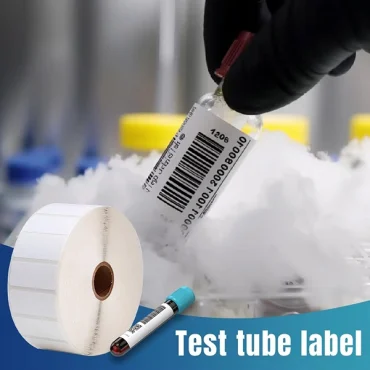
Cryo Laboratory Labels for Liquid Nitrogen Storage Survives direct immersion in liquid nitrogen at -196 °C without bond failure Cryogenic adhesive formulated for polypropylene cryovial bond strength at LN₂ temperature Frost-resistant face — barcodes and text remain scannable through surface ice Available for liquid-phase immersion and vapour-phase LN₂ storage systems Resistant to DMSO, ethanol, and […]
-
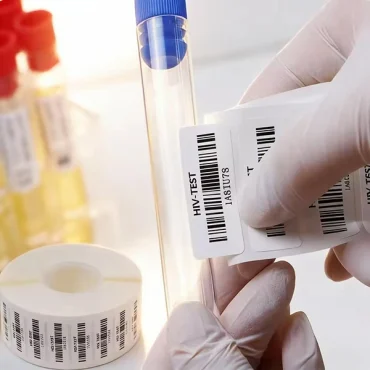
Cryogenic Labels for Laboratory Cold Storage Rated for -80 °C ULT freezer storage and -196 °C liquid nitrogen systems Adhesive maintains bond on polypropylene and glass across full cold storage range Frost-resistant polyester face — print legible through condensation on retrieval Suitable for cryovials, microcentrifuge tubes, blood collection tubes, and cryoboxes Resistant to freeze-thaw cycling […]
-
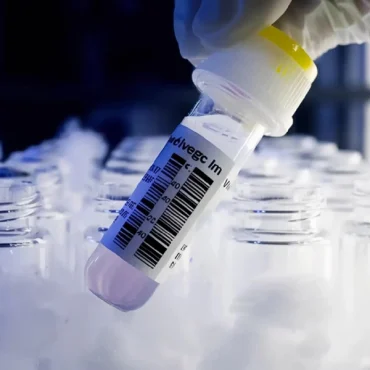
Laboratory Cryogenic Labels Rated to -196 °C for liquid nitrogen and vapour-phase cryostorage Cryogenic adhesive bonds to polypropylene, glass, and HDPE sample containers Frost-resistant polyester face maintains print legibility through condensation and ice Dimensionally stable — no shrinkage, cracking, or embrittlement at cryogenic temperatures Chemical resistant to DMSO, ethanol, glycerol, and aqueous cryoprotectant solutions Send […]
-
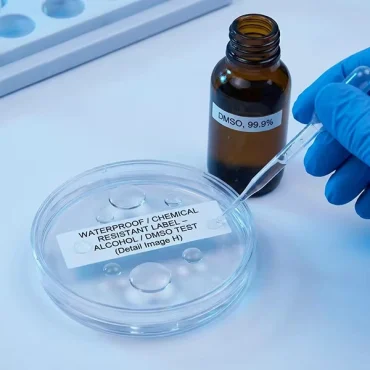
Laboratory Sample Identification Labels Suitable for tubes, microcentrifuge vials, plates, and sample containers Available for ambient, refrigerated, frozen, and cryogenic storage temperatures Chemical-resistant face material withstands ethanol, IPA, DMSO, and common lab reagents Compatible with thermal-transfer, laser, and direct-thermal laboratory printers Supports 1D barcodes, 2D Data Matrix, and QR codes for LIMS integration Send Your […]
-
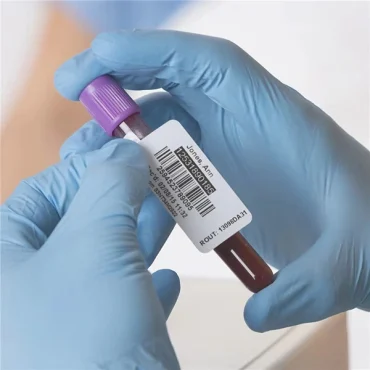
Liquid Nitrogen Label for 2ml Laboratory Tube Rated for continuous immersion in liquid nitrogen at -196 °C Cryogenic acrylic or rubber-based adhesive maintains bond at ultra-low temperatures Sized precisely for standard 2 ml microcentrifuge and cryovial tube formats Frost-resistant face material — print remains legible through ice and condensation Compatible with thermal-transfer, laser, and direct-thermal […]
Frequently Asked Questions
Yes. VIZLENT pre-prints Cryo Laboratory Labels for Liquid Nitrogen Storage with customer-specified Data Matrix ECC200 codes, Code 128 barcodes, QR codes, and human-readable accession numbers generated from a customer-supplied data file or numbering range. We provide the encoded data file alongside the label shipment for import into the biobank LIMS or repository management system. Custom fixed content — facility name, storage programme identifier, or species/sample type codes — can be incorporated alongside the variable accession number field.
Yes. VIZLENT’s Cryo Laboratory Labels for Liquid Nitrogen Storage are validated for direct liquid-phase LN₂ immersion, meaning the label is designed to survive complete submersion in liquid nitrogen at -196 °C — not just vapour-phase exposure. The cryogenic adhesive retains its bond on polypropylene under the rapid cold shock of LN₂ contact, and the polyester face does not crack or delaminate. After retrieval and thawing, the label print and adhesion remain intact. This performance is specifically validated by VIZLENT’s label construction testing protocol for LN₂ liquid-phase applications.
The minimum order quantity for Cryo Laboratory Labels for Liquid Nitrogen Storage is 1,000 labels per specification. Production lead time is 10–18 working days from artwork approval and deposit receipt. For GMP cell banking facilities and biobanks with high-volume sample intake programmes, VIZLENT offers scheduled delivery arrangements to ensure a consistent label supply without the need to place frequent small orders. Validation sample sets are available for LN₂ immersion testing before the first production order.
A detached label floating in a liquid nitrogen tank is a critical quality event in any biorepository, as it creates the risk of sample misidentification if the detached label comes to rest against an adjacent unlabelled or differently labelled tube. This is exactly the risk that VIZLENT’s Cryo Laboratory Labels for Liquid Nitrogen Storage are engineered to prevent. Our validated cryogenic adhesive bond on polypropylene at -196 °C is designed to eliminate label detachment under normal storage and retrieval conditions, removing the risk of label exchange within the tank. We strongly recommend requesting validation samples for testing on your specific tube brand before production to confirm that label adhesion meets your quality system’s acceptance criteria.
Application of pressure-sensitive labels to frosted or very cold tube surfaces is not recommended for optimal adhesive bond, as surface frost acts as a barrier between the adhesive and the tube substrate, preventing direct contact and bond formation. For biobank relabelling programmes, VIZLENT recommends allowing tubes to reach ambient temperature and ensuring the surface is completely dry and frost-free before label application. Where relabelling must be performed at low temperatures — for example, in a cold room to maintain sample integrity — we can advise on application techniques and adhesive specifications that improve performance under these conditions; please consult our technical team for guidance specific to your relabelling workflow.

