

Choosing heat shrink labels for electrical cable identification means matching a shrink-ratio sleeve, a printer-compatible material, and a temperature rating to the exact wire diameter, environment, and code requirements of your installation. A heat shrink label is a printable polyolefin sleeve that slides over a wire and shrinks tight with heat, locking a permanent, abrasion-resistant marker onto the cable. The right choice depends on three measurable factors: the cable diameter range the sleeve must shrink across, the operating temperature and chemicals it will face, and the printing method you use to apply text or barcodes.
Electricians, panel builders, and maintenance teams rely on these sleeves because adhesive labels eventually peel from bundled or oily cable, while a shrunk sleeve cannot fall off. A clear heat shrink labels for electrical cable identification guide turns that selection logic into a repeatable routine, helping you specify correctly the first time and avoid unreadable circuits, failed inspections, and costly rework during commissioning. The sections below cover what these sleeves are, the selection factors that matter, the printing options, and the step-by-step installation method our engineers recommend.
Need durable, printer-ready identification materials for wire and cable? Talk to the Vizlent engineering team about flame-retardant and heat-resistant constructions built for electrical work. Request a Quick Quote
What Are Heat Shrink Labels and How Do They Work
Heat shrink labels are printable tubular sleeves, usually made from cross-linked polyolefin, that contract to a smaller diameter when heat is applied. As heat shrink labels for electrical cable identification labels, they let a technician print the circuit number or barcode onto the flat sleeve, slide it over the conductor before termination, then apply a heat gun so the sleeve grips the cable permanently. The result is a wire marker that resists oil, solvents, abrasion, and repeated handling far better than a stick-on tag.
The shrink behavior is defined by a shrink ratio, commonly 2:1 or 3:1, which describes how much the sleeve reduces from its supplied size to its recovered size. A 2:1 sleeve shrinks to half its original diameter, letting one sleeve size fit a useful range of cable gauges. Understanding what are heat shrink labels at this mechanical level is the foundation for every selection decision that follows, because the ratio determines which conductors a single sleeve can cover.
Where Heat Shrink Wire and Cable Labels Outperform Adhesive Tags
Heat shrink wire and cable labels excel anywhere a cable is bundled, flexed, exposed to fluids, or expected to stay marked for the life of the installation. Adhesive wrap labels can lift at the edge on small-diameter wire, and oil or plasticizer migration eventually loosens their bond. A shrunk sleeve has no adhesive edge to fail, so it stays legible through years of vibration and contact.
These sleeves are standard in aerospace harnesses, industrial control panels, marine wiring, and data-center cable management for exactly this reason. When a maintenance technician traces a circuit five years after commissioning, the printed sleeve reads as clearly as the day it was applied. That durability is why heat shrink wire and cable labels are specified in environments where a lost marker means a safety or compliance failure.
- Bundled harnesses where adhesive label edges would catch and peel.
- Oily, greasy, or solvent-exposed cable runs that defeat adhesive bonds.
- High-vibration equipment where flexing loosens stick-on tags over time.
- Long-service installations needing legible markers for the cable lifetime.
How to Choose Heat Shrink Labels for Electrical Cable Identification by Diameter and Environment
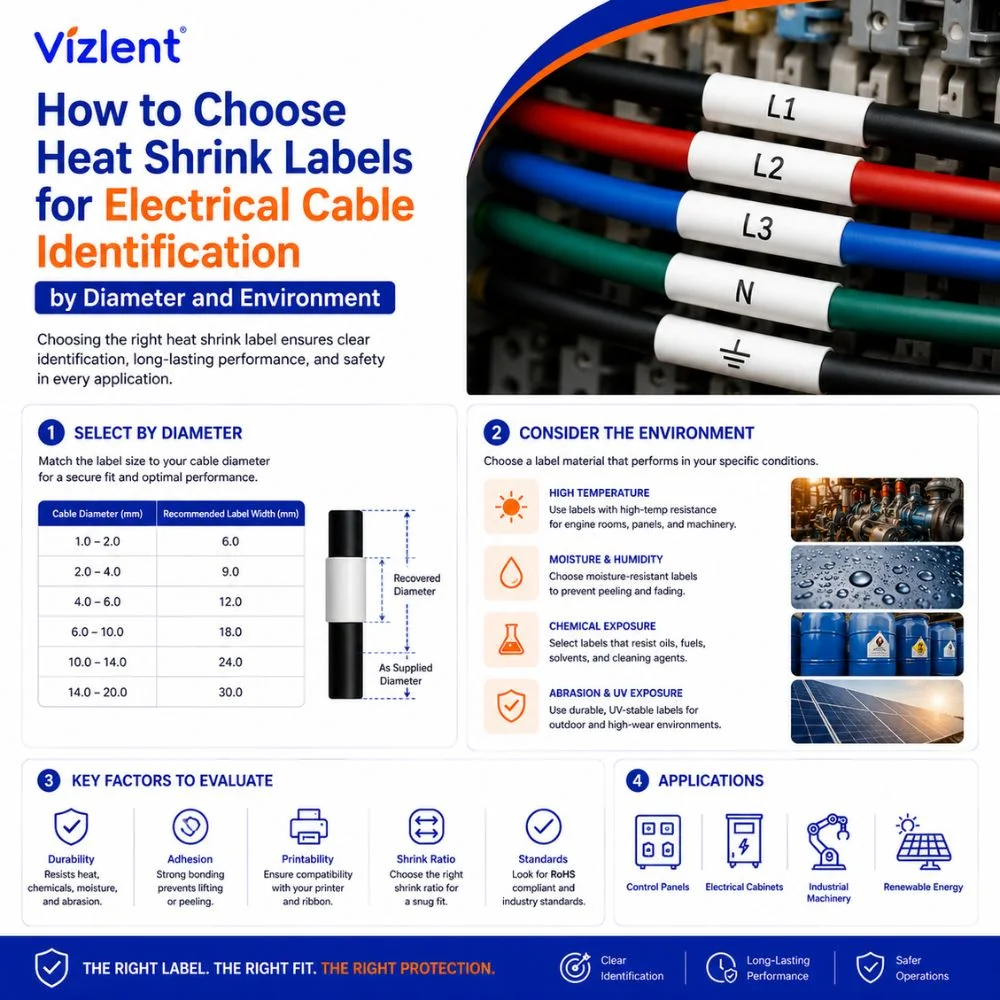
The first selection step is measuring the cable diameter range each sleeve must cover, then matching it to a shrink ratio that recovers tightly without being too loose. A sleeve supplied too large for the wire will not grip, while one too small will not slide on before shrinking. Using a shrink ratio such as 3:1 widens the range of conductors a single sleeve size can serve, simplifying inventory across mixed cable gauges.
The second step is profiling the environment, because temperature, chemicals, and UV exposure decide which sleeve material survives. A standard polyolefin sleeve handles most indoor panel work, while engine bays, aerospace harnesses, and outdoor runs demand higher-rated or flame-retardant constructions. Knowing how to choose heat shrink labels for electrical cable identification starts with these two measurements, diameter and environment, before any printing or branding question enters the decision.
Reading a Heat Shrink Labels for Electrical Cable Identification Chart
A heat shrink labels for electrical cable identification chart maps sleeve sizes to the cable diameter ranges and wire gauges they fit, so you can select without guesswork. Each row lists the supplied internal diameter, the recovered diameter, and the corresponding AWG or millimeter range the sleeve grips reliably. Keeping this chart at the workbench lets installers pull the correct sleeve size for any conductor on a mixed panel quickly.
A good chart also notes the shrink ratio and temperature rating alongside each size, since these affect both fit and survivability. Cross-referencing the conductor gauge against the recovered-diameter column prevents the two most common errors: a sleeve that floats loose or one that jams before it reaches its position. The reference table below shows how a typical heat shrink labels for electrical cable identification chart is structured.
| Supplied I.D. | Recovered I.D. | Fits Cable / Wire Range | Shrink Ratio |
|---|---|---|---|
| 3.2 mm | 1.6 mm | AWG 18 to 14 small signal wire | 2:1 |
| 6.4 mm | 3.2 mm | AWG 12 to 8 power conductors | 2:1 |
| 9.5 mm | 3.2 mm | Mixed-gauge bundles, 3:1 range | 3:1 |
| 12.7 mm | 6.4 mm | Large power and multicore cable | 2:1 |
Matching Sleeve Material to the Hazard Environment
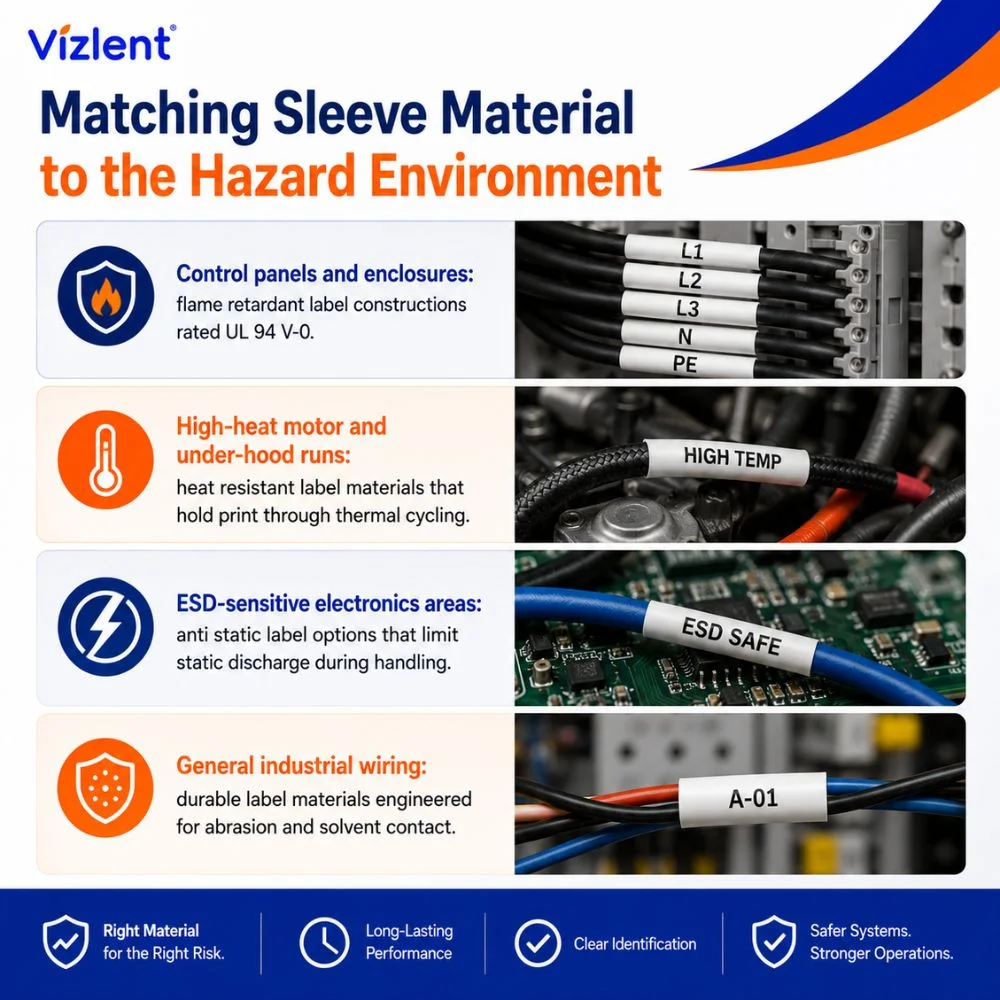
Material selection is where electrical safety codes intersect with label durability, and a mismatch can fail an inspection. Flame-retardant sleeves rated to UL 94 V-0 self-extinguish when a flame is removed, which is required in control panels, EV battery enclosures, and aerospace interiors. Standard polyolefin works for general indoor wiring, but high-heat zones near motors or under hoods call for a heat-resistant construction.
Beyond fire rating, the sleeve must resist the specific fluids and abrasion of its location to keep print legible. Engine compartments expose markers to oil and fuel, marine settings add salt and moisture, and industrial floors bring mechanical scuffing. Aligning the sleeve material to these stressors is the practical core of how to choose heat shrink labels for electrical cable identification that remain readable for the full service life.
- Control panels and enclosures: flame retardant label constructions rated UL 94 V-0.
- High-heat motor and under-hood runs: heat resistant label materials that hold print through thermal cycling.
- ESD-sensitive electronics areas: anti static label options that limit static discharge during handling.
- General industrial wiring: durable label materials engineered for abrasion and solvent contact.
Specifying sleeves for panels, harnesses, or outdoor runs? Vizlent supplies flame-retardant and heat-resistant materials matched to your exact electrical environment. Explore Heat Resistant Labels
Heat Shrink Labels Printer Options and Wrap Around Formats
The printing method you choose determines text durability, so the heat shrink labels printer decision is as important as the sleeve itself. Thermal transfer printers using resin ribbons produce the most durable marks, bonding pigment that survives heat, abrasion, and solvent wipe-down. Industrial label printers feed continuous or pre-cut sleeves and are the standard tool for panel shops producing high volumes of consistent markers.
For lower volumes or field work, smaller portable units print individual sleeves on demand at the job site. Whichever heat shrink labels printer you select, pairing it with a resin-grade ribbon is what keeps the printed circuit number legible after the sleeve shrinks and goes into service. Verifying ribbon and sleeve compatibility before a production run prevents the smudging and fade that wax ribbons cause under heat.
Wrap Around Heat Shrink Labels and Self-Laminating Alternatives
Wrap around heat shrink labels and self-laminating wrap labels solve the case where a cable is already terminated and a sleeve cannot slide over the end. A wrap around format encircles the installed conductor, and a self-laminating version adds a clear tail that wraps over the printed area to seal it. These formats let technicians label finished installations without disconnecting and re-pulling cable.
Vizlent manufactures a self-laminating vinyl wrap label engineered specifically for cable harness identification in electronics, giving installers a flame-retardant option for terminated wire. When a true slide-on sleeve is impractical, wrap around heat shrink labels keep the same durability goals in reach. Choosing between a sleeve and a wrap comes down to one question: is the cable end accessible at the time of marking.
Already-terminated cable that still needs durable marking? Vizlent’s self-laminating wrap-around wire labels deliver flame-retardant identification without re-pulling conductors. View Wrap Around Wire Labels
Heat Shrink Labels for Electrical Cable Identification Method and Installation
A reliable heat shrink labels for electrical cable identification method begins long before the heat gun, at the planning and measuring stage. The installer confirms the conductor gauge, selects the sleeve size from the chart, prints and verifies the marker, then stages the heat shrink labels for electrical cable identification tags in circuit order to avoid mix-ups. This disciplined sequence is what separates a clean, code-compliant panel from a tangle of mislabeled wires.
The heat shrink labels for electrical cable identification and installation workflow then moves to application, where even heat and correct positioning matter most. The sleeve must slide fully into place before any heat touches it, because a partially shrunk sleeve cannot be repositioned. Following a consistent method across every conductor produces uniform, professional results that pass inspection and read clearly years later.
How to Apply Heat Shrink Labels Step by Step
Learning how to apply heat shrink labels correctly prevents the scorching, uneven shrink, and crooked text that undermine an otherwise good installation. The core principle is to apply steady, rotating heat from the center outward so the sleeve recovers evenly without burning. Rushing the heat or holding the gun in one spot causes the polyolefin to char and the print to distort.
The heat shrink labels for electrical cable identification and installation steps below give installers a repeatable routine for every conductor. Following them in order ensures each sleeve seats fully, shrinks uniformly, and locks the printed marker in its final readable position. Consistency here is what makes a panel of hundreds of wires look and function as a single professional system.
- Measure the conductor gauge and select the sleeve size from the identification chart.
- Print the circuit number or barcode and confirm legibility before applying.
- Slide the sleeve fully onto the conductor and position it before any heat is applied.
- Apply a heat gun with steady, rotating motion from the center outward until the sleeve grips tight.
- Let the sleeve cool undisturbed so the polyolefin sets in its final shrunk position.
Sourcing Sleeves and Searching Heat Shrink Labels Near Me
Many installers begin a project by searching heat shrink labels near me to find local stock for an urgent job, which works for small quantities. For production volumes, mixed sizes, or specialized flame-retardant materials, sourcing directly from a manufacturer gives better consistency and price. A factory supplier can match the exact substrate, shrink ratio, and printer compatibility your installation needs rather than whatever a local shelf happens to carry.
Buyers who outgrow the heat shrink labels near me search usually move to a direct manufacturer for traceable quality and bulk lead times. Specifying material grade, size range, and ribbon compatibility up front avoids the substitutions that local resellers often make. Vizlent’s engineering team helps electrical contractors and panel builders standardize on a sleeve and ribbon pairing that performs identically across every order.
Buying beyond what a local shelf can supply? Get factory-direct, printer-matched identification materials with traceable quality from Vizlent. Ask a Vizlent Engineer
Specify Cable Identification Materials Built to Stay Legible
A cable identification program is only as reliable as the sleeve that survives years of vibration, heat, and handling, and the wrong material quietly turns a labeled panel into a guessing game. Vizlent manufactures flame-retardant, heat-resistant, and durable identification materials engineered to keep printed circuit data legible for the full life of an electrical installation. Our engineering team matches the substrate, size range, and ribbon to your exact conductors and environment rather than a generic catalog spec.
From control panels and harnesses to outdoor and high-heat runs, the right sleeve and ribbon pairing protects both your inspections and your maintenance teams. Send your cable gauge range, environment, and printer details, and we will recommend an identification material built to perform from installation through every future service call.
Ready to standardize on durable, printer-matched cable identification materials? Get a fast, engineer-reviewed quote from Vizlent today. Get Your Quick Quote Now
Frequently Asked Questions About Heat Shrink Labels for Cable Identification
What are heat shrink labels used for in electrical work?
Heat shrink labels are printable polyolefin sleeves that slide over a wire and shrink tight with heat to create a permanent circuit marker. They are used to identify conductors in control panels, harnesses, and cable bundles where adhesive tags would peel. Their abrasion and solvent resistance makes them the standard for installations expected to stay legible for years.
How do I choose the right heat shrink label size?
Choosing the right size means measuring the cable diameter, then selecting a sleeve whose recovered diameter grips that conductor firmly. A heat shrink labels for electrical cable identification chart maps supplied and recovered diameters to wire gauges so you can match them precisely. A shrink ratio such as 3:1 lets one sleeve size cover a wider range of mixed-gauge cable.
What shrink ratio should heat shrink wire and cable labels have?
The shrink ratio describes how much the sleeve contracts, with 2:1 halving the diameter and 3:1 reducing it to a third. A 3:1 ratio suits mixed cable gauges because one size fits a broader range, simplifying inventory. A 2:1 ratio gives a tighter, more precise fit when conductors are a consistent size.
What heat shrink labels printer and ribbon should I use?
A thermal transfer heat shrink labels printer paired with a resin ribbon produces the most durable, smudge-proof marks for cable identification. Resin ribbons bond pigment that survives the heat of shrinking and later solvent and abrasion exposure. Wax or wax-resin ribbons should be avoided because they fade or smear under the temperatures involved.
What is the difference between wrap around and slide-on heat shrink labels?
Slide-on sleeves must go over the cable end before termination, while wrap around heat shrink labels encircle a conductor that is already installed. Self-laminating wrap labels add a clear tail that seals over the printed area for extra durability. Choose a wrap format when the cable is already terminated and a sleeve cannot be threaded on.
How do I apply heat shrink labels correctly?
To apply heat shrink labels, slide the sleeve fully into position first, then apply a heat gun with steady, rotating motion from the center outward. Even heat lets the polyolefin recover uniformly without scorching or distorting the print. Let the sleeve cool undisturbed so it sets in its final readable position before handling the conductor.
Are heat shrink labels flame retardant for panel use?
Many heat shrink wire and cable labels are available in flame-retardant grades rated to UL 94 V-0, which self-extinguish when a flame is removed. These constructions are required in control panels, EV enclosures, and aerospace interiors where fire propagation is a risk. Confirm the UL rating and request compliance documentation before specifying sleeves for safety-critical wiring.
Where can I buy heat shrink labels beyond a local store?
Searching heat shrink labels near me finds local stock for small or urgent jobs, but production volumes are better sourced from a direct manufacturer. A factory supplier matches the exact substrate, shrink ratio, and printer compatibility your installation requires. Buying direct also gives traceable quality and consistent material across repeat orders, which local resellers rarely guarantee.






