

The cable labeling equipment that works best for server rooms is a thermal transfer printer paired with self-laminating wrap labels, heat-shrink sleeves, and pre-printed patch panel media, run from labeling software that imports your port schedule. A server room packs hundreds of identical patch cords into tight racks, so the equipment has to print durable, smudge-proof identifiers fast and apply them in cramped spaces. The best setup combines a quality printer, the right label media, and a verification workflow, rather than relying on any single device or a handheld marker.
Data-center and IT teams choose this combination because a mislabeled or faded cable turns a five-minute move into an hours-long trace. Thermal transfer printing with resin ribbon survives the heat, abrasion, and handling that direct-thermal labels cannot, keeping port numbers readable for years. The sections below break down the printer types, the label media that matters most, the standards that govern the work, and how to match equipment to your rack environment.
Need ESD-safe, heat-stable label media that runs cleanly on your rack printers? Talk to the Vizlent engineering team about anti-static and flame-retardant materials built for data-center wiring. Request a Quick Quote
What Cable Labeling Equipment Works Best for Server Rooms: The Core Tools
The core of any server-room labeling setup is a printer, and the choice usually comes down to a benchtop thermal transfer unit or a rugged handheld cable labeling machine for on-rack work. A thermal transfer printer melts resin or wax-resin ink onto the label, producing marks that resist the heat and abrasion of a packed rack far better than direct-thermal output. For high cable counts, a benchtop printer feeding continuous media is the productivity backbone of the workflow.
Around that printer sit the supporting tools that turn raw media into applied, verified labels. A portable cable labeling device handles spot fixes and additions at the rack without a trip back to the bench, while labeling software pulls port schedules so identifiers stay consistent. Deciding what cable labeling equipment works best for server rooms means weighing print volume, mobility, and how tightly the gear integrates with your documentation system.
- Benchtop thermal transfer printer: high-volume, durable resin printing for bulk runs.
- Handheld cable labeling machine: on-rack printing for moves, adds, and changes.
- Label applicators and dispensers: speed wrap and flag application in tight spaces.
- Labeling software: imports port schedules so naming stays consistent and auditable.
Cable Labeling Machine Versus Cable Labeling Device for Rack Work

A cable labeling machine usually refers to a benchtop or industrial printer built for volume, accuracy, and integration with rack documentation software. These units print hundreds of consistent labels in one run, support multiple media types, and connect to a network so naming conventions stay centralized. For a new build or a full recabling, a cable labeling machine of this class is the most efficient choice.
A handheld cable labeling device trades volume for mobility, letting a technician print and apply a marker right at the rack during a change. The tradeoff is slower throughput and a smaller media range, which suits maintenance rather than initial deployment. Most mature server rooms keep both: a cable labeling machine at the bench for bulk work and a cable labeling device on the cart for daily moves.
| Equipment | Best Use | Strength | Limitation |
|---|---|---|---|
| Benchtop thermal transfer printer | New builds, bulk recabling | High volume, durable resin print | Not mobile at the rack |
| Handheld cable labeling device | On-rack moves and changes | Portable, fast spot fixes | Lower throughput, fewer media types |
| Self-laminating applicator | Patch-cord wrap labels | Speeds clean application | One label format focus |
| Labeling software | Naming and documentation | Consistent, auditable IDs | Needs accurate port schedule input |
Types of Cable Labels and the Media That Determines Print Durability
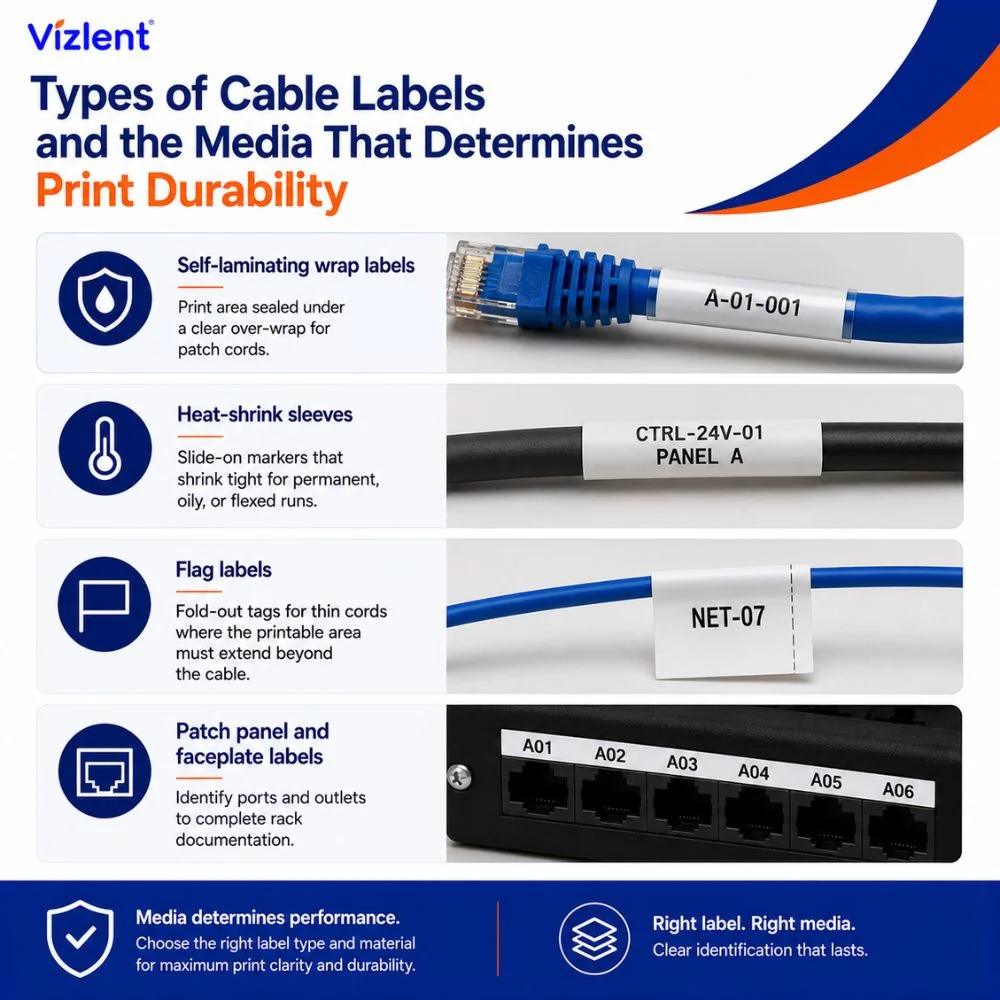
Equipment only performs as well as the media it runs, so understanding the types of cable labels is central to any server-room program. The three dominant formats are self-laminating wrap labels that encircle a cord and seal the print under a clear tail, heat-shrink sleeves that slide over a conductor and shrink tight, and flag labels that fold out for high-density identification. Each format suits a different rack scenario and printer feed.
Patch panel and faceplate labels round out the set, identifying ports rather than the cables themselves for a complete documentation picture. Matching the format to the location is what keeps a rack readable: wrap labels for patch cords, sleeves for permanent runs, and flags where cords are too thin to print on directly. Choosing among the types of cable labels is therefore a media decision that the equipment must accommodate.
- Self-laminating wrap labels: print area sealed under a clear over-wrap for patch cords.
- Heat-shrink sleeves: slide-on markers that shrink tight for permanent, oily, or flexed runs.
- Flag labels: fold-out tags for thin cords where the printable area must extend beyond the cable.
- Patch panel and faceplate labels: identify ports and outlets to complete rack documentation.
Why Label Material Decides Server-Room Print Survival
Server rooms run warm, vibrate from fans, and concentrate static-sensitive equipment, so label material matters as much as the printer. Anti-static label media limits electrostatic discharge during handling near sensitive gear, which is why ESD-safe constructions are specified around live equipment. A standard paper label can both fade in the heat and carry an unwanted charge, undermining the very gear it identifies.
Flame rating and heat tolerance add a second material requirement in any dense rack environment. Flame-retardant materials rated to recognized standards reduce fire-propagation risk in cable bundles, while heat-stable constructions hold print through years of warm-aisle operation. Pairing the right label material with the equipment is what turns a printed marker into one that survives the rack.
- ESD-sensitive racks: Anti static label media that dissipates charge during handling.
- Dense cable bundles: Flame retardant label materials rated to UL 94 to limit fire spread.
- Warm-aisle and equipment heat: Heat resistant label constructions that hold print through thermal cycling.
- General rack wiring: Durable label media engineered for abrasion and long service life.
The printer is only half the system. Vizlent supplies the ESD-safe, flame-retardant, and heat-stable label media that keeps rack identifiers legible for years. Explore Flame Retardant Label Media
Cable Labelling Standards and Electrical Equipment Labeling Requirements for Data Centers

Cable labelling standards give a server room a consistent naming and marking framework, which is what makes a rack auditable years after installation. In structured cabling, the ANSI/TIA-606 administration standard defines how to identify cables, patch panels, and pathways with a uniform labeling scheme. Following recognized cable labelling standards turns an ad-hoc rack into documentation that any technician can read without tribal knowledge.
Alongside naming conventions sit electrical equipment labeling requirements that govern safety marking on the powered side of the room. These electrical equipment labeling requirements draw on NEC and OSHA provisions for circuit identification, voltage warnings, and panel marking that protect personnel during maintenance. Meeting both the structured-cabling and the electrical-safety rules is what makes a data-center labeling program complete and defensible.
How Standards Shape Equipment and Media Choices
Standards do more than dictate text; they influence which equipment and media a team should buy. A naming scheme with long, structured identifiers favors a printer and software combination that imports those strings without retyping, reducing error. Durability clauses in many specifications effectively require thermal transfer printing on synthetic media rather than paper, steering the equipment decision.
Electrical equipment labeling requirements similarly push toward flame-rated and high-visibility materials for warning labels near power. A program built to satisfy both cable labelling standards and electrical-safety rules tends to converge on the same core equipment: a resin-capable printer, synthetic media, and software that enforces the naming scheme. Letting the standards guide procurement prevents buying gear that cannot produce compliant labels.
| Standard / Rule | Governs | Practical Equipment Impact |
|---|---|---|
| ANSI/TIA-606 | Cabling and pathway identification | Software-driven naming, consistent label format |
| NEC / OSHA marking | Circuit and voltage warning labels | Flame-rated, high-visibility warning media |
| UL 94 | Material flammability rating | Flame-retardant label stock in bundles |
| ANSI/ESD S20.20 | Static control near equipment | Anti-static label media for live racks |
Cable Labeling Systems and Solutions: Building a Complete Server-Room Workflow
Effective cable labeling systems combine hardware, media, and software into one repeatable workflow rather than a drawer of mismatched tools. The system starts with a documented naming convention, feeds it into labeling software, prints on a resin-capable printer, and applies durable media in a consistent format across every rack. Treating these elements as a single system, not separate purchases, is what produces a room that stays legible through years of change.
Mature cable labeling systems also build in verification, so a printed label is checked against the port schedule before the job closes. This closes the loop between documentation and the physical rack, catching transposed digits before they cause an outage. Investing in cable labeling systems at this level pays back every time a technician traces a circuit quickly instead of guessing.
Matching Cable Labeling Solutions to Rack Reality
The best cable labeling solutions account for the cramped, warm, static-sensitive reality of a working rack rather than an idealized bench. In tight bundles, self-laminating wrap media and a fast applicator beat hand-cut tags for both speed and durability. Around live equipment, anti-static media and careful handling protect the gear the labels identify.
Scaling cable labeling solutions across many racks means standardizing on one printer family, one media set, and one naming scheme so any technician can step in. The cable labeling equipment and equipment supplies you stock should be deliberately limited to keep training simple and quality consistent. Narrowing the toolkit to proven cable labeling solutions is what makes a large estate manageable rather than chaotic.
- Standardize on one resin-capable printer family across all racks for consistent output.
- Stock a deliberately limited media set so the cable labeling equipment and equipment supplies stay simple.
- Drive naming from software, not memory, so identifiers match the documentation exactly.
- Verify every printed label against the port schedule before closing the work.
Selecting Equipment for Your Specific Rack Environment
Choosing what cable labeling equipment works best for server rooms ultimately depends on print volume, mobility needs, and the environmental stress of your racks. A high-density new build justifies a benchtop printer and applicator, while a small room running occasional changes may need only a capable handheld device. Profiling your real workload prevents both under-buying and over-buying equipment.
The media decision follows the same logic, matched to heat, static, and bundle density rather than a generic catalog pick. Vizlent’s engineering team helps IT and data-center buyers specify ESD-safe, flame-retardant, and heat-stable label materials that run cleanly on their chosen printers. Aligning both equipment and media to your environment is the final step in a durable server-room labeling program.
Specifying media for a new rack build or a recabling project? Get factory-direct, printer-matched label materials with traceable quality from Vizlent. Ask a Vizlent Engineer
Frequently Asked Questions About Server-Room Cable Labeling Equipment
What cable labeling equipment works best for server rooms?
The best setup pairs a thermal transfer printer with self-laminating wrap labels, heat-shrink sleeves, and labeling software that imports your port schedule. A benchtop printer handles bulk runs while a handheld device covers on-rack changes. The combination matters more than any single device, because durable media and consistent naming are what keep a rack readable.
What is the difference between a cable labeling machine and a cable labeling device?
A cable labeling machine is typically a benchtop or industrial printer built for high volume and software integration, ideal for new builds. A cable labeling device usually means a portable handheld unit for printing and applying markers at the rack during changes. Most server rooms keep both: the machine for bulk work and the device for daily moves.
What are the main types of cable labels for server rooms?
The main types of cable labels are self-laminating wrap labels that seal print under a clear over-wrap, heat-shrink sleeves that slide on and shrink tight, and flag labels for thin cords. Patch panel and faceplate labels identify ports to complete the documentation. Matching the format to the location keeps the whole rack consistently readable.
What cable labelling standards apply to data centers?
ANSI/TIA-606 is the core cable labelling standard for identifying cables, patch panels, and pathways in structured cabling. NEC and OSHA provisions add electrical equipment labeling requirements for circuit identification and voltage warnings. Following both produces a rack that is auditable and safe for technicians working on the powered side.
What label material should I use near static-sensitive equipment?
Use anti-static label media rated to ANSI/ESD S20.20 with a surface resistivity that dissipates charge during handling near live gear. Standard paper labels can accumulate a charge and fade in rack heat, which risks the very equipment they identify. ESD-safe synthetic media paired with thermal transfer printing keeps both the gear and the print protected.
Do cable bundles in server rooms need flame-retardant labels?
Dense cable bundles benefit from flame-retardant label materials rated to UL 94, which reduce fire-propagation risk in concentrated wiring. Many electrical equipment labeling requirements and facility fire codes effectively push toward these materials in racks. Confirm the flammability rating and request documentation before specifying media for bundled runs.
What printing method gives the most durable cable labels?
Thermal transfer printing with a resin ribbon produces the most durable, smudge-proof marks for server-room cables. Resin bonds pigment that survives rack heat, abrasion, and cleaning, unlike direct-thermal labels that fade over time. Pairing a resin-capable printer with synthetic media is the standard for identifiers expected to last for years.
How do I build complete cable labeling systems for many racks?
Build cable labeling systems by standardizing one resin-capable printer family, a limited media set, and a software-driven naming convention across every rack. Add a verification step that checks each printed label against the port schedule before closing work. Narrowing the toolkit to proven cable labeling solutions keeps quality consistent and training simple at scale.






