
Filmic biodegradable labels are available and meet meet certifications like EN 13432 and ASTM D6400. They are manufactured from compostable film facestocks such as PLA (polylactic acid) and cellulose, with many produced by specialist manufacturers in China for export worldwide. A filmic biodegradable label uses a plant-derived film rather than paper as its face material, giving a clear or glossy finish that breaks down under industrial composting without leaving microplastic residue. These labels pair a compostable film with a water-based adhesive and a compostable liner.
Brands choose film-based biodegradable labels when they need the premium clarity or moisture resistance of plastic film but cannot accept conventional plastic’s environmental cost. The category has matured rapidly, and durable, certified compostable films are now produced at commercial scale. The sections below explain what these labels are, the materials and adhesives involved, where to source them, and the best practices for specifying them correctly.
Looking for certified compostable film label stock for your packaging line? Talk to the Vizlent engineering team about PLA and cellulose filmic constructions.
Are There Filmic Biodegradable Labels Available for Film and Product Packaging?
Filmic biodegradable labels for film packaging are available and increasingly specified where a paper label would clash with a transparent or glossy container. These labels use compostable film facestocks that deliver the clarity of conventional plastic while remaining certified to break down in industrial composting. The result is a no-label look or a high-gloss finish achieved without petroleum-based polypropylene or polyester.
Filmic biodegradable labels for products span cosmetics, beverages, organic foods, and premium retail goods that demand both shelf appeal and sustainability credentials. A compostable film facestock holds sharp print and resists moisture far better than uncoated paper on these surfaces. For brands balancing aesthetics against eco-compliance, film-based compostable labels solve a problem that paper alone cannot.
- Transparent containers needing a clear, no-label look without conventional plastic.
- Glossy premium packaging requiring high print clarity and a film finish.
- Moisture-exposed products where paper labels would wrinkle or fail.
- Eco-positioned brands needing certified compostable film rather than paper.
Filmic Biodegradable Labels Sticker and Material Options
A filmic biodegradable label sticker is typically die-cut from a Polylactic acid (PLA) or cellulose film facestock with a compostable pressure-sensitive adhesive. These stickers suit product sealing, promotional decoration, and retail branding where a paper sticker would look or perform poorly. The film delivers a smooth, premium surface that still meets composting certification at end of life.
The filmic biodegradable labels material itself is the defining choice, since the film determines clarity, moisture resistance, and compostability together. PLA film derived from plant starch is the most common filmic biodegradable label material, joined by cellulose films from wood pulp for higher clarity. Selecting the right film grade is the foundation of a compliant and attractive compostable label.
Filmic Biodegradable Labels Material, Paper Alternatives, and Adhesives
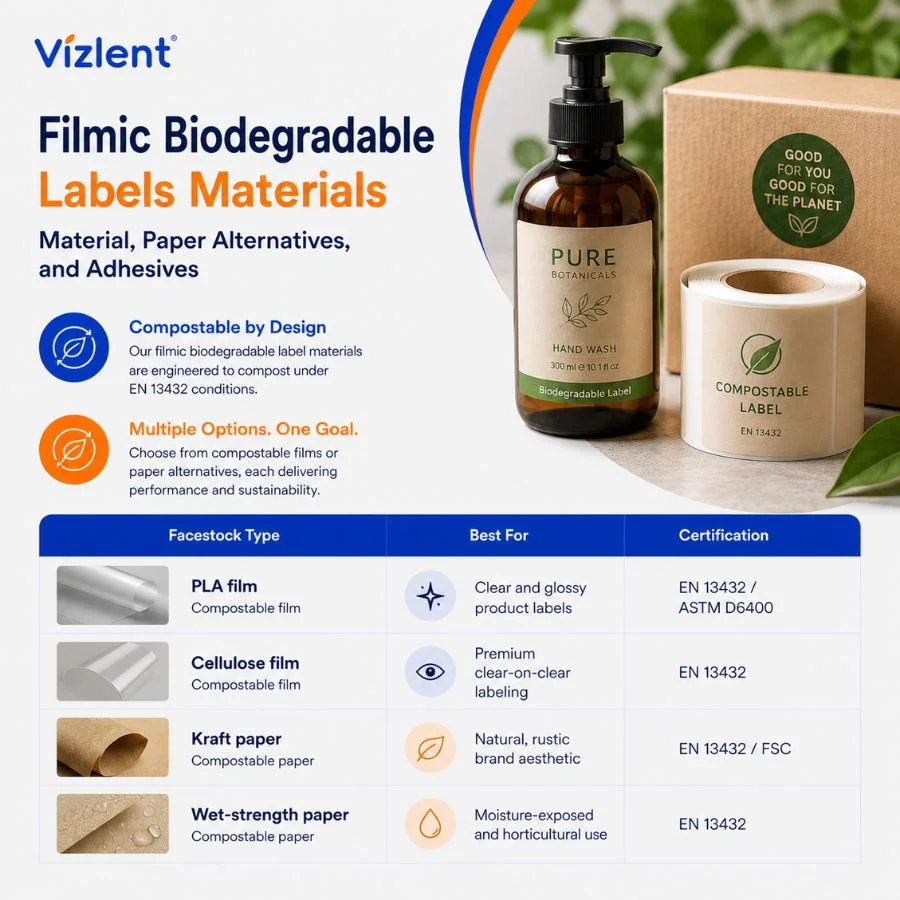
The filmic biodegradable labels material family centers on PLA and cellulose films, each engineered to compost under EN 13432 conditions. PLA film, made from fermented plant starch such as corn, offers a clear or white facestock at calipers around 60 to 120 microns. Cellulose film, derived from wood pulp, provides exceptional transparency for premium clear-on-clear labeling.
Where film is not required, filmic biodegradable labels paper alternatives such as kraft and wet-strength paper serve the same compostable goal with a natural look. Choosing between a filmic biodegradable labels paper facestock and a film facestock comes down to one priority: clarity and moisture resistance versus a fiber aesthetic. Both routes meet the same certifications when paired with a compliant adhesive and liner.
| Facestock | Type | Best For | Certification |
|---|---|---|---|
| PLA film | Compostable film | Clear and glossy product labels | EN 13432 / ASTM D6400 |
| Cellulose film | Compostable film | Premium clear-on-clear labeling | EN 13432 |
| Kraft paper | Compostable paper | Natural, rustic brand aesthetic | EN 13432 / FSC |
| Wet-strength paper | Compostable paper | Moisture-exposed and horticultural use | EN 13432 |
Filmic Biodegradable Labels Adhesive Systems
The filmic biodegradable labels adhesive is as important as the facestock, because a solvent-based or hot-melt adhesive would void composting certification. Compostable labels use water-based acrylic or natural rubber adhesives, typically coated at 18 to 25 grams per square meter dry. This adhesive choice is what allows the complete label, not just the facestock, to break down without persistent residue.
Adhesive performance must still match the application, since a compostable bond cannot compromise on real-world hold. A cold-temperature water-based acrylic maintains tack on chilled glass and refrigerated packaging, while a higher coat weight grips rough corrugated surfaces. Specifying the right filmic biodegradable labels adhesive ensures the label both performs and composts as a unified system.
Need a compostable adhesive matched to chilled glass, corrugated, or film surfaces? Vizlent tunes the adhesive, facestock, and liner as one validated system. Explore Biodegradable Label Materials
Filmic Biodegradable Labels for Packaging and Compostable Films
Filmic biodegradable labels for packaging close the loop on sustainable packaging by ensuring the label degrades alongside the container. A compostable mailer or food tray loses its eco-credentials if a conventional plastic label remains after composting, which is the gap filmic compostable labels fill. Matching the label to a compostable package is essential for a genuine closed-loop claim.
The relationship between filmic biodegradable labels and packaging is therefore a systems question, not a separate decision. A brand pairing filmic biodegradable labels and compostable films across both the wrap and the label achieves a fully degradable unit. This alignment is what regulators and certification bodies increasingly expect from sustainability claims.
How Filmic Biodegradable Labels and Compostable Films Work Together
When filmic biodegradable labels and compostable films are engineered together, they degrade at compatible rates under the same composting conditions. A mismatch, such as a slow-degrading label on a fast-degrading film, can contaminate a compost stream and fail certification. Coordinating the label and the film as one specification prevents this failure and supports a verifiable claim.
The interaction between filmic biodegradable labels and packaging also affects print and converting, since both layers must run on the same equipment. A converter benefits from sourcing compatible compostable film and label stock from one manufacturer that validates them as a pair. This integrated approach is what turns separate eco-materials into a coherent compostable package.
- Match label and film degradation rates to the same composting standard.
- Validate both layers under EN 13432 or ASTM D6400 as a unit, not separately.
- Source compatible film and label stock from one manufacturer to ensure they run together.
- Confirm food-contact compliance where the package holds food directly.
Where to Source Filmic Biodegradable Labels in Bulk
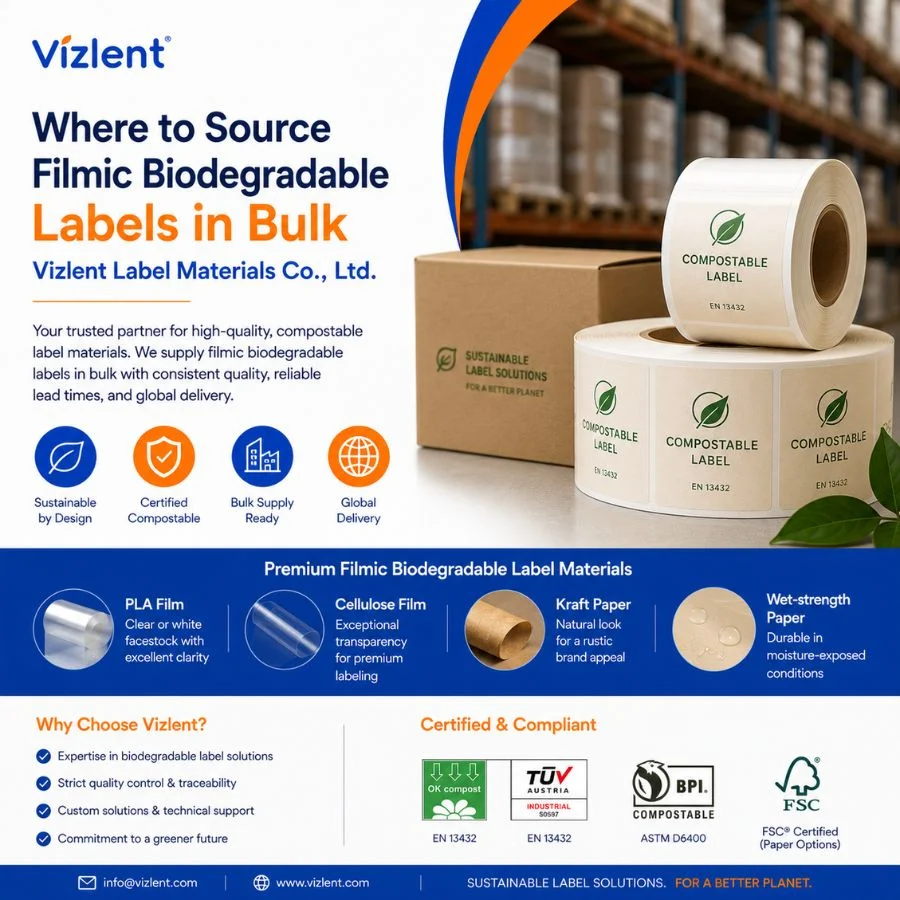
Sourcing filmic biodegradable labels bulk volumes works best through a direct manufacturer that coats its own compostable film and adhesive in-house. A filmic biodegradable labels maker with its own R&D and coating lines can tune the film, adhesive, and liner as a system rather than assembling mismatched components. Many of the most capable producers operate from China, combining compostable material engineering with large-scale, cost-efficient output.
Vizlent, for example, manufactures compostable label stock from a 20,000 square meter facility in Shenzhen, China, supplying converters and brand owners worldwide. A filmic biodegradable labels bulk order from a direct China-based manufacturer typically ships within about 15 days and includes export documentation. Placing a filmic biodegradable labels bulk order this way gives buyers traceable certification and consistent material across repeat runs.
Filmic Biodegradable Labels Business and Maker Considerations
Building a filmic biodegradable labels business as a converter, brand, or distributor depends on a reliable compostable material supply chain. The right filmic biodegradable labels maker provides certification documentation, free samples for testing, and the ability to scale from trial rolls to container volumes. These factors separate a genuine compostable manufacturer from a trading company reselling unverified stock.
A filmic biodegradable labels business also needs confidence that every batch meets the same composting and food-contact standards. A direct maker supplies technical data sheets, FSC chain-of-custody where paper is involved, and EN 13432 certification for each construction. Partnering with a manufacturer that controls its own production is what makes a compostable label business defensible and scalable.
- Choose a maker with in-house compostable film and adhesive coating, not a reseller.
- Confirm EN 13432 or ASTM D6400 certification documentation for each construction.
- Request free samples for print, adhesion, and composting pre-assessment before bulk commitment.
- Verify lead times and export documentation for a filmic biodegradable labels bulk order.
Planning a bulk order or building a compostable label line? Vizlent ships certified filmic biodegradable label stock worldwide with free samples first. Ask a Vizlent Engineer
Filmic Biodegradable Labels Best Practices for Specification and Use
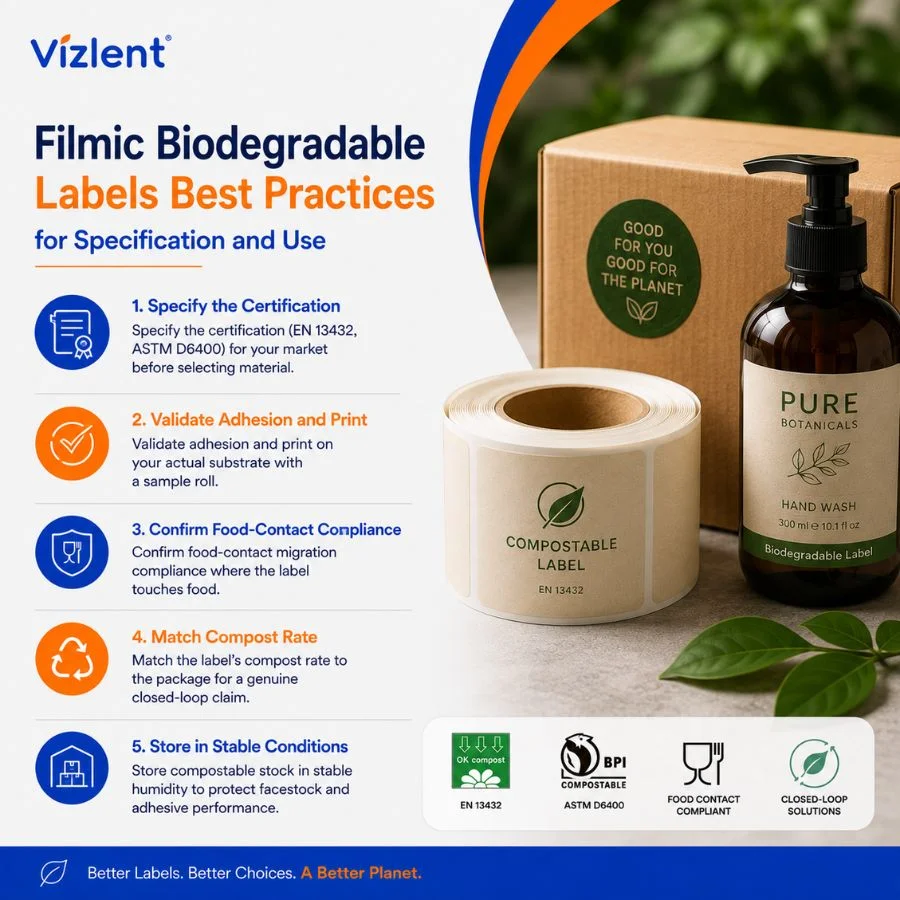
Following filmic biodegradable labels best practices starts with specifying the correct certification for your target market before anything else. The European market expects EN 13432 compostability, North America references ASTM D6400, and food-contact applications add migration compliance. Pinning down the required standard first prevents a costly material change late in development.
Sound filmic biodegradable labels best practices also include validating the full construction on your actual container and print equipment, not just in theory. A sample roll trial confirms adhesion, print fidelity, and converting behavior before a bulk commitment. Testing the complete label as a system is the single most reliable way to avoid field failures and certification gaps.
- Specify the certification (EN 13432, ASTM D6400) for your market before selecting material.
- Validate adhesion and print on your actual substrate with a sample roll.
- Confirm food-contact migration compliance where the label touches food.
- Match the label’s compost rate to the package for a genuine closed-loop claim.
- Store compostable stock in stable humidity to protect facestock and adhesive performance.
Matching the Construction to Your Application
The final best practice is aligning the filmic biodegradable labels material to the real demands of the product and its journey. A chilled beverage needs a cold-tack adhesive and moisture-resistant film, while a dry retail box can use a lighter construction. Profiling the application first ensures the compostable label performs through distribution as well as it composts afterward.
Vizlent’s engineering team helps brands and converters specify filmic and paper compostable constructions matched to container, temperature, and certification needs. Aligning the material to the application is what separates a label that merely claims to be green from one that performs and degrades as promised. This alignment is the practical answer for sourcing filmic biodegradable labels and labels that are both available and right for your program.
Ready to specify a certified compostable film label matched to your product and market? Get a fast, engineer-reviewed quote from Vizlent today. Get Your Quick Quote Now
Specify Certified Filmic Biodegradable Label Stock
Sustainable packaging only holds up when the label degrades as reliably as the package it sits on, and a filmic biodegradable label closes that gap with compostable film and adhesive. Vizlent manufactures PLA, cellulose, and paper compostable label stock from its Shenzhen, China facility, supplying converters and brand owners worldwide with EN 13432 and ASTM D6400 certified materials. Our engineering team tunes the film, adhesive, and liner as one validated system matched to your container and market.
From clear cosmetic film labels to compostable shipping labels, the right construction and certification protect both your sustainability claim and your shelf appeal. Send your container type, temperature range, print method, and target certification, and we will recommend a filmic or paper compostable construction built to perform and degrade as promised.
Ready to source certified, scalable filmic biodegradable labels for your packaging? Get your quote from Vizlent today. Get Your Quick Quote Now
Frequently Asked Questions About Filmic Biodegradable Labels
Are there filmic biodegradable labels available for commercial use?
Yes, filmic biodegradable labels are available commercially in PLA and cellulose film facestocks certified to EN 13432 and ASTM D6400. They deliver the clarity and moisture resistance of conventional plastic film while composting without microplastic residue. Many are produced at scale by specialist manufacturers in China and supplied to converters and brands worldwide.
What is a filmic biodegradable label made of?
A filmic biodegradable label uses a compostable film facestock, most commonly PLA derived from plant starch or cellulose from wood pulp. It is paired with a water-based acrylic or natural rubber adhesive and a compostable liner so the whole label degrades. This construction meets composting certification as a complete system rather than just the facestock.
What is the difference between filmic and paper biodegradable labels?
Filmic biodegradable labels use a clear or glossy compostable film, while paper versions use kraft or wet-strength fiber for a natural look. Film offers superior clarity and moisture resistance for premium and transparent packaging. Paper suits rustic branding and horticultural use, and both meet the same certifications with a compliant adhesive.
What adhesive is used on filmic biodegradable labels?
Filmic biodegradable labels use water-based acrylic or natural rubber adhesives, typically coated at 18 to 25 grams per square meter dry. Solvent-based and hot-melt adhesives are avoided because they void composting certification. Cold-tack water-based grades are available for chilled glass and refrigerated packaging applications.
Can filmic biodegradable labels be ordered in bulk?
Yes, a filmic biodegradable labels bulk order is best placed with a direct manufacturer that coats its own compostable film and adhesive. Vizlent supplies jumbo rolls up to around 1,050 mm, slit rolls, and sheets, with bulk orders typically shipping within 15 days. Buyers receive certification documentation and consistent material across repeat runs.
Do filmic biodegradable labels meet food-contact rules?
Water-based acrylic adhesive grades are formulated to comply with food-contact migration requirements, and FSC certification covers paper fiber chain-of-custody. For specific regulations such as EU 10/2011 or REACH, request the relevant technical data sheet and compliance documentation. Always confirm food-contact suitability for your specific application before production.
How do I start a filmic biodegradable labels business?
Building a filmic biodegradable labels business depends on a reliable supply of certified compostable film and label stock from a direct maker. Confirm EN 13432 or ASTM D6400 certification, request free samples for testing, and verify the ability to scale from trial rolls to bulk volumes. Partnering with a manufacturer that controls its own production keeps the business defensible.
What are the best practices for using filmic biodegradable labels?
Filmic biodegradable labels best practices start with specifying the correct certification for your market, then validating adhesion and print on your actual container. Match the label’s compost rate to the package for a genuine closed-loop claim, and confirm food-contact compliance where needed. A sample roll trial before bulk commitment is the most reliable way to avoid field failures.






