
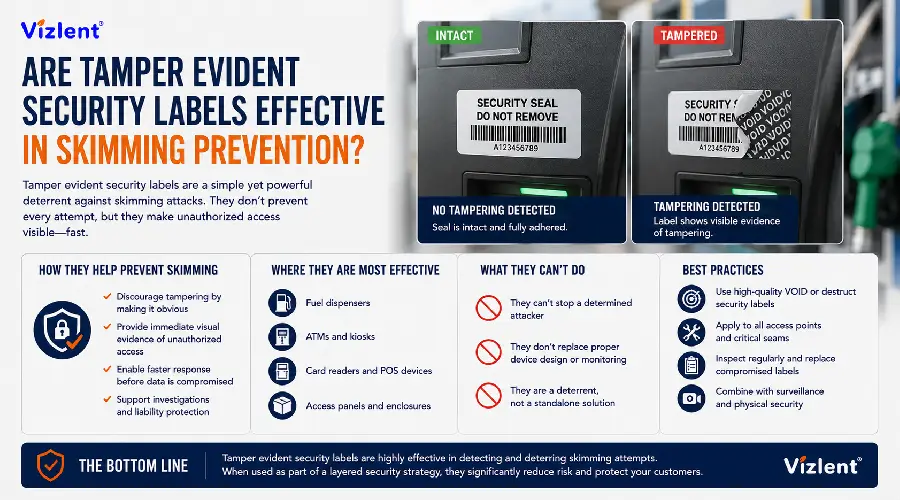
Tamper evident security labels are effective in skimming prevention. They create a visible, permanent record whenever an ATM panel, POS terminal, or card reader housing has been opened or removed. A genuine tamper evident security label reveals a VOID pattern, color change, or fractured face stock the moment someone attempts to lift it, which gives staff and customers an immediate visual warning before a compromised device is used. This direct mechanical response is why financial institutions, retailers, and equipment manufacturers rely on these materials as a first line of defense against skimming fraud.
What Are Tamper Evident Security Labels?
A tamper evident security label is a self adhesive material engineered to display permanent physical evidence the moment it is peeled, lifted, or cut. Under the broader tamper evident security labels & stickers category, suppliers group void stickers, eggshell paper, and destructible vinyl together because they all share this same fracture-on-removal principle. The construction typically pairs a brittle or void release face stock with an acrylic adhesive system calibrated to bond more strongly to the substrate than to the label itself. Common formats include destructible vinyl, eggshell paper, and polyester VOID stickers, each suited to a different surface and threat profile.
Manufacturers such as VIZLENT Label produce these materials for electronics housings, medical devices, and financial equipment where unauthorized access must be visible at a glance. The security label category covers void stickers, eggshell paper, and water sensitive stock, giving procurement teams a single source for different tamper detection mechanisms. Because skimming devices are almost always installed by opening or clipping onto an existing housing, a properly specified tamper evident security label is one of the simplest ways to expose that intrusion before a customer swipes a card.
Before evaluating if a specific product line fits a payment terminal, it helps to understand the baseline requirement: any credible tamper evident security must produce a permanent, unambiguous signal on first removal, with no way to reset or hide the evidence. This baseline is also the starting point for answering the broader question of tamper evident security labels effective in skimming prevention, since a label that fails this basic test cannot meaningfully reduce fraud risk regardless of price or branding. Procurement teams should treat this permanence requirement as non negotiable when comparing suppliers.
Understanding ATM and Card Skimming Threats
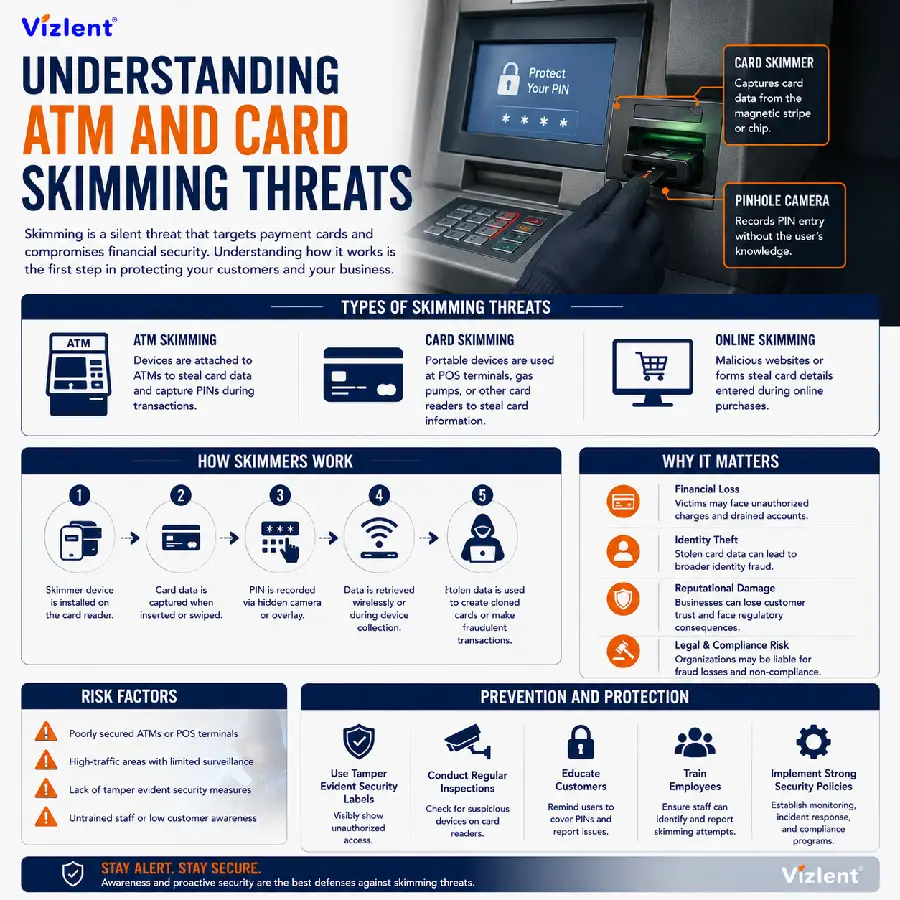
Card skimming occurs when a criminal attaches a hidden device over or inside a card reader, PIN pad, or ATM fascia to capture magnetic stripe data and PIN entries. These devices are frequently disguised to match the original equipment color and shape, which makes visual detection by customers difficult without additional cues. Modern skimming attempts also include deep insert skimmers placed inside the card slot itself, which are even harder to notice without a physical seal covering the access point.
Because most skimming devices must be installed by opening a panel, removing a fascia, or accessing an internal port, any security control that flags physical intrusion becomes a meaningful deterrent. This is where a tamper evident security label adds value, since the label itself becomes a checkpoint that either remains intact or shows unmistakable signs of interference. Banks, retailers, and gas station operators increasingly rely on these labels alongside cameras and encryption to close the physical gap that electronic security alone cannot cover.
Fraud prevention teams researching tamper evident security labels effective in skimming prevention often start by mapping every access point on a machine, since a skimmer can be fitted almost anywhere a panel separates from the housing. This mapping exercise typically reveals more vulnerable seams than expected, particularly on older ATM models retrofitted with new card readers. Once every seam is identified, each one becomes a candidate location for a tamper evident security label or tag.
Are Tamper Evident Security Labels Effective in Skimming Prevention?
The direct answer is yes: tamper evident security labels are effective in skimming prevention when they are correctly specified for the surface, checked regularly, and paired with staff training on what a broken seal looks like. A label that fractures, displays a VOID message, or changes color the instant it is disturbed removes the guesswork from a routine equipment check, turning a two second glance into a reliable inspection. This is precisely why compliance officers evaluating ATM and POS security programs keep asking if tamper evident security labels are effective in skimming prevention before approving a new equipment rollout.
Effectiveness depends on three factors working together: adhesive strength matched to the housing material, a visible and unambiguous tamper indicator, and a documented inspection routine that catches a broken seal quickly. Skipping any one of these factors weakens the entire control, since a seal that nobody checks provides no more protection than no seal at all. Card networks and payment terminal manufacturers that specify tamper evident materials as part of routine maintenance report faster detection of unauthorized access attempts compared with sites relying on cameras alone.
Tamper Proof Security Labels vs Tamper Proof Security Tags
Tamper proof security labels and tamper proof security tags serve the same general purpose but differ in form factor and typical placement. Labels are flat, adhesive-backed materials applied directly over a seam, screw, or access panel, while tags are often small preformed inserts, pull-tabs, or rigid indicators designed for repeated inspection points on machinery. Both formats rely on the same underlying principle of leaving irreversible physical evidence once the seal is broken.
For ATM and POS applications, tamper proof security tags are commonly used on internal cash cassettes and card reader modules, while labels cover the external housing seams most likely to be targeted by a skimming device. Choosing between the two formats comes down to the specific access point being protected and how often technicians need to service that component. A combined approach, using tags on internal modules and labels on external panels, gives the most complete tamper evident security coverage across the entire machine.
Industry data on payment terminal fraud consistently supports the case for tamper evident security labels effective in skimming prevention, since flagged tampering attempts are typically caught within a single maintenance cycle rather than going unnoticed for weeks. Operators who combine tags and labels report fewer repeat incidents at the same location, since a visibly protected machine tends to discourage further attempts. This layered placement strategy is now considered standard guidance among payment equipment manufacturers.
Tamper Evident Security Stickers and Tamper Evident Security Tags: Key Differences
Tamper evident security stickers are typically thinner, printable materials designed for high volume application across cartons, jars, electronics, and equipment panels. Tamper evident security tags, by comparison, are often built with a more rigid backing or a pull-cord mechanism, intended for points that are opened and closed more frequently during routine maintenance. Both share the defining trait of the category: an irreversible visual signal once tampering occurs.
Selecting between stickers and tags depends on the surface texture, the frequency of legitimate access, and the branding or serialization requirements of the deployment. A VOID Sticker construction, for example, suits smooth plastic or metal ATM fascia panels, while a tag-style indicator may suit a cash drawer that service technicians open daily. Matching the format to the access pattern keeps false alarms low while keeping genuine tamper evident security intact.
Reviewing real deployment data is the most reliable way to confirm tamper evident security labels effective in skimming prevention claims made by any single supplier, since results vary based on installation quality and inspection discipline. Sites that document label conditions at every visit consistently report faster identification of compromised equipment than sites relying on memory alone. This is one more reason format selection should never be treated as a purely cosmetic decision.
Materials Behind Tamper Evident Security Label & Sticker Performance
The face stock and adhesive chemistry behind a tamper evident security label determine if the seal will hold up in real deployment conditions. Eggshell paper is engineered to fracture into small, irremovable fragments the instant someone attempts to lift it, making reapplication or concealment practically impossible. Water sensitive paper takes a different approach, producing a visible color change on contact with moisture, which is useful for detecting condensation or liquid intrusion around card reader housings.
Polyester and vinyl VOID constructions add another layer of protection by transferring a permanent message pattern to the substrate on removal, so evidence remains even if the peeled label is discarded. VIZLENT also supplies polyester label materials calibrated for HDPE, glass, and painted metal, ensuring the adhesive bonds correctly without over-bonding on surfaces that require occasional clean removal. Choosing the correct substrate and adhesive pairing is what separates a tamper evident security label that performs reliably from one that peels away without leaving any trace.
Material testing is ultimately the deciding factor in any conversation about tamper evident security labels effective in skimming prevention, since a label can look correct on paper yet fail once applied to the actual housing texture. Peel strength testing, tensile evaluation, and thermal cycling all reveal weaknesses that a visual inspection alone would miss. Requesting lab test data from a supplier before a large order is a simple step that prevents costly field failures later.
Popular Tamper Evident Security Label Formats for Bulk and Custom Orders
Procurement teams sourcing tamper evident security labels bulk typically request standardized sizes and adhesive grades that can be applied consistently across hundreds or thousands of ATM and POS units. Businesses managing high volume rollouts often request tamper evident security labels blank so their own print vendor can add serial numbers, logos, or barcodes on demand. A tamper evident security labels custom order allows a company to specify color, wording, hologram overlays, and die-cut shapes that match a specific fascia or cassette design.
Common formats requested by financial equipment operators and label converters include:
- Tamper evident security labels bulk order quantities for multi-site ATM and POS rollouts
- Tamper evident security labels by the sheet for smaller service and repair teams
- Tamper evident security labels barcode formats for serialized asset tracking
- Tamper evident security labels clear options for discreet placement on visible panels
- Tamper evident security labels black constructions for equipment with dark housings
- Tamper evident security labels bags for sealing cash bags and deposit pouches
- Tamper evident security labels checks style seals for check processing and cash handling equipment
- Tamper evident security labels code formats that pair a unique verification code with the VOID message
Ordering in the correct format upfront reduces waste and rework, since resizing or reprinting a batch after installation has already begun is far more costly than specifying the right construction from the start. VIZLENT works directly with converters and brand owners to match facestock, adhesive grade, and print method to each of these formats before production begins. Reviewing sample rolls against the actual ATM or POS housing is the fastest way to confirm that a chosen format will hold up in the field.
Multi-site operators asking about tamper evident security labels effective in skimming prevention at scale should request a single standardized format across every branch rather than mixing suppliers, since inconsistent constructions make training and inspection far more difficult. A single approved format also simplifies reorders, since procurement teams can reference one specification sheet instead of tracking multiple adhesive grades. Standardization is one of the simplest ways to keep a large rollout both cost efficient and consistently protective.
Tamper Proof Stickers Near Me: Sourcing Considerations for Local Deployment
Operators searching for tamper proof stickers near me are usually trying to solve an urgent, single-site problem, such as replacing a damaged seal on one machine before the next audit. For that kind of need, a local security supplier or locksmith may carry generic stock, but the adhesive grade and face stock may not match the original specification used on the equipment. Larger deployments across multiple branches or retail locations are better served by working directly with a factory that can match the original label construction and ship in volume.
VIZLENT supports both paths by offering free sample rolls so a local technician or regional manager can test peel strength and tamper response before committing to a bulk order. This sampling step matters because a label that looks correct on the shelf can still fail if the adhesive is not calibrated to the specific plastic or metal housing on site. Businesses that standardize on one verified tamper evident security label across all locations avoid the inconsistency that comes from sourcing different generic products location by location.
Business Applications: Tamper Evident Security Labels Across Industries
Tamper evident security labels business applications extend well beyond ATMs into gas station pumps, vending machines, cash cassettes, and self checkout terminals. Retailers use these labels on till drawers and safe doors, while gas stations apply them to the seams around card readers at the pump to signal customers that the equipment has not been altered. Warranty and asset protection teams also rely on the same underlying tamper evident security mechanism to detect unauthorized equipment access unrelated to payment fraud.
Because skimming fraud can carry significant financial and reputational cost for a business, the labels function as both a technical control and a visible trust signal for customers standing at the machine. A visibly intact seal reassures a customer that the reader has not been opened since the last inspection, while a broken one prompts them to choose another terminal or notify staff. This dual role, protecting the business and reassuring the customer, is a major reason tamper evident security remains standard practice across the payment industry.
Across every industry surveyed, the answer to tamper evident security labels effective in skimming prevention questions comes down to consistent application and follow through rather than the label alone. A business that installs labels once and never checks them again gains little more protection than one with no labels at all. Building inspection into an existing maintenance routine is what makes the investment worthwhile over time.
Best Practices for Deploying Tamper Evident Security Against Skimming
Effective deployment starts with placing the label across every seam, screw, or access point where a skimming device could realistically be installed, not just the most obvious one. Staff should be trained to check each label during routine cleaning or cash replenishment rounds, comparing the current seal against a reference photo taken at installation. Any label that shows lifting, discoloration, or a partial VOID pattern should trigger an immediate equipment inspection before the machine is used again.
Documentation matters as much as the label itself: recording installation dates, batch numbers, and inspection results creates an audit trail that supports both fraud investigations and compliance reporting. Rotating a small percentage of labels on a schedule, rather than waiting for visible damage, also helps operators catch slow degradation from UV exposure or extreme temperatures before it compromises the seal. Following this kind of structured program is what turns tamper evident security labels effective in skimming prevention from a marketing claim into a measurable operational result.
Ultimately, every best practice above exists to answer the same operational question: are tamper evident security labels effective in skimming prevention at this specific site, on this specific equipment, under this specific inspection routine. Getting a clear yes to that question requires the format, the adhesive, and the process to all be right at once. Skipping any one of the three leaves a gap that a patient attacker can still find.
Conclusion: Are Tamper Evident Security Labels Effective in Skimming Prevention?
Tamper evident security labels are effective in skimming prevention when the format, adhesive, and inspection routine are matched to the equipment being protected. Getting this right turns a simple adhesive material into a reliable early warning system that protects both the business and the customer at the point of transaction. Operators managing ATMs, POS terminals, or fuel pumps should treat label selection and inspection scheduling as part of their core fraud prevention program rather than an afterthought.
VIZLENT Label manufactures void stickers, eggshell paper, and polyester tamper evident constructions used across financial equipment, electronics, and industrial applications worldwide. Teams evaluating if tamper evident security labels are effective in skimming prevention for their own sites can request free sample rolls to test peel strength and tamper response before committing to a bulk order. Contact our team to discuss the right tamper evident security label construction for your ATM, POS, or cash handling equipment, or visit our blog for more security labeling guidance.
Frequently Asked Questions
Are tamper evident security labels effective in skimming prevention?
Yes, tamper evident security labels are effective in skimming prevention when matched correctly to the housing material and checked on a regular schedule. The label itself will not stop a determined attacker from attempting to install a skimming device, but it will reliably reveal that an attempt was made. This visible evidence allows staff to pull a compromised machine from service quickly, which limits the number of customers exposed to a captured card or PIN.
What makes a tamper proof security label different from a standard adhesive label?
A tamper proof security label uses a face stock and adhesive system designed to fracture, transfer a VOID pattern, or change color once it is disturbed, unlike a standard label that simply peels off intact. This irreversible response is the defining feature that separates security labeling from ordinary printed adhesive stock. Standard labels offer no evidence of tampering and cannot be used to detect unauthorized access.
Can tamper evident security stickers be reapplied after removal?
No, a genuine tamper evident security sticker is designed so it cannot be reapplied without leaving visible evidence of the first removal. Attempting to reposition the sticker will either tear the brittle face stock or leave the VOID pattern behind on the substrate. This is precisely what makes the format useful for skimming detection rather than general labeling.
How often should tamper evident security tags be inspected on ATMs?
Most financial institutions inspect tamper evident security tags and labels during each cash replenishment visit, which typically happens several times per week depending on machine usage. High traffic locations may warrant daily visual checks in addition to scheduled maintenance rounds. Pairing a fixed inspection schedule with photo documentation gives operators a reliable record if a seal is ever found broken.
Do tamper evident security labels work on all ATM and POS materials?
Not universally; the adhesive and face stock must be matched to the specific surface, including painted metal, glass, or various plastic housings. A label formulated for HDPE plastic may not achieve the correct bond on glass, and vice versa. This is why sample testing against the actual equipment housing is recommended before ordering in bulk.
Are tamper evident security labels available in bulk for multi-site deployments?
Yes, tamper evident security labels bulk and tamper evident security labels bulk order options are widely available for companies managing dozens or hundreds of machines across multiple locations. Standardized bulk formats reduce per-unit cost and ensure every site uses the same verified construction. Custom die-cut shapes and barcode formats can also be produced at bulk volumes for serialized asset tracking.
What should a business do if a tamper evident security label shows signs of tampering?
The equipment should be taken out of service immediately and inspected internally before it is returned to customer use. Any suspicious findings should be documented with photographs and reported through the organization’s fraud or security channel. Replacing the label alone without inspecting the internal components does not address the underlying skimming risk.
Is a tamper evident security label alone enough to prevent skimming?
A label alone reduces risk but works best as part of a layered program that includes cameras, encrypted card readers, and routine staff inspection. Relying on any single control leaves gaps that a determined attacker may still exploit. Combining tamper evident security labels effective in skimming prevention with electronic safeguards gives the most complete protection available today.






