
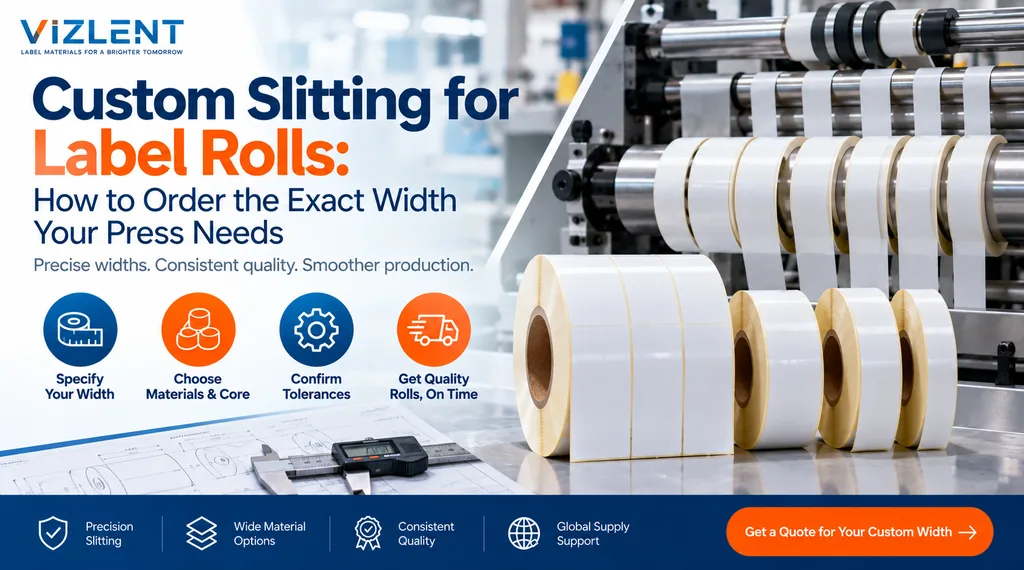
Custom Slitting for Label Rolls is the converting process that cuts a wide coated master reel into narrower finished rolls at a specified width, tolerance, core size, roll diameter and unwind direction. Order it against the web width your press is built to run, never against the size of your label or your die. Five numbers decide whether a roll runs cleanly or has to be set aside: slit width, width tolerance, core inner diameter, maximum roll outside diameter and unwind position.
What Custom Slitting for Label Rolls Actually Buys You
Slitting converts a coated master reel into finished rolls at the exact width one machine requires. Vizlent Label coats, siliconizes, slits, rewinds and sheets in house, so material is cut on the same site where the adhesive was applied. That matters, because slit width, edge quality and winding tension all depend on how the web behaves during coating.
Buying pre-slit stock removes a step from your operation. You stop pushing jumbos through a slitter, stop generating trim waste on your floor, and stop paying for the rewind slitting labour. For converters running short jobs across many SKUs, that is the difference between a press that runs and a press that waits.
- Fewer setups: rolls arrive press ready, so changeovers skip the slitting step.
- Less waste on your side: trim and edge scrap stay at the material plant.
- Tighter width control: precision slit rolls are cut using tension and caliper data a downstream slitter does not have.
- Format choice: one construction can ship as jumbo rolls, slit-to-width rolls or sheets.
Stop rewinding jumbos. Send Vizlent your press web width and core size, and get a slit specification confirmed within 24 hours. Submit your specification.
Start With Web Width, Not Label Width
Your press has a maximum and a minimum web width, and those two figures define every roll you can buy. Web width is the full width of material travelling through the machine, including the unprinted margin at both edges. Label width is only what the die cuts out of that web.
Ordering against label width is a common error in pressure-sensitive label stock buying. A 100 mm label does not run on 100 mm stock, because the web needs margin for guiding, for matrix stripping and for the die to cut cleanly inside it. Ask your die supplier which web width the tool was built for, and if a new die is being made, fix the stock width first and build the tool to match.
How to Read Your Press Specification Correctly
Every press and printer publishes a media width range. On a narrow web flexo press that appears as maximum and minimum web width, and the minimum matters just as much, because a web that is too narrow wanders in the guides. On a thermal printer the equivalent figure is maximum media width, usually paired with a maximum roll diameter and a fixed core.
Copy the number exactly as the manual states it, units included. Then confirm the width your operators actually run, which often sits just under the published maximum. A custom slitting for label rolls machine will hold whatever width you specify, but only the width your press was set up for will run.
The Seven Numbers Every Slitting Specification Needs
A complete slitting specification fits in one short email. Leave any item out and the supplier has to assume a value, and an assumption becomes a production run. The list below is the minimum Vizlent’s engineering team asks for before quoting custom roll slitting.
Send all seven together rather than in sequence. A supplier given a partial specification quotes a standard construction and corrects it later, adding a revision cycle to your lead time. One complete message removes that cycle.
- Slit width in millimetres or inches, to one decimal place.
- Width tolerance you can accept, as a plus or minus figure.
- Core inner diameter, commonly 25.4 mm, 38.1 mm or 76.2 mm.
- Maximum roll outside diameter your unwind can physically take.
- Roll length in linear metres, or a target roll weight.
- Unwind direction by number, plus a sketch of which edge leaves first.
- Facestock, adhesive and liner, plus the print method you will run.
Slitting Tolerance: What ±0.2 mm Actually Controls
Width tolerance is the permitted variation between the width you ordered and the width you receive. It is a capability tied to slitting equipment, knife condition and the material being cut, not a quality grade. Tighter tolerances can increase manufacturing and inspection requirements, depending on the slitting equipment and the material, so specify them where the machine genuinely needs them.
Tolerance is where Custom Slitting for Label Rolls specifications most often go unstated, and the supplier then applies its own house standard. A ±0.2 mm specification calls for tighter process control than ±0.5 mm, though the achievable figure depends on the material and the slitting equipment. A 0.5 mm variation may be acceptable for some manual applications and unacceptable on equipment with tight mechanical guides or edge-tracking sensors.
| Vizlent page | Published slitting figure | Typical use |
|---|---|---|
| Laminating films | Slit to ±0.2 mm on all roll widths, on servo-driven slitting lines | Narrow web and wide web laminating |
| Durable labels | Precision slit rolls from 25 mm upward at ±0.5 mm, ±0.3 mm on polyimide grades | Industrial and electronics converting |
| Flexible magnetic stickers | Slit rolls held to ±0.5 mm width tolerance | Direct press or applicator feed |
Figures published on the named Vizlent Label category pages at the time of writing. Each tolerance belongs to the product family on that page and is not a property of every construction Vizlent supplies. Confirm the tolerance for your exact facestock, adhesive and liner against the technical data sheet before ordering.
Core Size and Roll Diameter Decide Whether a Roll Fits
Core inner diameter and maximum roll outside diameter are physical limits, and missing either makes a roll unusable rather than merely awkward. Core ID has to match the mandrel or air shaft on your unwind. Maximum OD is capped by the space inside the machine and the weight the unwind bearings carry.
Those two numbers also set how much material each roll holds. A larger core at the same outside diameter means less footage per roll and more roll changes per shift. Converters who specify a large core out of habit, on a machine that also accepts a smaller one, give up running length for nothing.
Estimate roll length before you order. Where L is length, D is roll outside diameter, d is core outside diameter and t is total caliper of facestock plus adhesive plus liner, all in millimetres:
L = π × (D² − d²) ÷ (4 × t)
A 300 mm roll on a 76 mm core at 0.16 mm total caliper works out near 413 metres. Treat that as nominal only, because wound-in air, tension profile and caliper variation all move the real figure. Ask your supplier to confirm achievable length on your specified construction.
Unwind Direction and Wind Side
Unwind direction describes which edge of the label leaves the roll first and whether labels face outward or inward. Many label suppliers use eight standard unwind positions, commonly numbered 1 to 4 for wound-out rolls and 5 to 8 for wound-in rolls, each named for its leading edge. Numbering conventions are not universal, so confirm any number against your supplier’s or applicator’s own diagram.
Send a sketch or photo alongside the number. Your applicator manual states the feed orientation it needs, and the supplier can confirm it in a two-minute call. Getting it wrong can prevent correct label orientation and create feed or registration problems, usually discovered only after the roll is loaded.
- Wound out: face on the outside of the roll, the more common convention.
- Wound in: face on the inside, specified by certain applicators and print systems.
- Liner side: state which way the release liner faces, especially on unprinted stock.
- Hand application: unwind position matters far less, so do not pay for precision you will not use.
Not sure which unwind your line needs? Send the applicator make and model with your width and Vizlent will match the roll direction. Talk to an engineer.
Edge Quality, Adhesive Ooze and Defects to Inspect on Arrival
Slit width is half of a good roll, and edge condition is the other half. Shear, razor and crush slitting behave differently across coated papers, films and adhesive constructions, and performance depends on gauge, coating, knife geometry, machine setup and winding tension. Ask the converter which method is qualified for your specific material, because it changes the dust, burr and ooze you see downstream.
Pressure-sensitive adhesive is viscoelastic, so a freshly cut edge can cold flow and show up as edge tack, blocking or a roll that will not run off smoothly. Storage temperature and stacking pressure both accelerate that. Inspect one roll from every delivery before any of it reaches the press.
- Telescoping: layers slip sideways, usually a tension or core alignment fault.
- Dishing: the roll face is no longer flat, usually from uneven winding.
- Edge weave: the slit edge reads wavy against a straight edge.
- Slitting dust: paper debris that migrates into print heads and die stations.
- Adhesive ooze: visible glue at the roll edge, which causes blocking and feed faults.
Matching Slit Width to Facestock, Adhesive and Liner
The same nominal width behaves differently across constructions, because facestock stiffness and liner caliper change how a web tracks. A polyester label material, a BOPP label material and a coated paper each respond differently to web tension, depending on film gauge, stiffness, coating and liner. Liner choice compounds it, since glassine, CCK and PET liners differ in tear resistance and dimensional stability.
Custom slitting for label rolls and labels therefore has to be quoted against the full construction, not the width alone. Vizlent publishes 12 or more facestocks against 8 adhesive grades covering permanent, removable, freezer and wash-off, with glassine, CCK or PET liners. State the end use too, because a low temperature label and a heat resistant label can need different edge handling at the same width.
Print system note: on thermal transfer lines, select ribbon width according to the printer, printhead and printable area, following the printer manufacturer’s requirements rather than a general rule.
Custom Slitting for Label Rolls and Packaging: Where Odd Widths Come From
Odd widths are rarely arbitrary. They come from packaging lines where the applicator, the container and the label layout were fixed long before anyone considered material supply. Custom slitting for label rolls and packaging is the step that reconciles a legacy machine with a current material specification.
There is a cost angle worth working out. If a parent reel is 1,000 mm wide and your slit width divides into it cleanly, trim is minimal, while a width leaving a 40 mm remainder wastes that strip on every reel. Ask which widths nest efficiently in your supplier’s reels, because a small adjustment can lower material cost without touching your press.
- Applicator channel width fixed by machine design.
- Container diameter and wrap dictating label length and web layout.
- Multi-lane layouts placing two or three labels across the web.
- Legacy tooling built for a web width is no longer sold as standard.
Slit Width, Barcode Layout and Print Quality Standards
Narrowing a web narrows the space available for a barcode, and that limit comes from the applicable specification rather than from preference. GS1-128 X-dimension requirements depend on the GS1 application specification in force, and general distribution guidance commonly uses 0.495 mm to 1.016 mm, while GS1 also defines a smaller absolute minimum for units physically too small to carry it. Check the applicable GS1 specification for the required X-dimension, quiet zones of at least 10X on each side, and the 165.1 mm maximum symbol length including quiet zones, before you reduce web width.
Do not reduce a symbol below the applicable GS1 specification simply to save material. Print quality is assessed separately, and ISO/IEC 15416:2025 defines the methodology for measuring attributes of linear barcode symbols and deriving an overall quality assessment. Agree the acceptance grade in writing with your customer, then verify it on the slit stock you actually intend to run.
Before you commit to a narrower width, check the barcode still fits. Send Vizlent your label layout and get a construction and width recommendation back, with free samples to test.
Finding Custom Slitting for Label Rolls for Sale Without Buying From a Middleman
Searching for custom slitting for label rolls for sale returns direct manufacturers, converters and trading companies mixed together, and they behave very differently when something goes wrong. A pure trading company typically resells an existing construction, while a label stock supplier with in-house coating and converting can control formulation and coating variables directly. Some traders do work through affiliated factories, so ask who owns the coating and slitting lines rather than inferring it from the website.
Vizlent has operated as a direct manufacturer since 2011, supplying converters and distributors in more than 50 countries, certified to ISO 9001, FSC and SGS, with in-house Xenon Arc and shear testing. Published figures at the time of writing include a 7 to 15 day lead time on custom OEM and ODM runs, a nominal 1,000 square metre minimum that varies by material, and free A4 sheets and sample rolls for testing. Confirm current lead time, minimum order quantity and certificate validity on your quotation rather than from any web page, this one included.
Five questions that separate a factory from a reseller:
- Which slitting method runs on my construction, and what tolerance can you hold?
- Can you send the technical data sheet for this exact facestock, adhesive and liner?
- What core sizes and maximum roll diameters do you run as standard?
- Will you supply a free sample roll cut to my width before I commit?
- Can you provide current compliance documentation for my use and jurisdiction?
A Five-Step Ordering Sequence That Prevents Rework
Ordering out of sequence turns a straightforward custom slitting for label roll purchase into a three-week correction. The steps below put the cheap checks first and the expensive commitments last. Each one produces something you can inspect before committing to production.
Write your acceptance criteria before testing anything. Define in advance what a passing sample looks like: maximum edge lift, minimum barcode grade, no delamination, no print transfer, and a minimum peel result where peel matters. A sample trial without written criteria produces an opinion, not a qualification.
- Submit the specification. Web width, tolerance, core ID, maximum OD, length, unwind, construction, print method.
- Receive a recommended construction. Ask why each layer was chosen.
- Request the technical data sheet. A web page is not a data sheet, and figures need test conditions attached.
- Test samples against your written criteria. On your press, at your speeds, on your product.
- Quote at volume and lock the specification into the purchase order so repeat runs stay reproducible.
Get Your Slit Width Right the First Time
A roll that fails on press has usually failed weeks earlier, in an email that left a number out. Custom Slitting for Label Rolls is not complicated, it is simply unforgiving of incomplete information. Send all seven numbers with the enquiry and width problems largely stop recurring.
Vizlent supplies self adhesive material and raw material label stock as jumbo rolls, custom slit label stock and sheets, coated and slit in house, with free samples before any bulk commitment. Send your web width, core size, maximum roll diameter and construction, and the engineering team returns a recommended specification and a sample roll cut to your width. More guidance sits in the Vizlent knowledge library.
Send your slitting specification today and get free samples cut to your exact width. Request your quote and samples.
Frequently Asked Questions
What is Custom Slitting for Label Rolls?
It is the converting process that cuts a wide coated master reel into narrower finished label rolls at a customer-specified width, core size, roll diameter and unwind direction. Precision label-roll slitting runs on dedicated lines, normally after adhesive coating and siliconizing. Suppliers who coat and slit under one roof control tension and edge quality across both stages.
What width should I order for my press?
Order to your press web width, the full width of material passing through the machine, not the width of the finished label. That figure appears in your press or printer manual as a maximum and a minimum media width, and operators often run slightly below the published maximum. Fix the stock width before a new die is cut.
What slitting tolerance do I actually need?
It depends on how the material is guided. Hand application and mark-sensing systems tolerate wider variation, while automatic applicators with fixed guide channels and edge-sensing presses need tighter control. Vizlent publishes ±0.2 mm on laminating films and ±0.5 mm on precision slit durable label rolls, with ±0.3 mm noted for polyimide grades, at the time of writing. Ask for the tolerance applicable to your construction rather than assuming one site-wide figure.
What core size should I specify?
Specify the core inner diameter your unwind mandrel or air shaft physically accepts, commonly 25.4 mm, 38.1 mm or 76.2 mm depending on the machine. Desktop printers usually take smaller cores and cap roll diameter, while industrial presses accept larger cores and heavier rolls. A larger core at the same outside diameter reduces footage per roll, so check core ID and maximum roll diameter together.
Should I buy a slitting machine instead of pre-slit stock?
You can, and high-volume converters often do, but it is a capital decision rather than a purchasing one. A custom slitting for label rolls machine adds equipment cost, floor space, an operator, knife maintenance and trim waste disposal. It pays off at consistently high volume across few widths, while mixed SKU work with frequent width changes is usually cheaper on pre-slit rolls.
Does slitting affect adhesive performance?
Slitting exposes pressure-sensitive adhesive at the cut edge, which can produce edge tack, blocking or ooze when rolls are stored under pressure or at elevated temperature. It does not change the adhesive chemistry. Peel behaviour is characterised using methods such as ASTM D3330/D3330M-04(2025), which covers peel adhesion of pressure-sensitive tape across six test methods and notes that peel results usually bear no direct relationship to a functional requirement. Qualify the adhesive on your own substrate and conditions.
How does slit width affect barcode compliance?
A narrower web reduces printable area, which constrains X-dimension, quiet zones and symbol length. The GS1 General Specifications require quiet zones of at least 10X on both sides of a GS1-128 symbol and cap symbol length at 165.1 mm including those quiet zones, with the required X-dimension set by the applicable application specification. If the slit width cannot accommodate the required symbol size and quiet zones, revise the web or label layout before production. Verify the printed result against a defined grading method such as ISO/IEC 15416:2025.
What lead time and minimum order should I expect?
Vizlent Label figures published at the time of writing indicate a 7 to 15 day lead time on custom OEM and ODM runs and a nominal 1,000 square metre minimum that varies by material. Free A4 sheets and sample rolls are offered for testing, with the customer covering courier freight. Both figures depend on facestock, adhesive grade, width and production loading, so confirm them on your quotation.






