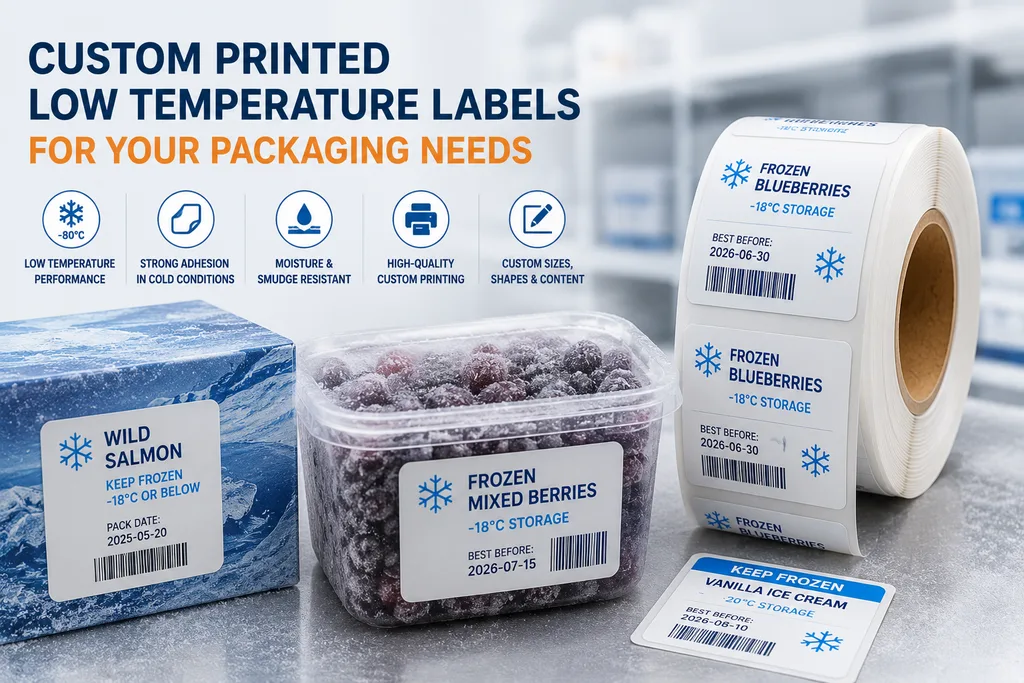
Sourcing a label that still works at -30°C is a routine request, and the short answer is that custom printed low temperature labels are available for almost any packaging format, printed with your own artwork, barcodes, and variable data. Converters and label stock manufacturers supply them as die-cut rolls, sheets, or jumbo stock, on facestock and adhesive systems built for freezer and cryogenic duty. Availability is rarely the obstacle, and specification usually is.
Cold storage punishes labels in ways ambient packaging does not. Adhesive stiffens, frost blocks contact, condensation creeps under the edge during thaw, and the facestock loses flexibility just as the carton gets handled roughly. Specifying correctly the first time costs far less than a pallet nobody can scan.
How to read the claims below:
- Regulatory requirement: a rule written into law or an official register, cited to its source.
- Industry convention: common practice among converters and end users, not a legal mandate.
- Vizlent product data: figures published on Vizlent product and category pages.
- Author recommendation: professional judgment from converting and supply experience.
What Custom Printed Low Temperature Labels Actually Are
Custom printed low temperature labels are pressure sensitive labels engineered so the adhesive, facestock, topcoat, and printed image all keep working below freezing. Every layer differs from an ordinary paper label, not just the glue. The facestock is chosen for moisture resistance, the adhesive is formulated to stay tacky in the cold, and the topcoat is selected to hold a thermal transfer image on a damp surface.
The term covers a wide performance band rather than one product. A chilled retail case label and a liquid nitrogen dewar label are both cold labels, yet they use different chemistry and different validation. Any competent supplier will ask about storage temperature, application temperature, and container material before quoting (author recommendation).
- Freezer-grade labels: constructions specified for conventional frozen storage, commonly around -20°C to -40°C
- Ultra-low-temperature labels: constructions designed for applications around -80°C
- Cryogenic labels: specialized constructions designed for extremely low temperatures, including liquid-nitrogen conditions around -196°C
- Verify before you buy: temperature ratings are construction-specific and manufacturers apply these category names differently, so always check minimum application temperature and service temperature against the current technical data sheet
Why Standard Label Stock Fails in the Cold
General purpose stock is tuned for room temperature convenience, and its adhesive was never asked to work at -30°C. As temperature drops, that adhesive stiffens and stops flowing into the microscopic texture of the container surface. Bond strength depends on that flow, so a stiff adhesive struggles to build the contact area it needs.
Cold failure is almost never a single mechanism. Moisture, frost, container material, surface energy, application pressure, and time under load all interact, and blaming glass transition temperature alone oversimplifies what is happening (industry convention). Peel performance is measured under defined conditions using methods such as FINAT FTM 1 and ASTM D3330, so datasheet numbers only compare when the test conditions match.
Application Temperature Versus Service Temperature
Two numbers decide whether custom printed low temperature labels will hold, and confusing them is the most common error in cold chain labeling. Minimum application temperature is the coldest surface at which the label can be applied and still bond. Service temperature is the range it survives once that bond has formed.
A label rated to -196°C in service may still need application at +10°C or warmer, which is what Vizlent specifies for its ultra low temperature cryogenic labels (Vizlent product data). Labelling products that are already frozen needs an adhesive formulated for cold application, not merely cold storage. State both numbers on the purchase specification.
- Ask for: minimum application temperature, service temperature range, and dwell time before freezing
- Confirm: whether the surface is dry, damp, or frosted at the moment of application
- Record: line speed, applicator pressure, and any wipe-down station already in use
Facestock and Adhesive Choices That Actually Hold
Conventional paper facestocks can absorb moisture, swell, and lose dimensional or print performance in freezer environments. Wet-strength and specialty coated papers can offer better resistance, while synthetic films generally provide stronger moisture resistance, with low-temperature flexibility depending on the polymer and construction. Vizlent publishes indicative service temperatures by facestock family across its low temperature label range: polypropylene film to -196°C, polyester film to -80°C, flexible vinyl to -40°C, and specialty coated paper to -20°C (Vizlent product data; indicative, confirm against the current technical data sheet).
Adhesive selection follows the container, not the freezer, and polyethylene or polypropylene tubs have low surface energy that needs chemistry built for that condition. Cryogenic permanent acrylics are commonly used for laboratory storage applications, while other formulations can be selected where fast initial grab on a chilled surface is important. Vizlent lists both acrylic and rubber based options on its freeze grade label stock and durable label pages (Vizlent product data).
Ready to match adhesive to your container? Send an actual bottle, vial, or carton to the Vizlent technical team through the contact page and ask for a cold application trial before committing to volume.
Custom Printed Low Temperature Labels for Food
Frozen food packaging combines cold duty with moisture, grease, and rough handling. Custom printed low temperature labels for food have to hold on polyethylene bags, waxed corrugate, and rigid tubs, often after a blast freezer. Print durability matters as much, since lot codes, use-by dates, and traceability barcodes must stay scannable through the whole chain.
Food packaging also carries a documentation burden other cold applications do not. Buyers and auditors ask what the label is made of and whether the adhesive may contact food, so file the technical data sheet and supplier declarations with the artwork. Vizlent’s custom labels for the food and beverage industry and beer and beverage pages list construction options (Vizlent product data).
Food Contact and Compliance Notes
In the United States, some label applications can be covered by 21 CFR 175.105 for adhesives behind a functional barrier, while 21 CFR 175.125 covers pressure sensitive adhesives where the adhesive is the food contact surface of a label applied to food (regulatory requirement). The applicable regulatory basis depends on the specific formulation, construction, intended use, food type, and conditions of use. Ask your supplier to name in writing the section relied on, and request current certificates for your market.
European buyers work under a separate framework, with Regulation (EC) No 1935/2004 setting general requirements for food contact materials (regulatory requirement). Traceability recordkeeping under FSMA 204 applies to foods on the Food Traceability List, and several fresh entries exclude previously frozen forms. The rule also contains exemptions and scope conditions, so confirm applicability for the specific food and operation before relying on it (regulatory requirement).
Print Methods That Survive Frost and Handling
Thermal transfer is widely used for cold chain variable data labeling because the printed image can be engineered for strong abrasion and moisture resistance through the ribbon and facestock combination. Resin ribbons generally provide higher abrasion and chemical resistance than wax based ribbons when paired with compatible synthetic facestocks. Vizlent specifies thermal transfer with resin ribbon as the primary print method for its cryogenic labels, with laser printing secondary (Vizlent product data).
Direct thermal still suits short cycles where labels are read within days rather than years. Flexographic or digital preprinting handles brand artwork, with variable data added in line at the packing station. Ribbon and facestock compatibility is specific rather than universal, so test your thermal transfer ribbon on the exact stock you plan to buy.
- Resin ribbon: generally the highest abrasion and solvent resistance on compatible film facestock
- Wax resin ribbon: mid range durability, often used on coated paper and matte films
- Direct thermal: simple and ribbonless, but vulnerable to abrasion and heat
Custom Printed Low Temperature Label Rolls and Formats
Custom printed low temperature label rolls are the standard format for automated applicators, and roll direction, core size, and outside diameter all belong on the order. Getting those wrong stops a line as effectively as a bad adhesive. Vizlent lists roll widths from 30mm to 1300mm, with jumbo rolls up to 1200mm supplied splice free (Vizlent product data).
Sheets and fanfold packs still make sense for laboratories, small batch producers, and hand application. Converters can also supply jumbo raw material label stock if you print and die-cut in house. Decide the format before artwork is finalized, because bleed, gap, and matrix design all depend on it.
- Rolls: specify core diameter, wind direction, labels per roll, and maximum outside diameter
- Sheets: specify sheet size, labels per sheet, and printer compatibility
- Jumbo stock: specify web width, splice policy, and liner type
Ordering Custom Printed Low Temperature Labels in Bulk
Buying custom printed low temperature labels in bulk changes both the economics and the qualification risk. Larger runs cut setup cost per label and improve color consistency, but they lock you into a construction before field experience exists. Order a qualification quantity first, run it through a full season of real handling, then scale (author recommendation).
Lead time and minimum order quantity vary with construction and with how much is custom. Vizlent publishes a standard minimum of roughly 1,000 sqm for stock programs, 1,000 pieces per size on its cryogenic label product, and a 7 to 15 day lead time on custom OEM and ODM orders (Vizlent product data). Confirm current figures at quoting time, since capacity and material availability move.
Planning a volume purchase? Request a free sample roll and a written construction sheet before releasing a bulk purchase order, so the label you validate is the label you receive.
Custom Printed Low Temperature Labels and Stickers for Mixed Duty
Most packaging programs need more than one cold label at once, and treating them as a single line item causes trouble. A single frozen pallet often carries several custom printed low temperature labels and stickers, each doing a different job, from a primary product label to a logistics label and a tamper evident seal. Buyers searching for a custom printed low temperature labels sticker usually mean a small promotional or informational decal, which carries nothing like the durability requirement of a barcode that must scan after two winters in a freezer.
Group requirements by function before requesting quotes. That single step usually reveals that only one or two items truly need cryogenic chemistry, while the rest run happily on freezer grade stock. Outdoor exposure adds another variable, and Vizlent’s outdoor and weather resistant and logistics and e-commerce ranges cover labels that meet cold, moisture, and UV together.
Testing and Qualification Before You Commit
Datasheet numbers are a starting point, not a guarantee, because your container, line speed, and handling profile are yours alone. Build a short qualification protocol that mirrors real conditions instead of laboratory ideals. Apply on the real line, freeze at the real storage temperature, and pull samples on a schedule matching your shelf life.
Barcode readability deserves its own check, and the symbology and applicable verification standard should be specified before testing starts. Print quality for linear symbols is graded against ISO/IEC 15416, while ISO/IEC 15415 is the relevant specification for certain two-dimensional symbols (industry convention). Acceptance thresholds should follow the specification agreed with your customer or the applicable industry standard, not a rule of thumb.
- Apply labels under production conditions, including line speed and applicator pressure.
- Condition samples at the true storage temperature for a defined dwell period.
- Inspect for edge lift, flagging, curl, and adhesive residue after thaw.
- Verify barcode grade before freezing, mid-cycle, and at end of intended life, using the verification standard that matches your symbology.
- Repeat on every container material and surface finish in your range.
Next Step: Submit a Complete Specification
The fastest route to a working label is a complete specification package, since incomplete briefs are the main cause of requoting and delay. Everything a converter needs fits on one page. Work through this checklist before requesting a quote.
- Container material, size, and surface finish, with a physical sample where possible.
- Application temperature, and whether the surface will be dry, damp, or frosted.
- Storage temperature, expected service life, and number of freeze and thaw cycles.
- Label size, shape, corner radius, and required roll or sheet format.
- Print method, printer model, and current ribbon type.
- Artwork, barcode symbology, and variable data requirements.
- Annual volume, first order quantity, and target delivery date.
- Regulatory documentation needed for your market and customers.
Get a specification review and free samples. Send your container details and cold chain profile to the Vizlent technical team through the contact page, or browse the low temperature label range to shortlist constructions first. The Vizlent knowledge library, laminating film range, and heat resistant label range cover related material choices.
Frequently Asked Questions
Can I get cold chain labels printed with my own artwork and barcodes?
Yes, they are routinely produced with brand artwork and variable data such as lot codes. Preprinting handles fixed elements while variable data is added in line at the packing station. Confirm barcode symbology, X dimension, and quiet zone with your converter, and ask for a printed proof on the exact stock.
What temperature range do freezer labels need to handle?
That depends on the construction and the application rather than on a category definition. Commercial freezer duty is commonly specified around -20°C to -40°C, ultra low temperature freezers run near -80°C, and liquid nitrogen storage reaches -196°C. Confirm the figure against the technical data sheet for the specific construction you buy.
Can labels be applied directly to frozen or frosted surfaces?
Many cold-rated adhesives still require the surface to meet a specified minimum application temperature, while specialized constructions are available for application to colder surfaces. Frost sits between adhesive and container as a physical barrier, and trapped moisture prevents proper wet-out. If your process demands application to an already frozen product, put that requirement in writing at the quoting stage.
Are cold chain labels safe for direct food contact?
Some constructions can be covered by United States food contact regulations, with 21 CFR 175.105 applying to adhesives behind a functional barrier and 21 CFR 175.125 addressing pressure sensitive adhesives as the food contact surface of labels applied to food. Coverage depends on the formulation, the food type, and the conditions of use, and European markets work under Regulation (EC) No 1935/2004. Request a written compliance statement and current documentation for your market.
What is the difference between freezer grade and cryogenic label stock?
Freezer-grade stock is generally intended for conventional frozen-storage conditions, but the actual temperature range and facestock depend on the construction. Cryogenic stock typically pairs synthetic facestock with a permanent acrylic built for liquid-nitrogen conditions and repeated freeze and thaw cycles, with tighter expectations for barcode legibility. Cost per label is higher, so confirm against the data sheet and reserve cryogenic constructions for containers that genuinely need them.
Which printing method works best for frozen packaging labels?
Thermal transfer with a resin or wax resin ribbon is the usual choice, since the printed image can be engineered for far better abrasion and moisture resistance than direct thermal. Direct thermal remains practical for short cycles where labels are read within days. Test the ribbon and facestock pairing together, since compatibility is construction-specific.
How small can an order for custom cold labels be?
Minimum order quantities vary with construction, print method, and whether die-cutting tooling is required. Vizlent publishes a standard minimum of roughly 1,000 sqm for stock programs and 1,000 pieces per size for its cryogenic label product, while noting flexibility on trial orders. Sample quantities for qualification are usually available separately, so confirm current figures directly.
How do I stop labels lifting after a product comes out of the freezer?
Edge lift after thaw can result from condensation and moisture intrusion, but low-temperature adhesion, surface condition, label geometry, and thermal cycling can all contribute. Synthetic facestock reduces the water absorption pathway, and a moisture resistant acrylic helps hold the perimeter. Rounded corners and a slightly smaller footprint also reduce the exposed edge, so test through a full freeze, thaw, and re-chill cycle.