
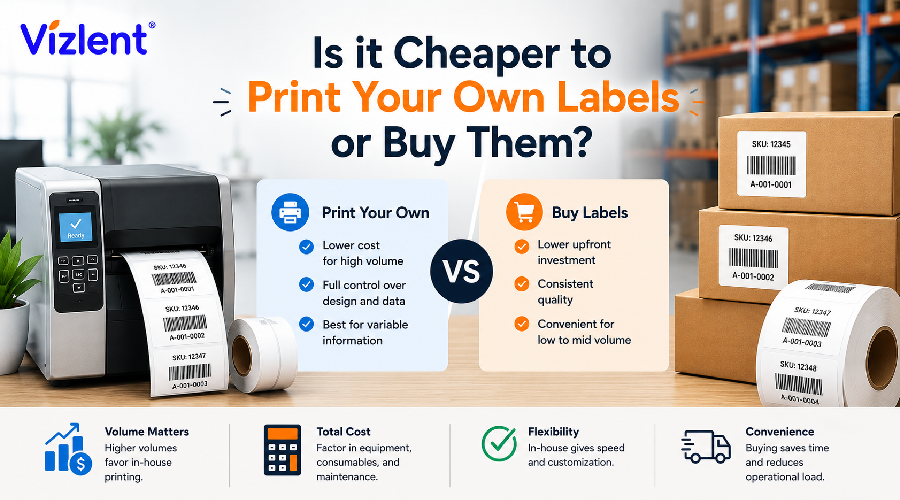
Whether it is cheaper to print your own labels or buy them depends entirely on your usage. If you are a business owner who needs high-quality, high-volume labels, it is much cheaper to buy them from a direct manufacturer in China like Vizlent Label, which supplies bulk and wholesale label materials at low prices without sacrificing quality. If you are an individual or a very small operation printing a handful of labels each month, printing at home can be the more economical short-term choice. However, you have to spend a good amount upfront.
The real answer lives in the math behind your volume, your quality requirements, and the true cost of the equipment you would need to buy and maintain. Home printing hides costs in ink, blank stock, printer wear, and your own time, while sourcing finished or bulk material shifts those costs into a predictable per-unit price. Understanding where that break-even point sits is what separates a smart sourcing decision from an expensive habit.
The Short Answer on Printing Versus Buying Labels
The decision to print your own labels or buy them comes down to a single question: how many labels do you actually need, and how good do they have to be. Home printing gives you speed and control for tiny batches, but the per-label cost stays stubbornly high because consumer ink and blank sheets are expensive on a per-unit basis. Buying finished labels or bulk label stock from a manufacturer lowers the per-unit price dramatically once your volume climbs past a few hundred units a month.
For most product businesses, the crossover happens faster than people expect. A short home print run feels free because you already own the printer, yet the moment you factor in ink replacement, wasted sheets, and the hours spent feeding paper, the hidden cost becomes clear. Vizlent Label supplies self adhesive label materials and finished label stock at factory-direct pricing, which is why growing brands tend to migrate from the home printer to a wholesale supplier as they scale.
What It Really Costs to Print Your Own Labels at Home
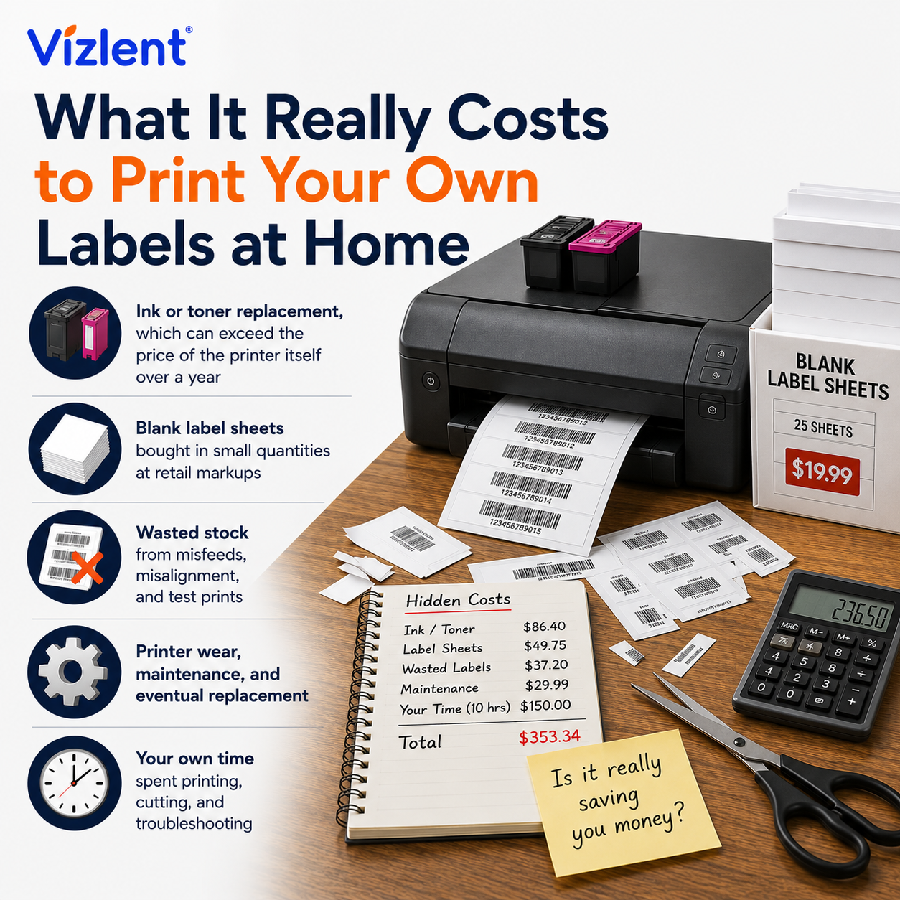
When you print your own labels at home, the printer is only the beginning of the expense. Consumer inkjet and laser ink is one of the most expensive liquids you can buy by volume, and a single label sheet can consume far more ink than it appears to when it carries color, logos, or barcodes. Blank label sheets also carry a markup, and low-cost stock often lacks the adhesive strength or print durability that a real product label demands.
There is also the cost of failure, which people rarely budget for honestly. Misaligned prints, jammed sheets, smeared toner, and peeling labels all turn into wasted material and wasted time. When you print your own labels at home, you are also the machine operator, the quality inspector, and the person who reorders supplies, and that labor has a real value even if it never shows up on an invoice.
Key hidden costs of home printing include:
- Ink or toner replacement, which can exceed the price of the printer itself over a year
- Blank label sheets bought in small quantities at retail markups
- Wasted stock from misfeeds, misalignment, and test prints
- Printer wear, maintenance, and eventual replacement
- Your own time spent printing, cutting, and troubleshooting
The durability gap is the cost most home printers overlook until a label fails in the field. Retail inkjet labels smear when they meet moisture, fade under sunlight, and lift at the edges on curved or textured surfaces. A product label that peels in a customer’s hands or a barcode that will not scan at the warehouse creates costs that dwarf the price of the label itself, from reprints to returns to lost sales.
Is It Cheaper to Print Shipping Labels at Home?
Whether it is cheaper to print shipping labels at home is a slightly different question because shipping labels are usually simple, single-color, and printed on demand. For low daily volumes, a thermal label printer that needs no ink can make home printing of shipping labels genuinely economical. Direct thermal shipping labels are inexpensive per unit, and skipping ink entirely removes the biggest recurring cost of consumer printing.
The economics shift again once your shipping volume grows into the hundreds or thousands per week. At that scale, buying thermal label rolls in bulk from a manufacturer beats retail pack pricing by a wide margin, and consistent roll quality keeps automated label applicators and scanners running without jams. So it can be cheaper to print shipping labels at home for a small store, but a high-volume fulfillment operation saves more by sourcing bulk thermal stock from a logistics and e-commerce label supplier.
Thermal print quality also depends on the stock itself, which is where cheap retail rolls cost more than they save. Poorly coated thermal labels produce faint barcodes that fail scans, and low-grade adhesive lets labels drop off parcels in transit. Sourcing consistent, well-coated thermal material in bulk protects your scan rates and keeps carriers from rejecting shipments, which is a real cost that pure per-unit price comparisons tend to miss.
Is It Cheaper to Print Your Own Stickers?
The question of whether it is cheaper to print your own stickers depends heavily on the finish, the durability, and the quantity you need. A few decorative stickers for a hobby project are cheap enough to print at home, especially if you already own a color printer and some sticker sheets. The per-sticker cost, however, rises quickly once you want waterproof material, rich color reproduction, die-cut shapes, or a laminated protective layer.
Professional stickers usually require materials that a home printer cannot match, such as vinyl facestocks, weather-resistant adhesives, and lamination films. Producing those finishes at home means buying specialty stock, a laminator, and possibly a cutting machine, which pushes the true cost well above what a manufacturer charges per unit. For anything beyond casual craft use, buying finished stickers or sourcing outdoor weather resistant material in bulk delivers better quality at a lower real cost.
When Home Printing Actually Makes Sense
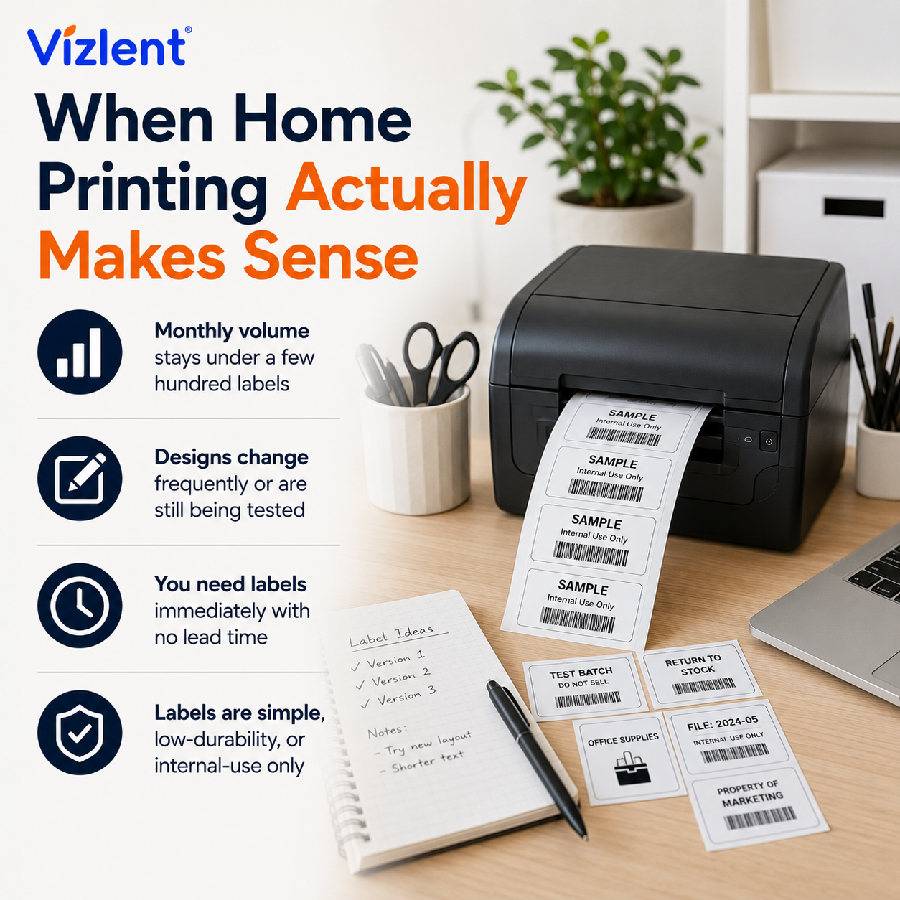
Home printing genuinely wins in a few specific situations, and it is worth being honest about them. If your volume is very low, your designs change constantly, or you need labels within minutes, a home printer earns its keep. Prototyping new label designs, printing one-off address labels, or labeling a handful of jars for a market stall are all cases where buying in bulk would leave you with more inventory than you can use.
The advantage of home printing is flexibility rather than cost efficiency at scale. You can change a design, print a single sheet, and adapt on the fly without waiting for a supplier lead time. When you print your own labels online using a design template or print your own labels at home for tiny personal batches, the convenience can outweigh the higher per-unit price, at least until your needs grow.
Home printing tends to make sense when:
- Monthly volume stays under a few hundred labels
- Designs change frequently or are still being tested
- You need labels immediately with no lead time
- Labels are simple, low-durability, or internal-use only
The trap is treating home printing as a permanent solution when it was only ever a starter step. Many businesses keep feeding an inefficient home setup long after their volume justified switching, paying a premium on every label out of habit rather than need. The smart move is to reassess the moment your monthly volume grows or your quality bar rises, because that is usually the point where buying overtakes printing on total cost.
Why Buying in Bulk Wins for Growing Businesses
For any business scaling past the hobby stage, buying labels in bulk almost always wins on total cost. Manufacturers spread fixed production costs across enormous runs, so the per-label price on a bulk order is a fraction of what home printing costs per unit. When you compare the option to print your own labels or buy them bulk, the bulk route delivers lower per-unit pricing, consistent quality, and materials engineered for real-world durability.
Bulk buying also removes the hidden labor and failure costs that quietly drain home printing budgets. You receive finished stock or precision-slit rolls ready to run, tested for adhesion and print compatibility, with no ink to reorder and no misfeeds to waste. Vizlent operates as a direct factory rather than a reseller, which means brands ordering durable label stock pay manufacturer pricing instead of the markups that pile up through trading companies and retail suppliers.
Consistency is the other advantage that bulk sourcing brings to a growing brand. Every roll from a certified line shares the same caliper, adhesive tack, and print surface, so your labels look identical across thousands of units and every batch you reorder. That uniformity matters for shelf appeal, for automated application, and for barcode scanning, none of which a home printer can guarantee once you scale beyond a few sheets at a time.
Print Your Own Labels or Buy Them for Business: The Volume Math
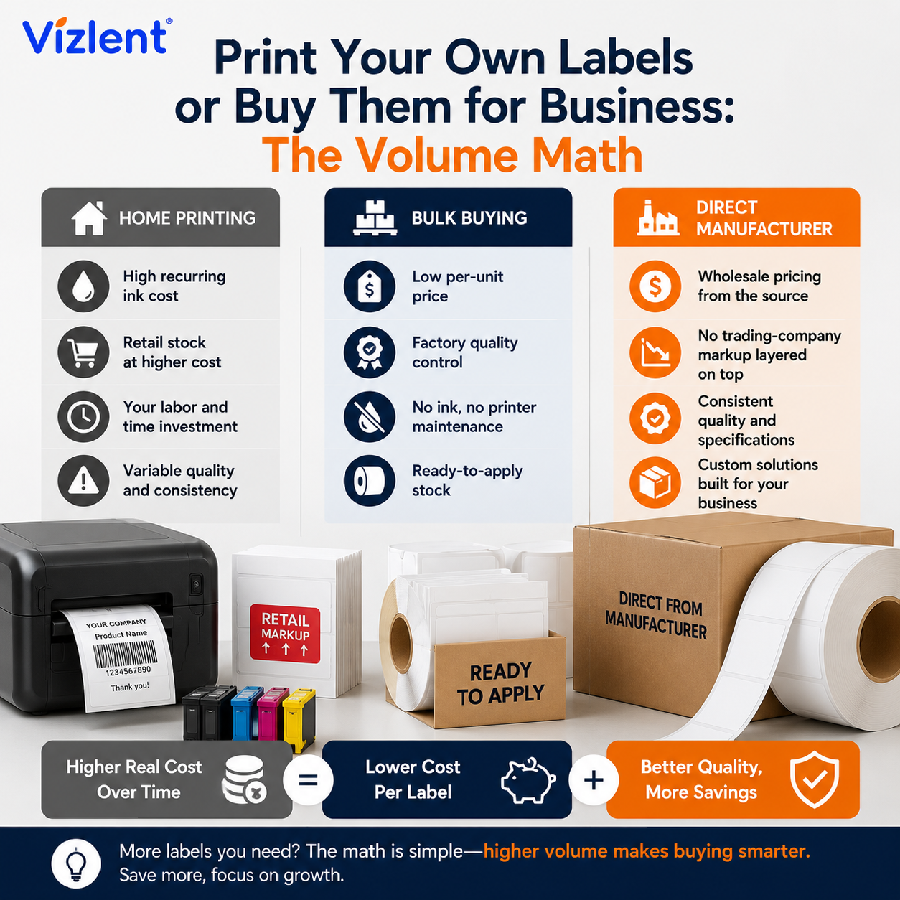
The core of the print your own labels or buy them for business decisions is a break-even calculation. At low volume, the fixed cost of a printer is spread across so few labels that each one carries a high effective price, and ink keeps that price high no matter how many you print. As volume rises, home printing costs stay roughly linear because ink and stock scale with every sheet, while bulk manufacturing costs drop sharply per unit as order size grows.
This is why the print your own labels or buy them business question usually resolves in favor of buying once a company reaches steady production. A brand shipping hundreds or thousands of units a month will almost always find that wholesale label stock beats home printing on price, quality, and reliability combined. Sourcing from a manufacturer also frees your team from running a print operation so they can focus on the product itself.
Consider the difference in what you are paying for:
- Home printing: High recurring ink cost, retail stock, your labor, variable quality
- Bulk buying: Low per-unit price, factory quality control, no ink, ready-to-apply stock
- Direct manufacturer: Wholesale pricing with no trading-company markup layered on top
To run your own numbers, add your ink cost per sheet, your blank stock cost per sheet, and a fair value for your time, then divide by the labels per sheet to get a true cost per label. Compare that figure against a bulk quote for the same quantity and the same durability grade. Most owners are surprised by how quickly the home-printed cost per label climbs once labor and waste are counted honestly, and how far below it a factory-direct quote sits at any real volume.
Print Your Own Custom Labels or Source Custom Stock?
Many businesses want to print their own custom labels because customization feels like it requires in-house control, but that assumption is often wrong. A direct manufacturer can produce fully custom labels with specific facestocks, adhesives, colors, and finishes at a per-unit cost far below what home customization achieves. Custom does not have to mean home-printed, and outsourcing custom production usually improves both quality and price at volume.
The same logic applies when you set out to print your own business labels for products, packaging, or branding. Home equipment limits you to whatever materials and finishes your printer can handle, while a manufacturer offers a full range of substrates and adhesive grades matched to your application. When you weigh whether to print your own labels or buy them for business, custom bulk production from a supplier like Vizlent typically delivers a more professional result at a lower true cost than any home setup.
Matching the material to the job is where a manufacturer adds value that a home printer simply cannot. A freezer product needs a cold-temperature adhesive, an outdoor label needs UV and moisture resistance, and a tamper-evident seal needs a destructible facestock, none of which comes off a standard sheet of inkjet labels. Sourcing custom stock means the material is engineered for the application from the start, which prevents the field failures that make cheap home labels expensive in the long run.
How Vizlent Delivers Bulk Labels Without Sacrificing Quality
Vizlent has manufactured self adhesive label stock since 2011 from a dedicated coating facility, supplying more than 1,000 clients across over 50 countries. As a direct factory rather than a trading company, Vizlent controls the full process from adhesive coating and siliconizing through precision slitting, which keeps costs low and quality consistent. Every roll is produced under ISO 9001, FSC, and SGS standards, giving businesses traceable, compliant material on every order.
This combination of factory-direct pricing and rigorous quality control is exactly what makes bulk buying cheaper than home printing for serious volume. Instead of paying retail markups and absorbing home-printing waste, businesses receive tested, ready-to-run stock built for their specific application. If you need security label material for brand protection or standard stock for everyday products, sourcing directly removes the cost layers that make small-batch printing so expensive.
Ready to see how factory-direct pricing compares to your current label costs? Contact the Vizlent team for a custom quote and free samples so you can test material performance before committing to a bulk order.
Frequently Asked Questions
Is it cheaper to print your own labels or buy them?
Whether it is cheaper to print your own labels or buy them depends on your volume and quality needs. For very small quantities, home printing can be cheaper because you already own the printer. For any meaningful volume, buying in bulk from a direct manufacturer is far cheaper per unit and delivers better quality, since ink, wasted stock, and labor make home printing expensive at scale.
Is it cheaper to print shipping labels at home?
For low daily volumes, printing shipping labels at home with a thermal printer can be cheaper because thermal labels need no ink. Once shipping volume reaches hundreds or thousands per week, buying bulk thermal label rolls from a manufacturer becomes cheaper per unit and keeps automated equipment running reliably. The break-even point depends on how many labels you print each day.
Is it cheaper to print your own stickers?
Printing your own stickers is cheaper only for small batches of simple designs. As soon as you need waterproof material, rich color, die-cut shapes, or lamination, home production requires specialty stock and equipment that pushes the real cost above manufacturer pricing. For durable or high-volume stickers, buying finished stickers or bulk material is more economical.
How many labels do I need before buying in bulk is cheaper?
Most businesses find that buying in bulk becomes cheaper once monthly volume passes a few hundred labels, though the exact point varies with design complexity and durability requirements. Simple labels reach that crossover sooner, while very basic low-volume needs may still favor home printing. Calculating your ink, stock, and labor cost per label is the best way to find your own break-even.
What hidden costs come with printing labels at home?
Home printing carries several hidden costs beyond the printer, including ink or toner replacement, retail-priced blank stock, wasted material from misfeeds, printer maintenance, and your own labor. These costs rarely appear on a single invoice, which makes home printing look cheaper than it is. Adding them up usually reveals a much higher true cost per label.
Can a direct manufacturer produce custom labels affordably?
Yes, a direct manufacturer can produce fully custom labels with specific facestocks, adhesives, colors, and finishes at a lower per-unit cost than home customization at volume. Customization does not require in-house printing, and outsourcing custom production to a factory usually improves both quality and price. This makes custom bulk orders a strong option for growing brands.
Why is buying from a direct factory cheaper than a reseller?
Buying from a direct factory is cheaper because there is no trading-company or retail markup added on top of the manufacturing cost. A factory like Vizlent controls production end to end, from coating to slitting, and passes those savings to the customer. Resellers add margin at each step, which raises the price you pay for the same material.
Does buying labels in bulk mean lower quality?
No, buying labels in bulk from a certified manufacturer usually means higher and more consistent quality than home printing. Bulk production is governed by documented quality control, with testing for adhesion, print compatibility, and dimensional accuracy on every batch. Home printers cannot match the material range or the consistency of a factory operating under ISO 9001, FSC, and SGS standards.
Still weighing whether to print your own labels or buy them for your business? Reach out to Vizlent for factory-direct pricing and free samples, or explore the full label material range to find the right stock for your application.






