
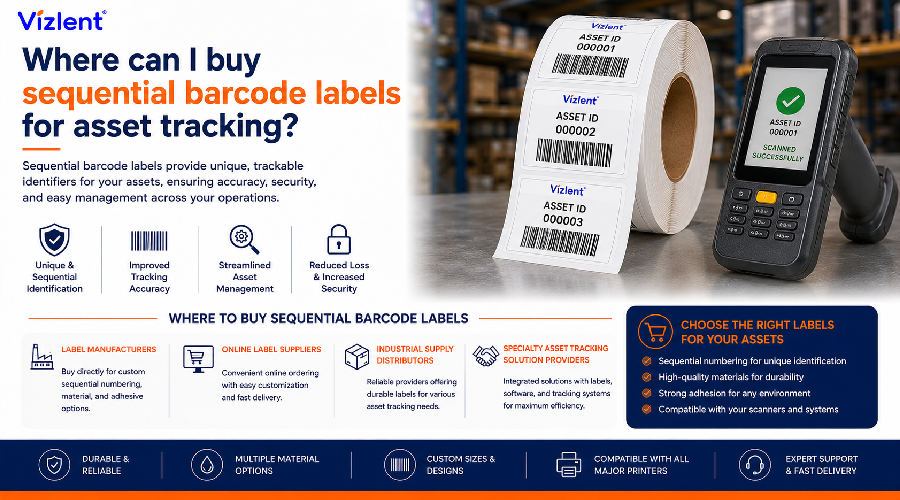
Sequential barcode labels for asset tracking are available directly from manufacturers such as Vizlent, which produce GS1 DataMatrix and QR-coded label materials at print quality grades meeting ISO/IEC 15415 Grade B or above for reliable long-term scanning. Facilities and IT asset managers typically source these labels either directly from a manufacturer for bulk custom runs or through a distributor for smaller trial orders. This guide covers where to buy sequential barcode labels for asset tracking, how the sequencing and scanning actually work, and what to check before placing a bulk order.
Where to Buy Sequential Barcode Labels for Asset Tracking
Sequential barcode labels for asset tracking system implementations are typically sourced through three channels: direct factory manufacturers, industrial label distributors, and general marketplaces, each suited to a different order size and technical requirement. Vizlent’s Security Labels range documents serialized 2D code capability alongside tamper-evident constructions for asset protection use cases where both identification and unauthorized removal detection matter. Buying directly from a manufacturer typically gives access to consistent facestock caliper and ink receptivity across production runs, which matters since barcode grade should not degrade as sequential label volumes scale.
Sequential barcode labels for asset tracking business relationships built around this kind of consistency generally hold up better across repeat orders than a one-off print shop arrangement. A facility standardizing its entire asset tagging program on one supplier avoids the mismatched print quality that comes from mixing labels from several sources over time. Vizlent’s contact page is a reasonable starting point for requesting a quote once your facestock, adhesive, and sequencing requirements have been documented.
- Direct factory manufacturers: consistent facestock caliper and barcode grade across large runs.
- Industrial label distributors: smaller trial orders and multi-brand stock availability.
- General marketplaces: fastest checkout, but limited technical documentation and customization.
Requesting a sample batch scanned on your actual handheld or fixed scanner remains the most reliable way to confirm print quality before committing to a full production run. A code that scans correctly in a lab test can still underperform on a specific scanner model or at a specific working distance in your facility. Testing under your real operating conditions, not just a manufacturer’s demonstration, is the standard first step before a bulk order ships.
How Sequential Barcode Labels Work in an Asset Tracking System
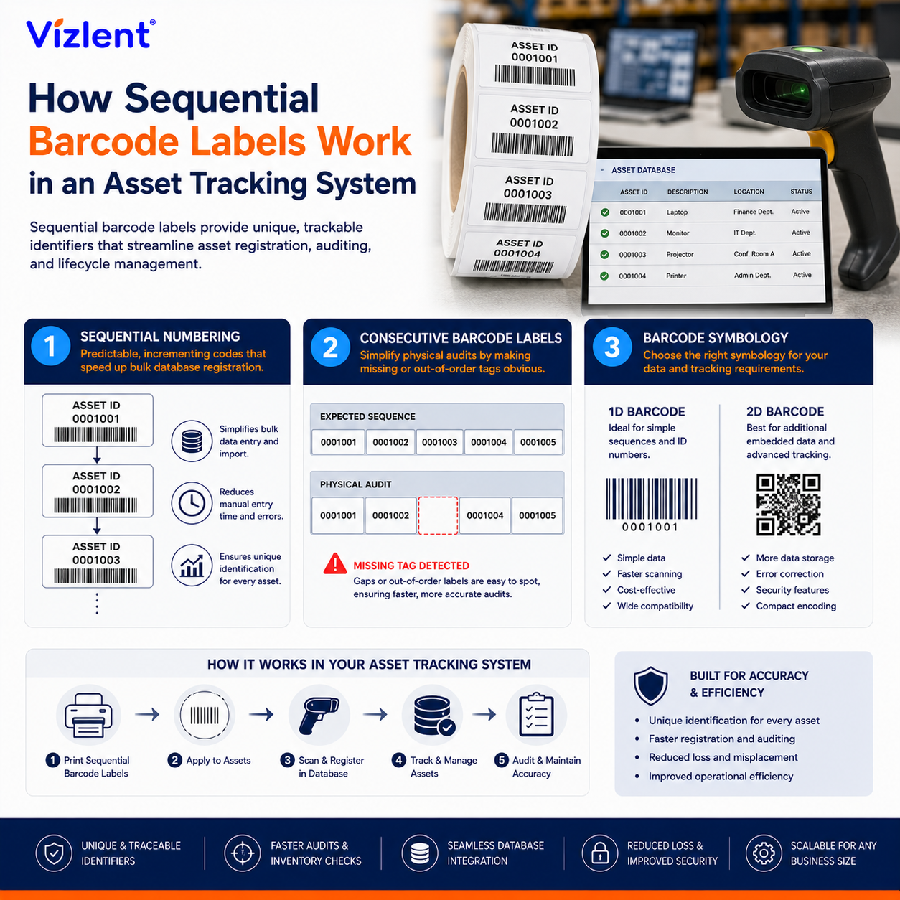
Sequential barcodes assign each label a unique, incrementing number or code, so asset A0001 follows asset A0000 in a predictable, auditable order that makes bulk registration into a database dramatically faster than random or manually typed identifiers. This is different from a sequential barcode labels for asset tracker application that only needs a handful of unique tags, since large-scale sequential runs benefit specifically from the predictability of an incrementing series during data entry and cross-referencing. Consecutive barcode labels printed in a single batch also simplify physical inventory audits, since a technician can quickly spot a missing or out-of-order tag during a walkthrough.
Sequential barcode labels for asset tracking barcode symbology choice affects both data capacity and scan reliability, since 1D barcodes like Code 128 handle simple sequential numbers efficiently, while 2D codes like GS1 DataMatrix or QR can carry additional data such as purchase date or warranty status alongside the sequence number. Per GS1 General Specifications, shipping and asset barcodes generally need to meet a minimum ISO/IEC 15415 print quality grade of 1.5, though most scanning systems perform more reliably at Grade B (2.5) or better. Confirming which symbology your existing scanning infrastructure supports before ordering prevents a costly mismatch discovered after labels are already applied to equipment.
- Sequential numbering: Predictable, incrementing codes that speed up bulk database registration.
- Consecutive barcode labels: Simplify physical audits by making missing or out-of-order tags obvious.
- Barcode symbology: 1D for simple sequences, 2D for additional embedded data alongside the sequence.
Buyers new to asset tracking should confirm both the starting sequence number and any embedded prefix or facility code with their supplier before a print run begins, since a numbering mistake discovered after printing usually means reprinting the entire batch. A manufacturer’s software or production team can typically generate a preview of the full sequence for review before committing to final production. This review step catches numbering errors far more cheaply than discovering them after labels are already applied across a facility.
Sequential Barcode vs QR Code Labels for Asset Tracking
Sequential qr code labels combine the predictable numbering benefit of a sequential series with the added data capacity of a 2D code, letting a facility encode a sequence number alongside a URL, warranty date, or maintenance schedule in a single scan. This differs from a simple sequential 1D barcode, which typically holds only the identifying number itself and requires a database lookup to retrieve any additional information. Types of barcode labels used in asset tracking range from basic sequential 1D codes on paper stock to fully synthetic, laminated 2D code labels rated for years of outdoor or industrial exposure.
Choosing between sequential 1D and sequential QR code formats depends on the need for offline functionality in your asset tracking system versus reliance on real-time database lookup during scanning. A warehouse with unreliable network connectivity may prefer QR codes that carry more embedded data directly on the label, reducing dependence on an active database connection at scan time. Facilities with reliable network access more often default to simple sequential barcodes paired with a centralized database, since this keeps label printing simpler and cheaper at scale.
- Sequential 1D barcodes: Simple numbering, requires database lookup for additional asset details.
- Sequential QR code labels: Embed more data directly on the label, reducing database dependency.
- Types of barcode labels: Range from basic paper stock to laminated synthetic constructions for harsh environments.
Facilities operating both indoor office equipment and outdoor industrial assets often need more than one type of barcode label from this range, since indoor equipment rarely faces the same environmental stress as outdoor machinery. Requesting samples of both simple sequential and QR-enhanced formats helps confirm which combination fits your specific asset mix. A supplier that stocks the full range of types of barcode labels, rather than only one format, is generally more convenient for a facility managing diverse asset categories.
Printing and Creating Sequential Barcode Labels
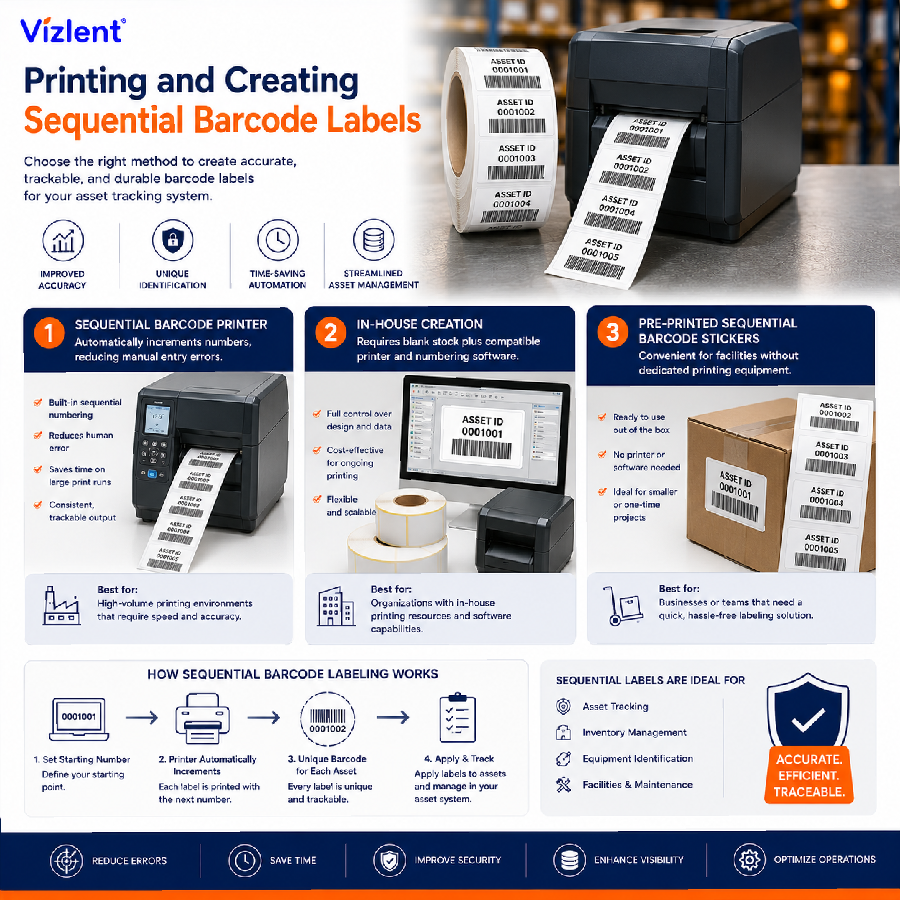
Print sequential barcode labels workflows generally rely on either a dedicated sequential barcode printer with built-in numbering software, or a standard thermal printer paired with label design software capable of generating an incrementing series. A sequential barcode printer configured correctly will automatically increment the number on each label as it prints, eliminating the manual entry errors that come from typing each identifier individually. Confirming that your printer and software combination supports true sequential numbering, rather than requiring a separate spreadsheet import for every batch, saves significant time on large asset tagging projects.
Create sequential barcode labels workflows in-house generally require blank, unserialized label stock so a facility’s own printer and software can generate the numbering at the time of application rather than relying on factory pre-printing. Sequential barcode stickers ordered pre-printed from a manufacturer remove this in-house printing step entirely, which suits facilities without a dedicated barcode printer or the staff time to manage in-house numbering. Choosing between in-house printing and factory pre-printed sequential barcode stickers generally comes down to order volume and the printing equipment your facility already owns. Facilities weighing this decision as part of a broader sequential barcode labels for asset tracking rollout should factor in staff time for numbering management alongside the raw per-unit cost.
- Sequential barcode printer: automatically increments numbers, reducing manual entry errors.
- In-house creation: requires blank stock plus compatible printer and numbering software.
- Pre-printed sequential barcode stickers: convenient for facilities without dedicated printing equipment.
Testing a small sample batch through your actual printer and software combination before committing to a full production run confirms compatibility and catches configuration errors early. A facility switching from manual asset numbering to a sequential barcode system should budget time for this testing phase, since printer driver and software compatibility issues are more common than buyers expect. Requesting vendor support during this initial setup phase can save considerable troubleshooting time later.
Best Practices for Sequential Barcode Labels for Asset Tracking
Sequential barcode labels for asset tracking best practices start with reserving blocks of sequence numbers by department, location, or asset category, rather than issuing one continuous series across an entire organization. This block reservation approach makes it easier to identify which department an asset belongs to at a glance, even before scanning the code, and simplifies future audits within a specific location. Sequential barcode labels best practices also include maintaining a master log of the starting and ending numbers issued in each batch, so gaps or duplicates can be identified quickly during an audit.
Sequential barcode labels for asset tracking best practices additionally cover physical placement, since a barcode mounted where it will face regular abrasion, moisture, or UV exposure needs a more durable facestock than one placed in a protected indoor location. Sequential barcode labels best selected for outdoor or harsh environments should use a laminated synthetic facestock rather than plain paper, since paper labels degrade quickly under repeated handling or weather exposure. Following a documented placement standard across a facility, rather than leaving placement to individual technician judgment, keeps scanning consistent across an entire asset base.
- Reserve number blocks by department or location rather than one continuous facility-wide series.
- Maintain a master log of issued sequence ranges to catch gaps or duplicates during audits.
- Match facestock durability to the physical placement and expected environmental exposure.
Facilities that skip these best practices often discover the cost later, when a poorly planned numbering scheme or under-specified facestock forces a full re-tagging project years into an asset tracking program. Investing the time to plan sequencing and facestock selection correctly from the outset avoids this costly rework. A supplier’s technical team can typically advise on both the numbering scheme and facestock selection once your asset categories and environments have been described.
Bulk Ordering and Local Sourcing for Sequential Barcode Labels
Sequential barcode labels bulk orders typically bring the per-unit cost down significantly compared to small trial batches, though setup costs for custom sequencing and any facility-specific prefix codes still apply regardless of order size. Facilities placing a large sequential barcode labels bulk order for the first time should request a detailed quote that separates setup cost from per-unit pricing, since combining the two into a single number makes it harder to compare suppliers fairly. Vizlent’s standard 7 to 15 day lead time on custom OEM and ODM orders applies to sequential barcode label runs once a numbering sequence and facestock have been confirmed.
Buyers searching barcode labels near me for a local supplier often do so for small, urgent trial orders rather than a full facility rollout, since local suppliers rarely match the per-unit pricing or facestock range of a direct manufacturer at scale. Comparing a local supplier’s sample against a direct manufacturer’s sample, using the same asset surface and environment, gives a clearer picture of long-term value than convenience alone. Requesting free samples before committing to either sourcing route remains standard practice across the label industry.
- Request a quote that separates setup cost from per-unit pricing on any bulk order.
- Confirm minimum order quantities before comparing suppliers on price alone.
- Compare local supplier samples against direct manufacturer samples on the same asset surface.
A short sample and compatibility test remains the fastest way to confirm real-world performance before a bulk commitment, regardless of how complete a specification sheet looks on paper. Facilities planning a multi-year asset tracking rollout benefit most from a direct manufacturer relationship, since consistent facestock and print quality across years of repeat orders matters more than any single batch’s price.
Ready to Source Sequential Barcode Labels for Asset Tracking
Understanding where to buy sequential barcode labels for asset tracking matters most once you are ready to match a specific facestock, symbology, and sequencing scheme to your actual facility. Vizlent has manufactured self adhesive label stock since 2011, supplying converters, distributors, and brand owners across more than fifty countries with serialization-ready materials meeting ISO/IEC 15415 Grade B print quality standards. Send an inquiry through Vizlent’s contact page to request samples and a quote suited to your exact asset environment, or explore the full Security Labels product range to compare serialized constructions side by side.
For labels facing outdoor exposure or harsh handling, Vizlent’s Durable Labels range and Outdoor Weather Resistant range document constructions built for years of service beyond typical indoor asset tags. Vizlent’s knowledge base and blog cover additional comparisons for teams evaluating sequential barcode labels for asset tracking against other labeling categories. Choosing the right construction comes down to matching facestock, symbology, and sequencing scheme to your actual asset environment, not the first listing that appears in a search.
Frequently Asked Questions
Where can I buy sequential barcode labels for asset tracking?
These labels are available directly from manufacturers, through industrial label distributors, and from general marketplaces, with each channel offering different levels of customization and documentation. Buying directly from a manufacturer typically gives access to consistent facestock caliper and barcode grade across large production runs. Requesting samples before committing to volume is standard practice regardless of which channel you choose.
What is the difference between sequential and consecutive barcode labels?
Sequential barcode labels and consecutive barcode labels generally describe the same underlying product, both referring to labels printed with an incrementing series of unique identifiers. The terminology difference usually comes down to regional or industry preference rather than a functional distinction. Both formats simplify bulk database registration and physical inventory audits compared to randomly assigned identifiers.
Should I choose sequential barcodes or QR code labels for asset tracking?
Sequential 1D barcodes work well when your facility has reliable network access to a centralized database, since the label only needs to carry the identifying number itself. Sequential QR code labels embed more data directly on the label, which helps in environments with unreliable network connectivity. The right choice depends on your specific network infrastructure and how much data needs to travel with the physical label.
What barcode printer do I need to print sequential barcode labels?
A dedicated sequential barcode printer with built-in numbering software automatically increments each label as it prints, reducing manual entry errors compared to importing a spreadsheet for every batch. Standard thermal printers paired with compatible label design software can also generate sequential series. Confirming true sequential numbering support, rather than manual batch imports, saves significant time on large tagging projects.
Can I create sequential barcode labels myself, or should I order them pre-printed?
Both options work, and the right choice depends on your order volume and existing equipment. Creating sequential barcode labels in-house requires blank stock plus a compatible printer and numbering software, suited to facilities with ongoing tagging needs. Pre-printed sequential barcode stickers from a manufacturer suit facilities without dedicated printing equipment or the staff time to manage in-house numbering.
What are the best practices for sequential barcode labels for asset tracking?
Best practices include reserving number blocks by department or location, maintaining a master log of issued sequence ranges, and matching facestock durability to the physical placement and expected environmental exposure. Following a documented placement standard across a facility keeps scanning consistent across the entire asset base. Skipping these practices often leads to costly re-tagging projects later in a program’s life.
Can sequential barcode labels be ordered in bulk, and where can I find a local supplier?
Yes, sequential barcode labels bulk orders typically bring the per-unit cost down significantly, though setup costs for custom sequencing still apply regardless of order size. Searching barcode labels near me can help for small, urgent trial orders, but larger facility-wide rollouts are usually better served through a direct manufacturer relationship. Requesting free samples before committing to either sourcing route remains standard practice.
How many different types of barcode labels exist for asset tracking?
Types of barcode labels used in asset tracking range from basic sequential 1D codes on paper stock to fully synthetic, laminated 2D code labels rated for years of outdoor or industrial exposure. The right type depends on the asset’s environment, expected service life, and available scanning infrastructure. A supplier stocking the full range is generally more convenient for facilities managing a diverse mix of indoor and outdoor assets.






