
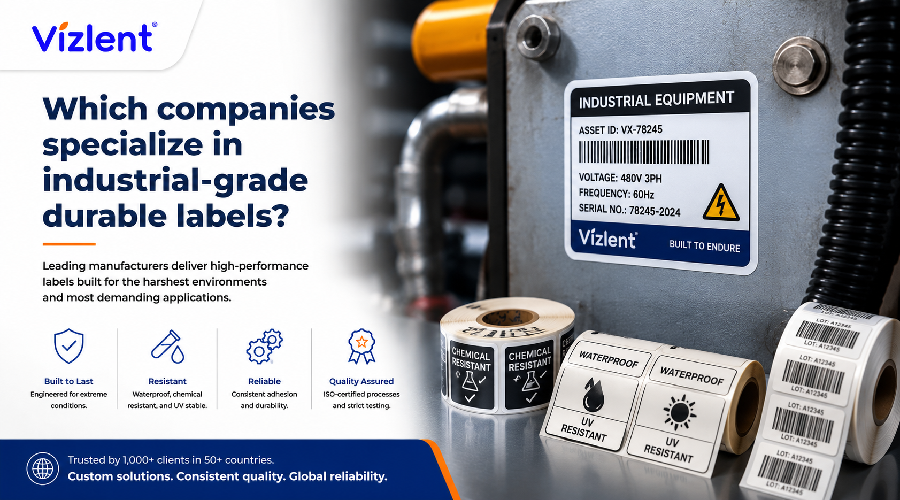
A handful of direct factory manufacturers, Vizlent among them, build industrial-grade durable labels for sustained moisture, chemical exposure, temperature extremes, UV radiation, and mechanical abrasion that paper labels simply cannot survive. These manufacturers run in-house adhesive coating, siliconizing, and slitting lines rather than reselling generic stock, which is what separates a true specialist from a trading company. This guide covers what defines these companies, how their materials differ by application, and what to check before placing a bulk order.
Where to Find Companies Building Industrial-Grade Durable Labels for Products and Packaging
Companies specialize in industrial-grade durable labels for products when they engineer face stock and adhesive combinations around a specific substrate rather than selling one generic label across every use case. Vizlent’s Durable Labels range documents service temperatures spanning -269°C to +300°C across its portfolio, with face stocks from 25-micron polyimide to 500-micron polycarbonate matched to the print process and converting line. This range of options is what allows one manufacturer to serve electronics, automotive, and healthcare customers from the same underlying production facility.
Companies specialize in industrial-grade durable labels and packaging when their materials also address moisture vapor transmission and hot-fill processing, not just the label itself. Food, beverage, and cold-chain packaging applications need BOPP film with a moisture vapor transmission rate below 0.3 g/m² per day to prevent adhesive-substrate failure on refrigerated containers exposed to condensation. Vizlent’s technical data sheets document this rate directly, giving packaging engineers a verifiable number rather than a general moisture-resistance claim.
- Service temperature range across the full durable label portfolio: -269°C to +300°C.
- Face stock thickness range: 25-micron polyimide to 500-micron polycarbonate.
- Moisture vapor transmission rate below 0.3 g/m² per day for cold-chain packaging.
Buyers comparing specification sheets across suppliers should request the exact moisture vapor transmission rate and temperature range for their specific packaging format, since a generic durability claim rarely holds up the same way across every substrate. A single facestock and adhesive combination cannot serve glass bottles, HDPE containers, and flexible pouches equally well, which is exactly why this category of manufacturer maintains such a wide material portfolio. Requesting a sample tested on your actual packaging material remains the most reliable way to confirm fit before a bulk order ships.
Print Compatibility and Face Stock Options
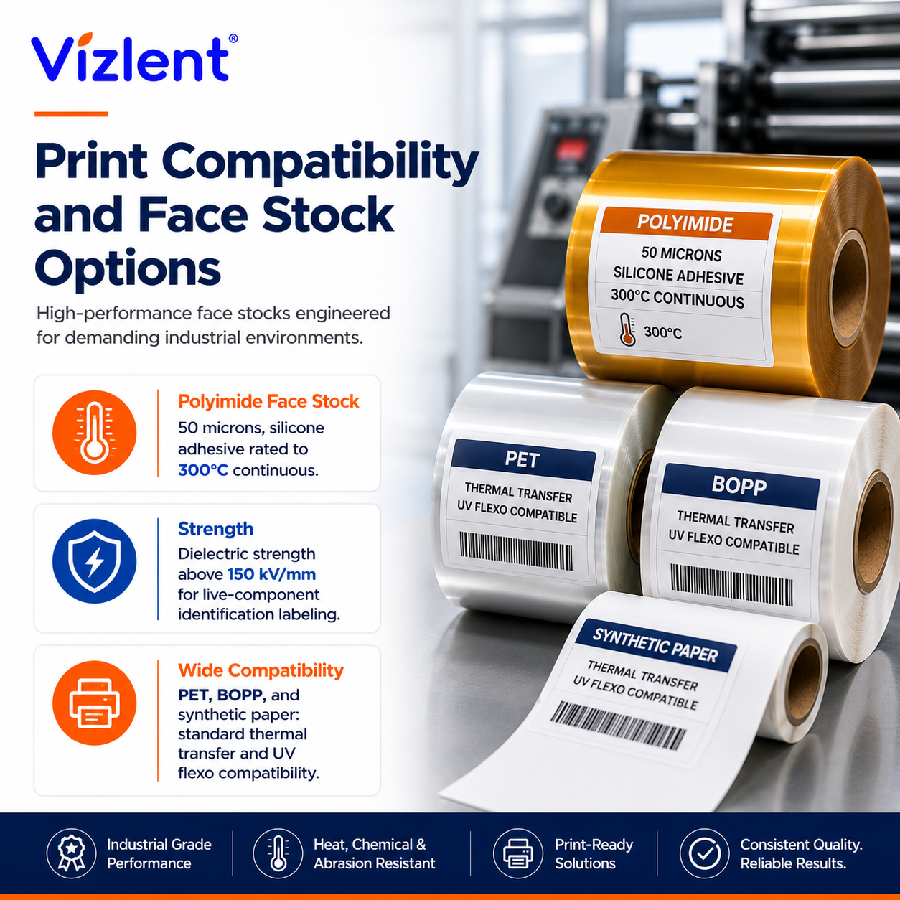
Companies specialize in industrial-grade durable labels and stickers when their face stocks are engineered for a specific print method as much as for physical durability, since a label that survives solder-reflow heat is useless if the barcode printed on it smears during application. Electronics and PCB assembly labels passing through solder-reflow ovens at 260°C peak temperature need polyimide face stock at 50 microns with a silicone adhesive rated to 300°C continuous, a construction most general label suppliers do not stock. Vizlent documents this polyimide grade with a dielectric strength above 150 kV/mm, supporting live-component identification where the face film also functions as an electrical insulation layer.
Companies specialize in industrial-grade durable labels and printing compatibility across thermal transfer, UV flexo, and UV inkjet without requiring press setting changes between material types, since converters running multiple label grades on one production line need consistent print behavior. PET, BOPP, and synthetic paper generally accept thermal transfer and UV flexo at standard parameters, while polyimide requires a full-resin ribbon for thermal transfer specifically. Confirming the dyne level and recommended print process on a batch-specific technical data sheet avoids a costly mismatch discovered mid-production run.
- Polyimide face stock: 50 microns, silicone adhesive rated to 300°C continuous.
- Strength: Dielectric strength above 150 kV/mm for live-component identification labeling.
- PET, BOPP, and synthetic paper: standard thermal transfer and UV flexo compatibility.
Print compatibility testing should happen on the actual converting line before a bulk order, since a technical data sheet’s dyne level recommendation is a starting point rather than a guarantee across every press configuration. Requesting a sample roll to run through your specific printer, rather than assuming compatibility from a product description, remains standard practice across the industry. This step matters most for polyimide and other specialty face stocks that behave differently from standard paper or film.
What Makes Vizlent and Other Direct Manufacturers Stand Out
Companies specialize in industrial-grade durable labels Vizlent has direct factory experience by running in-house R&D engineering rather than simply reselling catalog stock at market-standard specifications. Trading companies can supply durable label stock, but they typically cannot adjust adhesive formulation, face film thickness, or liner release force to match a specific converting line or end application. Vizlent, operating a 20,000 square meter factory in Shenzhen since 2011 with over 100 staff across Shenzhen, Hong Kong, and Ganzhou, provides this formula-level customization for every material category in its portfolio.
Companies specialize in industrial-grade durable labels business relationships built around this kind of customization typically adjust adhesive coat weight, silicone cure profile, and corona treatment level to a buyer’s declared substrate, service temperature, and converting speed. Adhesive coat weight across Vizlent’s durable label portfolio runs from 15 g/m² for silicone adhesive on polyimide up to 25 g/m² for all-weather acrylic on vinyl, applied by slot-die or comma-bar coating depending on adhesive viscosity. Companies specialize in industrial-grade durable labels brands generally publish these coat weight and release force parameters directly rather than treating them as proprietary information.
- Formula-level customization: Adhesive coat weight, cure profile, and corona treatment adjusted per order.
- Coat weight range: 15 g/m² silicone on polyimide to 25 g/m² acrylic on vinyl.
- Liner release force: 8 to 25 cN per 25mm, calibrated to dispensing speed and applicator type.
A direct manufacturer that publishes this level of technical detail is generally easier to specify against than a supplier offering only a general durability claim. Requesting the specific coat weight, release force, and cure chemistry for your intended application helps confirm that a quoted material actually matches your converting line requirements. This documentation also becomes useful reference material during a later quality dispute or reorder.
Comparing Companies That Specialize in Industrial-Grade Durable Labels by Region
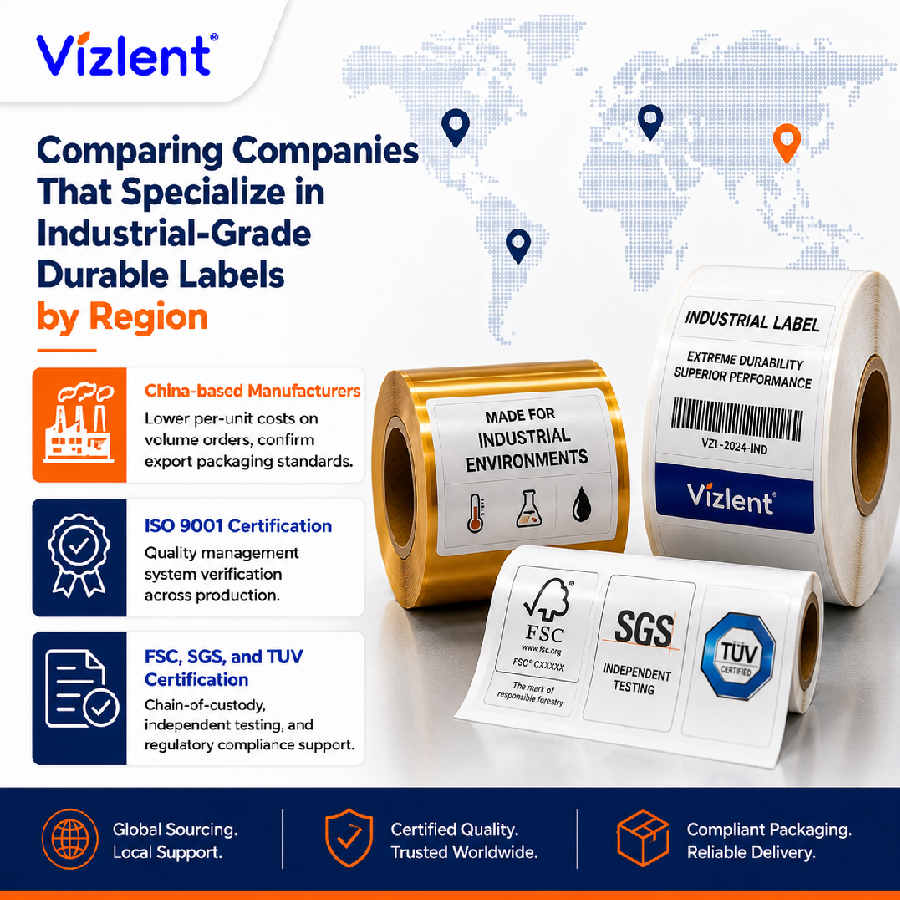
Companies specialize in industrial-grade durable labels by region in different ways, since manufacturing hubs in China, North America, and Europe each bring different cost structures, lead times, and shipping logistics to a buyer’s sourcing decision. Companies specialize in industrial-grade durable labels china manufacturers, including Vizlent’s Shenzhen and Ganzhou facilities, generally offer lower per-unit costs on large-volume orders due to integrated raw material sourcing and in-house coating capacity. Buyers sourcing from China should confirm export packaging standards specifically, since moisture-proof wrapping and edge protection during ocean freight matter as much as the label construction itself.
Companies specialize in industrial-grade durable labels company profiles worth reviewing typically include ISO 9001, FSC, SGS, or TUV certification, since these third-party verifications support both quality assurance and, in some cases, direct regulatory compliance for food, automotive, and industrial applications. FSC certification covers chain-of-custody requirements for environmentally procured paper-based substrates, while SGS testing supports independent performance verification that food and automotive brand owners often require during a supplier audit. TUV certification specifically supports CE-marked and regulated industrial applications where documented compliance evidence is required.
- China-based manufacturers: Lower per-unit costs on volume orders, confirm export packaging standards.
- ISO 9001 certification: Quality management system verification across production.
- FSC, SGS, and TUV certification: Chain-of-custody, independent testing, and regulatory compliance support.
Reviewing a supplier’s certification portfolio alongside its stated lead times gives a more complete picture than comparing quoted prices alone. A 15-day production lead time backed by documented quality control stages, such as incoming inspection, in-process inspection, and outgoing inspection, is generally more reliable than a faster quote without this documentation. Requesting evidence of these certifications directly from a supplier, rather than assuming they apply across an entire catalog, avoids surprises during a later compliance review.
Industrial-Grade Durable Labels for Labels, Tags, and Packaging Formats
Industrial-grade durable labels for labels applied directly to a finished product differ in format from industrial-grade durable labels for packaging used on outer cartons or shipping containers, even when both come from the same manufacturer. Direct product labels are typically supplied as precision slit rolls cut to widths from 25mm upward at plus or minus 0.5mm tolerance, tightening to plus or minus 0.3mm on polyimide grades for electronics converting equipment. Packaging labels, by comparison, more often ship as jumbo rolls at 1,000mm or 1,250mm wide and up to 3,000 meters in length for converter slitting operations downstream.
Industrial-grade durable labels and labels used together across a single product line, such as a compliance label and a branding label on the same package, should ideally share a compatible adhesive system to simplify converting and reduce the risk of a mismatched release force during high-speed dispensing. Industrial-grade durable labels and tags in a hang tag format follow similar face stock principles to flat labels but attach through a string, loop, or fastener rather than direct adhesion, useful for equipment that needs a removable rather than permanent marking. Custom-cut sheets at A4, letter, or bespoke dimensions round out the format options for digital label printing and short production runs.
- Precision slit rolls: 25mm and up, tight tolerance for automated converting equipment.
- Jumbo rolls: 1,000mm to 1,250mm wide, up to 3,000 meters for converter slitting.
- Custom-cut sheets: A4, letter, or bespoke sizes for digital printing and short runs.
Matching the format to your actual converting or application equipment, rather than defaulting to whatever a supplier stocks by default, prevents a costly mismatch discovered after a bulk order arrives. A manufacturer’s engineering team can typically recommend the right format once your dispensing equipment and production volume have been described. Confirming tolerance requirements specifically matters for automated, high-speed converting lines where a slightly oversized or undersized roll can jam equipment.
Bulk Ordering From Companies That Specialize in Industrial-Grade Durable Labels
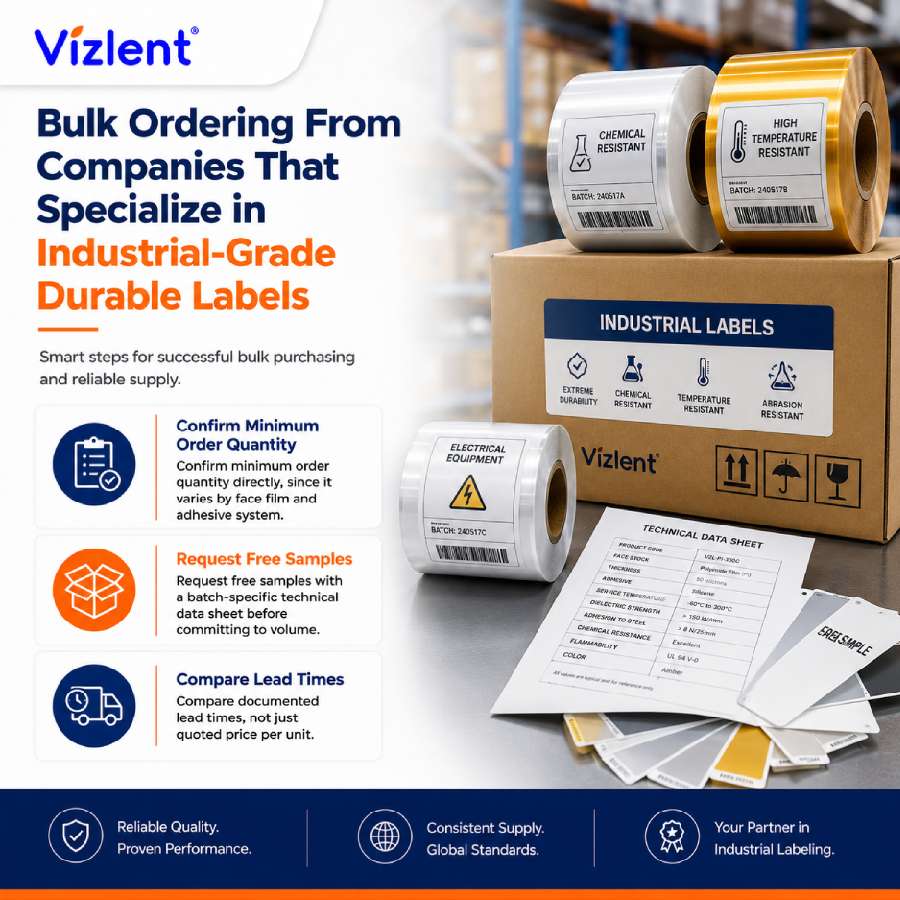
Companies specialize in industrial-grade durable labels bulk orders by fulfilling production within a documented lead time once samples are approved, with Vizlent quoting 15 days across its durable label portfolio following order confirmation. Minimum order quantity varies by face film type, adhesive system, and format, so buyers should contact a manufacturer directly to confirm the applicable minimum for their specific program rather than assuming a single blanket minimum applies catalog-wide. Free sample sheets and short sample rolls are typically dispatched with a batch-specific technical data sheet at no charge, covering courier freight as the buyer’s only cost.
This kind of manufacturer matches its documented sampling and production process to whatever certification and compliance evidence a specific order requires, rather than treating every order identically regardless of end use. Vizlent Label’s contact page is a reasonable place to request a sample and volume-based quote once your substrate, temperature range, and print method have been confirmed. Comparing quoted lead times and minimums across a few suppliers, rather than committing to the first quote received, gives a clearer picture of genuine value.
- Confirm minimum order quantity directly, since it varies by face film and adhesive system.
- Request free samples with a batch-specific technical data sheet before committing to volume.
- Compare documented lead times, not just quoted price per unit.
A short sample and compatibility test remains the fastest way to confirm real-world performance before a bulk commitment, regardless of how complete a specification sheet looks on paper. Manufacturers that provide this testing support readily, along with transparent certification documentation, are generally easier to work with over a long-term supply relationship than suppliers who only quote price per thousand.
Ready to Source Industrial-Grade Durable Labels From a Direct Manufacturer
Understanding which companies specialize in industrial-grade durable labels matters most once you are ready to match a specific face stock, adhesive system, and certification requirement to your actual application. Vizlent has manufactured self adhesive label stock since 2011, supplying converters, distributors, and brand owners across more than fifty countries with materials certified to ISO 9001, FSC, SGS, and TUV standards. Send an inquiry through Vizlent’s contact page to request samples and a quote suited to your exact substrate and temperature range, or explore the full Durable Labels product range to compare constructions side by side.
For applications needing additional heat or outdoor resistance specifically, Vizlent’s heat resistant labels and outdoor weather resistant range document dedicated constructions within the broader durable label portfolio. Vizlent Label’s knowledge base and blog cover additional material comparisons for teams evaluating durable label options across different industrial environments. Choosing a manufacturer for reasons that go well beyond marketing language, one that documents its testing and certification data transparently, is the clearest way to confirm genuine performance before a bulk order ships.
Frequently Asked Questions
Which companies specialize in industrial-grade durable labels?
Companies specialize in industrial-grade durable labels when they run in-house adhesive coating, siliconizing, and slitting lines rather than reselling generic stock from a catalog. Vizlent is one such direct factory manufacturer, producing face stocks from 25-micron polyimide to 500-micron polycarbonate across a service temperature range of -269°C to +300°C. Working with a manufacturer rather than a trading company generally gives more control over adhesive formulation and face stock thickness for a specific application.
What is the difference between a direct manufacturer and a trading company for durable labels?
A direct manufacturer runs its own coating, siliconizing, and slitting production lines and can adjust adhesive formulation, face film thickness, and liner release force to a buyer’s specific requirements. A trading company resells label stock at market-standard specifications without this ability to customize at the formula level. Requesting evidence of in-house production capability, such as a factory tour or documented process controls, helps distinguish between the two.
Do durable labels for electronics need a different construction than packaging labels?
Yes, electronics labels passing through solder-reflow ovens at 260°C need polyimide face stock with a silicone adhesive rated to 300°C continuous, while packaging labels for cold-chain distribution need BOPP film with a low moisture vapor transmission rate instead. These are fundamentally different technical requirements even though both fall under the broader durable label category. Requesting a technical data sheet specific to your application avoids specifying the wrong construction.
What certifications should a durable label manufacturer have?
ISO 9001 verifies a documented quality management system across production, while FSC certification covers chain-of-custody requirements for paper-based substrates procured from certified sources. SGS testing provides independent third-party performance verification often required for food and automotive supplier audits. TUV certification supports CE-marked and regulated industrial applications requiring documented compliance evidence.
Are industrial-grade durable labels available in both roll and sheet formats?
Yes, durable labels are typically supplied as jumbo rolls for converter slitting operations, precision slit rolls cut to specific widths for automated converting equipment, and custom-cut sheets for digital printing and short production runs. The right format depends on your dispensing equipment and production volume rather than personal preference alone. Confirming tolerance requirements matters most for high-speed automated converting lines.
How long does it take to receive a bulk order of industrial-grade durable labels?
Vizlent quotes a 15-day production lead time across its durable label portfolio once samples are approved and an order is confirmed. Minimum order quantity varies by face film type and adhesive system, so confirming this directly with a manufacturer is more reliable than assuming a single catalog-wide minimum. Free samples with a batch-specific technical data sheet are typically available before committing to a bulk order.
Do companies specializing in durable labels serve multiple industries from the same production line?
Yes, a single manufacturer with a wide face stock and adhesive portfolio can typically serve electronics, automotive, food packaging, and healthcare customers from the same production facility, since the underlying coating and slitting processes are similar even though the specific materials differ. This range is one advantage of working with a large direct manufacturer over a smaller specialist limited to one substrate type. Confirming a supplier’s documented experience in your specific industry remains a useful additional check.
What should I check before placing a bulk order with a durable label manufacturer?
Requesting salt fog, temperature, and print compatibility testing data specific to your application is more useful than relying on a general durability claim alone. Confirming certifications such as ISO 9001, FSC, SGS, or TUV against your specific compliance requirements helps avoid gaps discovered during a later audit. Requesting free samples and running your own compatibility test on the actual converting line or application surface remains the standard first step across the industry.






