
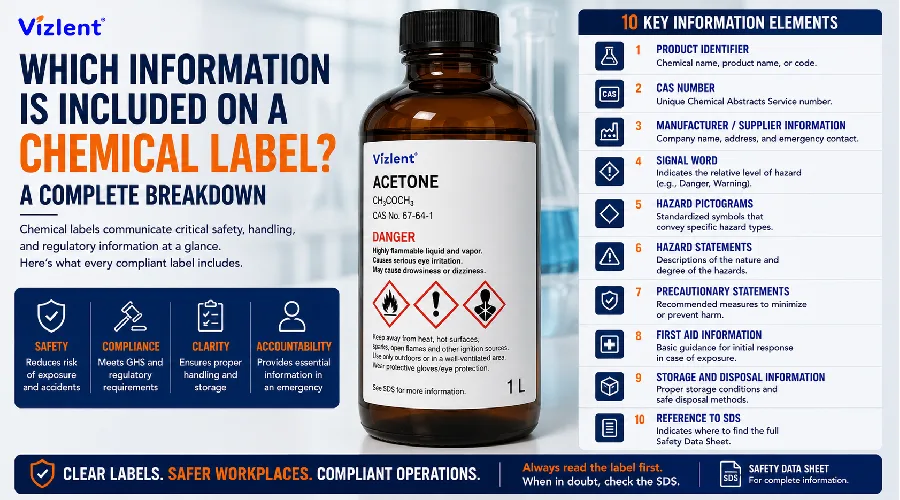
According to Occupational Safety and Health Administration (OSHA) and Globally Harmonized Systems (GHS), The standard hazardous chemical labels must include the following key information: product identifier, signal word, hazard statement, precautionary statement, pictogram, and supplier information. These elements are mirrored by similar frameworks worldwide. A label missing any one of these six elements does not meet current chemical labeling law, regardless of how complete it looks otherwise.
This piece walks through each required element, explains how bottle labels differ from drum and box labels, and covers the color codes, templates, and lookup tools workers and label buyers ask about most. It also touches on why the physical label material matters as much as the printed content, since a label that fades or peels removes the same safety information a missing pictogram would.
Chemical Labels Must Have Which of the Following Items
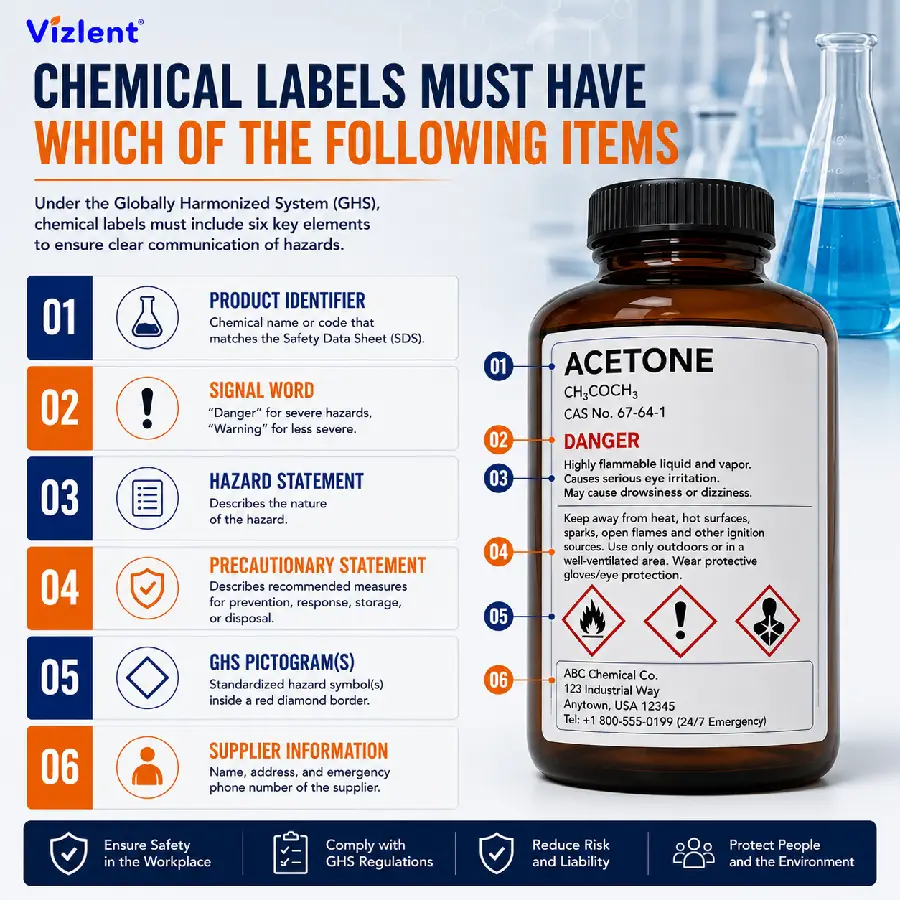
Chemical labels must have the following six items present and legible at the point of use: a product identifier matching the Safety Data Sheet, one signal word (either “Danger” or “Warning”), at least one hazard statement, matching precautionary statements, the correct GHS pictogram or pictograms, and supplier contact details. Each element serves a distinct communication purpose rather than repeating information already shown elsewhere on the label. Together, these six items form the baseline that OSHA, Health Canada, and the EU’s CLP regulation all recognize as the minimum standard.
Manufacturers sometimes add extra fields such as batch numbers, expiration dates, or storage temperature ranges, but these are supplementary rather than mandatory under GHS. The six core elements remain the test any inspector or auditor applies first. Skipping even one, such as printing a pictogram without the matching hazard statement, is treated as a labeling deficiency during compliance review.
- Product identifier (chemical name or code matching the SDS)
- Signal word (“Danger” for severe hazards, “Warning” for less severe)
- Hazard statement describing the nature of the hazard
- Precautionary statement describing prevention, response, storage, or disposal
- GHS pictogram(s) inside a red diamond border
- Supplier name, address, and emergency phone number
Chemical Label Requirements Under GHS and OSHA
Chemical label requirements in the United States come from OSHA’s Hazard Communication Standard, 29 CFR 1910.1200, which adopted the United Nations’ GHS framework in 2012 with a phased compliance deadline through 2016. The standard applies to any container of hazardous chemicals in a workplace, including secondary containers unless a narrow exception applies. Employers are required to train workers to read and understand these labels, not just to keep them attached to containers.
Outside the workplace, retail and consumer chemical products follow related but separate rules under the Consumer Product Safety Commission and, for certain categories, the EPA. International shipments add another layer, since transport labeling under the UN Model Regulations can differ slightly from workplace GHS labeling. A company selling the same chemical domestically and for export typically needs two label versions to stay compliant in both markets.
Chemical Label Components Explained
Chemical label components break down into pictorial and text-based groups, and understanding each group is what “which information is included on a chemical label” ultimately comes down to for most workers. The pictorial group includes the nine GHS pictograms, covering hazards such as flammability, corrosion, health hazard, and environmental toxicity, each printed inside a red diamond on a white background. The text group includes the signal word, hazard statements (H-codes), and precautionary statements (P-codes), all pulled from a standardized, non-editable list maintained by the UN.
Signal words are binary by design, since a label uses either “Danger” or “Warning,” never both, and never a softer substitute term. Hazard statements describe what the chemical does, such as “causes severe skin burns,” while precautionary statements describe what the handler should do in response, such as “wear protective gloves.” This separation between the “what” and the “do” is deliberate, since it lets a worker act on the label even without reading the full Safety Data Sheet first.
Chemical Labels for Bottles and Small Containers
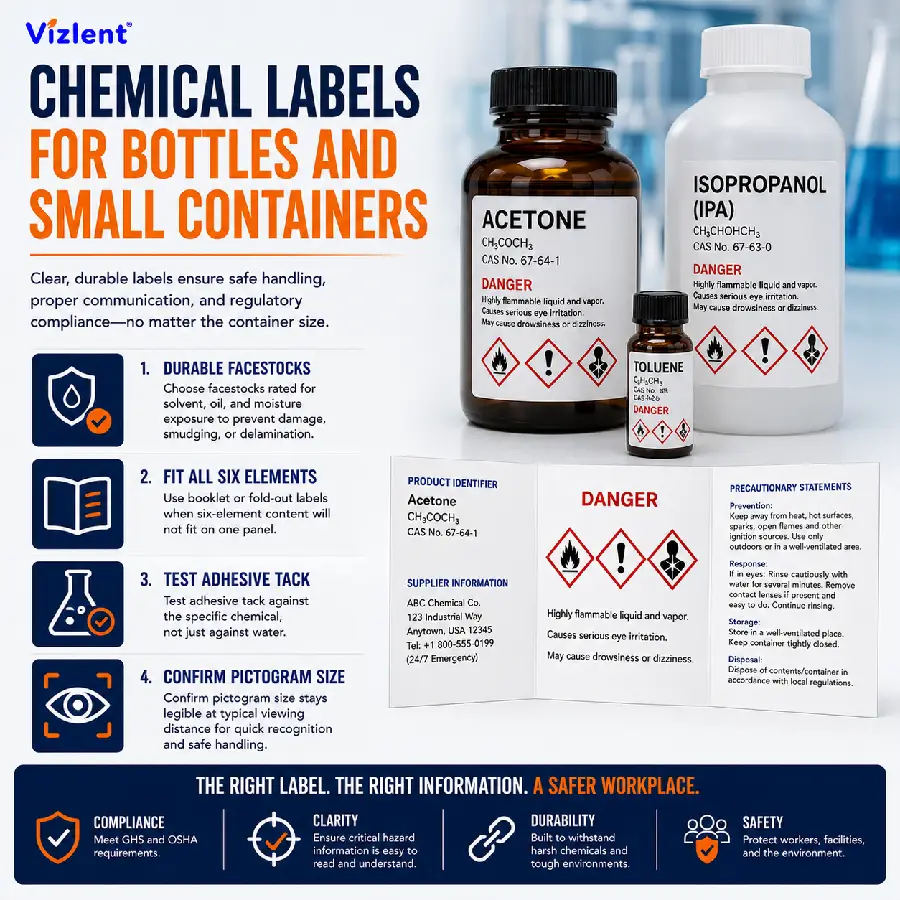
Chemical labels for bottles face a practical challenge that drum labels do not: limited surface area combined with exposure to spills, solvents, and repeated handling. A bottle label still needs all six GHS elements, so manufacturers commonly use smaller pictograms, tighter line spacing, and fold-out or booklet-style labels when a single panel cannot fit everything legibly. Chemical bottle label requirements do not relax simply because the container is small, which is why booklet labels exist as a compliant workaround rather than a shortcut.
A chemical label bottle format is where this challenge shows up most, since material selection matters more on bottles than on any other container type, since bottle labels are handled directly and frequently exposed to the chemical itself during pouring or dosing. A label printed on ordinary paper stock can smear or delaminate within days on a bottle used in a lab or production line, silently removing hazard information from active use. This is one reason chemical and industrial labeling programs increasingly specify chemical-resistant film facestocks such as those used in petrochemical and drum labeling applications even for smaller bottle formats.
- Choose facestocks rated for solvent, oil, and moisture exposure
- Use booklet or fold-out labels when six-element content will not fit on one panel
- Test adhesive tack against the specific chemical, not just against water
- Confirm pictogram size stays legible at typical viewing distance
Chemical Label Color Meaning and What Blue Represents
Chemical label color meaning is most commonly associated with the NFPA 704 diamond, a separate system from GHS used mainly for fire and emergency response rather than workplace compliance. The chemical label blue represents health hazards in the NFPA diamond, red represents flammability, yellow represents reactivity, and white carries special notices such as water reactivity or oxidizer status. Numbers from zero to four inside each colored section indicate severity, with four marking the most extreme hazard level.
GHS pictograms, by contrast, use a single consistent color scheme regardless of hazard type: a red diamond border on a white background with a black symbol inside. This is a deliberate difference from NFPA’s multi-color system, and confusing the two is a common source of labeling errors on facilities that use both systems side by side. A worker trained only on GHS pictograms may not automatically know that a blue NFPA section refers to health risk rather than cold storage or another unrelated meaning.
Chemical Label and SDS: How They Work Together
A chemical label and SDS (Safety Data Sheet) are designed to work as a pair, with the label acting as an at-a-glance summary and the SDS providing the full sixteen-section technical reference. The product identifier on the label must match the SDS exactly, since this is how a worker or emergency responder confirms they are looking at the correct document during an incident. Hazard and precautionary statements on the label are drawn directly from Sections 2 and 4 of the corresponding SDS rather than written independently.
The SDS also covers information a label physically cannot fit, including first-aid measures, exposure limits, and stability data. This is why OSHA requires both documents rather than treating either as a substitute for the other. A facility with current, correctly matched labels and SDS sheets is in a materially stronger compliance position than one with only labels, even though the label is what workers see most often.
Specialty Chemical Labels: Alcohol, Acetone, and Hazard-Specific Examples
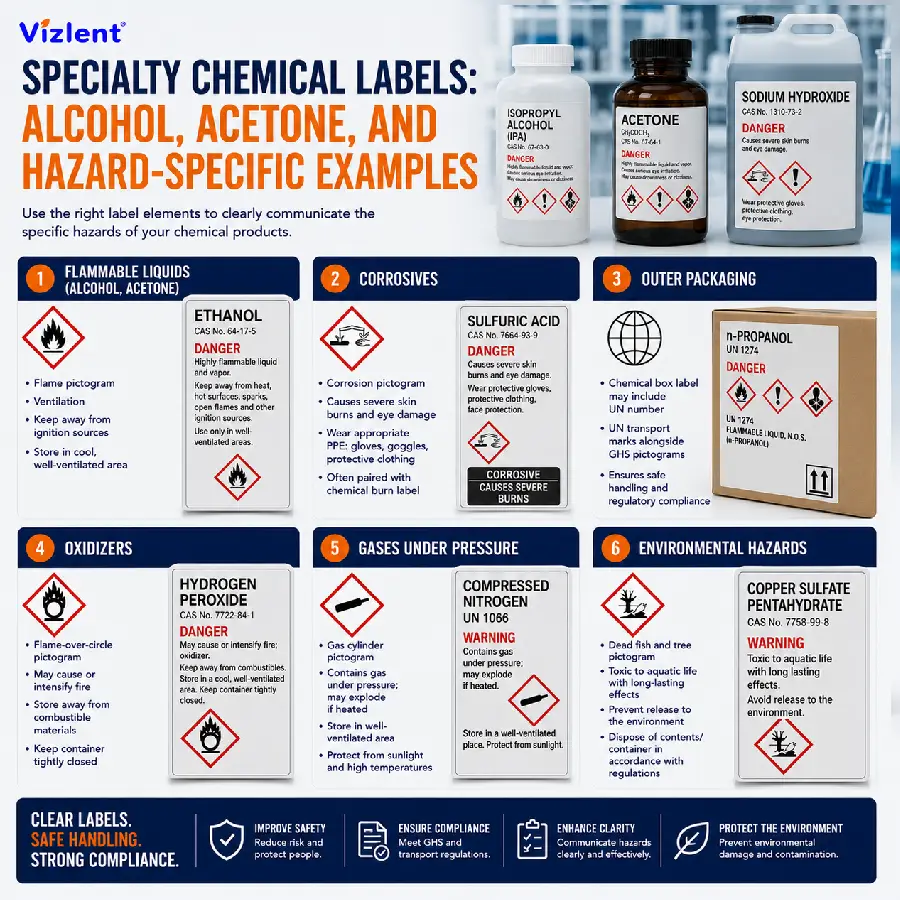
A chemical label for alcohol used in industrial or laboratory settings typically carries a flammable liquid pictogram, a “Danger” signal word for high-proof concentrations, and precautionary statements around ignition sources and ventilation. A chemical label acetone container follows a near-identical structure, since acetone is also classified as a flammable liquid with additional eye and respiratory irritation hazard statements. Reviewing a chemical label example from either substance shows how consistent the six-element structure stays across very different chemical classes.
Other specialty formats include the chemical burn label, used on corrosive substances to warn of skin and tissue damage risk, and the chemical box label, which covers outer packaging rather than the immediate container and often adds transport pictograms alongside GHS ones. A chemical bottle label design for a corrosive product will typically pair the corrosion pictogram with protective equipment icons in the surrounding artwork, even though those icons are not themselves part of the mandatory GHS element set.
- Flammable liquids (alcohol, acetone): Flame pictogram, ventilation and ignition precautions
- Corrosives: Corrosion pictogram plus PPE guidance, often paired with a chemical burn label
- Outer packaging: Chemical box label may add UN transport marks alongside GHS pictograms
- Oxidizers: Flame-over-circle pictogram with separate storage precautions
- Gases under pressure: Gas cylinder pictogram plus storage temperature precautions
- Environmental hazards: Dead fish and tree pictogram for aquatic toxicity warnings
What Chemical Labels Must Contain, and What They Don’t
Chemical labels must contain all of the following information except items that are commonly assumed to be mandatory but are not: batch or lot numbers, expiration dates, and net quantity are useful but not required under GHS itself, since these are typically driven by other regulations such as consumer packaging law rather than hazard communication rules. Chemical labels should include all of the following except a company logo used as a substitute for the actual supplier name and address, since a logo alone does not satisfy the identification requirement. This distinction trips up label designers who assume anything printed on the label counts toward compliance.
Recognizing what a label does not need to include is as useful as knowing what it must include, particularly when space is limited on small containers. Chemical labels will provide you with what type of information about a chemical matters more than decorative content, so designers should prioritize the six mandatory elements before adding secondary branding or marketing text. A compliant label with clean white space around its pictograms is preferable to a crowded one that squeezes in non-required content at the expense of legibility.
Chemical Label Lookup, Templates, and Design Resources
A chemical label lookup typically starts with the manufacturer’s own SDS, since the label content must trace back to that document rather than a generic online template. OSHA and the UN GHS purple book are the two primary official sources for pictogram artwork, hazard statement wording, and precautionary statement wording, and using unofficial paraphrases instead of the standardized text is a common audit finding. A blank chemical label template can be a useful starting point for internal secondary-container labeling, but any blank template still needs the six mandatory fields populated correctly before use.
For higher-volume production, a proper chemical bottle label template built in label design software gives more consistent results than a chemical bottle label maker built for general-purpose stickers, since dedicated GHS templates already position pictograms and text blocks to the correct proportions. Chemical labels meaning correct hazard communication depends on getting these proportions right, since an undersized pictogram can fail legibility standards even on an otherwise accurate label. Separately, for anyone who lands on this topic searching for the electronic music duo, chemical brothers label refers to their record label and has no connection to chemical hazard labeling.
Why Label Material Choice Affects Chemical Label Performance
The information printed on a chemical label only stays useful if the physical label survives contact with the chemical, moisture, temperature swings, and repeated handling it will face. A pictogram printed on ordinary paper facestock can smear within hours of solvent contact, and a hazard statement printed with low-grade ink can fade past legibility long before the container is used up. This is why chemical, laboratory, and industrial labeling programs increasingly specify facestocks engineered for solvent resistance, moisture resistance, and print durability rather than defaulting to general-purpose sticker stock.
Facestock selection also depends on the container’s electrical and environmental context, not just the chemical inside it. Electronics-adjacent chemical storage, for example, sometimes calls for anti-static label constructions alongside standard hazard pictograms to prevent electrostatic discharge near sensitive components. Matching facestock, adhesive, and print method to the actual use environment is what keeps every one of the six required chemical label components readable for the full life of the container.
- Match facestock to the specific chemical class, not chemicals in general
- Confirm print method (thermal transfer, inkjet, laser) holds pictogram detail at small sizes
- Test adhesive performance on the actual container surface, including curved or textured drums
- Account for outdoor storage, freezer storage, or high-heat environments separately
Get Compliant, Durable Chemical Labels That Last
Which information is included on a chemical label matters only if the label itself survives the environment it is used in, from solvent splashes on a lab bench to years of outdoor storage on a drum. Vizlent supplies chemical-resistant, weather-tested facestocks purpose-built for hazardous materials labeling, including options developed for petrochemical and drum applications and tamper-evident security label constructions for products at higher risk of relabeling. Our team can match facestock and adhesive selection to your specific chemical exposure, container type, and print method before you commit to a bulk order.
Request a Free Sample and Material Consultation
Frequently Asked Questions
What type of information will a chemical label provide about a chemical? A chemical label provides identification, hazard, and handling information about the specific substance inside its container. This includes the product identifier, signal word, hazard statement, precautionary statement, pictogram, and supplier contact details. Together these six elements let a worker judge the risk and the correct response without first consulting the full Safety Data Sheet.
Which of the following is not required on a chemical label? A company logo used in place of the supplier’s actual name and address is not a required element and does not satisfy GHS labeling rules. Batch numbers, expiration dates, and decorative branding also fall outside the six mandatory GHS fields. Only the product identifier, signal word, hazard statement, precautionary statement, pictogram, and supplier information are strictly required.
What does a chemical label blank look like before it is filled in? A chemical label blank is a pre-printed template with placeholder fields for the product identifier, pictogram, signal word, and statement text, but no chemical-specific content filled in yet. These blanks are common for facilities that label secondary containers on site rather than ordering pre-printed labels for every product. Every field on a blank template still needs to be completed accurately before the container enters use.
Is a chemical bottle label template different from a printed chemical label? A chemical bottle label template is the design file or layout used to produce the label, while the printed label is the finished physical product applied to the bottle. Templates are typically built in label design software to correctly proportion pictograms, signal words, and statement text before printing. The finished bottle label must still be printed on material that resists the specific chemical, moisture, and handling conditions it will face.
What is a chemical burn label and when is it used? A chemical burn label is a hazard warning applied to corrosive substances capable of causing skin or tissue damage on contact. It typically pairs the GHS corrosion pictogram with a “Danger” signal word and precautionary statements about protective equipment and first aid. These labels are common on acids, bases, and other corrosive cleaning or industrial chemicals.
Do chemical box labels follow the same rules as bottle labels? Chemical box labels follow the same core GHS element requirements as bottle labels but often add transport-specific marks for outer packaging used in shipping. Outer boxes may need UN numbers and transport pictograms in addition to the standard GHS hazard communication elements. The inner container and outer box can carry overlapping but not identical label content.
Where can I find a reliable chemical label lookup resource? The manufacturer’s own Safety Data Sheet is the most reliable chemical label lookup source, since label content must match the SDS exactly. OSHA’s Hazard Communication Standard page and the UN GHS purple book provide the official pictogram artwork and standardized statement wording. Third-party label databases can be useful for reference but should never replace verification against the current SDS.
Do all countries use the same chemical label requirements? Most countries base their chemical label requirements on the same UN GHS framework, but implementation details still vary by region. The United States applies GHS through OSHA’s Hazard Communication Standard, the European Union applies it through the CLP Regulation, and Canada applies it through the Workplace Hazardous Materials Information System. A product sold in multiple regions may need label wording adjustments even though the underlying six-element structure stays consistent.
Does chemical label material affect how long the printed information stays readable? Yes, label material has a direct effect on how long the required chemical hazard information stays legible in real use. Facestocks without chemical, moisture, or UV resistance can fade, smear, or delaminate well before the container is empty, effectively removing the hazard information from view. This is why industrial and chemical labeling programs increasingly specify outdoor weather resistant or flame retardant facestocks rather than standard paper stock.






