
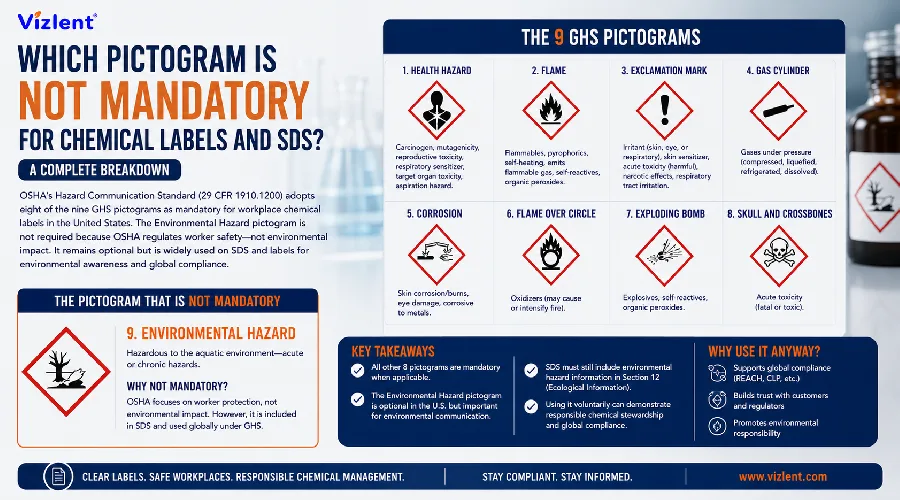
The exception is the environmental hazard pictogram, which shows a dead fish and a dead tree. This is under OSHA’s Hazard Communication Standard (29 CFR 1910.1200), eight of the nine GHS pictograms are mandatory for workplace chemical labels in the United States. This distinction matters because a label missing a required pictogram is a compliance failure, while a label missing the environmental symbol usually is not, at least under US workplace rules.
Understanding mandatory pictograms for chemical labels and SDS, and the one exception to that list, prevents both under-labeling and unnecessary redesign work. The sections below cover every mandatory symbol, the one non-mandatory symbol, and how pictograms on physical labels should be selected, printed, and maintained.
Mandatory Pictograms for Chemical Labels and SDS
Mandatory pictograms for chemical labels and SDS under OSHA’s Hazard Communication Standard total eight: flame, flame over circle, exploding bomb, corrosion, gas cylinder, skull and crossbones, exclamation mark, and health hazard. Each pictogram corresponds to a specific hazard class defined in the GHS classification criteria, and a chemical can require more than one pictogram if it meets multiple hazard classes at once. These eight symbols appear on both the physical container label and in Section 2 of the corresponding Safety Data Sheet, since the two documents are required to match.
None of these eight pictograms is optional once a chemical is classified into the hazard class that pictogram represents. A flammable liquid, for example, must display the flame pictogram regardless of container size, industry, or intended use, since the classification itself triggers the requirement rather than any judgment call by the label designer. This is why label design teams treat the eight-pictogram list as a fixed reference rather than a menu of choices.
- Flame: Flammable liquids, gases, solids, and aerosols
- Flame over circle: Oxidizing chemicals
- Exploding bomb: Explosives and self-reactive substances
- Corrosion: Skin and metal corrosive substances
- Gas cylinder: Gases under pressure
- Skull and crossbones: Acute toxicity, most severe categories
- Exclamation mark: Irritants, narcotic effects, and less severe acute toxicity
- Health hazard: Carcinogens, respiratory sensitizers, and reproductive toxicity
Which Pictogram Is Not Mandatory for Chemical Labels and SDS
The answer becomes clearer when comparing the eight required symbols above to the ninth GHS pictogram, the environmental hazard symbol showing a dead fish and tree. OSHA’s Hazard Communication Standard does not require this pictogram because the standard’s scope covers occupational chemical exposure, not aquatic or environmental toxicity, which falls under EPA and international maritime authorities instead. A manufacturer selling only within the US workplace market can classify a chemical as environmentally hazardous on the SDS without printing the fish-and-tree symbol on the physical label.
This does not mean the environmental pictogram is irrelevant everywhere, since the European Union’s CLP Regulation and several international transport frameworks do require it for qualifying substances. A company exporting the same chemical to the EU typically needs to add the environmental pictogram to that market’s label version, even if the US label omits it entirely. Chemical hazard label symbols should always be checked against the destination market’s specific rule set rather than assumed to be identical everywhere.
Chemical Hazard Label Symbols Explained
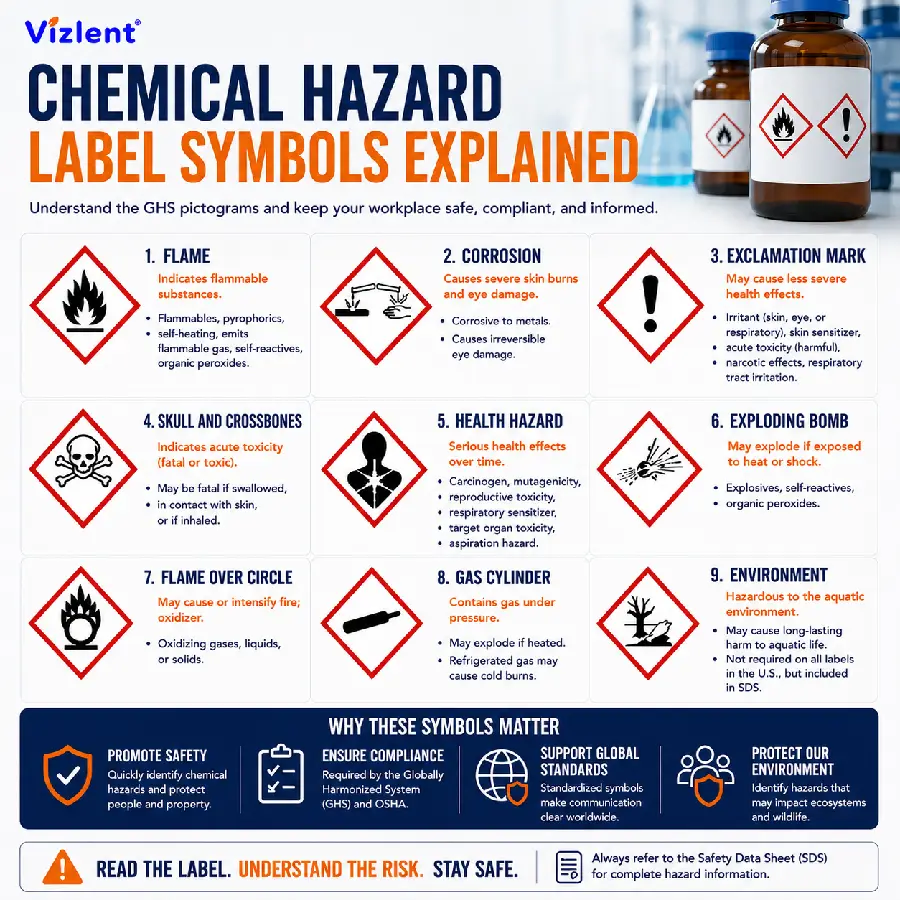
Chemical hazard label symbols follow a consistent visual format regardless of which of the nine hazard classes they represent: a black symbol centered inside a red-bordered diamond on a white background. This consistency is intentional, since it lets workers recognize the pictogram format instantly even before reading the specific symbol inside it. A pictogram chemical hazard label loses that recognition value if the diamond shape, red border, or white background is altered for branding or design reasons.
Some symbols carry more than one meaning depending on context, which is why the accompanying hazard statement always clarifies the specific risk. The exclamation mark, for instance, can indicate skin or eye irritation, respiratory tract irritation, or narcotic effects, and only the paired hazard statement tells the reader which applies. Reading the pictogram alone is a starting point, not a complete safety determination on its own.
- Flame and flame over circle: Fire and oxidation risk
- Exploding bomb: Instability under shock, heat, or friction
- Corrosion: Damage to skin, eyes, or metal on contact
- Gas cylinder: Pressurized contents, handling and storage risk
- Skull and crossbones: Severe acute toxicity, immediate danger
- Exclamation mark: Milder irritation, sensitization, or narcotic effects
- Health hazard: Long-term or chronic health risk from repeated exposure
- Environmental hazard: Aquatic toxicity, mandatory in some jurisdictions but not under US HazCom
Pictogram SDS Labels: Matching Container and Document Symbols
Pictogram SDS labels are designed to mirror the pictograms shown on the physical container exactly, since Section 2 of the SDS, titled Hazard Identification, lists the same GHS symbols required on the label. A mismatch between the label pictograms and the SDS pictograms is treated as a documentation error during a compliance audit, even if both documents are otherwise accurate. This is one reason label content should always be generated from the same source data as the SDS rather than created independently by a separate design team.
Digital SDS management systems typically auto-populate label templates from the same hazard classification data used to build the SDS, reducing the risk of this kind of mismatch. Facilities without this kind of integrated system need a manual cross-check step before printing any new chemical label, comparing the label proof against the current SDS revision. Pictogram sds labels that fall out of sync after an SDS update are a common finding in third-party compliance reviews.
Pictogram Labels for Chemicals: Placement and Design Rules
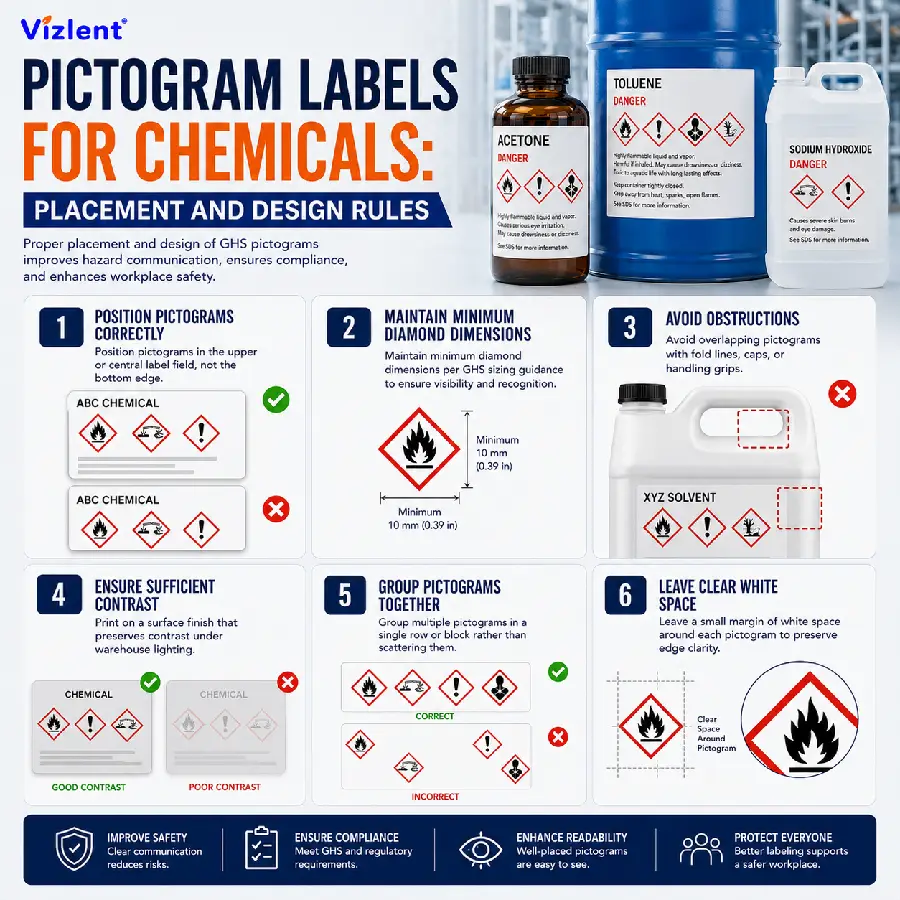
Pictogram labels for chemicals follow placement rules focused on visibility rather than decoration, since a pictogram hidden behind a cap, fold, or low-contrast background fails its purpose even if technically present. GHS guidance calls for pictograms sized to remain legible at normal handling distance, with a minimum diamond size that scales down only as far as the container allows before symbols become unreadable. Placement in the upper portion of the label, near the product identifier and signal word, keeps the most urgent information together in one glance.
Design teams sometimes try to minimize pictogram size to leave more room for branding, but this trade-off works against both compliance and worker safety. A label that prioritizes logo size over pictogram legibility can still pass a cursory visual check while failing a proper legibility standard under close inspection. Pictogram labels for chemicals should be treated as a fixed minimum footprint that branding elements work around, not the other way around.
- Position pictograms in the upper or central label field, not the bottom edge
- Maintain minimum diamond dimensions per GHS sizing guidance
- Avoid overlapping pictograms with fold lines, caps, or handling grips
- Print on a surface finish that preserves contrast under warehouse lighting
- Group multiple pictograms in a single row or block rather than scattering them
- Leave a small margin of white space around each pictogram to preserve edge clarity
Are Pictograms on Chemical Labels Optional? Common Misconceptions
Pictograms on chemical labels are optional is a misconception that circulates informally, usually because people confuse the one non-mandatory environmental symbol with the full pictogram set. In reality, any pictogram tied to a hazard class the chemical actually meets is mandatory, and the only symbol treated as optional under US workplace rules is the environmental hazard pictogram discussed earlier. Believing pictograms on chemical labels are optional across the board is a labeling error that puts both workers and the business at compliance risk.
This misconception sometimes stems from older, pre-GHS labeling systems that used different, less standardized symbols and did not treat any of them as strictly mandatory. Since the 2012 OSHA adoption of GHS, that flexibility no longer applies to the eight required pictograms, even though it still technically applies to the ninth. Businesses transitioning from legacy labeling systems should assume every applicable pictogram is required unless a specific regulatory citation says otherwise.
Pictogram Color Rules: Red, White, and Never Green
A common search question asks if a pictogram chemical labels be red or green requirement exists, and the answer is no; GHS pictograms are never printed with a green border under any hazard class or jurisdiction. The correct standard is that pictogram chemical labels be red or white only, meaning a red diamond border on a white background with a black symbol centered inside. This two-color scheme stays identical across all nine pictograms, which is part of why the format is so quickly recognizable on a crowded shelf or storage area.
Color confusion sometimes comes from NFPA 704 diamonds, a separate fire-response system that does use multiple colors, including blue, red, yellow, and white sections. Facilities using both GHS pictograms and NFPA diamonds side by side should train workers on the distinction, since assuming pictogram chemical labels be red like every section of an NFPA diamond leads to misreading either system. Keeping the two color conventions mentally separate avoids a common and preventable safety training gap.
Pictogram Chemical Labels for Bottles and Small Containers
Pictogram chemical labels bottles present a sizing challenge similar to the rest of the label content, since a diamond pictogram needs enough physical space to stay legible even on containers under 100 milliliters. Manufacturers commonly solve this with fold-out or booklet-style labels when multiple pictograms and full statement text cannot fit on a single small panel. A pictogram chemical labels blank template used for secondary containers still needs correctly sized pictograms filled in, not simplified or shrunk past the legibility threshold.
Corrosive or high-risk chemicals dispensed into secondary bottles raise an additional concern, since pictogram chemical labels burn risk from a corrosive substance that needs to stay visible even after repeated handling and potential splash exposure. Chemical-resistant facestocks matter more here than on any other container type, since bottle labels are handled directly and are the most likely to face solvent contact during use. Choosing durable petrochemical and drum-grade facestock materials, scaled down to bottle formats, keeps pictograms legible for the full life of the container.
Chemical Pictogram Stickers and Physical Label Materials
Chemical pictogram stickers only communicate hazard information for as long as the physical label survives its use environment, which makes facestock and adhesive choice a safety decision, not just a design one. A pictogram printed on a low-grade sticker can fade, smear, or peel within days of solvent exposure, silently removing hazard information from a container that still holds a full charge of the product. This is why industrial labeling programs increasingly specify chemical-resistant, outdoor weather resistant facestocks rather than general-purpose sticker stock for anything touching hazardous chemicals.
Facilities storing flammable chemicals near heat sources or open flame risk also benefit from flame retardant label constructions, which keep the pictogram and hazard statement intact even under thermal stress. Tamper-evident security label constructions add a further layer of protection for high-value or frequently relabeled chemical products. Matching sticker material to the actual chemical, container, and storage environment is what keeps chemical hazard label symbols readable for the life of the product rather than just at the moment of printing.
Finding Reliable Pictogram Chemical Labels and SDS References
Reliable references for pictogram chemical labels and SDS come in several formats depending on how a facility trains its workers and manages compliance documentation. Some formats work well posted physically near chemical storage, while others fit better inside a training packet or a digital reference library. The right format depends on the goal, quick visual recognition, structured onboarding, or periodic compliance review.
- Pictogram chemical labels and SDS charts posted near chemical storage and mixing areas
- Pictogram chemical labels and SDS cards used for quick desk or toolbox reference
- Pictogram chemical labels and SDS codes summarizing hazard and precautionary statement numbers
- Pictogram chemical labels and SDS sheets included in new-hire training packets
- Pictogram chemical labels and SDS activity exercises used during safety onboarding sessions
- Pictogram chemical labels and SDS answer key documents used to grade internal training quizzes
- Pictogram chemical labels and SDS answers should always be verified against OSHA HazCom text, not assumed from memory
- Pictogram chemical labels and SDS analysis conducted during periodic internal safety audits
- Pictogram chemical labels and SDS articles from OSHA.gov and the UN GHS purple book remain the most reliable primary sources
- Pictogram chemical labels and SDS and labels used for transport packaging follow a related but separate UN numbering system
Get Pictogram-Ready Labels Built to Last
Which pictogram is not mandatory for chemical labels and SDS matters less in practice than making sure every mandatory pictogram stays legible for the full life of the container. Vizlent supplies chemical-resistant, weather-tested facestocks purpose-built for hazardous materials labeling, including options developed for petrochemical and drum applications and durable constructions suited to bottles, drums, and boxes alike. Our team can match facestock, adhesive, and print method to your exact chemical exposure and container type before you commit to a production run.
Request a Free Sample and Material Consultation
Frequently Asked Questions
What pictogram is not required on a chemical label or SDS? The environmental hazard pictogram, showing a dead fish and a dead tree, is the pictogram not mandatory under OSHA’s Hazard Communication Standard. It remains optional for US workplace labels because OSHA regulates occupational exposure rather than environmental impact. Other jurisdictions, including the EU’s CLP Regulation, do require it for qualifying substances.
What are the mandatory pictograms for chemical labels and SDS? The eight mandatory pictograms are flame, flame over circle, exploding bomb, corrosion, gas cylinder, skull and crossbones, exclamation mark, and health hazard. Each corresponds to a specific GHS hazard class and must appear whenever a chemical meets that classification. These pictograms must match exactly between the physical label and Section 2 of the SDS.
Are pictograms on chemical labels optional in general? No, pictograms on chemical labels are optional only in the single case of the environmental hazard symbol under US workplace rules. Every other applicable pictogram is mandatory once a chemical is classified into that hazard class. Treating pictograms as generally optional is a common but incorrect assumption.
Can a pictogram chemical labels be red or white only, or are other colors used? GHS pictograms use only a red border and a white background with a black symbol inside, regardless of hazard class or country. No pictogram is printed with a green, blue, or yellow border under the GHS system. Color variation belongs to the separate NFPA 704 diamond system, not GHS pictograms.
Why do pictogram chemical labels bottles sometimes look different from drum labels? Bottle labels often use smaller pictograms or booklet-style formats to fit all required content on limited surface area, while drum labels have more room for full-size symbols. Both formats must meet the same minimum legibility standard despite the size difference. Material choice matters more on bottles, since they face more direct handling and chemical contact.
Where can I find an official chart of chemical hazard label symbols? OSHA’s Hazard Communication Standard page and the UN GHS purple book both publish official pictogram artwork and hazard class assignments. These are the most reliable sources for a pictogram chemical labels and SDS chart, ahead of any third-party training material. Internal training charts should always be checked against these primary sources during periodic review.
Is there an answer key for common pictogram chemical labels and SDS training quizzes? Most legitimate training programs build their own answer key internally, based directly on OSHA and GHS source material rather than a generic online worksheet. A pictogram chemical labels and SDS answer key from an unverified source can contain outdated hazard class assignments. Cross-checking any training answer key against the current OSHA HazCom text before use is the safer practice.
Do chemical pictogram stickers need to be replaced on a set schedule? There is no universal replacement schedule, since sticker lifespan depends on the facestock material, adhesive, and the specific chemical and environment involved. A label showing fading, peeling, or reduced pictogram contrast should be replaced immediately regardless of its age. Choosing durable, chemical-resistant facestock from the start reduces how often this kind of early replacement is needed.
Does the environmental pictogram being non-mandatory affect SDS accuracy? No, an SDS can still classify a chemical as environmentally hazardous in Section 2 even if the workplace label omits the environmental pictogram. The SDS documents the full hazard classification regardless of which pictograms a given jurisdiction requires on the physical label. Omitting the pictogram from the label does not permit omitting the hazard classification from the SDS itself.






