
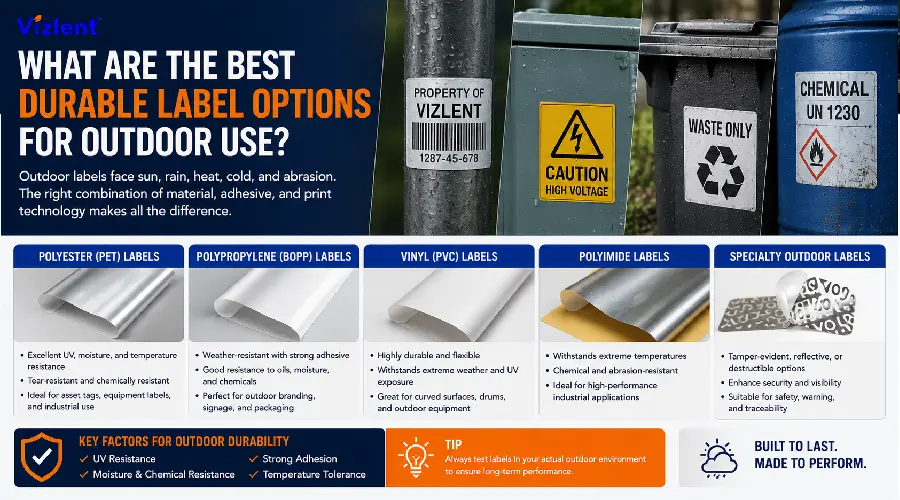
When it comes to the best durable label options for outdoor use, Vinyl tops the list. Its construction resist rain, salt spray, temperature swings from -40°C to 150°C, and years of direct sun exposure without fading, curling, or lifting. Procurement teams sourcing outdoor labeling solutions should weigh substrate, adhesive, and lamination together, since each factor plays a distinct role in service life.
This guide breaks down the material science, adhesive chemistry, and certification standards behind the best durable label options for outdoor use, so engineers and brand owners can specify with confidence instead of guesswork.
Why Outdoor Labeling Demands a Different Standard
Indoor labels rarely face more than dust and gentle handling, but outdoor labels face a hostile combination of ultraviolet radiation, moisture, temperature cycling, and physical abrasion every single day. A label that performs well on a warehouse shelf can chalk, crack, or peel within months when it is mounted on a utility pole or a piece of construction equipment left outdoors. This gap between indoor performance and outdoor survival is exactly why buyers search specifically for durable outdoor labels rather than general-purpose stickers.
Regulatory bodies recognize this gap too, which is why standards such as UL 969 and ANSI Z535 exist specifically for outdoor labeling solutions used on safety signage and equipment identification. A warning decal that fades after one summer is not just a cosmetic failure, it becomes a compliance and safety liability. Choosing among the best durable label options for outdoor use from the start prevents costly reprints, equipment downtime, and failed safety audits down the line.
What Makes an Outdoor Label Truly Durable
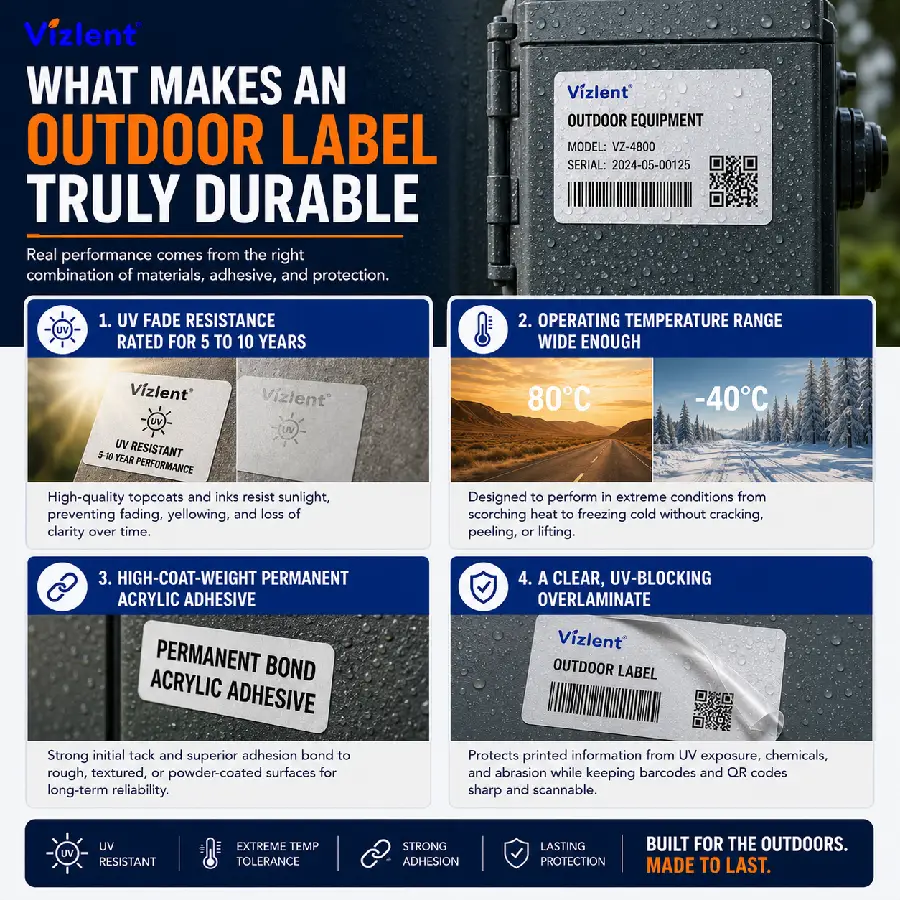
Three engineering factors separate a genuinely durable outdoor label from a label that merely claims to be one: the facestock, the adhesive, and the overlaminate. Facestock determines dimensional stability and tensile strength, adhesive controls how well the label stays bonded through thermal expansion and contraction, and overlaminate determines how much UV radiation and moisture actually reach the printed image. Skipping any one of these three elements shortens the service life of an outdoor product label considerably.
Manufacturers test these factors using accelerated weathering equipment such as QUV testers and Xenon Arc chambers, which simulate years of sun and moisture exposure within a matter of weeks. This lab-based verification is what separates a genuine outdoor label material from a label that was only tested indoors. Buyers evaluating an outdoor durable label design should always request this test data before committing to a bulk order.
- UV fade resistance rated for 5 to 10 years of continuous outdoor exposure
- Operating temperature range wide enough to cover both summer heat and winter frost
- High-coat-weight permanent acrylic adhesive for textured or powder-coated surfaces
- A clear, UV-blocking overlaminate that shields ink without distorting barcode or QR readability
Best Durable Label Options for Outdoor Use: Comparing the Materials
When engineers compare the best durable label options for outdoor use, the shortlist usually comes down to outdoor-grade polyester (PET), UV-coated vinyl (PVC), and specialty laminating films applied over either substrate. Polyester offers the highest dimensional stability and tensile strength, making it the preferred outdoor label material for flat rating plates and rigid equipment panels. Vinyl, by contrast, flexes and contours around curved or textured surfaces such as utility poles and vehicle panels without lifting at the edges.
Beyond the two core substrates, buyers frequently ask about specialty formats such as an outdoor durable label tape for quick field application, or outdoor durable label sheets for smaller in-house print runs. Each format uses the same underlying facestock and adhesive chemistry, only the conversion and dispensing method changes. The table below summarizes how the leading substrate choices stack up against one another.
| Material | Best For | Temperature Range | Typical Lifespan Outdoors |
| Outdoor-grade Polyester (PET) | Flat rating plates, rigid equipment panels | -40°C to 150°C | 5 to 10 years |
| UV-coated Vinyl (PVC) | Curved surfaces, vehicle panels, utility poles | -40°C to 150°C | 5 to 8 years |
| Laminated Paper with Overlaminate | Short-term signage, budget applications | Limited moisture resistance | 6 to 18 months |
Laminated paper can work for short-term outdoor signage, but it is rarely counted among the best durable label options for outdoor use once moisture and prolonged sun exposure enter the picture. For anything mounted outdoors for more than a season, polyester or vinyl paired with a proper overlaminate remains the safer specification.
Outdoor Durable Label Adhesive: Why the Bond Matters as Much as the Facestock

An outdoor durable label adhesive has to do more work than an indoor equivalent, because thermal expansion and contraction constantly stress the bond line between the label and the substrate. A thin, low-tack adhesive might hold on a smooth glass surface, but it will fail within weeks on textured plastics, cast metal, or powder-coated frames commonly found on outdoor equipment. This is why high-coat-weight, cross-linked permanent acrylic formulations dominate the outdoor equipment label category.
Coat weight and cure time both affect how deeply the adhesive flows into micro-cavities on a rough surface before it sets. A properly cured, high-coat-weight adhesive creates a mechanical anchor in addition to a chemical bond, which is what allows the label to resist wind, rain, and repeated pressure washing. Buyers sourcing an outdoor durable label adhesive for rough or textured mounting surfaces should always confirm the coat weight specification before placing a bulk order.
- Cross-linked permanent acrylic for textured, powder-coated, or cast metal surfaces
- Standard acrylic for smooth, high-energy surfaces such as glass or bare aluminum
- Removable acrylic only for temporary outdoor signage that will be relocated
- Adhesive rated to the full -40°C to 150°C service range for year-round exposure
Outdoor Durable Label Design, Color, and Regulatory Considerations
Good outdoor durable label design starts with legibility under fading light and glare, not just aesthetics. Bold, high-contrast typography combined with ANSI Z535 safety colors such as safety red for danger, warning orange for warning, and caution yellow for caution keeps warning signage readable at a distance even after years of sun exposure. Engineers frequently ask how an outdoor durable label vs black label, an outdoor durable label vs red label, or an outdoor durable label vs blue label should be selected, and the answer usually traces back to the ANSI Z535 hierarchy rather than a specific brand naming convention.
Under this hierarchy, red typically signals immediate danger, orange signals a warning-level hazard, yellow signals general caution, and blue is reserved for mandatory or notice-level instructions rather than hazard severity. Choosing the correct color band is a regulatory decision as much as a design one, since OSHA and ANSI both reference this same color hierarchy during safety audits. A versatile outdoor durable label construction should hold all four color bands equally well without one fading faster than the others.
- Confirm ANSI Z535 color compliance before finalizing artwork
- Use high-contrast typography sized for the expected viewing distance
- Verify barcode or QR code print quality meets ISO/IEC 15415 Grade B or higher
- Request a physical proof before committing to a full production run
Outdoor Durable Label Roll, Sheet, and Tape Formats Compared

Format choice affects how efficiently a label gets applied in the field, and it is one of the most overlooked parts of choosing among the best durable label options for outdoor use. An outdoor durable label roll suits automated label applicators and high-volume production lines, since rolls feed continuously through dispensing equipment without manual handling. An outdoor durable label sheet, on the other hand, works better for smaller in-house print runs using a standard laser or inkjet printer.
An outdoor durable label roller, meaning a hand-operated or motorized roll applicator, helps maintain even pressure across the label during field application, which reduces the risk of trapped air bubbles that later let in moisture. Outdoor durable label tape, a continuous adhesive-backed strip rather than a die-cut shape, suits cable bundling and continuous surface marking rather than discrete asset tags. Selecting the correct format prevents wasted material and reduces labor time during installation.
- Rolls: Best for automated applicators and high-volume production lines
- Sheets: Best for smaller in-house print runs and short production cycles
- Tape: Best for cable bundling and continuous surface marking
- Die-cut singles: Best for irregular equipment geometries and custom shapes
Outdoor Durable Label QR Code and Serialization for Asset Tracking
Modern outdoor equipment labels increasingly carry more than a part number, they carry a scannable outdoor durable label QR code linked to maintenance records, warranty data, or inventory systems. Printing a reliable QR code on an outdoor-durable label requires facestock with consistent surface smoothness and ink receptivity, since even minor surface irregularities can degrade scan accuracy after prolonged UV exposure. This is especially important for utilities, logistics, and fleet operators who depend on fast, error-free scanning in the field.
Serialization adds another layer of value, allowing each label to carry a unique identifier for warranty tracking, chain-of-custody documentation, or regulatory traceability. Facilities that combine durable outdoor sticker materials with GS1 DataMatrix or QR serialization gain full lifecycle visibility on outdoor assets, from installation through eventual decommissioning. Because scan reliability depends directly on facestock quality, this is not an area where buyers should compromise for a lower unit price.
Industries That Rely on Outdoor Product Labels
Construction and heavy equipment manufacturing represent some of the most demanding use cases for outdoor product labels, since excavators, cranes, and bulldozers face constant kinetic impact, abrasive dust, and direct sunlight. Manufacturers in this sector depend on outdoor equipment label constructions for pinch-point hazard markers, rating plates, and operating instruction decals that must remain legible for the full service life of the machine. A single illegible warning decal on a piece of heavy equipment can create a genuine safety incident.
Utilities, energy, HVAC manufacturing, logistics, and agriculture all lean on the same underlying material science for different reasons. HVAC outdoor units need rating plates that survive 15 to 20 years of continuous outdoor exposure, while logistics operators need outdoor use labels that keep barcodes scannable after diesel exposure, road salt, and automated truck washes. Across every one of these sectors, specifying the best durable label options for outdoor use up front avoids expensive mid-life label replacement programs.
- Construction and heavy equipment: Impact-resistant hazard and rating labels
- Utilities, energy, and HVAC: Long-life rating plates and compliance labeling
- Logistics and transportation: Barcode-scannable shipping and fleet labels
- Agriculture: Labels resistant to fertilizer, moisture, and prolonged sun exposure
Choosing an Outdoor Durable Label Dealer or Manufacturer
Not every outdoor durable label dealer manufactures its own material, and this distinction matters more than most buyers realize. A trading company reselling generic stock cannot always confirm coat weight, cure schedule, or lamination specification, while a direct manufacturer can document every stage of production and adjust the formulation to a buyer’s exact application. For any project describing itself as an outdoor durable label business, working with a facility that controls its own coating and laminating lines removes an entire layer of supply chain risk.
Vizlent Label Materials Co., Ltd. has manufactured self-adhesive label stock and laminating films since 2011, supplying OEM and ODM customers across more than 50 countries. Every batch of outdoor weather resistant label stock is lab-tested using Xenon Arc weatherometers and shear testing equipment, and certified to ISO 9001, FSC, and SGS standards. Buyers evaluating outdoor durable label dealers for a new project can review Vizlent’s full durable label range or request free samples before committing to a bulk order.
Send Your Inquiry to Vizlent’s Engineering Team →
Best Durable Label Options for Outdoor Use for Business Buyers: Brands, Cost, and Quick Sourcing
Business buyers researching the best durable label options for outdoor use for business rarely evaluate material science alone, they also weigh brand reputation, minimum order quantities, and how quickly a supplier can turn around a sample. A well-known name does not always translate into the correct outdoor label material for a specific application, since outdoor durable label brands vary widely in facestock quality, adhesive formulation, and lab testing rigor. Comparing outdoor durable label brands on paper specifications, not marketing claims, protects buyers from paying a premium for a construction that underperforms in the field.
Color coding adds another layer of consideration for procurement teams managing large facilities, since outdoor signage is rarely limited to a single shade. Beyond the familiar red, orange, yellow, and blue hierarchy under ANSI Z535, some facilities also specify brown or green bands for informational or environmental markers on outdoor equipment. A dependable outdoor durable label business partner should be able to match any required color band consistently across production runs, not just the most common ones.
- Compare outdoor durable label brands on lab test data, not marketing language alone
- Confirm minimum order quantities before committing to a new outdoor durable label business relationship
- Ask for a quick-turn sample program to validate performance before a bulk order
- Verify that color-matching, including brown, green, or custom Pantone references, stays consistent across production batches
Common Mistakes Buyers Make When Sourcing Outdoor Labels
Many procurement teams default to the cheapest laminated paper option without accounting for the total cost of reprinting and reapplying labels every six to twelve months. This short-term savings almost always costs more over a multi-year equipment lifecycle than specifying a proper outdoor-rated construction from the outset. A single field service visit to replace faded warning decals can easily exceed the price difference between paper and a proper polyester or vinyl construction.
Another common mistake is assuming that all vinyl or polyester stock performs identically regardless of supplier, when adhesive coat weight, overlaminate thickness, and pigment quality all vary between manufacturers. Skipping the accelerated weathering test data, or failing to request a physical sample before a bulk order, leaves buyers exposed to inconsistent batches down the line. Working with a factory-direct manufacturer that documents every stage of production, rather than a reseller repackaging unknown stock, closes this gap.
- Do not select material based on price alone without checking accelerated weathering data
- Do not assume every polyester or vinyl label performs the same across suppliers
- Always request a physical sample before committing to a bulk production run
- Confirm adhesive coat weight and overlaminate thickness in writing before ordering
Ready to Specify the Best Durable Label Options for Outdoor Use?
Choosing among the best durable label options for outdoor use does not have to involve guesswork or costly trial and error. Vizlent’s engineering team can review your facestock, adhesive, and certification requirements and recommend the right outdoor-grade construction for your application. Request a free sample or a custom quote today and see how a factory-direct partner approaches outdoor label durability.
Frequently Asked Questions
What are the best durable label options for outdoor use?
The best durable label options for outdoor use are UV-stabilized polyester (PET) or UV-coated vinyl (PVC) facestocks combined with a cross-linked permanent acrylic adhesive and a UV-blocking overlaminate. This combination resists rain, salt spray, and temperature swings between -40°C and 150°C without fading or lifting. Polyester suits flat, rigid surfaces, while vinyl suits curved or textured surfaces that need to flex without cracking.
How long do outdoor durable labels typically last?
Most high-quality outdoor durable labels are rated for 5 to 10 years of continuous outdoor exposure, depending on geographic solar intensity and material construction. Some HVAC and utility rating plates are specified to last 15 to 20 years using premium overlaminate systems. The exact lifespan always depends on the specific combination of facestock, adhesive, and lamination chosen.
What is the difference between an outdoor durable label and a waterproof label?
A waterproof label resists water exposure but may not include UV-blocking overlaminate or wide-temperature-range adhesive. An outdoor durable label is engineered for the full range of outdoor stressors, including UV radiation, temperature cycling, and abrasion, not just moisture. For any application facing direct sunlight, a fully outdoor-rated construction is the safer specification.
Does an outdoor durable label vinyl sticker work on curved surfaces?
Yes, UV-coated vinyl (PVC) is specifically valued for its flexibility on curved or contoured surfaces such as utility poles, pipes, and vehicle panels. Polyester, by comparison, is more rigid and better suited to flat panels. Choosing between the two mainly comes down to the geometry of the surface the label will be applied to.
Are outdoor durable label adhesives safe for painted or powder-coated metal?
Yes, provided the adhesive is a high-coat-weight, cross-linked permanent acrylic formulation designed for textured surfaces. Standard low-tack adhesives are better suited to smooth glass or bare aluminum and may fail on powder-coated or textured metal over time. Always confirm the adhesive coat weight specification before ordering for a rough-surface application.
Can outdoor durable label QR codes still scan reliably after years outdoors?
Yes, as long as the facestock maintains consistent surface smoothness and the overlaminate does not distort the printed image over time. Print quality meeting ISO/IEC 15415 Grade B or higher is recommended for long-term outdoor scan reliability. Facilities that lab-test their materials under accelerated UV exposure can confirm scan performance before full production.
What certifications should I look for in outdoor durable label materials?
UL 969 Recognized for Outdoor Use confirms that a label construction has been independently tested for UV, water, and thermal exposure without peeling or losing legibility. ANSI Z535 governs the safety color hierarchy used on warning and hazard labels. ISO 9001 manufacturing certification adds an additional layer of quality assurance across production batches.
Are custom sizes available for outdoor durable label tags and decals?
Yes, most manufacturers offer standard sizes such as 2 inches by 4 inches or 4 inches by 6 inches alongside custom die-cut singles for irregular equipment geometries. Custom sizing is particularly useful for heavy machinery warning signs and HVAC rating plates that must fit a designated flat space. Buyers should confirm minimum order quantities before requesting a custom die-cut run.






