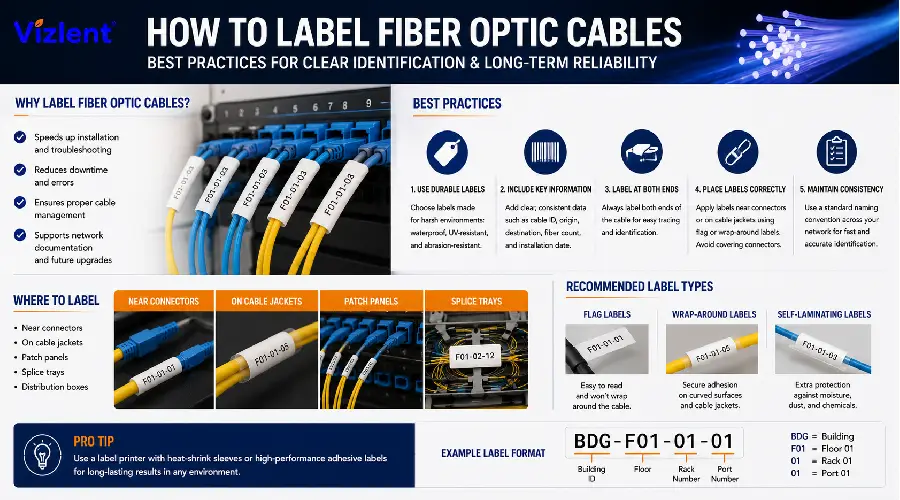
To label fiber optic cables correctly, installers attach a durable, legible marker at both ends of every run, at each junction point, and at regular intervals along the cable path, using materials that resist abrasion, moisture, and UV exposure over the life of the network. A proper labeling system prevents costly cross connection errors, speeds up troubleshooting during outages, and keeps a data center or campus network compliant with recognized documentation standards.
Self adhesive laminating sheets play a central role in this process because they seal printed text against fading, smudging, and physical wear without adding bulk to the cable jacket. The standards, materials, and hands on steps below keep a fiber network organized from the patch panel to the buried trunk line.
What It Means to Properly Tag and Identify a Fiber Network
Labeling a fiber run means applying a printed, adhesive marker that records the cable ID, origin, destination, and sometimes the fiber count and cable type. Technicians rely on these markers to trace a single strand through a bundle of hundreds without cutting into a jacket or disturbing a splice tray. Good labels for fiber optic cable installations are readable under low light, resistant to handling, and consistent in format across the entire facility.
Every fiber optic labels program should follow a naming convention that stays the same from the first patch panel to the last outdoor pedestal. Consistency matters more than any single label material choice, though the material still determines how long that consistency survives in the field. A quality protective laminate extends the working life of the printed information by forming a clear barrier between the ink and the surrounding environment.
- Cable ID and circuit number
- Origin and destination points
- Fiber count and connector type
- Installation date and technician initials
Ready to standardize your fiber network labeling? Contact our support team for a material recommendation suited to your site conditions.
Fiber Optic Cable Labeling Standard Requirements
A fiber optic cable labeling standard typically draws from frameworks such as TIA 606 for administration and ANSI Z535 for safety color coding, which together define how cables, panels, and pathways should be marked. These frameworks specify label placement, minimum text size, and color use so that any technician, regardless of who installed the run, can read the network the same way. Facilities that skip a formal standard tend to accumulate inconsistent, hand written tags that slow down repairs and increase the risk of disconnecting the wrong strand.
Meeting a recognized labeling standard also means choosing print and material combinations that pass accelerated aging tests for the expected service environment. Self adhesive laminating sheets are frequently specified in these frameworks because they protect thermal transfer or laser printed text from the humidity and temperature swings common in telecom rooms and outside plant cabinets. Choosing a compliant material up front avoids the expense of relabeling an entire rack years into its service life.
Explore our durable label range engineered to meet demanding facility labeling standards.
Choosing a Fiber Optic Cable Label Maker
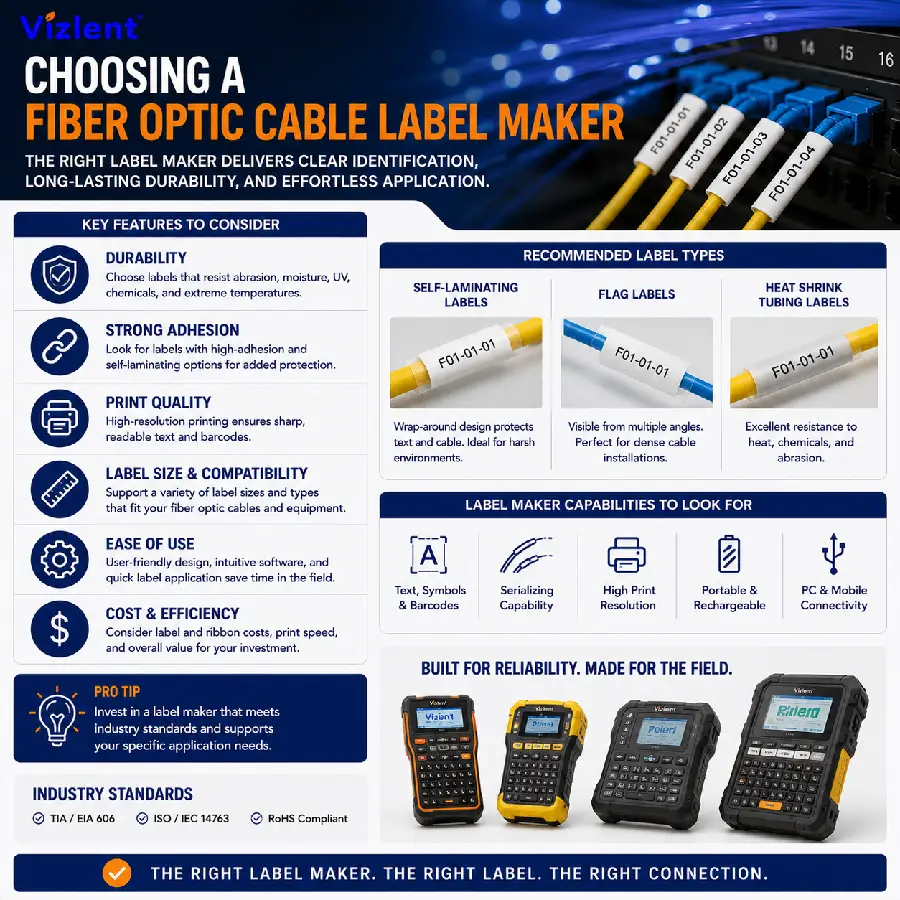
A fiber optic cable label maker needs to print small, high resolution text that stays sharp on narrow jacket diameters and compact wrap around tags. Thermal transfer printers paired with the correct ribbon and facestock combination tend to produce the sharpest, longest lasting results for this application. Inkjet options exist for lower volume jobs, though thermal transfer remains the preferred choice for facilities printing large batches of cable identification tags.
The printer is only half of the equation, since the facestock and overlaminate determine how well that printed image survives handling and environmental exposure. Self adhesive laminating sheets applied after printing add a protective layer that resists smearing from cable ties, dust, and incidental contact with cleaning chemicals. Pairing the right label maker with the right laminate keeps text legible for the full service life of the installation rather than just the first few months.
- Thermal transfer printers for durable, high contrast text
- Laser printers for indoor patch panel labels
- Handheld label makers for quick field identification
Send us your specification sheet and our technical support team will recommend a compatible facestock and laminate combination.
Fiber Optic Cable Tags and Their Everyday Uses
Fiber optic cable tags come in wrap around, flag, and clip on styles, each suited to a different point along the cable run. Wrap around tags work well on trunk cables where the label needs to stay flat against a curved jacket, while flag tags give technicians more surface area for longer circuit descriptions. Clip on tags suit temporary labeling during installation before a permanent marker is applied.
Selecting the right tag style depends on cable diameter, available space, and how often the label needs to be read during maintenance. A durable overlaminate protects the printed face of these tags from the friction of being pulled through conduit or handled repeatedly during patching. A tag that resists curling and lifting at the edges will outlast a poorly laminated equivalent by years in a busy telecom room.
Browse our self adhesive material options built for tight bend radii and repeated handling.
Fiber Optic Cable Markers for Outdoor and Buried Installations

Buried fiber optic cable markers face a different set of demands than indoor tags, since they must survive direct soil contact, groundwater, and years of temperature cycling without losing legibility. These markers typically use a heavier gauge facestock combined with an aggressive adhesive that will not lift when the surrounding jacket contracts in cold weather. Outdoor fiber optic cable markers also need UV stable inks so that sun exposure does not fade the printed circuit information over time.
Self adhesive laminating sheets rated for outdoor exposure add the extra protection these buried and above ground markers need to remain functional for the decade plus lifespan expected of outside plant infrastructure. A well laminated marker resists cracking in freezing conditions and stays flexible enough to wrap tightly around a jacket without splitting at the seam. Choosing a laminate with proven weatherability up front is far less expensive than sending a crew back out to relabel a buried vault years later.
- UV stable ink formulations for sun exposed markers
- Aggressive adhesive systems for cold weather adhesion
- Heavier facestock gauges for below grade durability
Review our outdoor weather resistant label materials for buried and above ground fiber runs.
Fiber Optic Cable Stickers for Quick Identification
Fiber optic cable stickers serve a simpler purpose than full identification tags, often marking color coded fiber counts, connector polarity, or a quick reference number at a glance. These stickers are common on patch cords, breakout kits, and inside cabinets where space is tight and technicians need fast visual cues rather than long text strings. A good sticker holds its color and adhesion through repeated handling without leaving residue when removed.
Because stickers are often smaller than full tags, the printed graphic needs a laminate that will not peel at the corners after months of contact with fingers and cable management tools. A protective laminate sized for small format printing keeps these stickers crisp and readable even on connectors that get touched daily. Facilities that skip lamination on stickers tend to see faded color coding within the first year of heavy use.
Ask about our small format self adhesive material for sticker scale identification projects.
Fiber Optic Patch Cable Labels for Data Centers
Fiber optic patch cable labels sit at the busiest point of any data center, where hundreds of short jumper cables connect switches, panels, and servers in a constantly changing layout. A patch cable label needs to survive frequent unplugging, cable management sleeves, and the general wear of a high traffic rack without smearing. Color coding on patch cable labels also helps technicians confirm connector type and circuit function before they trace a single strand back to its source.
Because patch cables move often, the label material has to resist lifting at the flexible bend point near each connector. Self adhesive laminating sheets designed for flexible substrates keep patch cable labels intact through thousands of bend cycles without cracking. A data center that standardizes on a proven laminate for patch cable labels spends far less time reprinting and reapplying tags after routine moves, adds, and changes.
Contact us to sample our flexible facestock and laminate combination before your next patch panel refresh.
Caution Fiber Optic Cable Tags and Safety Compliance
A caution fiber optic cable tag warns technicians and other personnel about laser hazards present in an active fiber connection, since even invisible infrared light can cause eye damage if viewed directly. These tags typically follow ANSI Z535 color and symbol conventions, using bright yellow or orange backgrounds with clear laser hazard icons. Placing caution tags at every access point where a live fiber could be disconnected keeps a facility aligned with recognized safety practices.
Safety labeling only works if the tag remains legible for as long as the hazard exists, which can be the full service life of the network. A weatherable laminate protects the caution symbol and text from fading, so the warning stays as visible after five years as it was on day one. Facilities that treat caution tags as an afterthought risk both compliance gaps and genuine safety incidents during maintenance work.
Speak with our team about flame retardant labels and safety compliant facestocks for hazard signage.
Fiber Optic Cable Identification Tags and Symbols
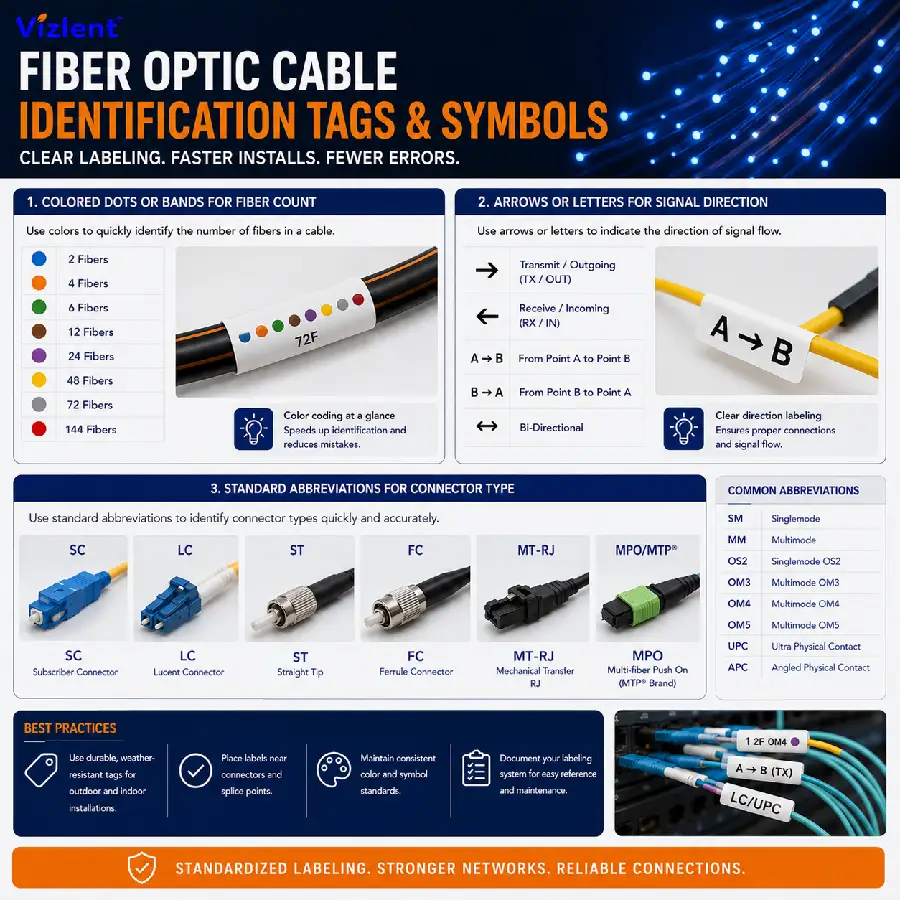
Fiber optic cable identification tags rely on a consistent set of symbols and color codes so that anyone reading the label understands cable type, count, and function without needing a separate reference sheet. Common conventions include colored dots for fiber count, arrows for signal direction, and standardized abbreviations for connector types such as LC, SC, and MPO. Wrap around fiber optic cable labels that circle the entire jacket give technicians a symbol visible from any viewing angle.
Printing consistent symbols across every identification tag depends on a facestock that reproduces fine detail without ink spread or smearing. Self adhesive laminating sheets preserve that print detail so small symbols and abbreviations remain sharp even after months of handling in a crowded rack. A facility that standardizes its identification tags and symbols across every site cuts training time for new technicians significantly.
- Colored dots or bands for fiber count
- Arrows or letters for signal direction
- Standard abbreviations for connector type
View our anti static labels and identification facestocks suited for electronics and datacom environments.
Why Self Adhesive Laminating Sheets Are Central to Cable Label Durability
Self adhesive laminating sheets are thin, clear films applied over a printed label to shield the ink from moisture, abrasion, chemicals, and ultraviolet light. In fiber optic cable labeling, this protective layer is what separates a tag that lasts a few months from one that lasts the full service life of the network. Without a laminate, thermal transfer or laser printed text on a cable tag can fade, smear, or flake off within weeks of installation in a busy telecom room.
Self adhesive laminating sheets come in cold and thermal application types, each suited to different printing equipment and environmental demands. Cold lamination sheets work well for facilities without a heat sealing press, while thermal lamination sheets bond more aggressively for outdoor and industrial cable runs. Selecting the correct laminate type for a given cable labeling project depends on the printer, the facestock, and the conditions the finished tag will face in service.
- Cold lamination sheets for press free application
- Thermal lamination sheets for aggressive, heat sealed bonding
- Gloss or matte finishes depending on glare and readability needs
Explore our laminating films and cold lamination films built specifically for demanding label applications.
Fiber Optic Cable Labels, UV Light, and UL Listing Requirements
Fiber optic cable labels exposed to sunlight need UV stable inks and a laminate that will not yellow or become brittle after years outdoors. A label that fails under UV light typically shows fading text first, followed by cracking and lifting at the edges as the facestock degrades. Facilities in high sun regions should specify fiber optic cable labels rated for a set number of hours in accelerated weathering tests before approving a material for outdoor use.
UL listed fiber optic cable labels have passed recognized flammability and material safety testing, which matters for labels placed near electrical panels or in plenum rated spaces. Choosing UL listed materials also reduces the risk of fiber optic cable labels causing data loss during an incident, since a mislabeled or illegible tag can send a technician to the wrong strand during an emergency repair. Self adhesive laminating sheets that carry UL recognition give facility managers one less compliance question to answer during an audit.
Ask about UL listed laminating films for panels and plenum rated cable pathways.
Best Practices to Label Fiber Optic Cables for Long Term Durability
Facilities that succeed at fiber network labeling over the long term standardize on a single naming convention, a single approved facestock, and a single laminate before the first cable goes into service. Retrofitting a labeling standard after a network has grown to thousands of strands is far more expensive than establishing the rules on day one. Documenting the chosen materials and format in a facility handbook keeps future contractors and technicians consistent with the original design.
Regular audits catch labels and stickers that have started to fade, curl, or fall off before they become a troubleshooting problem during an outage. Self adhesive laminating sheets should be re-specified every few years as new formulations improve UV resistance, adhesion, and print clarity beyond what was available when the network was first installed. A facility that reviews its labeling materials on a set schedule keeps its fiber network as easy to trace on year ten as it was on day one.
- Standardize naming conventions before installation begins
- Choose one approved facestock and laminate combination facility wide
- Schedule periodic audits of existing labels and stickers
- Update material specifications as new laminate formulations become available
Request a free sample of our self adhesive material range to test against your facility’s durability requirements.
Applying and Maintaining Fiber Optic Cable Labels
Proper application starts with a clean, dry jacket surface, since dust or moisture trapped under the label will shorten its working life regardless of material quality. Technicians should apply wrap around tags with firm, even pressure so no air pockets form between the adhesive and the jacket. Curing time matters too, since some adhesive systems reach full bond strength only after several hours at room temperature.
Maintenance is as important as the initial installation, since even the best self adhesive laminating sheets will eventually show wear on the highest traffic cables in a facility. Technicians should replace any tag showing curling edges, faded text, or adhesive failure rather than layering a new sticker over a failing one. A consistent replacement policy keeps the entire fiber network as reliable to trace in year five as it was on installation day.
Contact our support team for guidance on application best practices for your specific cable types and environment.
Final Thoughts
A well planned labeling program keeps a fiber network easy to trace, easy to repair, and compliant with recognized safety and documentation standards for decades. Choosing the right combination of tags, stickers, inks, and self adhesive laminating sheets up front saves far more time and cost than relabeling a facility after the fact. Our engineering team works directly with converters, integrators, and facility managers to match label materials to real world conditions rather than a generic catalog spec.
Contact Vizlent today to request free samples and a material recommendation for your next fiber optic cable labeling project, or learn more about our company and manufacturing capabilities.
Frequently Asked Questions
What is the best way to label fiber optic patch cable connections?
The best way to label fiber optic patch cable connections uses a small format, color coded sticker paired with a clear laminate that resists smearing from frequent handling. Technicians benefit from consistent color coding for connector type and a short circuit reference number rather than long descriptive text. Self adhesive laminating sheets sized for patch cord diameters keep these labels legible through thousands of connect and disconnect cycles.
How do fiber optic cable labels prevent data loss during maintenance?
Fiber optic cable labels prevent data loss by giving technicians a reliable way to identify the correct strand before disconnecting or splicing a cable during maintenance work. A faded or illegible label increases the chance of a technician disturbing the wrong circuit, which can interrupt live traffic on an unrelated connection. Clear, laminated identification tags reduce this risk by staying readable for the full service life of the installation.
What do the symbols on fiber optic cable labels usually represent?
Symbols on fiber optic cable labels usually represent fiber count, signal direction, and connector type using colored dots, arrows, and standardized abbreviations such as LC, SC, or MPO. These symbols let a technician understand a cable’s role at a glance without reading a full text description. Consistent symbol use across a facility speeds up training for new staff and reduces labeling errors.
Do fiber optic cable labels need to be UV resistant?
Fiber optic cable labels need UV resistance whenever they will be installed outdoors, in sunlit equipment rooms, or near windows where direct light reaches the cable jacket. Standard indoor inks and facestocks can fade or discolor within months under regular UV exposure. Choosing UV stable inks and a rated laminate keeps outdoor and sun exposed labels readable for years rather than months.
Are UL listed fiber optic cable labels required for data centers?
UL listed fiber optic cable labels are often required in plenum rated spaces and near electrical panels where fire safety codes govern acceptable materials. Facility managers should confirm local code requirements before specifying labels for these locations. Choosing UL listed facestocks and laminates from the start avoids a costly relabeling project if a compliance audit flags noncompliant materials later.
How often should buried fiber optic cable markers be replaced?
Buried fiber optic cable markers should be inspected during routine maintenance and replaced whenever fading, cracking, or adhesive failure appears, typically every several years depending on soil and climate conditions. Markers rated for outdoor exposure and paired with a weatherable laminate generally outlast unlaminated alternatives by a significant margin. A scheduled inspection program catches failing markers before they cause confusion during an emergency repair.
What is the difference between fiber optic cable tags and stickers?
Fiber optic cable tags are typically larger, wrap around or flag style labels used for full circuit identification, while stickers are smaller and used for quick visual reference such as fiber count or connector polarity. Tags carry more text and are placed at junctions and panel entries, while stickers appear directly on connectors and jumper cables. Both benefit from a protective laminate to resist fading and smearing over time.
Can self adhesive laminating sheets be applied to existing, unlaminated cable labels?
Self adhesive laminating sheets can be applied over many existing labels, provided the original printed surface is clean, dry, and free of curling or lifting at the edges. Retrofitting a laminate onto aging labels can extend their working life, though newly printed and laminated tags generally perform more reliably than a retrofit. Facilities considering a retrofit should test a small batch first to confirm adhesion and clarity before treating an entire rack.