
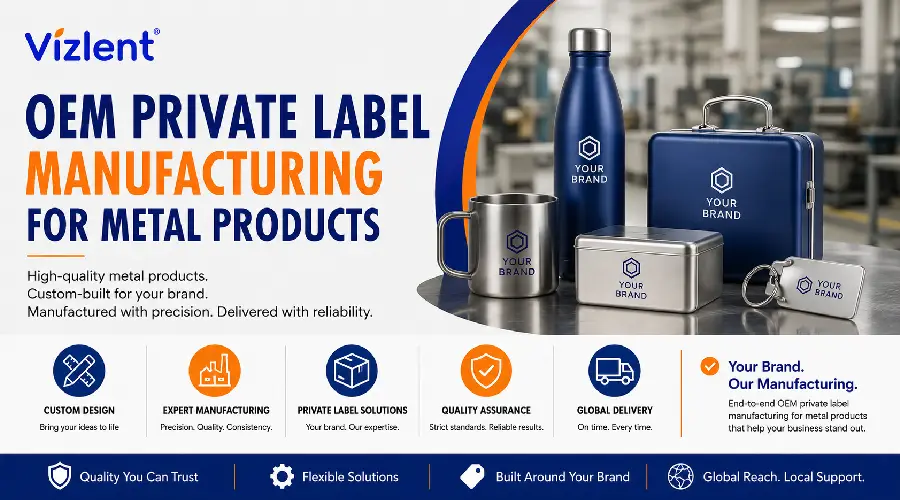
Companies that offer OEM private label manufacturing for metal products fall into three groups: contract metal fabricators and die-casting plants, factory groups in manufacturing hubs such as Guangdong and Zhejiang, and specialized component makers that produce finished goods under your brand name. These suppliers build the product to your specification, apply your branding, and ship retail-ready stock that carries no trace of the factory’s own identity. The branding layer itself, including nameplates, etched marks, and durable identification labels, is usually supplied by a separate materials partner such as a self adhesive material manufacturer.
Metal product categories that run heavily on this model include cookware, hand tools, hardware, fitness equipment, drinkware, and outdoor gear. The factory carries the tooling, certifications, and capacity, while the brand carries the design, the marketing, and the customer relationship. Getting the split right is what turns a generic metal item into a branded product that commands a margin.
What Does OEM Private Label Mean?
The oem private label meaning is simple at its core: an Original Equipment Manufacturer produces goods that another company sells under its own brand. In practice, OEM private labeling covers everything from stamping your logo on an existing factory design to building a fully custom product from your engineering drawings. The factory stays invisible, and the buyer’s brand takes full ownership of the product in the market.
For metal goods, the arrangement usually includes surface finishing, packaging, and permanent brand marking as part of the contract. A stainless bottle factory, for example, will powder coat, laser mark, box, and barcode the product before it leaves the line. The brand receives sealed cartons ready for a warehouse or a retail shelf.
OEM vs. ODM vs. Private Label: Sorting Out the Difference

The oem private label difference comes down to who owns the design. Under a pure OEM contract you supply the drawings and the factory builds exactly what you specify, while under private label you select an existing catalog product and the factory applies your brand to it. An ODM sits in between, offering a factory-designed product that can be modified and branded for you.
A capable OEM private label service will run all three models under one roof, which is common among established Chinese manufacturers. Vizlent operates this way in the label materials sector, producing custom-engineered constructions for OEM clients and brandable catalog stock for private label buyers. Working with a private label (oem) manufacturer that supports both paths lets a brand start fast on catalog goods and migrate to custom tooling as volume grows.
- OEM: Your design, factory’s production line, highest control and highest tooling cost
- ODM: Factory’s design with your modifications, faster launch, shared design ownership
- Private label: Factory’s catalog product with your branding, lowest cost and fastest route to market
Types of Companies That Offer OEM Private Label Manufacturing for Metal Products
Suppliers offering OEM private label manufacturing for metal products b2b services cluster into recognizable categories, each suited to different product types. Sheet metal fabricators handle enclosures, brackets, and housings, while die-casting and forging plants serve tool, hardware, and automotive part brands. CNC machining shops take on precision components, and vertically integrated consumer factories build finished goods like cookware and drinkware end to end.
An OEM private label manufacturing for metal products business relationship works best when the factory’s core process matches your product’s dominant manufacturing step. A brand buying stainless tumblers should sit with a deep-draw stamping and welding specialist, not a general trading company. Asking to tour or video-audit the actual production line is the fastest way to confirm a supplier makes rather than resells.
- Sheet metal fabricators: Enclosures, panels, brackets, shelving, and custom housings
- Die-casting and forging plants: Tools, hardware, hinges, and structural fittings
- CNC and precision machining shops: Components with tight tolerances and complex geometry
- Integrated consumer goods factories: Cookware, drinkware, fitness gear, and outdoor equipment
- Surface finishing specialists: Anodizing, powder coating, plating, and polishing offered as standalone contract services for brands that split production across suppliers
Sourcing OEM Metal Manufacturing From China
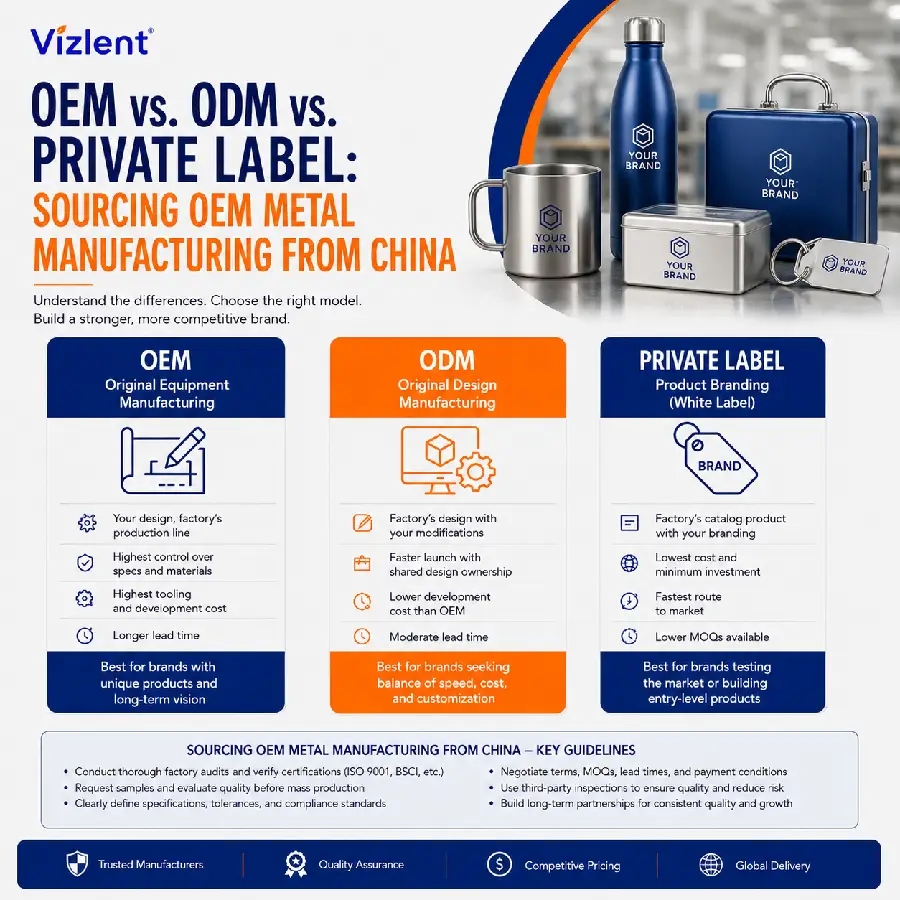
Buyers searching for oem private label manufacturing for metal products china options are looking at the world’s deepest supplier base, concentrated in Guangdong, Zhejiang, Jiangsu, and Shandong. Sourcing OEM private label manufacturing for metal products from China brings cost advantages of 30 to 60 percent against Western contract pricing, along with mature export logistics. The trade-off is distance, so verification, sampling, and third-party inspection become non-negotiable steps.
Search phrases like private label oem/odm manufacturer / china logistic reflect the real buyer concern: production and freight have to be managed as one pipeline. Established factories quote FOB or DDP terms, book container space, and handle export documentation as standard service. Vizlent ships label materials to more than 50 countries on this model, and the same export discipline applies to any credible metal goods factory.
- Confirm the Quote Basis: FOB gives you freight control, DDP gives you a single landed price
- Add QC Inspection Rights: Put inspection rights in writing so your oem private label manufacturing for metal products contract allows third-party QC before shipment
- Consolidate Freight: Consolidate branding materials and product freight where possible to cut booking and customs costs
- Plan Around China Holidays: Plan around Chinese New Year and Golden Week, which remove two to four production weeks each year
How Metal Product Brands Handle Branding and Identification
Every private label metal product needs permanent brand marking, and this is where OEM private label manufacturing for metal products intersects with our own factory’s specialty. Direct methods include laser engraving, etching, embossing, and pad printing applied by the metal factory itself. Applied methods use high-durability label constructions, and laser etched labels deliver metal-plate appearance with pressure-sensitive convenience.
Applied labels win when products need serial numbers, compliance data, or variable barcodes that change per unit. Constructions from a durable label range survive abrasion, chemicals, and outdoor exposure on tool housings, equipment panels, and appliance backs. Pairing them with resin-grade thermal transfer ribbon printing gives metal product brands rating plates and asset marks that stay legible for the life of the product.
What to Look for in an OEM Partner
Vetting a supplier of OEM private label manufacturing for metal products comes down to proof rather than promises. Ask for business licenses, ISO 9001 certification, export records, and named references from brands in your category. A factory that hesitates on any of these items has answered your question already.
Serious buyers also test communication speed and engineering depth before placing tooling orders. Send a technical drawing with one deliberate ambiguity and watch what happens: strong factories ask a clarifying question, weak ones quote anyway. Companies advertising OEM private label manufacturing for metal products for sale on B2B marketplaces should always be traced back to a verifiable factory address and audit trail.
- Certifications: ISO 9001 as the baseline, plus category-specific marks like FDA or LFGB for food contact
- Tooling ownership: Get written confirmation that molds and dies you pay for belong to you
- Sampling discipline: Golden samples signed by both sides before mass production starts
- Inspection access: Third-party QC such as SGS permitted at the factory without restriction
- Brand protection: NDAs plus tamper-evident and security label options to protect your channel
- Payment structure: Standard terms of 30 percent deposit and 70 percent against inspection report, never full prepayment
- Aftersales terms: Defect thresholds, replacement policy, and claim windows agreed in the contract, not by email later
What OEM Metal Manufacturing Costs
Pricing for an OEM private label manufacturing for metal products co arrangement is built from four blocks: material, process time, tooling amortization, and finishing. Raw material indexes for stainless, aluminum, and carbon steel move monthly, so factories quote with validity windows of 15 to 30 days. Tooling for die-cast or deep-draw products runs from a few thousand to tens of thousands of dollars, amortized across your committed volume.
MOQs for private label metal goods typically start between 500 and 2,000 units for catalog products and rise for custom tooling projects. Branding adds a small increment, with laser marking priced per second of beam time and applied labels priced per thousand pieces. Asking for a cost breakdown by block rather than a single unit price makes supplier quotes comparable.
- Material block: Alloy grade, gauge or wall thickness, and current index pricing with a validity window
- Process block: Stamping, casting, machining, and welding time at quoted line rates
- Tooling block: Mold and die cost, amortization schedule, and written tooling ownership terms
- Finishing and branding block: Coating, plating, marking, labels, and retail packaging per unit
Common OEM Search Terms, Clarified
The phrase oem/private-label production describes the combined model where one factory handles both custom OEM builds and brandable catalog goods, which is now the norm among larger Chinese manufacturers. Listings for OEM /private label services on B2B platforms usually mean the same thing, with the slash signaling that both engagement types are available. Neither term implies a different legal structure, so the contract details matter more than the label a supplier uses.
An oem private custom label request, in factory language, means brand marking built to your artwork rather than a generic factory mark. For metal products this covers etched logos, printed rating plates, embossed badges, and serialized identification labels. Vizlent produces the applied-label side of this work as an OEM and ODM materials manufacturer, with constructions engineered to bond permanently to powder-coated, anodized, and bare metal surfaces.
Where Vizlent Fits in the Metal Product Supply Chain
Vizlent is not a metal fabricator, and saying so plainly is part of giving honest sourcing advice. Our factory manufactures the label stock, laminating films, and ribbon consumables that metal product brands and their converters use for rating plates, serial labels, tamper seals, and brand marks. An oem private label manufacturing for metal products company handles the fabrication, while we supply the identification layer that makes the finished product traceable and retail-ready.
We have run our own coating and slitting lines since 2011, hold ISO 9001, FSC, and SGS certification, and supply more than 1,000 converters and brand owners worldwide. Buyers can review our production capabilities and testing equipment on the about us page before requesting samples. Free sample rolls and A4 sheets ship on request, so adhesion to your specific metal finish is verified before any purchase order.
Source Your Branding Layer Alongside OEM Private Label Manufacturing for Metal Products
While your metal factory handles fabrication, Vizlent supplies the identification materials that complete the product: durable label stock, laser etched constructions, thermal transfer ribbons, and tamper-evident seals, all manufactured on our own certified lines. Send your surface type, durability requirements, and volumes through the contact page and our engineering team will respond within 24 hours with a factory-direct quotation and free samples matched to your metal finish. Brand marks are the one part of a private label product the customer sees every day, so specify them at factory grade.
Frequently Asked Questions
What is OEM private label manufacturing?
OEM private label manufacturing is an arrangement where a factory produces goods that are sold under another company’s brand name. The factory contributes production capacity, tooling, and quality control, while the brand contributes the design direction and owns the customer relationship. The finished product carries only the buyer’s branding. This model dominates categories like cookware, tools, drinkware, and hardware.
What is the difference between OEM and ODM?
OEM means the factory builds a product to the buyer’s own design and specification, while ODM means the factory supplies its own design that the buyer brands and sells. OEM gives full design ownership but requires engineering resources and tooling investment. ODM launches faster and cheaper but the underlying design may also be sold to other brands. Many factories offer both models under one contract framework.
Which countries lead in OEM metal product manufacturing?
China leads global OEM metal manufacturing by capacity, followed by India, Vietnam, Taiwan, and Turkey. Chinese clusters in Guangdong and Zhejiang concentrate stamping, casting, machining, and finishing within short supply chains. Vietnam and India are growing fast for brands diversifying sourcing. Buyers weigh unit cost against lead time, tariffs, and audit access when choosing a country. Many brands now split volume across two countries to protect supply continuity.
How do I verify a metal OEM factory in China?
Verify a Chinese metal OEM factory by checking its business license, requesting ISO 9001 certificates, and commissioning a third-party audit from an inspector such as SGS or TUV. A video walkthrough of the live production floor separates real factories from trading companies quickly. Export records and references from existing overseas clients add further proof. Never rely on marketplace badges alone. Cross-check the factory address against its registration documents as a final step.
What MOQs apply to private label metal products?
Private label MOQs for catalog metal products usually start between 500 and 2,000 units per SKU. Custom OEM projects carry higher commitments because tooling cost must amortize across the order. Some factories accept lower trial quantities at a per-unit premium to start a relationship. Branding consumables like labels and ribbons carry their own separate, generally low, MOQs. Negotiating a stepped price ladder across quantity breaks keeps reorders predictable.
How do private label brands put logos on metal products?
Brands mark metal products through laser engraving, etching, embossing, pad printing, or high-durability applied labels. Direct marking is permanent and clean but fixed at production time. Applied labels handle variable data such as serial numbers, barcodes, and compliance text that changes per unit. Most metal products ship with a combination of one direct mark and one applied label. The direct mark carries the brand while the label carries the data.
Are laser etched labels better than printed labels for metal surfaces?
Laser etched labels outperform standard printed labels on metal because the image is burned into the material layer rather than sitting on the surface as ink. They resist abrasion, solvents, and outdoor exposure, which suits tools, equipment panels, and industrial goods. Printed labels remain the right choice for retail graphics and frequently updated artwork. Many brands specify both types on one product.
How long does OEM metal production take?
OEM metal production typically runs 30 to 60 days from deposit for catalog products and 60 to 120 days for custom-tooled projects. Tooling fabrication is the long pole, often taking 25 to 45 days before first samples appear. Sea freight adds 15 to 40 days depending on destination. Branding materials such as labels ship faster, with 7 to 15 day factory lead times.






