
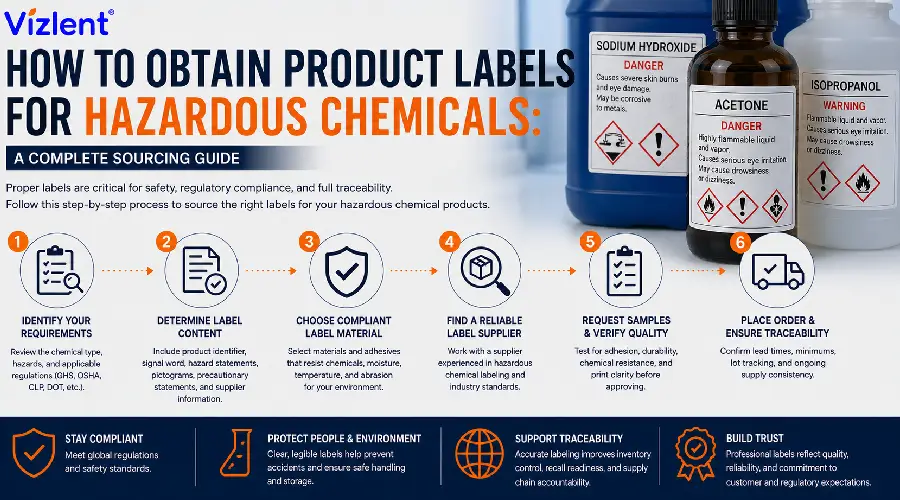
You obtain product labels for hazardous chemicals by confirming the regulations that apply to your containers, specifying a label construction that survives contact with the chemical, and sourcing certified label stock from a qualified manufacturer or supplier. The full process covers regulatory research, material selection, print method matching, and supplier verification. Get any one of those steps wrong and the label fails, which puts workers at risk and exposes your company to citations.
At Vizlent Label Materials Co., Ltd, we have supplied self adhesive label stock to chemical packagers, drum fillers, and label converters in more than 50 countries since 2011. The sourcing questions we answer daily from EHS managers and procurement teams shaped every recommendation below. Follow the steps in order and you will end up with labels for hazardous chemicals that stay legible, stay attached, and keep auditors satisfied.
What Are Product Labels for Hazardous Chemicals?
Product labels for hazardous chemicals are printed identification markings that communicate the identity, hazards, and safe handling requirements of a chemical to anyone who stores, transports, or uses it. Regulators treat these labels as a primary hazard communication tool, not as packaging decoration. A missing or illegible product label for chemicals is a compliance violation in nearly every industrial jurisdiction.
The category includes primary container labels, secondary workplace labels, and transport markings. Hazardous materials labels provide the first information a worker sees before opening a drum, pouring from a bottle, or loading a pallet. Product hazard labels also serve emergency responders, who rely on pictograms and signal words in the first minutes of an incident.
Regulations That Set Hazardous Chemicals Labelling Requirements
Hazardous chemicals labelling requirements in the United States start with the OSHA Hazard Communication Standard, 29 CFR 1910.1200, which aligns with the Globally Harmonized System (GHS). Consumer products fall under the Federal Hazardous Substances Labeling Act, administered today by the Consumer Product Safety Commission. Transport labeling adds another layer through DOT 49 CFR and international frameworks such as ADR and IMDG.
The Hazardous Substances Labeling Act matters for household chemical makers because it requires cautionary statements sized and worded for consumers rather than trained workers. GHS governs workplace and industrial supply chains, and most other countries apply their own GHS adoption with local language rules. Confirm the framework that applies to your product before you order a single roll, since each system specifies different wording, sizing, and placement.
What Hazardous Chemical Labels Must Contain
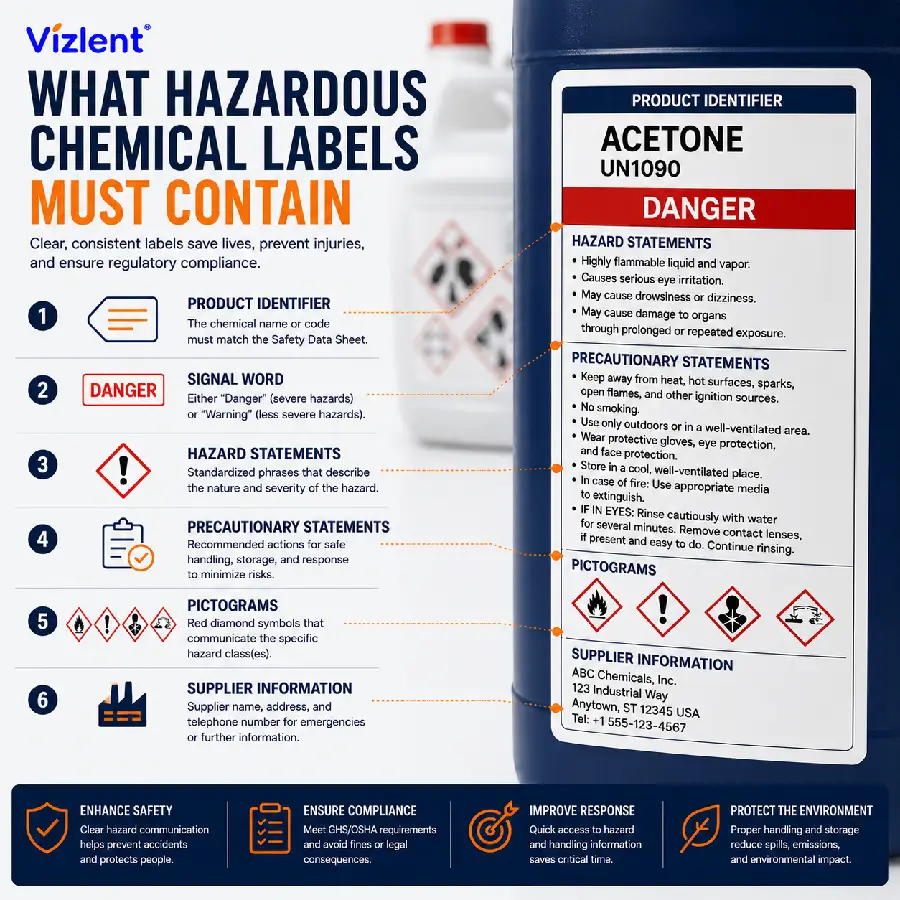
Hazardous chemical labels must contain six core elements under GHS, and each element carries formatting rules that affect the material and print method you choose. The required elements are:
- Product identifier matching the safety data sheet
- Signal word, either Danger or Warning
- Hazard statements describing the nature of the hazard
- Precautionary statements for handling, storage, and response
- Red diamond pictograms for each hazard class
- Supplier name, address, and telephone number
A hazardous chemical container label that omits any element fails inspection, no matter how durable the material is. Labels for hazardous chemical containers in the workplace can use simplified systems such as NFPA 704 or HMIS as long as workers can access full hazard information nearby. Document every format decision, because auditors ask for the reasoning behind each one.
Chemical Hazard Label Colors and Color Codes
Chemical hazard label colors carry regulatory meaning, so print accuracy is a compliance matter rather than a design preference. GHS pictograms require a red diamond border on a white background with a black symbol. NFPA 704 chemical hazard label color codes assign blue to health, red to flammability, yellow to instability, and white to special hazards.
A hazardous materials labeling chart from OSHA or your national regulator shows every pictogram alongside its assigned hazard class, and it belongs on the wall of every filling line. Faded reds and muddy yellows are among the most common findings in labeling audits. Specify UV-stable inks and facestocks such as outdoor weather resistant labels when containers sit in yards or tank farms.
Step 1: Map Your Containers and Exposure Conditions
The first sourcing step is a survey of every container type, surface, and storage environment in your operation. HDPE drums, steel pails, glass bottles, and IBC totes each demand different adhesive chemistry, since HDPE in particular has a surface energy too low for standard acrylic adhesives. Labels for hazardous chemicals fail most often because the buyer matched the label to the chemical but never matched it to the container surface.
List each substance the label may touch, including splash from filling, vapor, and cleaning agents, then record temperature ranges from filling through storage. Cleaning compounds are the exposure that buyers forget most often, and they attack adhesives and inks aggressively. Our engineers request this exposure map before quoting petrochemical and drum label materials, because peel data from an idealized test panel means little on a contaminated drum surface. A complete exposure map records:
- Container material and surface texture at the point of application
- Every chemical contacted through filling, vapor, or wash-down
- Temperature range from filling line through final storage
- Storage location, indoors, outdoors, or mixed, with expected duration
Step 2: Specify a Label Material That Survives the Chemical
Material selection determines how long product labels for hazardous chemicals remain readable and attached. Paper facestocks suit indoor, short-term secondary containers at best. Solvent contact, outdoor storage, and abrasion call for synthetic constructions engineered as durable labels. Common facestock choices include:
- Polyester (PET): broadest solvent and abrasion resistance, the default for drum labels
- Vinyl (PVC): conformable on curved drums and pails, strong outdoor performance
- BOPP: cost-efficient moisture resistance for bottles and secondary containers
- Laminated paper: budget option for short-life indoor workplace labels
A custom polyester label material with a solvent-resistant topcoat outperforms vinyl and paper against aromatic hydrocarbons such as xylene and toluene. A hazardous chemical label for corrosive acids or alkalis needs adhesive chemistry validated against the specific substance, not a generic chemical resistant claim. Request immersion test data on the exact facestock and adhesive combination before committing to volume.
Step 3: Match the Print Method to the Label Life
Print durability matters as much as material durability, because hazardous substances labels lose all value once the text rubs off. Thermal transfer printing with a resin ribbon produces solvent-resistant, scratch-resistant images and is the standard pairing for GHS drum labels. Wax ribbons cost less but smear under chemical contact or abrasion.
Color GHS pictograms usually arrive pre-printed by flexo or digital press, with variable data added on site through thermal transfer ribbons. Verify barcode scan grades after chemical exposure, not only at print time. For extra protection, a clear laminating film shields printed text from scuffing and splash.
Not sure which construction fits your exposure list? Send it through the Vizlent contact page and our engineering team will recommend a facestock and adhesive combination within 24 hours.
Step 4: Choose Between Pre-Printed Labels and Custom Label Stock
Product labels for hazardous chemicals for sale through safety supply catalogs come pre-printed with standard pictograms and wording. Stock hazardous chemicals stickers work well for secondary workplace containers, small labs, and low-volume operations. High-volume fillers and label converters save significantly by buying blank label stock in rolls and printing variable data in house.
Custom label stock lets you specify the facestock, adhesive, liner, and roll width your applicator equipment requires. Converters buying jumbo rolls gain full control of die-cut shapes and per-label cost. The trade-off is a minimum order quantity, and a direct factory can often flex that minimum to support a trial run.
Cost Factors When Buying Product Labels for Hazardous Chemicals
Per-label cost is driven by material class, order volume, and how much of the supply chain sits between you and the coating line. Polyester constructions cost more per square meter than paper, yet a single failed drum label in the field costs far more than the material upgrade. Direct factory pricing removes distributor margins that can add 20 to 40 percent on identical stock. The main cost variables are:
- Facestock class, with paper cheapest and topcoated polyester at the premium end
- Adhesive grade, since low surface energy and freezer formulations carry a surcharge
- Roll format, because jumbo rolls cost less per label than finished die-cut rolls
- Order volume, where container-load quantities unlock the lowest tier pricing
- Freight and packaging, including moisture-proof export wrapping for sea shipment
Sampling is the cheapest insurance in the whole process. A free sample roll tested on your own filling line reveals adhesion or print problems before money is committed. Budget for one trial order at a flexed minimum quantity before scaling to full production volume.
Special Cases: Carcinogens, Waste Products, and Biologics
Product labels for hazardous chemicals and carcinogens carry added requirements under OSHA substance-specific standards, which mandate wording such as Danger and Cancer Hazard on regulated carcinogen containers. Product labels for hazardous chemicals and waste products fall under EPA RCRA rules, which require the words Hazardous Waste plus accumulation start dates. Product labels for hazardous chemicals and biologics add the biohazard symbol governed by OSHA bloodborne pathogen rules and CDC and NIH guidance.
Search interest also includes the phrase product labels for chemistry, which refers to reagent and laboratory container labels rather than a separate regulatory category. Lab labels follow the same GHS elements at smaller sizes, often on cryogenic or autoclave-rated materials. Heat resistant labels and flame retardant labels cover autoclave cycles and hot-surface applications in these environments.
How Should Product Labels for Hazardous Chemicals Be Stored and Applied?
Unused rolls perform best stored flat or on end in original packaging at roughly 20 to 25 degrees Celsius and around 50 percent relative humidity. Heat and humidity degrade adhesive on the roll before a label ever reaches a container. Most pressure-sensitive stock carries a shelf life of one to two years under those conditions.
Application discipline matters just as much as storage. Apply to clean, dry surfaces above the adhesive’s minimum application temperature, then press with firm, even pressure across the full label face. Allow 24 to 72 hours for the adhesive to build final bond strength before chemical exposure or outdoor placement.
Why Source From a Direct Label Stock Manufacturer
Buying through layers of trading companies hides the test data that hazardous materials labels and markings depend on. A direct manufacturer can show immersion results, peel values on your actual drum stock, and weathering data from its own lab. Vizlent runs Xenon Arc weatherometers and shear testing equipment in house, and every roll ships ISO 9001, FSC, and SGS certified.
Since 2011 we have supplied converters, distributors, and chemical packagers across 50 plus countries with pressure-sensitive stock built for hard environments. Free sample rolls and A4 sheets let you verify print compatibility and adhesion before any bulk order. Read more about our production standards on the Vizlent about page.
Get Compliant Label Stock Direct From the Factory
Vizlent manufactures solvent-resistant, UV-stable label stock for chemical drums, pails, totes, and laboratory containers, with custom facestock, adhesive, and liner combinations slit to your equipment specs. Free samples let you prove adhesion and print quality on your own containers before you commit. When product labels for hazardous chemicals have to survive the real world, factory-direct material data is the safest place to start.
Send your container list and chemical exposure details through the Vizlent contact page today, and our engineers will respond with a recommended construction and a free sample offer within 24 hours.
Frequently Asked Questions
What must product labels for hazardous chemicals include to pass a GHS audit?
Product labels for hazardous chemicals must include a product identifier, signal word, hazard statements, precautionary statements, pictograms, and supplier identification under GHS. Every element must match the safety data sheet for the same substance. Auditors also check legibility, so faded print or lifted edges count against you even when the wording is correct.
What is the difference between hazardous materials labels and hazardous substances labels?
Hazardous materials labels generally refer to DOT and UN transport markings applied for shipping, while hazardous substances labels refer to workplace and consumer hazard communication under OSHA or the Federal Hazardous Substances Labeling Act. The two systems use different symbols, colors, and wording rules. Many containers legally require both at the same time, one for the road and one for the workplace.
What do chemical hazard label colors mean?
Chemical hazard label colors identify hazard categories at a glance: GHS uses a red diamond around black pictograms, while NFPA 704 assigns blue to health, red to flammability, yellow to instability, and white to special hazards. Numbers from 0 to 4 inside NFPA segments rank severity. Print these colors to specification, because off-tone pictograms are a recognized audit finding.
Does the Federal Hazardous Substances Labeling Act apply to my product?
The Federal Hazardous Substances Labeling Act applies to hazardous products intended for household or consumer use, and it requires cautionary labeling written for the general public. Industrial and workplace chemicals fall under OSHA HazCom instead. Products sold into both channels often need packaging variants with different label text.
What material works best for labels for hazardous chemical containers?
Polyester facestock with a solvent-resistant topcoat and an aggressive permanent adhesive is the strongest all-around choice for labels for hazardous chemical containers. It resists aromatic solvents, abrasion, and UV better than vinyl or paper. Vinyl remains useful on tightly curved pails where conformability matters more than peak chemical resistance.
Where can I find a hazardous materials labeling chart?
A hazardous materials labeling chart is published free by OSHA for GHS pictograms and by the DOT for transport hazard classes. NFPA and HMIS charts are available from their respective organizations and from safety suppliers. Post the relevant chart at filling stations so operators can confirm the right pictogram set before a batch runs.
Can I buy pre-printed hazardous chemicals stickers instead of custom stock?
Pre-printed hazardous chemicals stickers are a practical choice for secondary containers, labs, and low-volume operations because the pictograms and wording arrive ready to apply. They limit you to catalog sizes, materials, and layouts. Operations printing thousands of labels per week almost always move to blank custom label stock for cost and flexibility.
How long do labels for hazardous chemicals last outdoors?
Labels for hazardous chemicals built on UV-stabilized polyester or cast vinyl with resin-printed text typically stay legible for three to five years outdoors, and calendered vinyl manages one to two years. Climate, chemical vapor, and handling all shorten that window. Ask your supplier for accelerated weathering data per ASTM G154 or G155 and treat it as a comparison tool rather than a guarantee.






