
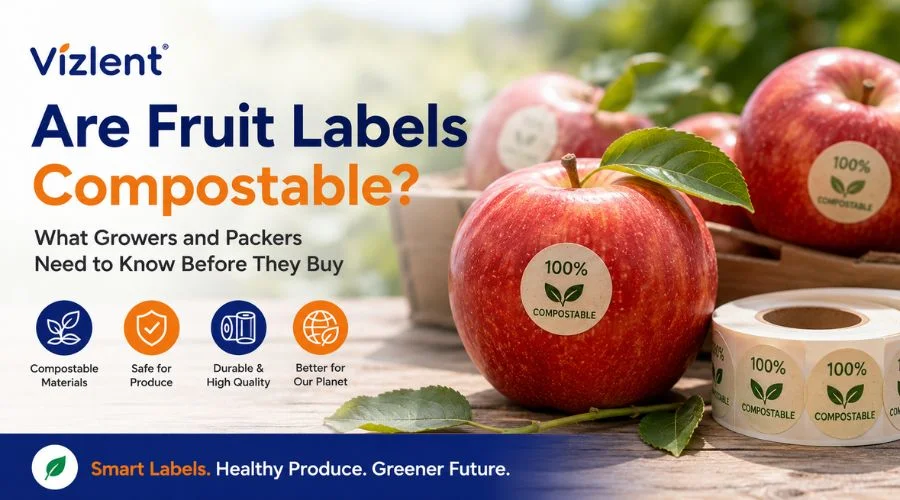
The answer is NO. Most fruit labels are not compostable since standard sticker uses a plastic or coated paper face with a synthetic adhesive that does not break down. Only a small number of capable label manufacturers like Vizlent Label Materials Co., Ltd., produce compostable fruit labels built from plant-based face stock and water-based adhesive that meet recognized composting standards. So the honest answer to are fruit labels compostable is: it depends entirely on the material the label is made from, not on the fact that it sits on fruit.
The difference matters more than it sounds. A conventional sticker that ends up in a home or municipal compost bin contaminates the finished compost with microplastic fragments that never fully disappear. This guide explains what makes a label compostable, which claims to trust, and how growers and packers can source the right stock in bulk without guessing.
| Need produce labels that actually break down in compost instead of contaminating it? See Vizlent’s biodegradable and compostable fruit label range. |
What Makes a Fruit Label Compostable in the First Place
A compostable fruit label has to break down completely under composting conditions, leaving no plastic residue behind. Every layer has to qualify, which means the face stock, the adhesive, and the release liner all need to be made from materials that microbes can digest. If even one layer is conventional plastic, the whole label fails the standard, no matter what the marketing says.
This is why so few suppliers can honestly sell compostable produce stickers or compostable fruit stickers at scale. Most printers buy ready-made plastic facestock and standard acrylic adhesive, then apply it to fruit without changing the underlying material. Producing a genuinely compostable construction means reformulating the adhesive and sourcing plant-based film or paper, which only a capable adhesive label manufacturer is set up to do.
The three layers that decide compostability
- Face stock: plant-based polylactic acid (PLA) film, kraft paper, or wet-strength uncoated paper that degrades cleanly.
- Adhesive: a water-based acrylic or natural rubber system, since solvent hot-melts block composting certification.
- Release liner: glassine or a compostable PLA liner that still die-cuts accurately on converting lines.
Are Fruit Stickers Biodegradable, Compostable, or Just Greenwashed?

People often ask are fruit stickers biodegradable, and the words biodegradable and compostable get used as if they mean the same thing. They do not. Biodegradable only means a material will break down eventually, with no promise on timeframe or end residue, while compostable means it breaks down within a set period into safe, non-toxic matter under defined conditions.
That gap is where greenwashing hides. A label marked biodegradable might still take decades and leave microplastic behind, which is why the question are fruit stickers compostable deserves a stricter answer than a vague eco claim. Look for a named certification standard rather than a soft adjective, because the standard is what holds the manufacturer accountable.
Biodegradable vs compostable at a glance
| Term | What it promises | What to verify |
|---|---|---|
| Biodegradable | Breaks down eventually | No fixed time or residue limit |
| Compostable | Breaks down fully and safely | Certified to a named standard |
| Home compostable | Degrades in a backyard bin | Lower-temperature certification |
| Industrial compostable | Degrades in a commercial facility | EN 13432 or ASTM D6400 proof |
The Certifications That Separate Real Compostable Labels From Claims
Certification is the line between a trustworthy compostable food labels supplier and a hopeful marketing claim. Two standards do most of the work globally: EN 13432 in Europe and ASTM D6400 in North America, both of which verify that a material disintegrates and biodegrades within a controlled composting window. A serious manufacturer will name the exact standard its construction meets and provide the documentation on request.
On the food-safety side, growers also ask about the regulatory status of anything that touches produce. For compostable fruit labels fda guidance treats the label as a food-contact material, so the face stock and adhesive should use components that are recognized as safe for direct food contact. Pairing a composting certification with food-contact-appropriate materials is what makes a label safe on the fruit and safe in the bin.
Standards worth asking for by name
- EN 13432: European standard for industrial compostability of packaging.
- ASTM D6400: North American standard for compostable plastics and constructions.
- Food-contact compliance: materials suited to direct contact with produce under FDA-recognized guidance.
- FSC-certified fiber: paper face stock from responsibly sourced renewable fibers.
| Want labels backed by EN 13432 or ASTM D6400 documentation, not vague eco wording? Ask a Vizlent engineer about certified compostable food labels |
Why Most Suppliers Cannot Deliver True Compostable Produce Stickers

The honest reason genuine compostable produce stickers are rare comes down to manufacturing depth. Making them requires in-house control over adhesive formulation and facestock sourcing, not just a printing press that takes whatever roll arrives. A trading company or a print-only shop usually cannot change the material, so it sells the same plastic stock to everyone and calls it eco-friendly.
Vizlent Label Materials Co., Ltd. sits in the small group that can actually build the construction from the ground up. As a direct manufacturer running its own coating, siliconizing, and slitting lines since 2011, it formulates the water-based adhesive and pairs it with plant-based biodegradable label stock rather than buying a finished plastic roll. That vertical control is exactly why a capable manufacturer can certify the result while a reseller cannot.
What to ask before you trust a compostable claim
- Does the supplier coat its own adhesive, or buy finished plastic stock?
- Can it name the composting standard and share the test report?
- Will it send free samples so you can test degradation and adhesion yourself?
- Has it run compostable constructions before, or is this a one-off trial?
Sourcing Compostable Fruit Labels in Bulk Without Overpaying
For a packing operation, a compostable fruit labels bulk order has to balance certification, runnability, and price across millions of units. The good news is that buying direct from the manufacturer removes the reseller markup that inflates many eco-label quotes. A compostable fruit labels bulk program priced at the factory gate keeps the sustainable choice from becoming a punishing cost line.
Building a compostable fruit labels business case is easier when the numbers are transparent. The full landed cost includes the material, die-cutting, and freight, and a direct producer will break each line out rather than hide it inside one figure. Brands comparing options often find that compostable fruit labels cost less than expected once the middleman is removed from the chain.
Cost lines to model for a bulk program
| Cost line | What drives it | How to control it |
|---|---|---|
| Facestock | PLA film vs paper grade | Match grade to the application, not the maximum |
| Adhesive | Water-based formulation | Buy from a coater, not a reseller |
| Die-cutting | Label size and shape | Standardize sizes across SKUs |
| Freight | Order volume and route | Consolidate compostable fruit labels bulk order shipping |
Who Is Actually Buying Compostable Fruit Labels Right Now

Demand for compostable fruit and produce labels is no longer limited to a few organic specialists. Grocery chains with sustainability targets, organic growers, farmers market vendors, and education programs are all moving away from plastic stickers. Schools in particular have driven interest, since compostable fruit labels for schools fit cafeteria composting and waste-reduction programs that plastic stickers quietly sabotage.
The buying channels have widened too, which makes adoption easier than it was a few years ago. Smaller buyers can order compostable fruit labels by mail in modest quantities, while packers source compostable fruit labels for sale in container loads direct from the factory. That spread of options means a backyard grower and a national distributor can both find a format that fits.
Common buyers and what they need
- Organic growers: certified compostable face stock that supports their organic positioning.
- Grocery chains: high-volume, consistent stock that runs on existing applicators.
- Schools and institutions: compostable fruit labels for schools that match cafeteria composting.
- Small vendors: compostable fruit labels by mail in quantities that suit a stall or farm shop.
How to Choose the Best Compostable Fruit Label for Your Operation
Choosing the compostable fruit labels best suited to your operation starts with your composting reality, not the label alone. If your produce flows into industrial composting, an EN 13432 or ASTM D6400 construction is the fit, while home-compostable claims matter more for direct-to-consumer brands. Matching the certification to the actual end-of-life path prevents paying for a feature your waste stream never uses.
After certification, weigh runnability and print quality against your line and your brand. The label still has to feed cleanly through your applicator and hold ink sharply enough to carry a PLU code and logo. A capable manufacturer will send samples so you can confirm that compostable fruit labels biodegradable claims hold up on your own equipment before you commit to volume.
A short decision checklist
- Confirm the composting path: industrial, home, or both.
- Match the certification standard to that path.
- Test runnability and PLU print clarity on your applicator.
- Verify food-contact suitability for direct fruit application.
- Lock pricing direct from the manufacturer to protect margin.
| Comparing compostable fruit labels for sale and want to test before you scale? Request free compostable label samples from Vizlent Label Materials Co., Ltd. |
Source Compostable Fruit Labels From a Manufacturer That Can Prove It
The question of are fruit labels compostable has a clear answer once you look past the marketing: only labels built from certified compostable materials qualify, and only a capable manufacturer can deliver them at scale. Vizlent Label Materials Co., Ltd., produces compostable and biodegradable label constructions from plant-based face stock and water-based adhesive, certified to EN 13432 or ASTM D6400, on its own coating lines in China and Hongkong since 2011. As an ISO 9001, FSC, and SGS-certified producer supplying 50+ countries, it backs every claim with documentation and free samples.
| Ready to switch from plastic stickers to compostable fruit labels you can actually certify?Send your inquiry to Vizlent’s compostable labeling team |
Frequently Asked Questions
Are fruit labels compostable?
Most fruit labels are not compostable, since the standard sticker uses plastic film and synthetic adhesive that do not break down. Only a few capable manufacturers, including Vizlent, make genuinely compostable fruit labels from plant-based face stock and water-based adhesive certified to a recognized composting standard. Always check the material and certification rather than assuming the label degrades.
Are fruit stickers biodegradable or compostable?
The two terms differ. Biodegradable only means a material breaks down eventually, with no promise on time or residue. Compostable means it breaks down fully and safely within a defined period under composting conditions. When you ask are fruit stickers biodegradable, push for a named certification, because compostable to EN 13432 or ASTM D6400 is the stronger, verifiable claim.
What are compostable produce stickers made from?
Compostable produce stickers use a plant-based face stock such as PLA film, kraft, or wet-strength paper, paired with a water-based acrylic or natural rubber adhesive. The release liner is glassine or a compostable PLA liner. Every layer must qualify, which is why a solvent-based adhesive or plastic film disqualifies the whole construction from composting certification.
Do compostable fruit labels meet FDA food-contact rules?
For compostable fruit labels fda guidance treats the sticker as a food-contact material, and the question of fruit labels compostable fda status comes up often with growers. The face stock and adhesive should use components recognized as safe for direct contact with produce. A capable manufacturer pairs a composting certification with food-contact-appropriate materials, so the label is safe on the fruit and safe in the compost bin at end of life.
How much do compostable fruit labels cost in bulk?
Compostable fruit labels cost more than plain plastic stickers, but the gap narrows sharply when you buy direct from the manufacturer instead of a reseller. A compostable fruit labels bulk order priced at the factory gate removes the middleman markup. Model facestock, die-cutting, and freight separately, and standardize label sizes across SKUs to control the total.
Can I order compostable fruit labels by mail in small quantities?
Yes. Smaller growers and vendors can order compostable fruit labels by mail in modest runs, while packers buy compostable fruit labels for sale in container loads. The same certified construction is available across both, so a farm stall and a national distributor can each pick a quantity and format that fits their operation.
Are compostable fruit labels suitable for schools?
They are a strong fit. Compostable fruit labels for schools work with cafeteria composting and waste-reduction programs that conventional plastic stickers undermine. Because the label breaks down with the fruit waste, it does not contaminate the finished compost, which supports the sustainability goals many education programs are now measured against.
How do I choose the best compostable fruit label?
Start with your composting path, then match the certification to it: industrial composting needs EN 13432 or ASTM D6400, while direct-to-consumer brands may want home-compostable proof. Test runnability and PLU print clarity on your applicator, confirm food-contact suitability, and buy direct to protect margin. Samples let you verify the compostable fruit labels best for your line before scaling.






