
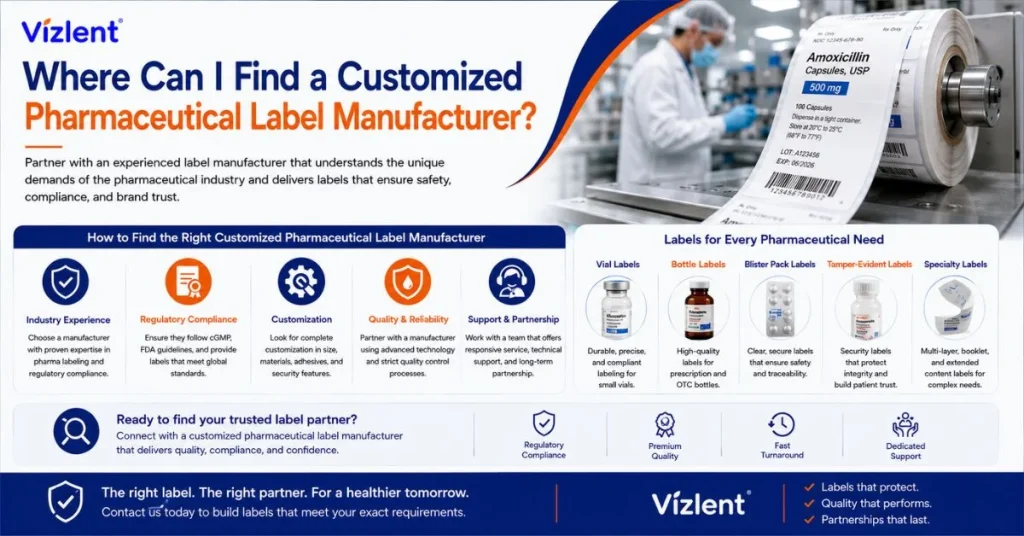
You can find a customized pharmaceutical label manufacturer through direct factory suppliers like Vizlent Label Materials Co., Ltd., industry directories, trade associations, and global sourcing platforms, with many established producers based in China supplying chemical-resistant, serialization-ready label stock worldwide. A customized pharmaceutical label manufacturer engineers facestocks, adhesives, and print constructions to survive sterilization, cold-chain storage, and chemical exposure while meeting strict regulatory marking rules. The right source depends on your container type, sterilization method, compliance obligations, and the volume and customization you need.
Pharmaceutical buyers search for the right partner because a label failure on a vial or blister pack is a patient-safety event, not just a cosmetic flaw. Sourcing well means weighing certifications, material engineering depth, serialization support, and supply consistency rather than price alone. The sections below map where to look, what credentials to demand, why China-based manufacturers feature prominently, and how to evaluate a partner before committing.
Need a custom pharmaceutical label construction validated for your container, sterilization method, and serialization requirements? Talk to the Vizlent engineering team. Request a Quick Quote
Where Can I Find a Customized Pharmaceutical Label Manufacturer: Your Sourcing Channels
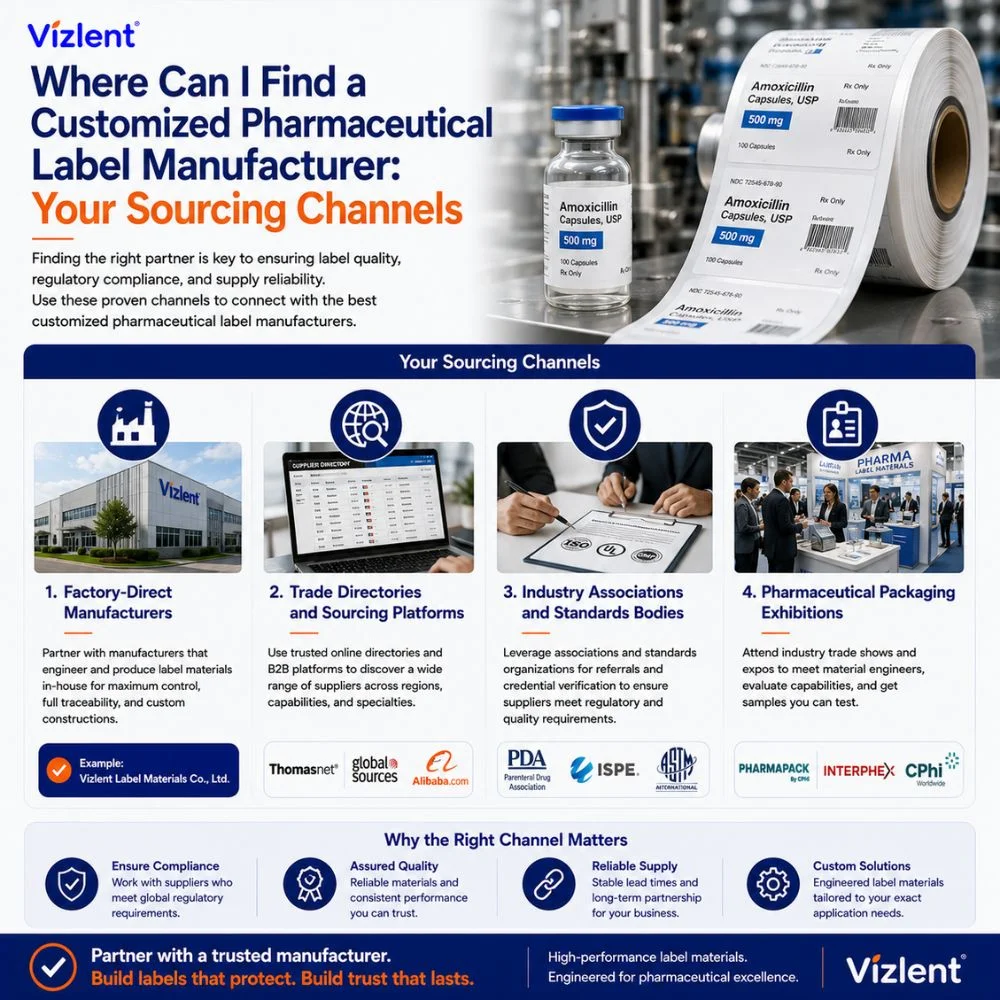
The most direct route is a factory-direct manufacturer that engineers label materials in-house rather than reselling another producer’s stock. Direct suppliers can adjust facestock, adhesive chemistry, and topcoat to your exact vial, syringe, or blister application, which a trading company cannot. For regulated products, sourcing from the actual maker gives you the technical data sheets and change-control transparency that audits require.
Beyond direct factories, buyers locate partners through trade directories, sourcing platforms, industry referrals, and exhibitions focused on pharmaceutical packaging. Each channel surfaces a different slice of the market, from large contract converters to specialized material engineers. Knowing where to find a customized pharmaceutical label manufacturer begins with deciding which you need: a material innovator, a high-volume converter, or both in one supplier.
- Factory-direct manufacturers: In-house material engineering, full traceability, and custom constructions like Vizlent Label Materials Co., Ltd.
- Trade directories and sourcing platforms: Broad supplier discovery across regions and capabilities.
- Industry associations and standards bodies: Referrals and credential verification for vetted suppliers.
- Pharmaceutical packaging exhibitions: Direct contact with material engineers and samples in hand.
Using a Customized Pharmaceutical Label Manufacturers List Effectively
A customized pharmaceutical label manufacturers list compiled from directories or trade shows is a useful starting point, but it is only a shortlist, not a decision. The value of any list depends on filtering it against the credentials and capabilities your specific product demands. A long list of names means little until each entry is checked for the certifications and material engineering your application requires.
Treat a customized pharmaceutical label manufacturers list as the first screen, then narrow it by sterilization validation data, serialization support, and quality-system documentation. The strongest candidates can supply technical data sheets, change-control commitments, and sample material for your own testing. Working a list this way turns a directory of suppliers into a genuine evaluation rather than a guess based on marketing copy.
Skip the directory guesswork. Vizlent engineers pharmaceutical label materials in-house and supplies full technical data sheets for your own validation testing. Explore Pharmaceutical Label Materials
Why China-Based Manufacturers Lead in Customized Pharmaceutical Labels
China has become a central source for customized pharmaceutical label materials because its manufacturers combine deep material engineering with large-scale, cost-efficient production. Established factories operate dedicated R&D teams that formulate cryogenic adhesives, sterilization-stable facestocks, and serialization-ready surfaces for export markets. This pairing of technical depth and volume capacity is why many global buyers route pharmaceutical label sourcing through China.
Vizlent Label Materials, for example, manufactures from a Shenzhen facility and supplies label converters, brand owners, and procurement teams across North America, Europe, and Southeast Asia. A China-based manufacturer of this kind can adjust adhesive coat weight, facestock thickness, and topcoat chemistry to a buyer’s exact specification rather than offering only fixed catalog products. The result is custom material engineering delivered at a scale and price that many regional converters cannot match.
What China-Based Engineering Capacity Means for Buyers
Direct access to a manufacturer’s R&D engineers lets a pharmaceutical buyer solve adhesion and sterilization problems at the source. A factory in China that controls its own coating and lamination lines can switch adhesive systems, modify a topcoat, or trial a new facestock without routing the request through a middleman. That control shortens development cycles and gives buyers documentation traceable to the actual production batch.
Scale also brings consistency, since a large manufacturer runs the same validated construction across repeat orders for years. Quality assurance through incoming, in-process, and outgoing checks, paired with batch technical data sheets, supports the audit trail regulated buyers need. Choosing a capable China-based manufacturer means gaining both custom engineering and the supply stability that pharmaceutical programs depend on.
- In-house R&D to formulate cryogenic, sterilization-stable, and serialization-ready constructions.
- Control of coating and lamination lines for true customization, not catalog-only options.
- Batch technical data sheets and quality checks supporting regulated audit trails.
- Scale that delivers consistent material across repeat orders at competitive cost.
Credentials, Associations, and Standards to Demand From Any Manufacturer
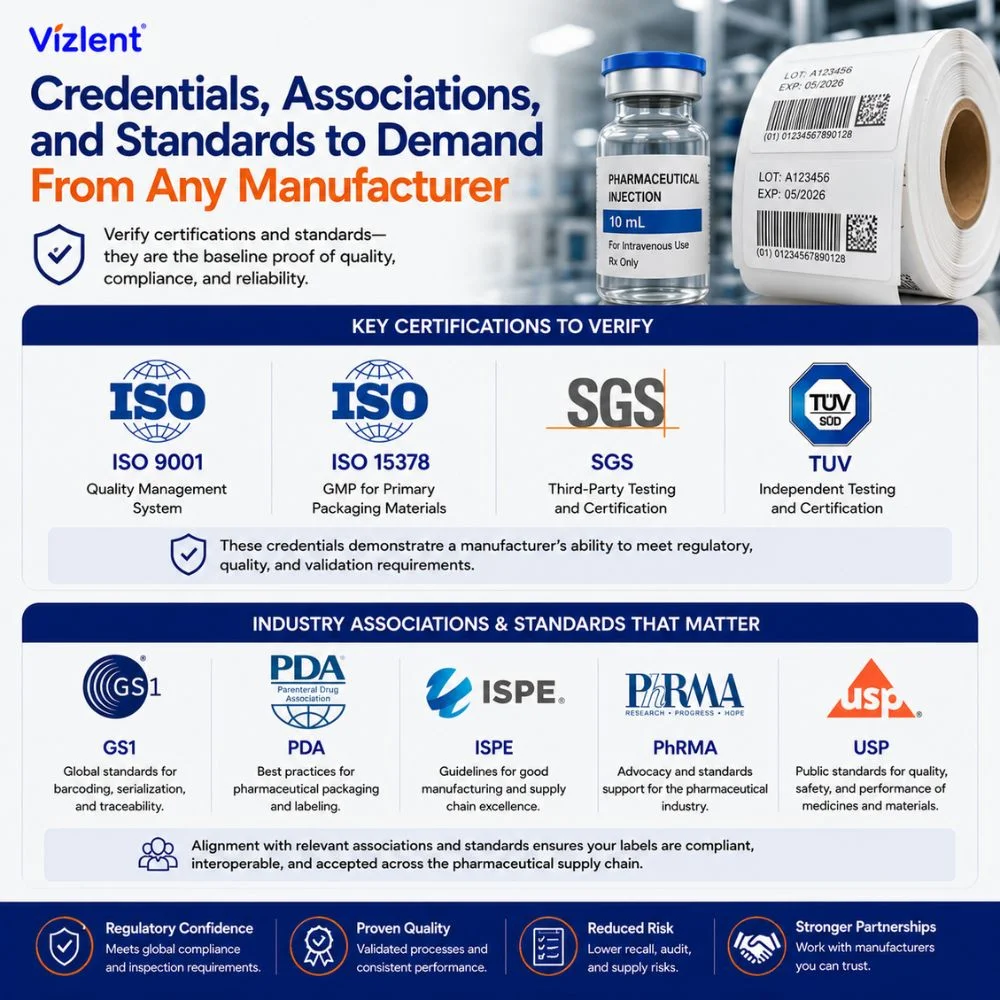
Before committing to any supplier, verify the certifications and standards that govern pharmaceutical labeling rather than relying on marketing claims. Recognized marks such as ISO 9001 quality management, ISO 15378 for primary packaging GMP, and third-party laboratory certifications from bodies like SGS and TUV signal a serious manufacturer. These credentials are the baseline evidence that a producer can meet the validation burden a regulated product carries.
Industry associations and standards organizations also shape how pharmaceutical labels must perform and serialize. A customized pharmaceutical label manufacturer association, in practice, refers to the bodies and standards groups, from GS1 for barcoding to packaging and pharmaceutical associations, whose rules a supplier must follow. Confirming a supplier’s alignment with the relevant customized pharmaceutical label manufacturers association standards is part of responsible vetting, even where no single named membership organization applies.
Reading Association and Standards Signals Correctly
Membership claims and association references should be checked against actual standards compliance, not taken at face value. The meaningful question is simple: do a supplier’s materials meet GS1 serialization quality, ISO sterile-barrier rules, and GMP primary-packaging expectations, regardless of which logos appear on a website. A customized pharmaceutical label manufacturer association reference matters only when it maps to verifiable standards your product must satisfy.
For private-label and contract programs, the same verification discipline applies with even more weight. A customized pharmaceutical label manufacturer private arrangement, where a producer makes label stock under a buyer’s brand or specification, still requires the full certification and change-control trail. Treating private-label sourcing as exempt from standards scrutiny is a common and costly mistake in regulated supply chains.
| Credential / Standard | What It Covers | Why It Matters |
|---|---|---|
| ISO 9001 | Quality management system | Baseline process consistency and traceability |
| ISO 15378 | GMP for primary packaging | Pharma-specific manufacturing discipline |
| GS1 standards | 2D DataMatrix serialization | DSCSA and EU FMD barcode compliance |
| SGS / TUV testing | Third-party lab verification | Independent proof of material performance |
Vetting a pharmaceutical label partner? Ask for certifications, batch data sheets, and serialization support. Vizlent provides all three and engineers to your spec. Ask a Vizlent Engineer
Red Flags to Avoid When Choosing a Pharmaceutical Label Manufacturer
Some warning signs separate a genuine material engineer from a reseller that cannot support a regulated program. A supplier that cannot produce batch-level technical data sheets, or that resists sharing sterilization and cold-chain validation data, should raise immediate concern. In pharmaceutical labeling, missing documentation is not a paperwork gap but a compliance liability waiting to surface during an audit.
Another red flag is a vendor that offers only fixed catalog products yet markets itself as a custom manufacturer. True customization requires control of coating and lamination lines, not relabeling of someone else’s stock. Probing a supplier on its actual production capability quickly reveals if it can engineer to your specification or merely resell.
Documentation and Traceability Gaps
A manufacturer that hesitates to provide a change-control commitment is signaling future risk to your filings. Undisclosed reformulations of facestock or adhesive can alter label performance and trigger regulatory obligations without warning. A supplier unwilling to commit in writing to advance notice of material changes is one to avoid for any regulated product.
Traceability gaps compound the problem, since a label issue cannot be investigated without batch records tying material to production. Reputable manufacturers run incoming, in-process, and outgoing quality checks and document each batch. The absence of that trail makes root-cause analysis impossible and leaves the brand owner exposed.
Capability and Communication Warning Signs
Slow or vague technical responses often indicate a lack of in-house engineering depth. A capable manufacturer answers adhesion, sterilization, and serialization questions with specifics and supporting data rather than generic reassurance. When technical questions are deflected or routed through non-specialist sales staff, the supplier likely lacks the R&D to solve hard problems.
Reluctance to provide samples for independent testing is a final warning sign worth heeding. A confident manufacturer welcomes the buyer validating material on the actual container and conditions. A partner that discourages or delays sample testing is rarely one to trust with a patient-safety-critical label.
A disciplined evaluation tests a supplier against your actual product conditions, not a generic capability pitch. Request sample material and run your own validation for sterilization survival, cold-chain adhesion, chemical resistance, and serialization barcode grade on the real container. A manufacturer confident in its construction will welcome this testing and supply the data sheets that support it.
Equally important is the supplier’s transparency around material changes, since an undisclosed reformulation can trigger a regulatory change-control event. A strong partner commits in writing to advance notice of any change to facestock, adhesive, or topcoat. Building that requirement into a supply agreement protects your filings and your patients across the life of the program.
- Request samples and validate sterilization, cold-chain, chemical, and barcode performance yourself.
- Demand batch-level technical data sheets and full quality-system documentation.
- Secure written change-control commitments covering any material reformulation.
- Confirm serialization support for compliant DataMatrix print at unit-of-use symbol sizes.
Private-Label and Contract Manufacturing Considerations
Private-label sourcing lets brand owners and converters sell pharmaceutical label stock under their own specification while a factory handles production. A customized pharmaceutical label manufacturer private arrangement works well when the producer offers genuine material engineering and transparent quality systems. The buyer gains brand control and custom constructions without operating a coating and lamination plant themselves.
The tradeoff is that the brand owner inherits responsibility for the material’s regulatory performance, making supplier selection critical. A private-label partner must supply the same certifications, batch data, and change-control discipline as a directly branded manufacturer. Choosing a producer with in-house R&D and audit-ready documentation is what makes a private-label program defensible rather than risky.
Matching the Manufacturer to Your Application
The final step is aligning the supplier’s strengths with your specific labeling challenge, from cryovials to serialized cartons. A manufacturer strong in cold-chain adhesives suits a biologics program, while one with serialization expertise suits high-volume prescription packaging. Profiling your application first ensures the partner you choose actually solves your hardest labeling problem.
Vizlent’s engineering team helps pharmaceutical buyers specify constructions matched to container, sterilization method, storage temperature, and serialization needs. Aligning the manufacturer’s capability with your real application is the difference between a label that merely prints and one that protects the patient. This alignment is the true answer to where can I find a customized pharmaceutical label manufacturer that fits your program.
Ready to source a pharmaceutical label partner that engineers to your exact application? Get a fast, engineer-reviewed quote from Vizlent today. Get Your Quick Quote Now
Source a Pharmaceutical Label Partner That Engineers to Your Spec
Sourcing pharmaceutical labels is a patient-safety decision, and the right manufacturer engineers materials to survive your exact sterilization, storage, and serialization conditions. Vizlent manufactures chemical-resistant, cold-chain, and serialization-ready pharmaceutical label materials from its Shenzhen facility, supplying converters, brand owners, and procurement teams worldwide. Our engineering team matches the facestock, adhesive, and topcoat to your container and lifecycle rather than offering a fixed catalog product.
From cryovials and syringes to serialized cartons, the right material and documentation protect both your compliance record and the patients who depend on it. Send your container type, sterilization method, storage range, and serialization needs, and we will recommend a validated construction built to perform from application through end of use.
Ready to work with a customized pharmaceutical label manufacturer that supplies full data sheets and engineers to your application? Get your quote from Vizlent today. Get Your Quick Quote Now
Frequently Asked Questions About Sourcing Pharmaceutical Label Manufacturers
Where can I find a customized pharmaceutical label manufacturer?
You can find one through factory-direct suppliers, trade directories, industry associations, and pharmaceutical packaging exhibitions, with many capable producers based in China. Factory-direct manufacturers offer the deepest customization and full traceability for regulated products. Start by deciding which you need: a material innovator, a high-volume converter, or a single supplier that provides both.
Why are so many pharmaceutical label manufacturers based in China?
China-based manufacturers combine in-house material engineering with large-scale, cost-efficient production that suits export markets. Established factories run dedicated R&D teams that formulate cryogenic adhesives, sterilization-stable facestocks, and serialization-ready surfaces. This blend of technical depth and volume capacity is why many global pharmaceutical buyers source label materials from China.
How do I use a customized pharmaceutical label manufacturers list?
Treat a customized pharmaceutical label manufacturers list as a starting shortlist, not a final decision. Filter each entry against the certifications, sterilization validation, and serialization support your product requires. The strongest candidates supply technical data sheets and sample material for your own testing, which turns a directory into a real evaluation.
What certifications should a pharmaceutical label manufacturer hold?
Look for ISO 9001 quality management, ISO 15378 GMP for primary packaging, and third-party lab certifications from bodies such as SGS and TUV. GS1 alignment is essential for compliant DataMatrix serialization under DSCSA and EU FMD. These credentials are the baseline evidence that a producer can meet the validation burden of a regulated product.
What does a customized pharmaceutical label manufacturer association refer to?
In practice, a customized pharmaceutical label manufacturer association refers to the standards bodies and industry groups whose rules a supplier must follow, such as GS1 and packaging or pharmaceutical associations. The meaningful test is simple: do a supplier’s materials meet those standards, not which logos appear on a website. Verify alignment with the specific standards your product must satisfy.
Can I source pharmaceutical labels on a private-label basis?
Yes, a customized pharmaceutical label manufacturer private arrangement lets you sell label stock under your own brand or specification while a factory produces it. The brand owner still inherits responsibility for the material’s regulatory performance, so the partner must supply full certifications and change-control discipline. Choose a producer with in-house R&D and audit-ready documentation to keep the program defensible.
How do I evaluate a pharmaceutical label manufacturer before ordering?
Request sample material and validate sterilization survival, cold-chain adhesion, chemical resistance, and barcode grade on your actual container. Demand batch-level technical data sheets and written commitments to advance notice of any material change. A manufacturer confident in its construction will welcome this testing and provide the supporting documentation.
What label materials do pharmaceutical applications require?
Pharmaceutical applications need synthetic facestocks such as polyester or polyolefin with adhesives matched to the surface, temperature, and chemicals involved. Cryovials need adhesives flexible to -196°C, sterilized devices need facestocks stable through autoclave or gamma cycles, and serialized units need surfaces that print compliant DataMatrix codes. Matching material to the full lifecycle is what prevents a label failure becoming a patient-safety event.






