
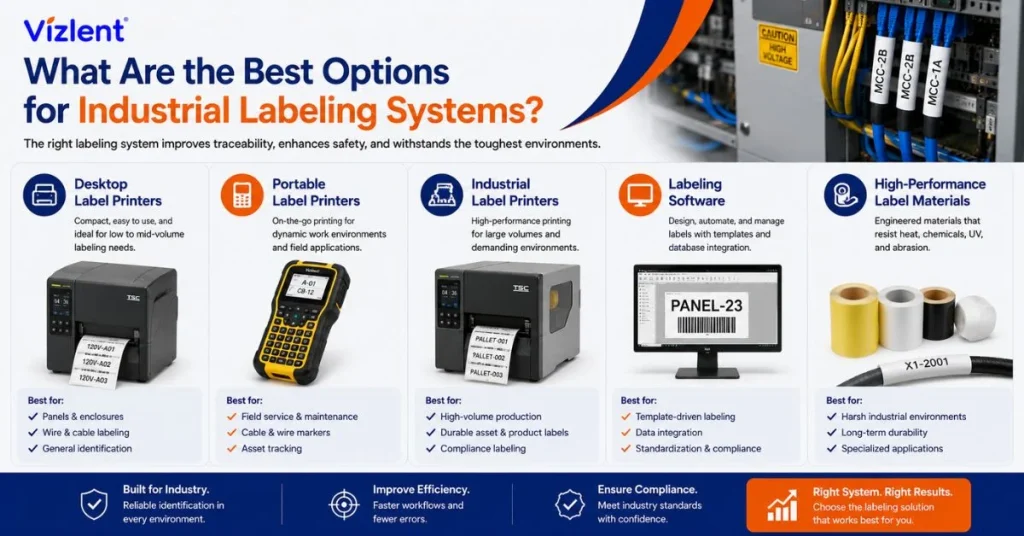
The best options for industrial labeling systems pair a durable print engine, such as a thermal transfer or laser-marking unit, with synthetic label media and software that drives consistent, compliant identifiers across the plant. An industrial labeling system is the complete combination of hardware, label material, ink or ribbon, and naming software that produces marks able to survive heat, chemicals, and abrasion for years. The right choice depends on print volume, the surfaces and stressors involved, and the regulatory marks the labels must carry.
Manufacturers and plant engineers invest in these systems because a faded asset tag or an unreadable safety mark causes downtime, failed audits, and liability exposure. A complete system balances three layers: the marking hardware, the durable media that holds the print, and the documentation that keeps naming consistent. The sections below compare the marking technologies, the media that determines durability, the standards that govern the work, and how to match a system to your production reality.
Need durable, compliant label media that runs cleanly on your plant printers? Talk to the Vizlent engineering team about heat-resistant, chemical-resistant, and flame-retardant materials built for industrial identification. Request a Quick Quote
What Are the Best Options for Industrial Labeling Systems: Marking Technologies Compared
The marking technology at the heart of any system is the first decision, and thermal transfer printing leads to durable, variable-data labels. A thermal transfer printer melts resin or wax-resin ink onto synthetic media, producing barcodes and text that resist the heat, solvents, and handling of a plant floor. For most asset tags, rating plates, and safety labels, this is the workhorse industrial labeling machine that balances durability with flexibility.
Other technologies fill specific roles where thermal transfer is not ideal. Laser marking and laser-etched plates suit permanent metal identification, inkjet and print-and-apply units handle high-speed packaging lines, and dot-peen systems mark directly onto hard parts. Choosing among these means asking what surface, volume, and permanence each application demands before settling on a single industrial labeling machine.
- Thermal transfer printers: Durable resin or wax-resin print on synthetic media for tags and safety labels.
- Laser marking and laser-etched plates: Permanent identification on metal and high-durability surfaces.
- Print-and-apply and inkjet units: High-speed labeling on packaging and carton lines.
- Direct part marking (dot-peen, laser): Permanent codes on hard components without a label at all.
Industrial Labeling Machine Versus Industrial Marking Systems
The terms industrial labeling machine and industrial marking systems overlap, but the distinction guides procurement. A labeling machine applies a printed adhesive label to a surface, while industrial marking systems can also mark a part directly through laser, etch, or peen without any label media. Plants that track removable assets lean on labels, while those identifying permanent components often add direct marking.
Most mature operations run a blend, since no single method covers every surface and lifecycle. Industrial marking systems for permanent metal parts sit alongside thermal transfer printers producing removable asset and safety labels. Understanding that an industrial labeling machine is one tool within a broader marking strategy prevents buying hardware that cannot address every identification need on the floor.
| Technology | Best Surface | Permanence | Typical Use |
|---|---|---|---|
| Thermal transfer printer | Synthetic label media | Years with resin ribbon | Asset tags, safety, rating labels |
| Laser marking / etch | Metal, coated plates | Permanent | Nameplates, serial plates |
| Print-and-apply | Cartons, packaging | Shipment life | High-speed logistics lines |
| Direct part marking | Hard metal parts | Permanent | Traceable components |
Label Media: The Layer That Decides Industrial Print Durability
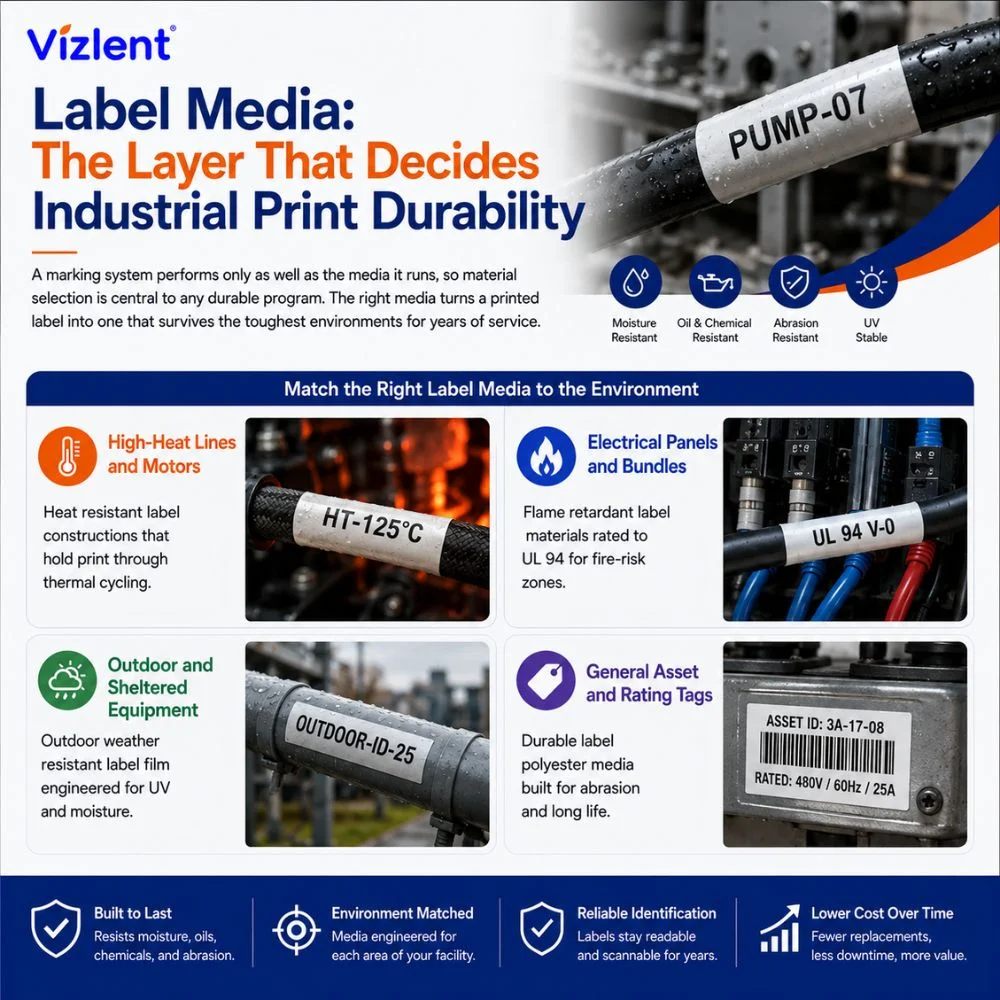
A marking system performs only as well as the media it runs, so material selection is central to any durable program. Synthetic facestocks such as polyester and polypropylene resist the moisture, oils, and abrasion that destroy paper labels in a plant. Matching the facestock and adhesive to the surface and environment is what turns a printed label into one that survives a decade of service.
Different zones of a facility stress labels in different ways, and the media has to match each one. High-heat lines near ovens or motors call for heat-resistant constructions, chemical wash-down areas need solvent-resistant facestocks, and outdoor equipment demands UV-stable film. Specifying media by environment rather than by catalog default is the practical core of a reliable manufacturing labeling system.
- High-heat lines and motors: Heat resistant label constructions that hold print through thermal cycling.
- Electrical panels and bundles: Flame retardant label materials rated to UL 94 for fire-risk zones.
- Outdoor and sheltered equipment: Outdoor weather resistant label film engineered for UV and moisture.
- General asset and rating tags: Durable label polyester media built for abrasion and long life.
Ribbon and Print System Pairing
The ribbon choice is as decisive as the facestock, because the print is only as durable as the ink bonded to it. Resin thermal transfer ribbons produce the most chemical- and abrasion-resistant marks, while wax ribbons suit short-life carton labels at lower cost. Pairing the wrong ribbon with a durable facestock wastes the material, since the print fades long before the label fails.
The ribbon choice deserves the same scrutiny as the facestock, because a durable label with a fading image still fails its job. Resin thermal transfer ribbon grades bond pigment that survives solvents and heat, while wax grades fit short-life logistics labels. Matching ribbon to facestock and to the environment is what locks legibility in for the service life of the equipment.
The printer is only half the system. Vizlent supplies the durable facestocks and matched ribbons that keep industrial identifiers legible for years. Explore Durable Label Media
Standards and Providers Behind Industrial Labeling Systems
Recognized standards give an industrial labeling program the consistency and legal defensibility that auditors expect. UL 969 governs marking and labeling systems on listed equipment, GHS and OSHA HazCom rules cover hazard communication, and ANSI and NEMA standards define safety and nameplate marking. Building a system around these standards turns ad-hoc labeling into documentation that withstands inspection.
On the supply side, the market includes equipment makers, label-media manufacturers, and integrators that combine them into turnkey lines. Providers in this space, from a regional industrial labelling systems ltd to a larger industrial labeling systems corporation, typically bundle printers, software, and consumables for a sector. Knowing which layer of that market a vendor occupies helps a buyer assemble the right combination rather than over-relying on one source.
How the Market Is Structured
The providers behind these systems fall into a few recognizable categories that shape how you buy. Equipment specialists focus on the marking hardware, a media manufacturer engineers the facestocks and ribbons, and a systems integrator stitches them together with software and service. An industrial labeling systems business may occupy one layer or span several, which affects pricing, customization, and support.
Recognizing these roles helps a procurement team avoid gaps and overlaps in a labeling program. A vendor positioned as an industrial labeling systems corporation may excel at integration yet rely on a separate media supplier for durable stock, while a focused industrial labelling systems ltd might specialize in one industry. Mapping each provider to its true role lets a buyer combine the strongest options from each layer rather than accepting a single bundled compromise.
| Provider Type | Core Focus | What They Supply |
|---|---|---|
| Equipment specialist | Marking hardware | Printers, laser and peen systems |
| Label-media manufacturer | Facestocks and ribbons | Durable synthetic media, matched ribbons |
| Systems integrator | Turnkey lines | Hardware, software, service bundles |
| Sector-focused provider | One industry | Tailored consumables and support |
Industries That Depend on Industrial Labeling Systems
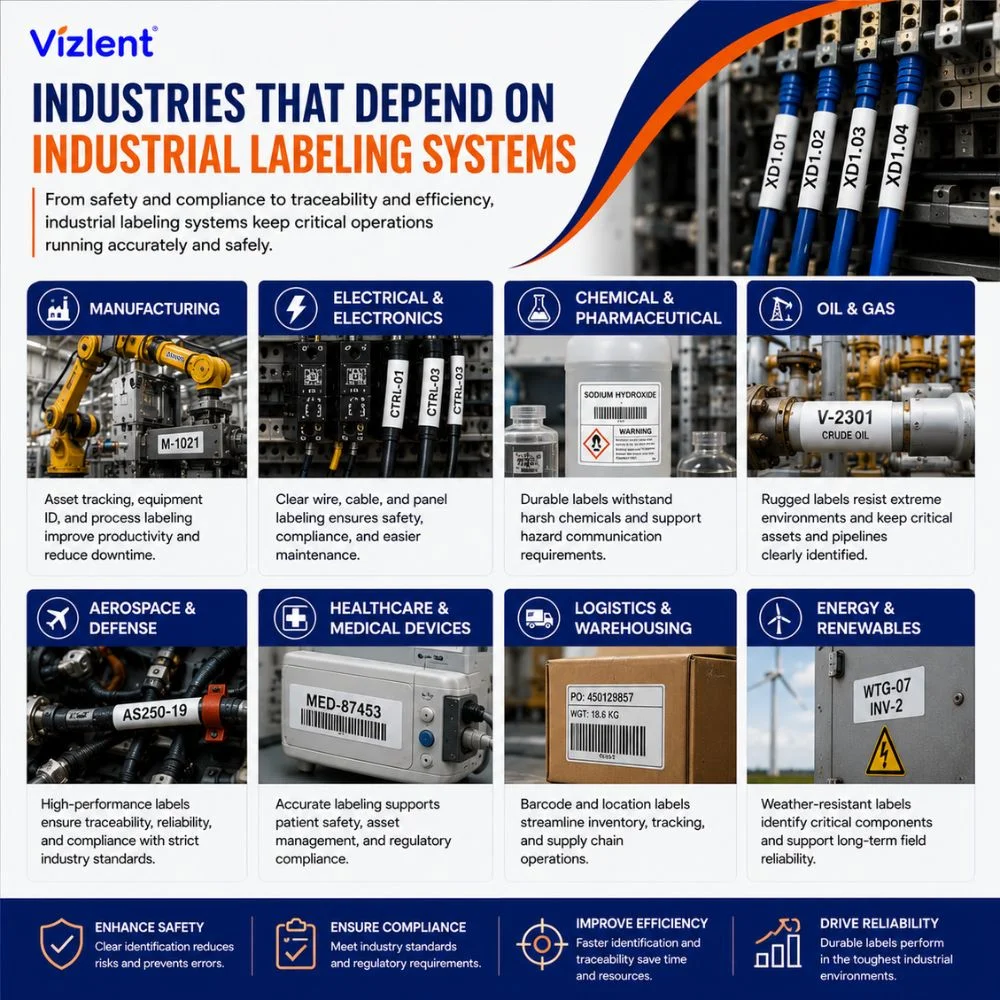
Industrial labeling systems serve sectors where a misread or missing identifier carries real safety and financial consequences. Automotive plants tag components for traceability through assembly, while appliance makers apply rating and energy labels that must stay legible for the product lifetime. Each sector imposes its own mix of heat, chemical, and abrasion stress that the system must withstand.
Heavy industry and utilities push the demands further, with pipe markers, panel labels, and asset tags exposed to outdoor weather and aggressive cleaning. Pharmaceutical and food plants add wash-down chemicals and strict compliance marking to the picture. Matching industrial labeling systems to these sector-specific stressors is what keeps identification reliable across very different operating conditions.
Heavy Manufacturing and Utilities
Foundries, machine shops, and power facilities expose labels to radiant heat, oil, vibration, and constant handling over long service lives. Asset tags and safety labels in these settings need synthetic facestocks and resin print to remain scannable through years of abuse. A label that fades on a critical motor or panel turns a quick maintenance check into a slow, error-prone trace.
Outdoor utility equipment adds UV and moisture as further failure modes that ordinary stock cannot survive. UV-stable film with a hardened topcoat keeps pipe markers and enclosure labels readable in full sun and rain. Specifying these durable constructions up front avoids the recurring cost of relabeling equipment in the field.
Regulated and Wash-Down Environments
Pharmaceutical, medical-device, and food-processing plants combine strict compliance marking with daily exposure to harsh cleaning agents. Labels here must carry mandatory content while resisting bleach, alcohol, and degreasers used in routine sanitation. A facestock and ink system validated against the actual cleaners is the only way to guarantee both legibility and compliance.
These environments also demand consistency, since every container and machine must read the same way across audits. Software-driven naming and a standardized media set keep the identification uniform and traceable. Building manufacturing labeling systems to this discipline protects both product safety and the facility’s audit record.
Selecting the best options for industrial labeling systems starts with profiling the real demands of each labeling task, not a generic spec. The decisive variables are print volume, the surface and its energy, the temperature and chemical exposure, and the regulatory marks required. Measuring these at the actual label location prevents both over-buying hardware and under-specifying media that fails early.
From that profile, a buyer matches the marking technology, the media, and the software into one coherent manufacturing labeling system. A high-volume packaging line may justify print-and-apply automation, while a maintenance shop needs a flexible thermal transfer printer and durable stock. Letting the application drive the system, rather than a vendor bundle, produces identification that performs where it matters.
- Profile each task: volume, surface, temperature, chemicals, and required compliance marks.
- Match marking technology to permanence: labels for removable assets, direct marking for permanent parts.
- Specify media by environment: heat, chemical, UV, and abrasion, not by catalog default.
- Drive naming from software so identifiers stay consistent and auditable across the plant.
- Validate durability with print and adhesion testing on the actual surface before rollout.
Matching the System to Your Plant Reality
The strongest system on paper still fails if it ignores the conditions of your specific facility. A wash-down food plant, a foundry, and an outdoor utility yard each impose different heat, chemical, and UV stress on the same printed label. Profiling those conditions and testing media against them is what separates a durable rollout from a recurring relabeling cost.
Standardizing on a proven media set and ribbon pairing across the plant keeps quality consistent and training simple. Vizlent’s engineering team helps manufacturers specify heat-resistant, chemical-resistant, flame-retardant, and UV-stable materials that run cleanly on their chosen printers. Aligning both the marking hardware and the media to your real environment is the final step in building durable industrial labeling systems.
Specifying media for a new line or standardizing across plants? Get factory-direct, printer-matched label materials with traceable quality from Vizlent. Ask a Vizlent Engineer
Specify Label Media That Performs Across Your Plant
An industrial labeling program is only as reliable as the media that survives years of heat, chemicals, and abrasion, and the wrong stock quietly turns a labeled plant into a relabeling expense. Vizlent manufactures heat-resistant, chemical-resistant, flame-retardant, and UV-stable label materials engineered to run cleanly on your marking hardware and stay legible for the life of the equipment. Our engineering team matches the substrate and ribbon to your surfaces, temperatures, and compliance needs rather than a generic catalog spec.
From new production lines to multi-plant standardization, the right media and ribbon pairing protects both your uptime and your audit record. Send your environment, printer model, and label format, and we will recommend a material built to perform from application through years of service.
Ready to standardize on durable, printer-matched label media for your operation? Get a fast, engineer-reviewed quote from Vizlent today. Get Your Quick Quote Now
Frequently Asked Questions About Industrial Labeling Systems
What are the best options for industrial labeling systems?
The best options pair a durable print engine, usually thermal transfer or laser marking, with synthetic label media and naming software. Thermal transfer printers cover most asset, safety, and rating labels, while laser systems handle permanent metal marking. The right combination depends on print volume, surface, environment, and the compliance marks the labels must carry.
What is the difference between an industrial labeling machine and industrial marking systems?
An industrial labeling machine applies a printed adhesive label to a surface, while industrial marking systems can also mark a part directly through laser, etch, or dot-peen without label media. Labels suit removable assets and surfaces that change, while direct marking suits permanent components. Most plants run a blend of both to cover every identification need.
What label media works best for industrial environments?
Synthetic facestocks such as polyester and polypropylene outperform paper against the heat, oils, and abrasion of a plant floor. High-heat lines need heat-resistant constructions, chemical wash-down areas need solvent-resistant facestocks, and outdoor equipment needs UV-stable film. Specifying media by environment rather than a catalog default is what delivers a decade of service.
What ribbon should an industrial thermal transfer printer use?
A resin thermal transfer ribbon produces the most chemical- and abrasion-resistant marks for durable industrial labels. Wax or wax-resin ribbons suit short-life carton and logistics labels at lower cost but fade under heat and solvents. Pairing the ribbon to the facestock and environment is essential, since print durability is only as good as the weakest layer.
What standards govern industrial labeling systems?
UL 969 governs marking and labeling systems on listed equipment, while GHS and OSHA HazCom cover hazard communication labels. ANSI safety standards and NEMA MG 1 nameplate rules add safety and motor-marking requirements. Building manufacturing labeling systems around these standards keeps a plant auditable and legally defensible.
How are providers of industrial labeling systems structured?
Providers range from equipment specialists and label-media manufacturers to full systems integrators that bundle hardware, software, and consumables. A regional industrial labelling systems ltd may focus on one sector, while a larger industrial labeling systems corporation may emphasize turnkey integration. Mapping each vendor to its true role lets a buyer combine the strongest options from each layer.
Can one label construction serve multiple plant environments?
A UV-stabilized polyester facestock with a permanent acrylic adhesive can often serve both indoor and outdoor uses, simplifying inventory. The construction must meet the most demanding environment it will face, and the print must use UV-stable ribbons so the image lasts as long as the facestock. Validating the construction with wipe and exposure testing confirms it before standardizing.
How do I choose an industrial labeling system for my plant?
Profile each labeling task by volume, surface, temperature, chemical exposure, and required compliance marks before selecting hardware or media. Match the marking technology to the permanence needed, specify media by environment, and drive naming from software for consistency. Validating durability on the actual surface before rollout prevents the early failures that drive relabeling costs.






