
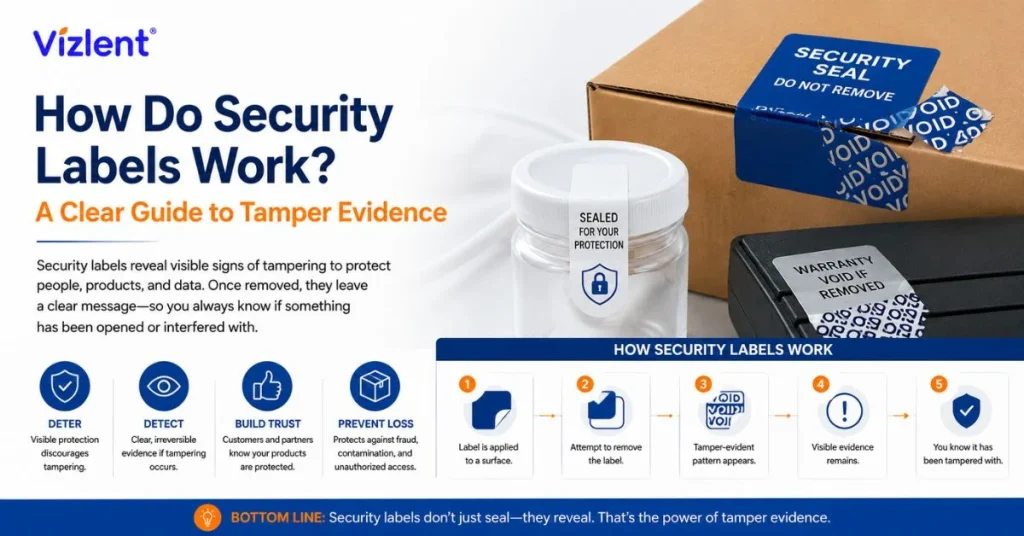
Security labels work by using hidden patterns that cause visible damage when opened, copied or if someone steal the item. These help deter theft, verify product authenticity and expose any interference. The material use a special split-layer construction, a destructible film, or a transfer adhesive, so the label either reveals a hidden message like VOID, breaks into pieces, or marks the surface beneath it. Once that evidence appears, it cannot be reversed, which makes any attempt to open, move, or relabel an item immediately obvious.
Need tamper-evident labels engineered for your product or assets? Request a factory-direct quote from Vizlent and get a security label matched to your surface and conditions.
How Do Security Labels Work at the Material Level?
The answer to how do security labels work starts with the layers inside the label. A tamper-evident label is built so its internal bond is weaker than its grip on the surface, which forces it to fail in a controlled, visible way. When someone peels it, the label cannot come off cleanly, so it self-destructs or splits and leaves a mark behind.
That controlled failure is the whole point of the design. A regular sticker peels off in one piece and hides any sign of removal, while a security label is engineered to do the opposite. The result is a permanent record of interference that protects products, warranties, and high-value assets.
The engineering behind this balance is precise and deliberate. Manufacturers tune the cohesive strength of the film against the tack of the adhesive, often using a 2-mil polyester face and a high-tack acrylic glue. Get that ratio right, and the label always fails internally, leaving the tamper message exactly where it belongs.
The Main Types of Security Labels

Most security label stickers fall into three working categories. Each one signals tampering in a different way, from a hidden message to total destruction of the label. Choosing among them depends on the surface, the environment, and how obvious you want the evidence to be.
These are the three core mechanisms used in the field:
- Void labels: a hidden VOID or OPENED message appears on the label, the surface, or both when peeled
- Destructible vinyl: a brittle film that shatters into small fragments and cannot be lifted in one piece
- Security cut labels: a face stock with engineered cuts or perforations that break apart the moment removal is attempted
Within those categories, adhesives add another layer of choice. Total-transfer types leave a sticky VOID message on the item, while non-residue types only mark the label itself. A manufacturer can match the adhesive to the surface so the evidence shows up clearly every time.
Void Labels and Security Cut Labels
Void labels rely on a split-layer build with a precisely tuned adhesive. The top film and the adhesive layer are designed to separate under stress, revealing pre-printed VOID text embedded between them. Because the message is built into the structure, no amount of careful peeling can hide that the label was lifted.
Security cut labels take a more mechanical approach to the same goal. Fine cuts, slits, or perforations weaken the face stock so it tears apart instead of releasing cleanly. These security cut labels suit asset tags and seals where a torn, unusable label is the clearest possible signal of tampering.
Destructible vinyl is a close cousin worth understanding alongside cut labels. This brittle film is engineered so its bond to the surface beats its own internal strength, which makes it shatter into fragments on removal. Because the pieces cannot be reassembled, it gives strong evidence on rough or textured surfaces where void films struggle.
Protecting industrial equipment or regulated goods? See Vizlent durable and chemical-resistant label stock built to hold up where standard labels fail.
Security Labels for Computers, Electronics, and Assets
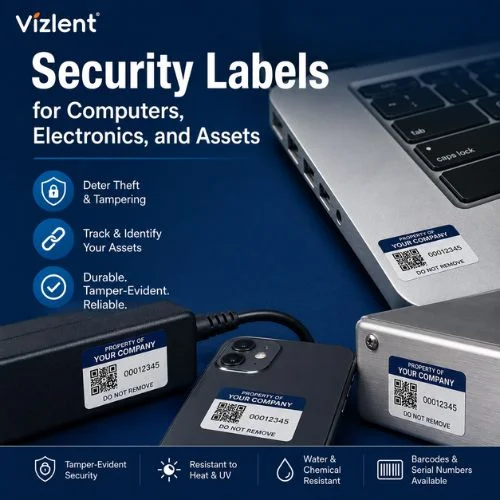
Electronics and IT hardware are among the most common places where security labels appear. Security labels for computers seal screws, ports, and casings so any unauthorized opening shows immediately and can void a warranty. Laptops, servers, and network gear all use these seals to prove a device has not been opened or swapped.
Asset management is the second big use case across organizations. Serial-numbered tamper labels let IT and finance teams track equipment and confirm it has not been relabeled or moved without approval. The same seals protect medical devices, pharmaceuticals, and high-value goods where chain-of-custody matters.
The placement of a seal is as important as the seal itself. On a laptop, a label across a case screw or a memory door stops a quiet swap of parts, while a port seal flags unauthorized access. Choosing the right spot turns a small sticker into a dependable checkpoint for the whole device.
What Makes Security Labels Tamper-Proof?
The phrase security labels tamper-proof points to a precise engineering balance. The adhesive must bond to the surface more strongly than the label holds together internally, so removal always damages the label or the surface. Material choice, adhesive chemistry, and surface compatibility all decide how reliably that happens.
No label is truly impossible to defeat, so the honest term is tamper-evident rather than tamper-proof. The goal is not to make removal impossible, but to make it impossible to remove without leaving proof. The table below compares the main mechanisms so you can match one to your security needs:
| Mechanism | How Tamper Shows | Best Use |
|---|---|---|
| Void label | VOID message on label or surface | Electronics, warranty seals |
| Destructible vinyl | Label shatters into fragments | Asset tags, tools, rough surfaces |
| Security cut label | Face stock tears apart | Seals, high-visibility tagging |
| Total-transfer adhesive | Sticky VOID stays on the item | High-deterrence packaging |
Total Transfer, Partial Transfer, and Non-Residue Seals
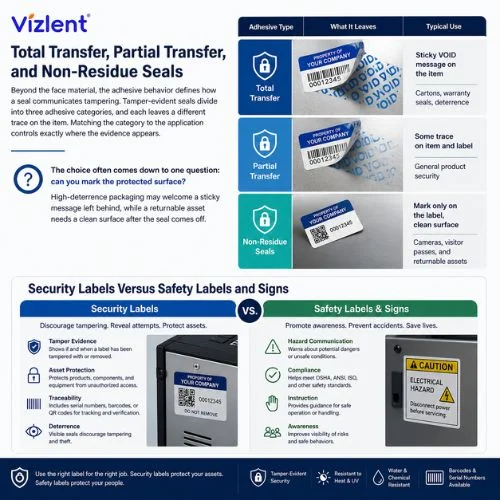
Beyond the face material, the adhesive behavior defines how a seal communicates tampering. Tamper-evident seals divide into three adhesive categories, and each leaves a different trace on the item. Matching the category to the application controls exactly where the evidence appears.
The choice often comes down to one question: can you mark the protected surface? High-deterrence packaging may welcome a sticky message left behind, while a returnable asset needs a clean surface after the seal comes off. This comparison lays out the three options side by side:
| Adhesive Type | What It Leaves | Typical Use |
|---|---|---|
| Total transfer | Sticky VOID message on the item | Cartons, warranty seals, deterrence |
| Partial transfer | Some trace on item and label | General product security |
| Non-residue | Mark only on the label, clean surface | Cameras, visitor passes, and returnable assets |
Security Labels Versus Safety Labels and Signs
Security labels are sometimes confused with safety labels and signs, but the two serve different jobs. Security labels prove if an item was tampered with, while safety labels and signs communicate hazards and instructions. Both protect people and property, yet they solve very different problems on the package or product.
A clear warning label list helps separate the categories in practice. Knowing which type you need prevents ordering a tamper seal when you actually need a hazard notice. A typical warning label list for compliance and operations includes the following:
- Hazard warnings: flammable, corrosive, high voltage, or biohazard notices
- Handling instructions: fragile, this side up, keep dry, and load limits
- Regulatory marks: GHS pictograms, compliance icons, and certification seals
- Security seals: void, destructible, and tamper-evident labels for access control
Many products carry both kinds at once for full coverage. A shipping carton may use safety labels and signs for handling and a security seal across the opening. Pairing the two gives clear instructions and clear proof of integrity in a single package.
How to Choose the Right Security Label
Selecting a security label comes down to a few practical questions. Consider the surface, the environment, the level of evidence you need, and any data the label must carry. Matching those factors to the right material and adhesive is what makes a seal reliable in the field.
Use this checklist before placing an order:
- Surface: smooth glass and metal suit void films, rough surfaces suit destructible vinyl
- Evidence level: choose a visible VOID message, a shattering label, or a surface-marking transfer
- Environment: confirm ratings for heat, moisture, UV, and chemical exposure
- Harsh conditions: pair the seal with chemical-resistant label stock or cryogenic label stock where needed
- Data: add serial numbers, barcodes, or QR codes for tracking and authentication
Testing on the actual surface is the final, essential step. Performance can shift between glass, powder-coated metal, and textured plastic, so a sample run prevents surprises. A manufacturer that supplies samples lets you confirm the evidence before a full production order.
Industries That Depend on Security Labels
Tamper-evident seals show up wherever product integrity carries real consequences. Healthcare, electronics, logistics, and the government all rely on them to prove an item stayed sealed and authentic. In regulated sectors, visible proof supports compliance and audit requirements as much as it deters theft.
The application shapes the material and the data on each label. Pharmaceutical seals favor clear, destructive evidence, while IT asset tags lean on serial numbers and barcodes for tracking. A few common settings show how widely these seals are used:
- Healthcare and pharma: tamper-evident seals on medication and device packaging
- Electronics and IT: warranty and access seals on laptops, servers, and network gear
- Logistics and shipping: void seals that confirm parcels stayed closed in transit
- Government and aerospace: serialized seals on parts and controlled equipment
Limitations to Keep in Mind
A security label is a strong deterrent, not an absolute barrier. A determined attacker with heat, solvents, or time may still attempt removal, which is why the term tamper evident is more accurate than tamper-proof. The label’s job is to make any such attempt obvious, not to make it physically impossible.
Performance also depends on the correct application and the right surface. A seal applied to dust, oil, or a low-energy plastic may not bond well enough to fail as designed. Clean the surface, allow proper dwell time, and test the material first so the evidence appears reliably when it matters.
Why Businesses Rely on Tamper-Evident Labels
The value of security labels reaches well beyond simple deterrence. They reduce fraud, protect warranties, support compliance, and give customers confidence that a product arrived untouched. For regulated industries, proof of integrity is often a requirement rather than a nice-to-have.
Understanding how these seals function helps a business pick the right level of protection. The correct seal lowers losses from tampering and counterfeiting while strengthening brand trust. A small label, chosen well, protects both the product and the reputation behind it.
Applying Security Labels for Reliable Results
Even the best seal underperforms if it is applied poorly. Surface prep, dwell time, and placement all determine whether the tamper evidence appears as intended. A few simple habits make the difference between a dependable seal and a weak one.
Build these steps into your labeling process before a full run:
- Clean the surface so it is free of dust, oil, and moisture before applying
- Apply firm, even pressure across the whole label to seat the adhesive
- Allow full dwell time so the bond reaches strength before handling
- Place the seal across a seam, screw, or opening so removal is unavoidable
- Verify on a sample that the VOID message or fracture shows clearly
Get Tamper-Evident Security Labels Built for Your Application
The right security label turns any removal attempt into permanent, visible proof. Vizlent manufactures security and durable label stock with custom materials, adhesives, and serialization for electronics, packaging, and industrial assets. Share your surface, environment, and security goals, and the right seal gets matched to the job.
Talk to the Vizlent team about security labels or browse adhesive and label stock options to get started today.
Frequently Asked Questions
How do tamper-evident labels show that tampering happened?
Security labels work by failing in a controlled, visible way when removed. Their internal bond is weaker than their grip on the surface, so peeling reveals a VOID message, shatters the label, or transfers adhesive to the item. That permanent evidence cannot be reversed or hidden.
What is the difference between tamper-proof and tamper-evident?
Tamper-evident means a label clearly shows when tampering has occurred, while tamper-proof implies it cannot be defeated at all. No label is truly impossible to remove, so the accurate term is tamper-evident. The goal is to make removal impossible without leaving proof.
What are security cut labels?
Security cut labels have engineered cuts, slits, or perforations in the face stock that cause it to tear apart on removal. This mechanical weakening makes clean peeling impossible. They are ideal for seals and asset tags where a torn, unusable label is the clearest sign of tampering.
Do security label stickers leave residue?
It depends on the adhesive type. Total-transfer security labels and stickers leave a sticky VOID message on the surface, while non-residue types only mark the label itself and leave the item clean. You choose based on how visible you want the evidence to be.
Are security labels for computers worth using?
Yes, security labels for computers seal screws, ports, and casings so any unauthorized opening is immediately visible. They protect warranties, support IT asset tracking, and deter internal tampering. Serial-numbered versions also help confirm a device has not been swapped or relabeled.
What surfaces do tamper-evident labels work on?
Void films bond best to smooth surfaces like glass, metal, and plastic, while destructible vinyl suits rougher or textured surfaces. Adhesive choice matters for low-energy or curved surfaces. Testing on the actual surface is recommended before a full order to confirm clear tamper evidence.
How are security labels different from safety labels and signs?
Security labels prove if an item was tampered with, while safety labels and signs communicate hazards and handling instructions. One protects integrity, the other protects people. Many products use both, pairing a tamper seal with the appropriate warning label.
Can security labels include barcodes or serial numbers?
Yes, most security labels support variable data such as serial numbers, barcodes, and QR codes. This adds traceability and authentication on top of tamper evidence. Each label becomes a unique identifier for asset management, warranty tracking, and anti-counterfeiting programs.






