
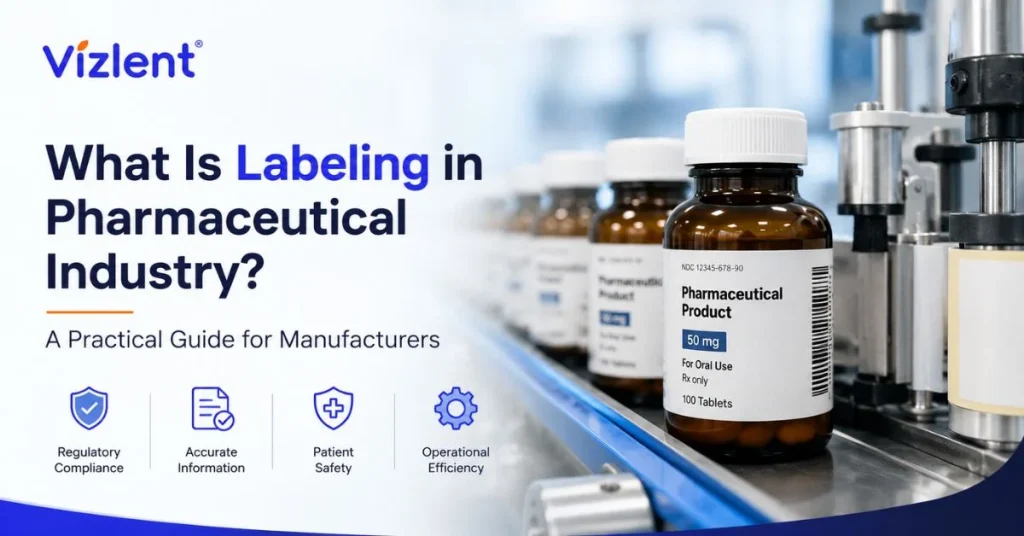
Pharmaceutical Labeling refers to manufacturer labels that contain drug information. This includes name, dosage form, quantity, strength, instructions, batch number, manufacturer details and more. Labeling in pharmaceutical industry production is the design, printing, application, and verification of every printed material attached to a drug product or its container.
The scope covers primary labels on vials, ampoules, and blister packs, plus secondary cartons, package inserts, and outer shipping marks. Each printed unit must carry the product identifier, lot number, expiry date, dosing instructions, warnings, and serialization codes that match the approved regulatory file.
Anyone asking what labeling is in pharmaceutical industry quickly finds it sitting at the intersection of patient safety, brand protection, and regulatory compliance. Authorities, including the Food and Drug Administration (FDA), European Medicines Agency (EMA), MHRA, TGA, Health Canada, and PMDA, each set their own format and content rules. Substrate, ink chemistry, and adhesive performance are qualified with the same rigor as the drug formulation itself.
Need pharmaceutical-grade label stock with documented compliance? Request a free sample from Vizlent to test peel strength and print performance before your next batch.
Where Labeling in the Pharma Industry Workflow Belongs
Labeling in pharma industry workflows spans artwork, packaging engineering, quality assurance, regulatory affairs, and supply chain operations. Artwork teams own the master file, regulatory affairs locks the content against the approved submission, and packaging engineering qualifies the substrate and machinery. Every handoff is logged so QA can trace any change back to its source.
That cross-functional model exists because a single typo, a mismatched serial number, or a smudged barcode can halt shipments at the border. Procurement teams now sit at the same table as artwork and QA, since substrate sourcing has direct safety and yield implications. A weak link anywhere in that chain shows up as a reject, a complaint, or a recall.
The Labeling Process in Pharmaceutical Industry
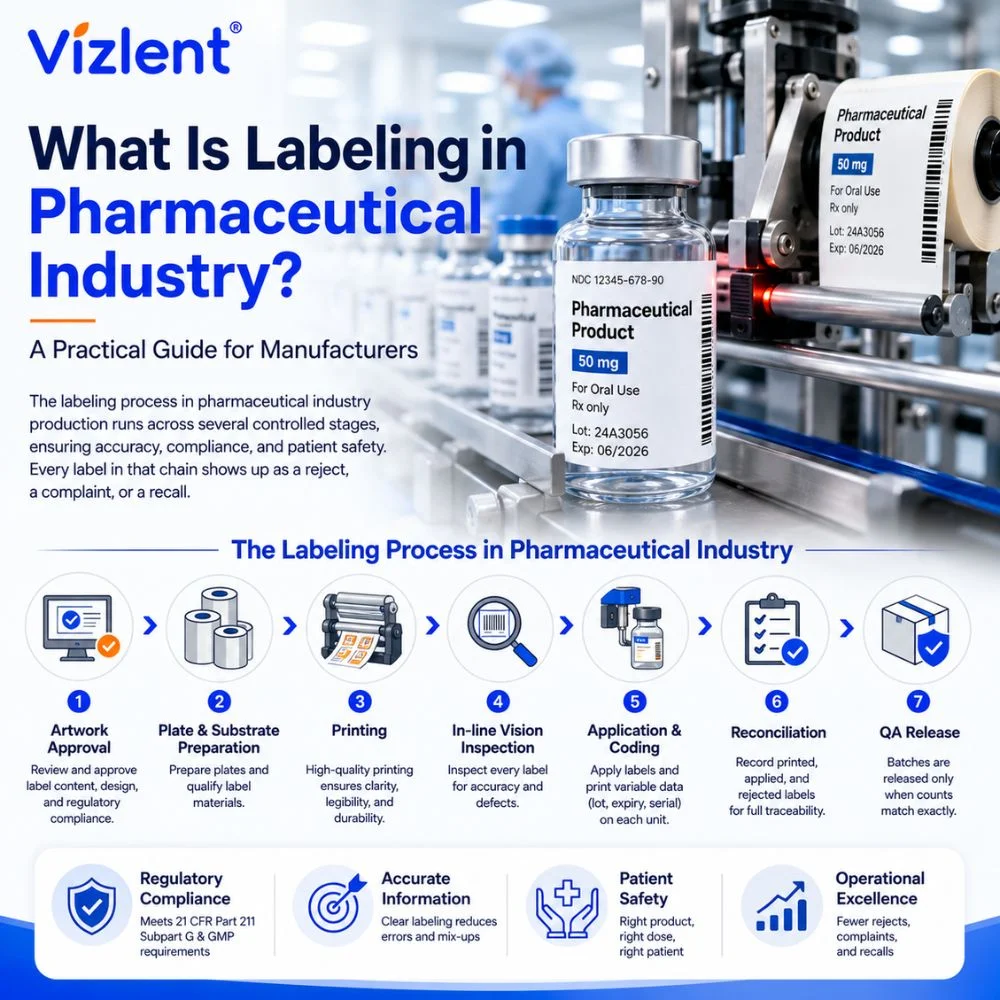
The labeling process in pharmaceutical industry production runs across several controlled stages, beginning with artwork approval and ending with reconciliation of every printed unit. Each step follows SOPs and is verified by QA to prevent mix-ups, mislabeling, or counterfeit infiltration. GMP rules under 21 CFR Part 211 Subpart G set out exactly how labels must be stored, issued, applied, and accounted for.
A typical pharmaceutical labeling process workflow moves from artwork approval to plate preparation, substrate qualification, printing, in-line vision inspection, application, and final batch reconciliation. Variable data, such as lot numbers and expiry dates, are added through thermal transfer or laser coding at the point of application. Operators record every printed and rejected label so finished batches can be released only when counts match exactly.
Material Selection and Substrate Preparation
The starting point for the pharmaceutical labeling process is matching the substrate to the container, the storage conditions, and the printing method. Options range from semi-gloss paper for outer cartons to PE, PP, and PET films for blister packs, ampoules, IV bags, and refrigerated vials. Each pairs with a specific adhesive formulated for the surface, temperature range, and removal needs.
Vizlent supplies coated facestocks engineered for inkjet, thermal transfer, and laser print compatibility, with adhesive grades covering deep freeze, autoclave, and standard pharmacy storage. Our self-adhesive material range supports paper, PET, BOPP, and PVC carriers for primary and secondary packaging. Lab testing confirms peel strength, release force, and print anchorage before any roll ships to the converting line.
Printing, Inspection, and Application
After substrate approval, artwork is printed using flexographic, digital, or hybrid presses depending on volume and color complexity. In-line vision systems verify barcode grade, character readability, and color match against the master file in real time. Rejected labels are diverted to a secure waste stream and logged in the batch record.
Application happens on high-speed lines fitted with sensors that confirm label presence, position, and orientation on every container. Reject stations remove any missed, skewed, or unreadable units before they enter secondary packaging. The combined inspection and application data feed back into the batch reconciliation step required by GMP.
Packaging and Labeling in Pharmaceutical Industry
Packaging and labeling in pharmaceutical industry operations are managed together because the carton, leaflet, and label form a single regulated unit. Carton printing, label application, leaflet insertion, and outer case marking happen on linked equipment that shares the same batch identifier. Coordinating these steps protects against mix-ups between products, dosages, and shipment lots.
Primary packaging refers to anything in direct contact with the drug, such as the vial, bottle, blister, or syringe label. Secondary packaging covers the outer carton, leaflet, and tamper-evident seal that holds the primary unit in place. Tertiary packaging includes the shipping case, pallet, and outer track-and-trace identifiers used for distribution across the cold chain.
The Labeling Machine in Pharmaceutical Industry
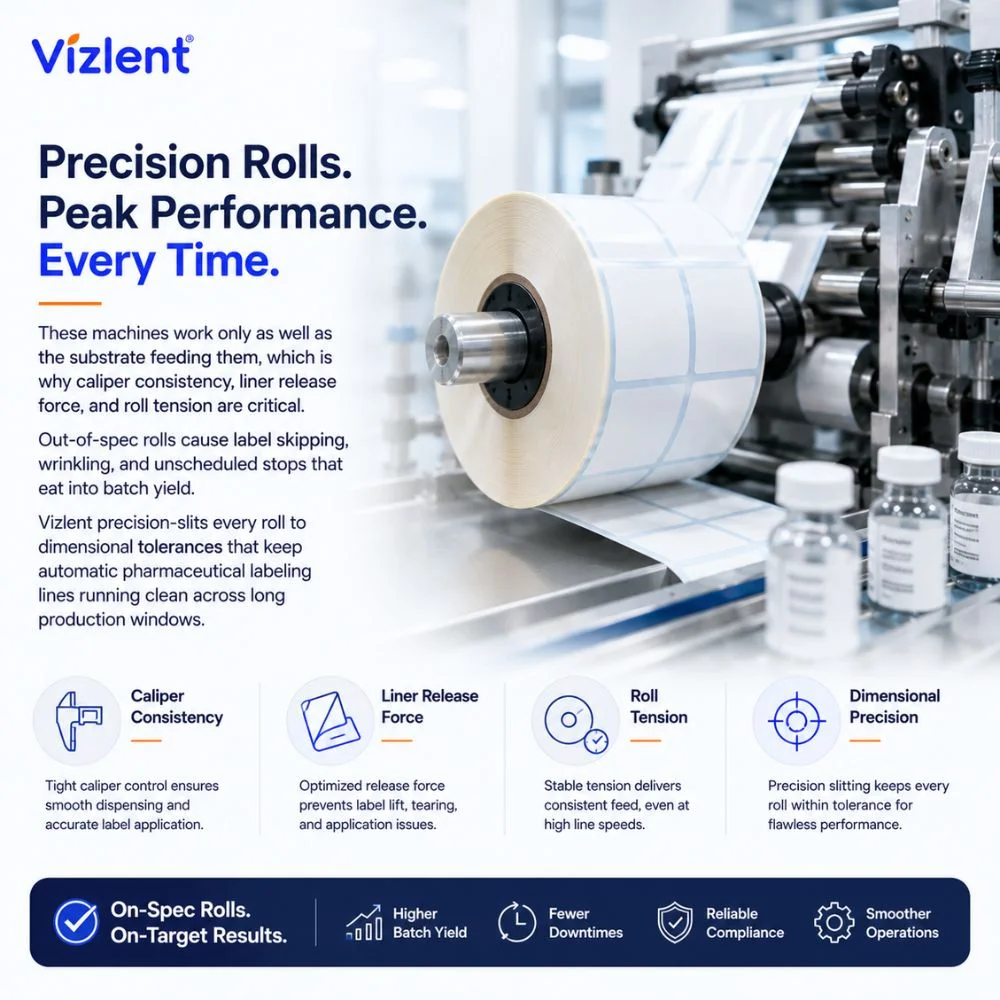
A labeling machine in pharmaceutical industry production is purpose-built for high-speed accuracy on small, round, irregular, or fragile containers. Common configurations include wrap-around units for cylindrical bottles, top-and-bottom applicators for blister cards, and front-and-back units for vials and ampoules. Output speeds range from 60 to 600 units per minute, depending on container geometry and label complexity.
These machines work only as well as the substrate feeding them, which is why caliper consistency, liner release force, and roll tension are critical. Out-of-spec rolls cause label skipping, wrinkling, and unscheduled stops that eat into batch yield. Vizlent precision-slits every roll to dimensional tolerances that keep automatic pharmaceutical labeling lines running clean across long production windows.
Pharmaceutical Labeling Requirements
Pharmaceutical labeling requirements are set by national health authorities and harmonized in part through ICH guidelines. In the United States, 21 CFR Part 201 and 21 CFR Part 211 govern label content, control, and storage. The EU operates under Directive 2001/83/EC and the Falsified Medicines Directive, while other markets follow MHRA, TGA, Health Canada, and PMDA frameworks.
Content rules cover the active ingredient, dosage form, strength, route of administration, lot number, expiry date, storage instructions, and warning statements. Format rules cover font size, contrast, language, and placement, with extra rules for braille on EU packs. Missing any of these triggers detention at port, market withdrawal, or full recall.
FDA and Global Regulatory Layers
The FDA sets detailed expectations for both prescription and over-the-counter labels, including the format of the Drug Facts panel and the structure of prescribing information. Imports must clear customs with labels that match the approved NDA or ANDA on file. Discrepancies between filed and printed content can lead to Import Alerts that block entire shipments.
In the EU, the EMA reviews label content for centrally authorized products, while national agencies cover decentralized and mutual recognition routes. Other major markets, such as Japan, Australia, and Brazil, maintain their own format rules and approval timelines. Manufacturers that serve multiple regions usually run parallel artwork management systems to keep regional versions aligned.
Serialization, Track-and-Trace, and Anti-Counterfeit Layers
DSCSA in the US and the EU Falsified Medicines Directive require unit-level serialization, with GS1 DataMatrix codes carrying product identifier, batch, expiry, and serial number data. Aggregation rules link those serials from item to bundle to case to pallet for full chain-of-custody visibility. Substrate caliper, surface smoothness, and print contrast all influence whether the code can be read at every distribution point.
Brand protection adds another layer through covert UV inks, holographic overlaminates, void-release adhesives, and tamper-evident seals. Vizlent manufactures security label materials with those layered features built into a single self-adhesive construction. The result is overt, covert, and forensic authentication on the same label real estate, with no extra steps for the converting line.
Importance of Labelling in Pharmacy
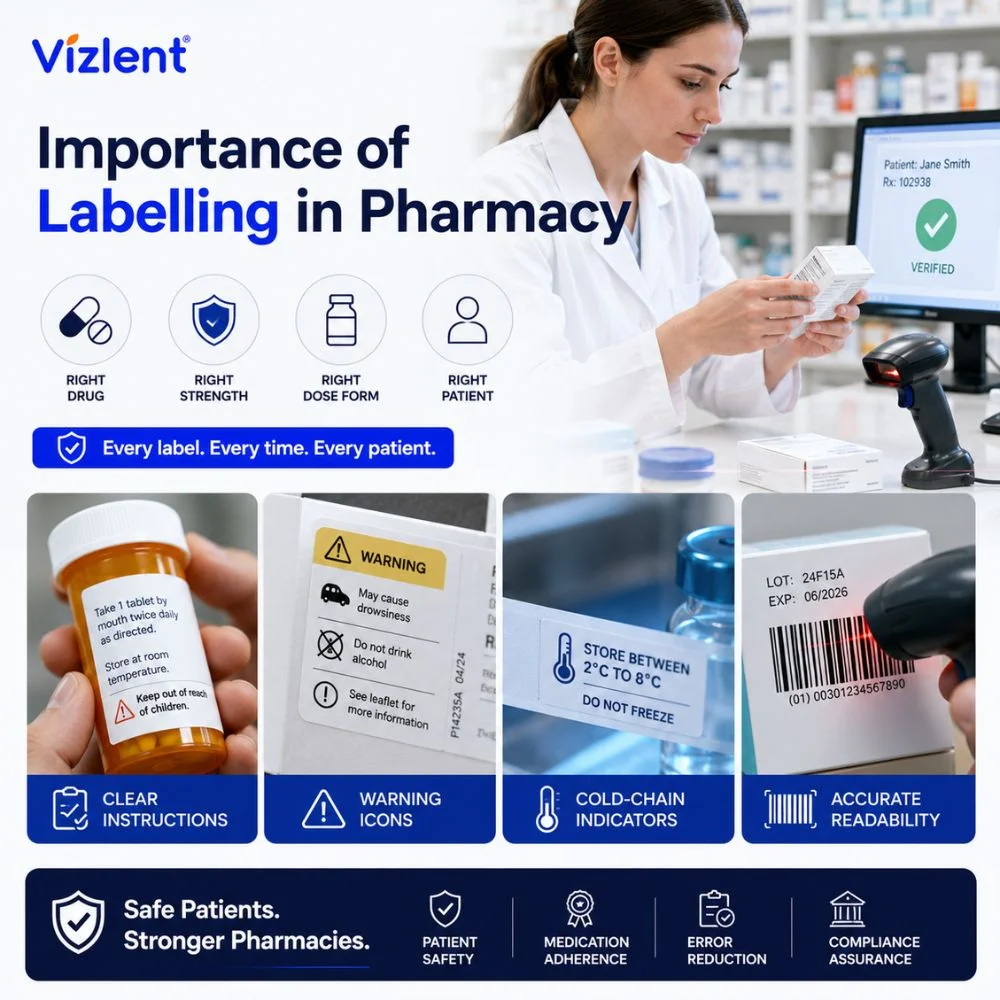
The importance of labelling in pharmacy goes beyond simple identification of a product on the shelf. Pharmacists rely on label data to confirm the right drug, strength, dose form, and patient at the point of dispensing. Misreads or smudged barcodes during this final check are a leading contributor to dispensing errors in retail and hospital settings.
Clear, durable labels also support medication adherence by giving patients legible dosing instructions, warning icons, and storage notes. Cold-chain medications carry temperature indicators that alert pharmacy staff if the product has been compromised in transit. A label that fails on any of these fronts puts both patient safety and the pharmacy’s compliance standing at risk.
Labeling in Pharmaceutical Industry Best Practices
Strong labeling in the pharmaceutical industry best practices starts with treating the label as a regulated component, not a printed accessory. That means qualifying every substrate supplier, locking artwork through version control, and validating every machine that prints or applies labels. Audit trails should capture every change to the master file, every operator intervention, and every reject.
The most reliable programs share recurring habits across production sites and quality teams. They treat artwork, substrate, and machine settings as connected risk surfaces rather than isolated tasks. A handful of core practices show up in every operation that holds up under regulatory inspection:
- Lock artwork in a centralized system with role-based approval and full audit history
- Qualify substrate suppliers on coating uniformity, release force, and print compatibility
- Validate every printer, applicator, and vision system on installation and after maintenance
- Reconcile printed and applied label counts against batch size at every run
- Run challenge tests for cold chain, autoclave, gamma, and EtO exposure scenarios
- Train operators on mix-up prevention, line clearance, and reject handling
Material Qualification and Supplier Audits
Material qualification covers facestock weight, adhesive coat weight, release liner force, and dimensional tolerance. Each lot of incoming material should ship with a Certificate of Analysis tied to the validated specification. Receiving labs verify a sample from every batch before the roll is released to production.
Supplier audits cover ISO 9001, FSC, and SGS certifications, plus on-site review of coating, slitting, and storage practices. Vizlent operates from a 10,000sqm ISO 9001 facility in Shenzhen with FSC and SGS certifications across the full product range. That documented control gives pharmaceutical buyers a clean trail from coating line to converting machine.
Risk-Based Validation and Continuous Improvement
Validation under GMP follows a risk-based model that focuses on heavy testing of the components most likely to cause patient harm. Label legibility, adhesive performance under storage, and barcode readability sit at the top of that risk register. Validation protocols should cover IQ, OQ, and PQ stages with acceptance criteria pulled from the regulatory file.
Continuous improvement programs feed rejected data, customer complaints, and audit findings back into substrate selection and machine settings. Vendor scorecards track on-time delivery, defect rates, and response time, giving procurement teams data to push for upgrades. Closing this loop turns label production from a static cost line into a quality and yield lever.
Looking for pharma-grade label stock backed by ISO 9001, FSC, and SGS certifications? Speak with our technical team to match your container and storage profile to the right substrate.
Labeling in Pharmaceutical Industry Benefits
The labeling in pharmaceutical industry benefits stretch across patient safety, brand protection, operational uptime, and regulatory standing. Reliable labels reduce recall risk, support cold-chain integrity, and protect the brand from counterfeit penetration. They also keep automatic application lines running at design speed, which protects margin on every batch.
Quantifying the gain is straightforward when production teams track the right metrics. Improvements in label performance show up as fewer rejected units, fewer line stops, and cleaner audit findings on every regulatory visit. Top-performing programs report measurable lifts across the following areas:
- Lower reject rates on inspection lines through consistent print contrast
- Higher first-pass yield on automatic applicators through tight caliper tolerance
- Faster audit clearance through documented supplier and substrate trails
- Stronger barcode grade across the supply chain for serialization compliance
- Reduced recall exposure through verified durability under storage conditions
- Improved patient adherence through legible, durable dosing instructions
Labeling Pharma Jobs and Career Tracks
Labeling pharma jobs cover a wide span of technical, regulatory, and operational roles across manufacturing and supply chain teams. Common titles include Labeling Specialist, Artwork Manager, Regulatory Labeling Lead, Serialization Engineer, and QA Compliance Auditor. Each role contributes to keeping printed material aligned with the approved regulatory file and the validated production process.
Skills in demand include GS1 standards, artwork management platforms such as BLUE, Esko, and Loftware, plus a working grounding in 21 CFR Part 211 and EU GMP Annex 11. Many roles also call for knowledge of cold-chain logistics and serialization standards under DSCSA and FMD. Pay bands reflect the regulatory weight, with senior labeling roles often sitting on the same grade as production or quality leadership.
Material Choices for Labeling Pharmaceutical Products
For labeling pharmaceutical products, material choice depends on container type, storage profile, and the printing method. Paper facestocks remain popular for outer cartons and prescription bottles, while PET, PP, and PVC films handle blister packs, IV bags, and sterile vials. Each option ships with a paired adhesive engineered for the exact application surface and environmental stress.
Understanding what labeling is in pharmaceutical industry helps procurement and QA teams pick materials that survive every step from autoclave to outpatient counter. Vizlent supports brand owners and converters with pharmaceutical and healthcare label solutions that hold up under steam autoclave, gamma, and EtO sterilization profiles. Each construction is lab-tested for adhesion, print contrast, and barcode grade before release.
Why Vizlent Stands Out for Labeling Pharma Supply
For converters and pharmaceutical manufacturers sourcing materials for labeling pharma products, Vizlent provides factory-direct supply backed by 15 years of coating and slitting expertise. Our 10,000sqm facility in Shenzhen and Ganzhou is certified to ISO 9001 with FSC and SGS verification on every roll. The portfolio covers paper, PET, BOPP, and PVC face stocks with eight adhesive formulations, including deep freeze, autoclave-resistant, and tamper-evident grades.
We support OEM and ODM orders with 7 to 15 day lead times, free samples for compatibility testing, and dedicated technical support for substrate selection. Customers include label converters, contract packagers, and pharmaceutical brand owners across 50+ countries. Browse our thermal transfer ribbon and laminating film catalogs, or visit About Vizlent to learn more about our team and certifications.
Source Pharma-Grade Label Stock From Vizlent
Sourcing reliable label stock for your pharmaceutical operation starts with a qualified supplier and validated material. Vizlent ships factory-direct pharma-grade self-adhesive label materials, thermal transfer ribbons, and laminating films to converters and brand owners across 50+ countries. Request a free sample roll today and see how the right material lifts every step of your program: visit vizlent.com or reach out through our contact page to speak with our engineering team.






