

On how to read drug labels, you need to check the medication name, the patient name, the dosage, route of administration, expiration date, and safety warnings printed on a medication container to confirm correct use, accurate dosing, and regulatory compliance before administration. Patients, pharmacists, nurses, and healthcare workers depend on this label-reading practice to prevent dosing errors, harmful drug interactions, and missed contraindications. Knowing how to decode every section of the label for drugs gives you confidence with prescriptions, over-the-counter remedies, and clinical medications alike.
What Is a Drug Label and Why Does It Matter?
A drug label is the printed or digital information attached to a medication that identifies the product, explains how to use it, and lists safety warnings. The drug label definition under federal regulations covers all written, printed, or graphic matter on the immediate container, outer packaging, and accompanying inserts. Every prescription bottle, vial, syringe, and ampoule carries one because regulators treat the label as a primary safety document.
Reading a drug label correctly protects you from common medication errors, including double-dosing, mixing incompatible drugs, and missing key contraindications. Pharmacists check labels several times during dispensing, and nurses verify them at the bedside before administration. For patients managing chronic conditions, careful label reading at home reduces the risk of hospitalization and improves treatment outcomes.
Components of Drug Labels

The components of drug labels are the standardized printed elements every medication must carry, including the active ingredient, strength, dosage form, route of administration, expiration date, lot number, and storage conditions. The required drug label content appears in a predictable order across all manufacturers to support rapid clinical reading. Each element serves a specific safety purpose and must remain legible from the manufacturing line through patient use at home.
Medication labels contain which information depends on the product category, since prescription drugs, OTC remedies, and clinical injectables follow different formatting rules. Prescription products include patient counseling sections, boxed warnings, and pharmacist instructions, while OTC labels follow the Drug Facts panel format. Hospital pharmacy labels add details such as the patient name, room number, administration time, and barcode identifier.
Required Elements Should You Always Find on a Drug Label
Required elements on a drug label are the core identifiers every compliant product carries to allow safe identification and traceability. These components form the foundation of medication safety across pharmacies, hospitals, and consumer households. Missing or illegible information typically requires the product to be returned to the dispensing pharmacy for verification.
Look for these elements on any properly labeled drug product, since their absence or smudging may signal a counterfeit or compromised batch. Hospital pharmacists run a checklist verification against each item before dispensing to inpatients. Patients can do the same quick visual check at home before taking any dose.
- Brand and generic drug name
- Active ingredient strength per unit
- Dosage form (tablet, capsule, liquid, injection)
- Route of administration (oral, IV, IM, topical)
- Quantity in the container
- Expiration date and lot number
- Manufacturer name and address
- National Drug Code (NDC)
How Does Drug Label Content Differ by Medication Category?
Drug label content differs by category because each medication type carries distinct regulatory and clinical requirements. Veterinary medications include species, weight ranges, and withdrawal periods relevant to livestock or pets. Clinical injectables used in hospitals add concentration per milliliter, reconstitution instructions, and infusion rate guidance.
Investigational drugs used in clinical trials follow yet another format, including a protocol number, study sponsor, and a Caution: New Drug statement. Compounded medications prepared by specialty pharmacies show the formulation date, beyond-use date, and the compounding pharmacist’s initials. Recognizing these category differences helps you spot whether a label matches the product type you expect at first glance.
The FDA and Drug Label Standards

The FDA regulates drug labels through Title 21 of the Code of Federal Regulations, which sets enforceable rules for every commercial medication sold in the United States. Every FDA label for drugs must pass review for accuracy of clinical claims, dosing guidance, contraindications, and warnings before the product reaches pharmacies. Manufacturers face penalties, recalls, and criminal liability when the drug labels FDA approves contain misleading or unsubstantiated claims.
FDA enforcement extends beyond initial approval, with post-market surveillance tracking adverse events, mislabeling complaints, and counterfeit reports. Healthcare professionals and patients can report labeling concerns through the agency’s MedWatch program. Pharmacy chains and hospital systems use FDA-published label updates to revise their dispensing protocols across all locations.
How Do You Use the FDA Drug Labels Database?
The FDA Drug Labels Database, known as DailyMed, is the public drug label database that publishes the official label for every prescription and OTC medication sold in the United States. Patients, prescribers, and label converters use this resource to verify dosing instructions, contraindications, and storage requirements. The database refreshes daily and reflects the most current FDA-approved labeling for each product.
Searching the database by drug name, NDC, or manufacturer pulls up the structured product label that pharmacists and clinicians rely on for clinical reference. Each entry covers boxed warnings, adverse reactions, dosage information, and patient counseling guidance. Using the database before starting a new medication helps you confirm what your prescription bottle should match when you pick it up.
Need pharmaceutical-grade label stock that holds up to autoclave sterilization, cold chain storage, and barcode scanability requirements? Explore Vizlent’s pharmaceutical and healthcare label solutions built for global compliance.
Reading Different Types of Drug Labels
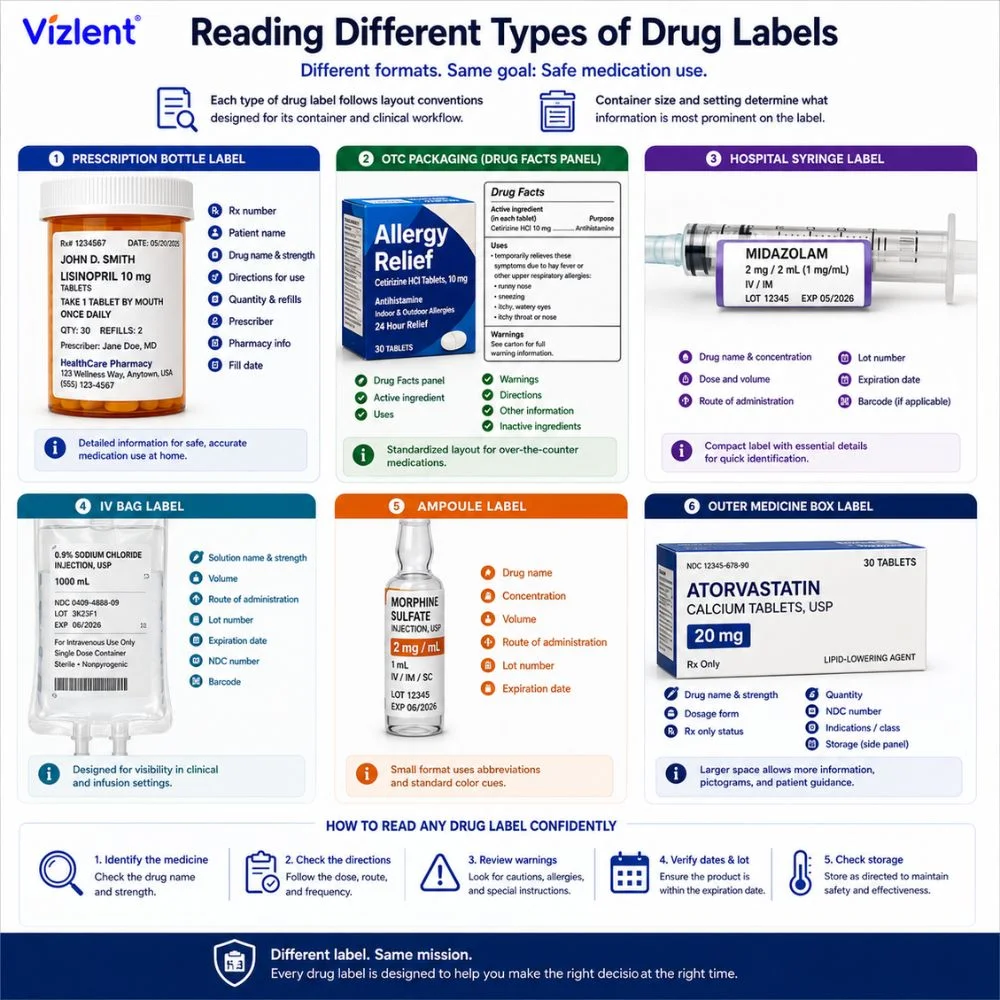
The different types of drug labels include prescription bottle labels, OTC packaging, hospital syringe labels, IV bag stickers, ampoule labels, and outer medicine box labels. Each format follows slightly different layout conventions to fit the container size and clinical workflow. Knowing which format you are holding helps you find the information you need without confusion.
The container size and intended setting shape what information appears most prominently on the label. Compact formats such as syringes and ampoules use abbreviations and color coding because available print space is limited. Larger formats, such as prescription bottles and medicine boxes, allow more detailed patient counseling, dosing tables, and pictograms.
Prescription Bottle Labels and Drug Bottle Label Layout
Prescription bottle labels are the most common drug bottle label format you encounter as a patient and follow a structure set by state pharmacy boards and federal regulators. Standard medicine bottle labels include the patient name, prescriber, drug name and strength, directions for use, refill count, and pharmacy contact information. Auxiliary warning stickers on the cap or side, often in yellow or red, flag specific cautions such as drowsiness or food interactions.
When reading a prescription bottle label at home, verify that the patient name and drug name match what your doctor ordered before taking the first dose. Check the dosing directions against the prescriber’s written instructions, since transcription errors do occur during dispensing. Note the fill date and discard date carefully, since stored medications lose potency or stability past the marked expiration.
Drug Labels for Syringes and Injectables
Drug labels for syringes include the drug name, concentration in milligrams per milliliter, total volume, expiration date, and the preparer’s initials in a compact, high-stakes format. Nurses and clinicians read these labels under time pressure during injection administration. ISMP and Joint Commission guidelines require that the strength always appear with the unit of measurement to prevent tenfold dosing errors.
Color coding on syringe labels indicates therapeutic class, and the practice has become standard across anesthesia, ICU, and emergency settings. A yellow label marks induction agents, while blue indicates opioids and orange signals muscle relaxants. Healthcare workers cross-check the label against the original vial before drawing up and again before injecting into the patient.
Drug Bag Stickers and Medicine Box Labels
Drug bag stickers carry the patient identifier, medication name, dose, route, administration time, and any compatibility warnings for co-infused drugs. They are applied to IV infusion bags, unit-dose pouches, and pharmacy dispensing bags before products leave the pharmacy. The barcode on the sticker links the product to the electronic medication administration record for bedside scanning verification.
Medicine box labels are the outer carton labels for commercial drug products and provide the marketing brand identity along with required regulatory information. The box label includes the NDC, lot number, expiration date, and the same content found on the inner container or blister pack. Storing the outer box keeps regulatory documentation available for returns, recalls, and clinical questions long after the inner product is gone.
For dispensing bag stickers and IV labels that survive cold chain handling and barcode scanning, browse our durable label materials engineered for healthcare workflows.
Drug Label Colors and Font Standards

Drug label colors and fonts are functional design elements that carry safety information alongside the printed text, helping clinicians and patients identify medication classes and read warnings at a glance. Color coding helps clinicians spot the right class of medication quickly, especially during emergencies when reading time is short. Font choices affect legibility under poor lighting, when held at arm’s length, or by patients with low vision.
Manufacturers test label designs against ergonomic and human-factors standards before launch to confirm that the printed information reads cleanly in real-world settings. Independent groups such as the Institute for Safe Medication Practices publish design recommendations to reduce look-alike confusion between similar drug names. Hospitals enforce their own internal standards for repackaged and compounded products to maintain consistency across the facility.
What Do Drug Label Colors Mean?
Drug label colors follow industry conventions that vary by setting, with the most consistent system covering anesthesia and critical care syringe labels. ASTM D4774 and ISO 26825 specify color codes by drug class, including red for paralytics, fluorescent red for vasopressors, and violet for hypnotics. These standards reduce the chance of mistaking one syringe for another during a code blue or surgical intubation.
Pharmacy auxiliary labels also use color to flag specific patient warnings, and you have likely seen these small stickers on your prescription bottles. Yellow stickers commonly mark may cause drowsiness, while red stickers warn against alcohol or specific food combinations. Blue, green, and orange stickers cover refrigeration, shake-well, and finish-the-prescription instructions, respectively.
How Are Drug Label Fonts Chosen for Readability?
Drug label font selection follows guidance from the FDA, ISMP, and human-factors researchers focused on medication safety. Sans-serif fonts such as Helvetica and Arial are preferred for clinical readability because the letterforms are clean and uncluttered. Minimum font size requirements vary by product type, with prescription drug labels typically requiring 6-point text or larger for body content.
Tall-man lettering is a font convention where part of a drug name is printed in capital letters to distinguish look-alike medications. Examples include hydrOXYzine versus hydrALAzine and predniSONE versus predniSOLONE. This typographic technique appears in pharmacy computer systems, drug shelves, and dispensing labels to reduce selection errors at every step of the workflow.
How Do You Read Drug Label Dosage Calculations?
Drug label dosage calculations use the printed concentration and volume from the label to determine the actual amount a patient needs at the bedside. Nurses and pharmacists apply the standard formula of desired dose divided by available strength, multiplied by the volume on hand, to compute the dispensed amount. The label provides every variable in this equation, which is why misreading any component leads directly to dosing errors.
Pediatric and weight-based dosing adds another layer of calculation that depends on accurate label reading of milligram-per-milliliter concentrations. Clinical pharmacists double-check high-risk calculations such as insulin, heparin, and chemotherapy doses against the original label before dispensing. Independent double-checks at the patient bedside catch the remaining percentage of math errors that single verification misses.
How Do Drug Labels Change Over Time?
Drug labels change over time as new safety data, indications, and warnings come from post-market surveillance of real-world clinical use. The FDA requires manufacturers to update labels through supplemental new drug applications when significant changes occur. Pharmacies and clinical reference systems push these updates downstream so that dispensing software and electronic health records stay current.
Watching for drug label changes matters for patients on long-term therapy whose product may carry a new boxed warning or revised dosing. Subscribing to FDA email updates for your specific medications keeps you aware of changes that affect your therapy. Pharmacy systems flag changed labels at refill, but reading the printed information yourself remains a strong final safeguard.
How Do You Track Drug Label Changes Over Time?
You can track drug label changes through the FDA’s public list of approved label updates, published monthly alongside manufacturer notifications. Manufacturers must distribute revised labels with new shipments and notify prescribers through Dear Healthcare Provider letters when changes affect patient safety. The history of label changes for a single drug can run dozens of pages over the product’s market life.
Patients managing chronic conditions benefit from periodic reviews of their medication labels with a pharmacist, since the printed information may differ from a year-old bottle still at home. Hospitals run scheduled formulary reviews to align their order sets with current label content. Compounding pharmacies update their internal master formulas whenever the source drug label changes.
How Does a Drug Label Generator Work?
A drug label generator is software that produces a compliant printed label from structured product data entered by the pharmacist or technician. The system pulls patient identifiers, drug information, dosing instructions, and auxiliary warnings from the pharmacy database. The generator then outputs the file to a thermal or laser printer using barcode encoding for downstream scanning verification.
Commercial systems include integration with electronic health records, e-prescribing platforms, and inventory management for end-to-end traceability. Custom in-hospital generators allow compounding pharmacies to print beyond-use dates and preparer initials directly onto the patient label. Print quality, adhesive strength, and label material matter as much as the software, since faded text or peeled labels create the same safety risk as missing information.
How Do Label Materials Influence Drug Safety?
Label materials influence drug safety by carrying every printed instruction from manufacturer to patient, with material performance directly affecting whether the information stays legible at the point of care. Pharmaceutical labels face moisture, temperature swings, sterilization cycles, and chemical exposure that can degrade lesser materials over time. Choosing the right facestock, adhesive, and topcoat protects the printed content over the product’s full shelf life.
Vizlent manufactures self-adhesive label stock engineered for the demands of pharmaceutical packaging, including autoclave-safe constructions, cold-chain adhesives, and tamper-evident formats such as VOID security stickers. Our pharmaceutical-grade heat-resistant labels maintain barcode integrity through gamma sterilization, while our biodegradable label range meets sustainable packaging requirements. We supply converters and pharmaceutical brands across 50+ countries with ISO 9001, FSC, and SGS-certified materials backed by 15 years of manufacturing expertise.
Final Takeaway: Read Every Drug Label Carefully
Reading a drug label is a clinical skill that protects you and your family every time medication enters the household or workflow. Patients who pause to verify drug name, strength, directions, and expiration date prevent the dosing errors that send people to the emergency room each year. Pharmacies, hospitals, and label converters share the responsibility of keeping the printed information accurate, legible, and durable from the manufacturing line to the bedside.
Pharmacists remain your best resource when a label looks unclear, damaged, or different from your previous fill of the same medication. Take a moment at every pickup to read the label out loud with the dispenser before leaving the counter. The habit costs nothing and catches the rare but serious mistakes that automated systems sometimes miss.
Partner with a label material manufacturer that takes pharmaceutical compliance seriously. Contact the Vizlent team to request samples of our pharmaceutical-grade label stock and discuss your converting requirements with our engineering team.






