
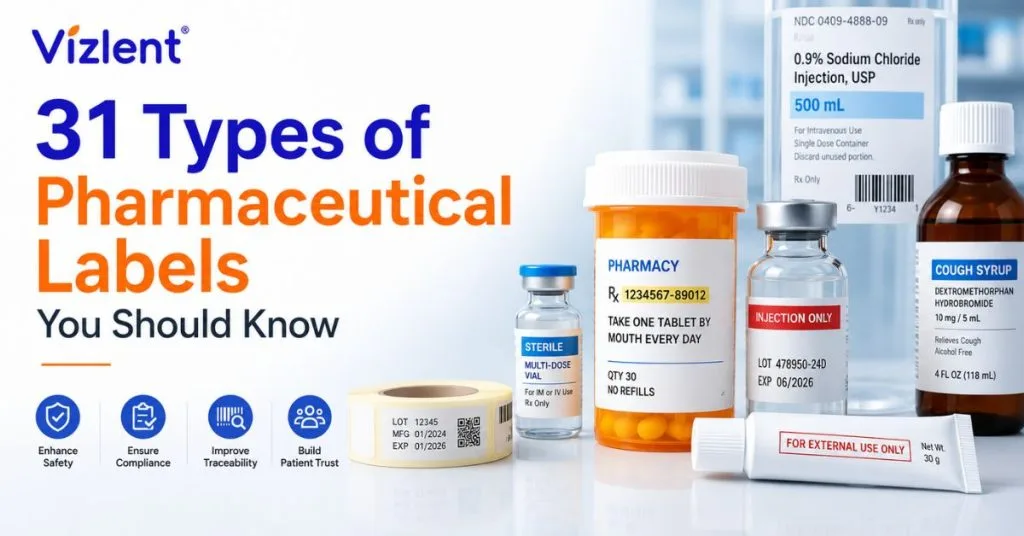
Pharmaceutical labels are not a single product. The 31 types of pharmaceutical labels phrase covers dozens of distinct categories defined by container format, warning function, regulatory role, material performance, and where each one sits in the supply chain from manufacturer to patient. Mixing them up at procurement time costs money and compliance points.
The 31 best types of pharmaceutical labels you should know fall into seven natural groupings. Each grouping addresses a different question: where the label sits, what it has to say, what it has to survive, and what the regulator requires. The breakdown below walks through each in turn.
Browse Vizlent’s pharmaceutical and healthcare label range →
4 Types of Drug Labels by Position in Packaging
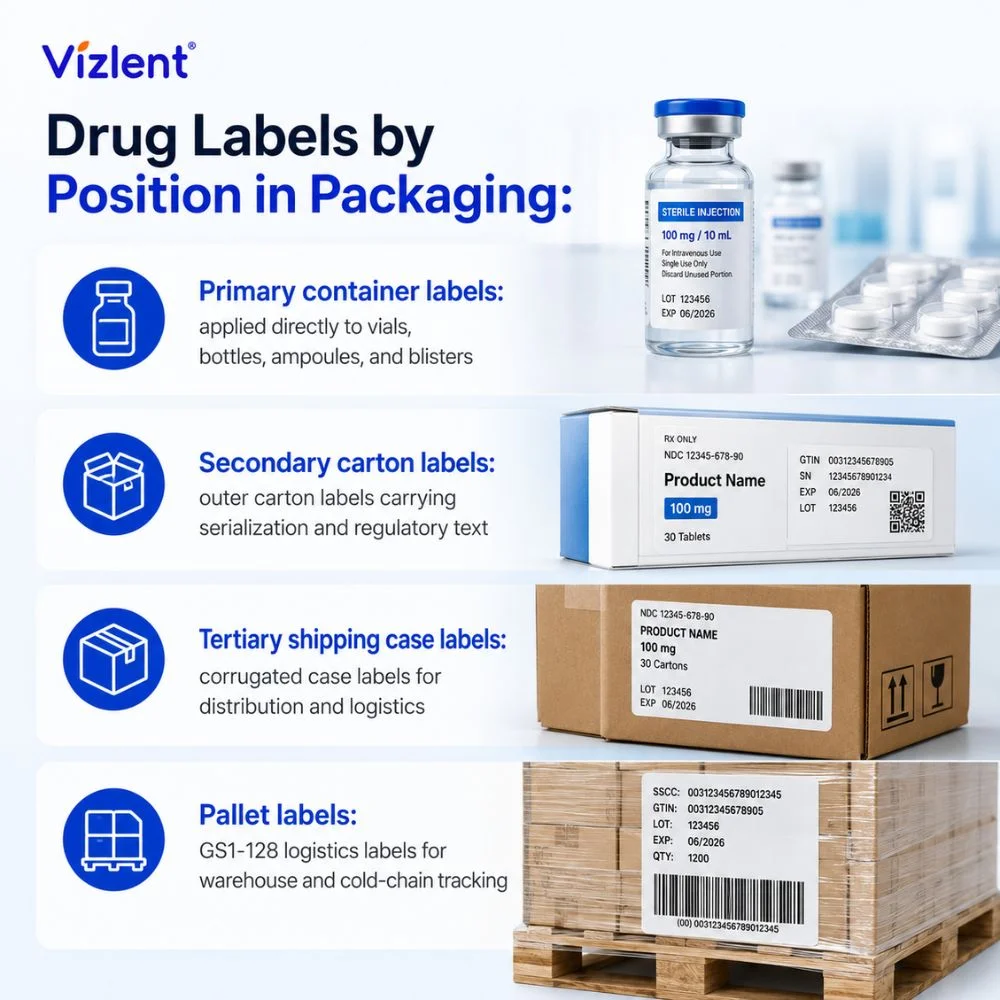
Every pharmaceutical package has three structural layers. The label that touches the drug directly behaves differently from the label on the outer carton, and both behave differently from the shipping case label. Each layer answers a separate question about traceability, branding, and logistics.
Types of drug labels in this group are defined by what they wrap. Primary container labels stick directly to the bottle, vial, ampoule, or blister, while secondary labels sit on the outer carton and tertiary labels handle the shipper and the pallet. Each carries a different regulatory weight under FDA 21 CFR 211.
The four position-based types:
- Primary container labels: applied directly to vials, bottles, ampoules, and blisters
- Secondary carton labels: outer carton labels carrying serialization and regulatory text
- Tertiary shipping case labels: corrugated case labels for distribution and logistics
- Pallet labels: GS1-128 logistics labels for warehouse and cold-chain tracking
6 Types of Pharmaceutical Labels Used in Pharmaceutical Packaging by Container Format

Container format dictates label material and adhesive choice almost completely. A pharmaceutical vial label faces glass curvature and autoclave heat, a blister pack label faces foil and ambient temperature, and an IV bag label faces flexible polyethylene and saline contact. Each demands a tailored substrate.
The format list runs longer than expected. Pharma bottle labels for HDPE retail packaging, pharmaceutical vial labels for glass injectables, ampoule labels for break-and-fill, blister labels for unit-dose, IV bag labels for clinical use, and syringe labels for sterile delivery all sit inside this cluster. Each format triggers a different combination of facestock, adhesive, and topcoat.
The six container-format types:
- Pharma bottle labels: retail dispensing bottles in HDPE, glass, or PET
- Pharmaceutical vial labels: small-diameter glass containers for injectables
- Ampoule labels: narrow break-and-fill glass containers for single-dose injectables
- Blister pack labels: foil and paperboard unit-dose carriers
- IV bag labels: flexible polyethylene infusion bag containers
- Syringe labels: prefilled sterile delivery device labels
5 Types of Medication Labels by Information and Warning Function
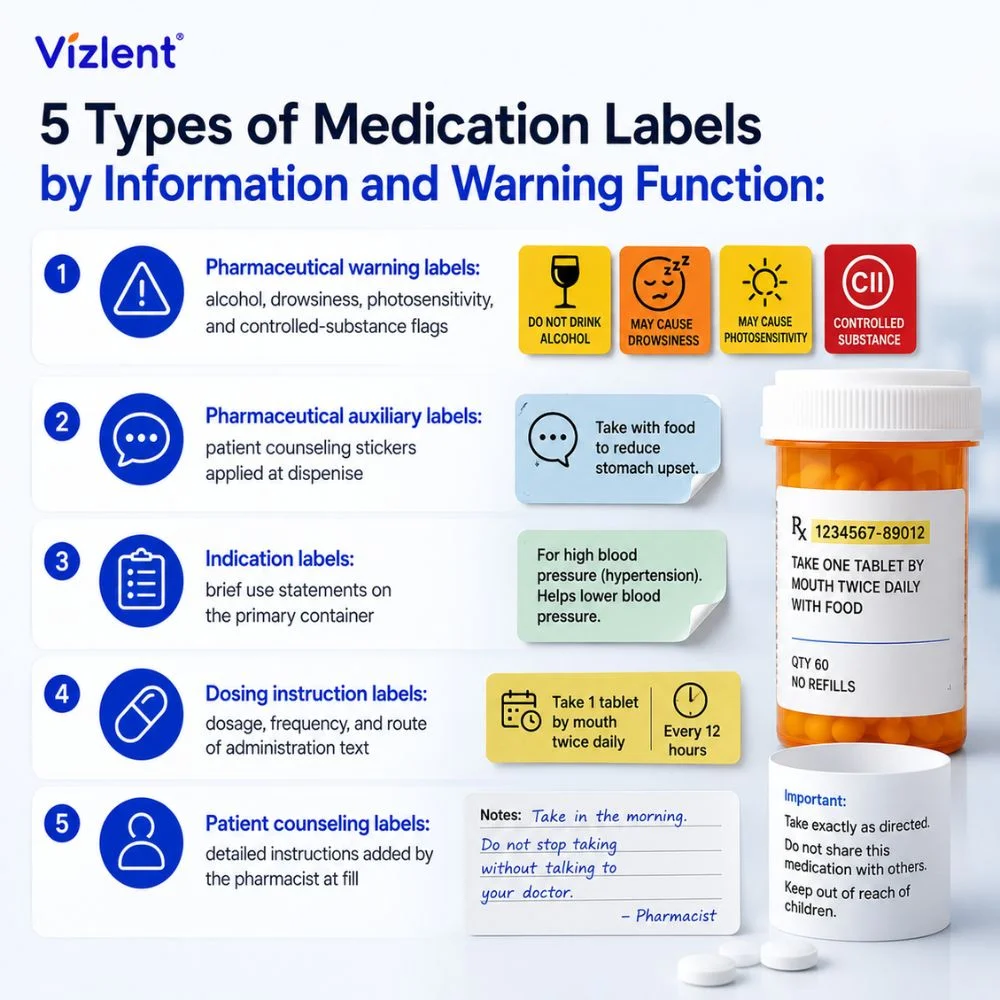
Some labels exist purely to convey information. Pharmaceutical warning labels flag hazards like alcohol interaction, drowsiness, photosensitivity, and controlled-substance status, while pharmaceutical auxiliary labels carry patient counseling instructions added at the dispensing pharmacy. Both sit alongside the primary label rather than replacing it.
Indication, dosing, and counseling layers round out the information set. Medicine labels and instructions for use vary in format from a single printed line on the bottle face to a multi-page patient information leaflet folded inside the carton. The patient sees them last but uses them most.
The five information and warning types:
- Pharmaceutical warning labels: alcohol, drowsiness, photosensitivity, and controlled-substance flags
- Pharmaceutical auxiliary labels: patient counseling stickers applied at dispense
- Indication labels: brief use statements on the primary container
- Dosing instruction labels: dosage, frequency, and route of administration text
- Patient counseling labels: detailed instructions added by the pharmacist at fill
4 Types of Label in Pharmacy by Regulatory and Compliance Role
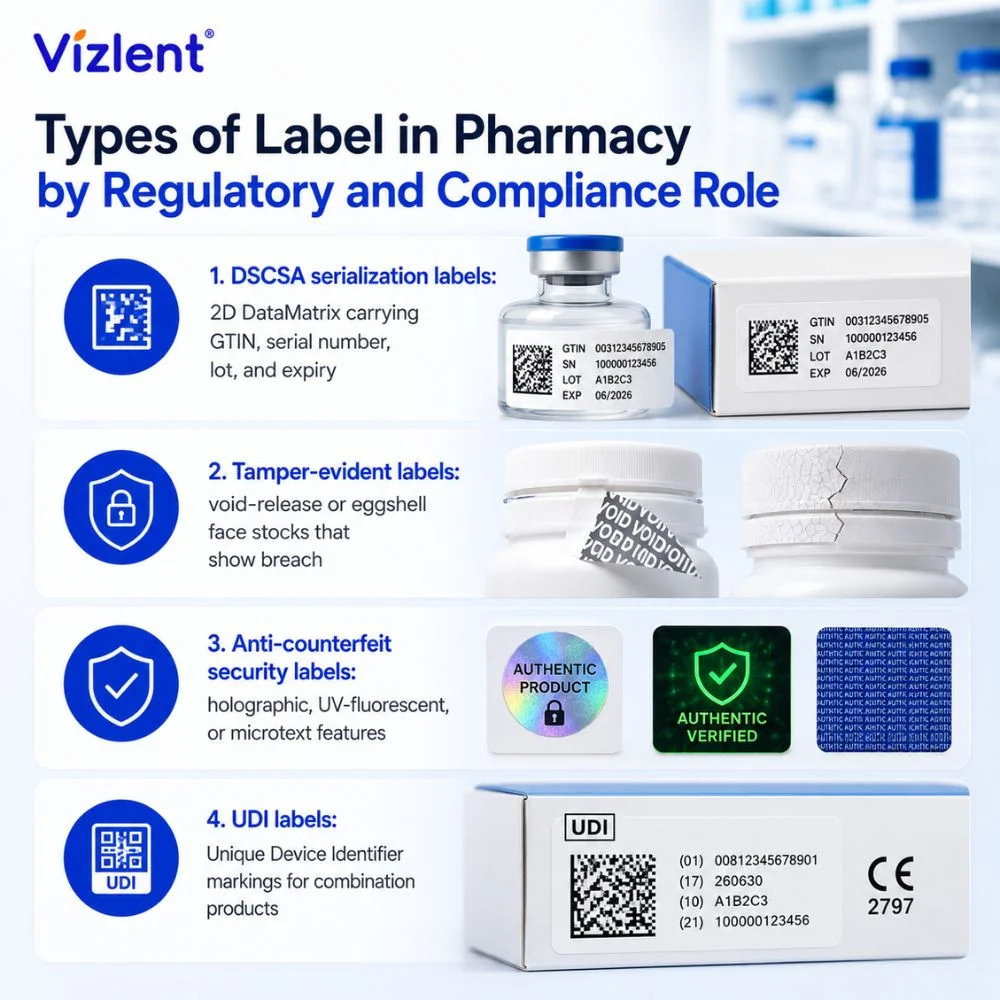
Regulators set strict requirements on a specific subset of labels. The DSCSA in the United States and the FMD in Europe both mandate serialization through a 2D DataMatrix code printed on every saleable unit of prescription medicine. Anti-counterfeit features layer on top.
Tamper evidence is the second regulatory pillar inside this cluster. A tamper-evident face stock fractures visibly when a package is opened, and the same construction often carries a serialized barcode that ties the broken seal back to a specific lot. Both layers protect against product diversion and counterfeit infiltration.
The four regulatory-role types:
- DSCSA serialization labels: 2D DataMatrix carrying GTIN, serial number, lot, and expiry
- Tamper-evident labels: void-release or eggshell face stocks that show breach
- Anti-counterfeit security labels: holographic, UV-fluorescent, or microtext features
- UDI labels: Unique Device Identifier markings for combination products
6 Specialty Pharmaceutical Labels for High-Risk Applications
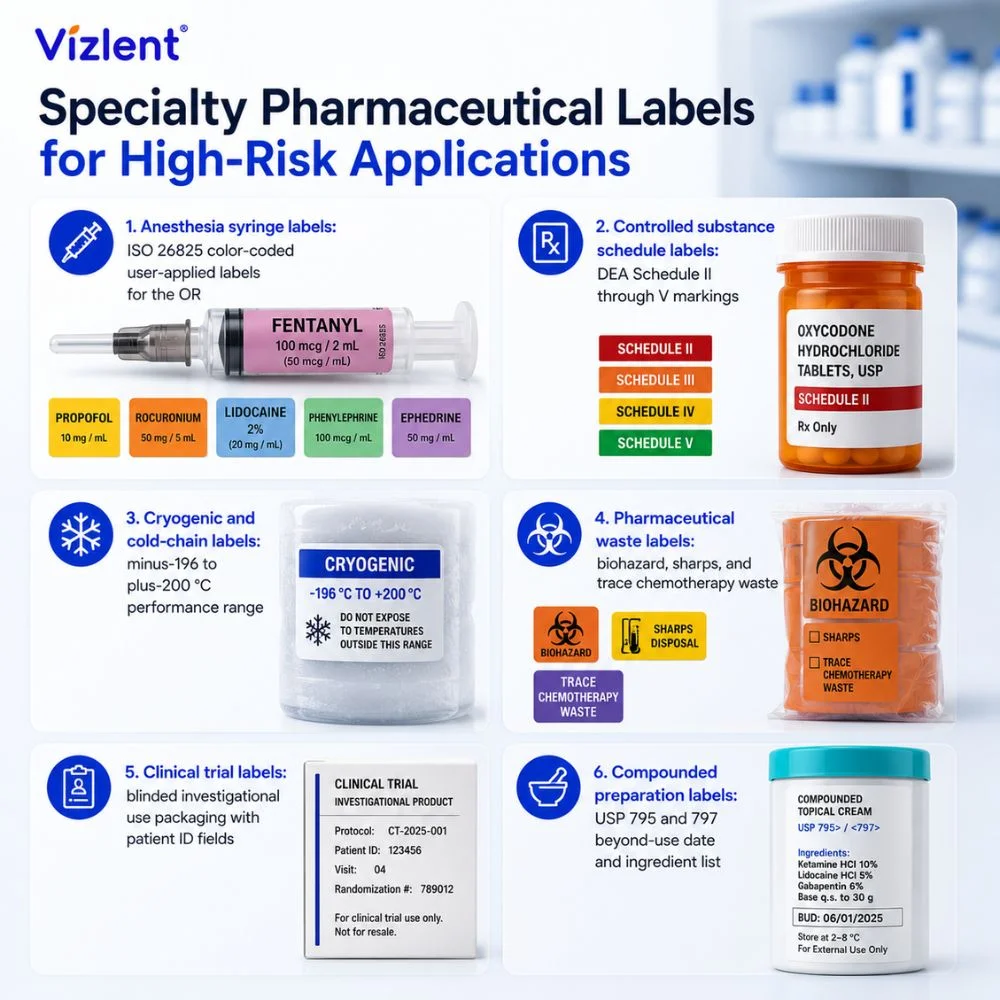
Some applications require dedicated label categories. Drug labels for anesthesia operate under ISO 26825, which mandates user-applied color-coded labels on syringes in the operating room to prevent dosing errors during procedures. The system uses standardized colors for each drug class to support rapid visual identification.
Cold-chain and waste streams add their own categories. Cryogenic and low-temperature labels survive minus 196 degrees Celsius in liquid nitrogen storage, while pharmaceutical waste labels handle biohazard, sharps, and chemotherapy waste streams. Clinical trial and compounding pharmacy labels carry custom investigational use and beyond-use date information under USP 795 and 797.
The six specialty types:
- Anesthesia syringe labels: ISO 26825 color-coded user-applied labels for the OR
- Controlled substance schedule labels: DEA Schedule II through V markings
- Cryogenic and cold-chain labels: minus-196 to plus-200 degrees Celsius performance range
- Pharmaceutical waste labels: biohazard, sharps, and trace chemotherapy waste
- Clinical trial labels: blinded investigational use packaging with patient ID fields
- Compounded preparation labels: USP 795 and 797 beyond-use date and ingredient list
4 Pharmaceutical Labels by Material Performance Requirements

Material performance is its own classification system. A durable polyester label survives autoclave sterilization, gamma irradiation, and routine isopropyl alcohol wipe-downs that would degrade a basic paper label within days. Heat-resistant and low-temperature variants extend the working range further in each direction.
Void and tamper-release labels make up the fourth performance category in this cluster. A void label leaves a visible pattern on the substrate when peeled, which serves as both a tamper indicator and a deterrent to relabeling counterfeit products. The performance class drives substrate selection long before artwork enters the conversation.
The four material-performance types:
- Durable polyester labels: survive autoclave, gamma, and solvent exposure
- Heat-resistant labels: stable through autoclave and depyrogenation cycles
- Low-temperature labels: cryo-rated facestock and adhesive for liquid nitrogen
- Void and tamper-release labels: leave visible pattern when removed from substrate
2 Brand and Identification Pharmaceutical Product Labels
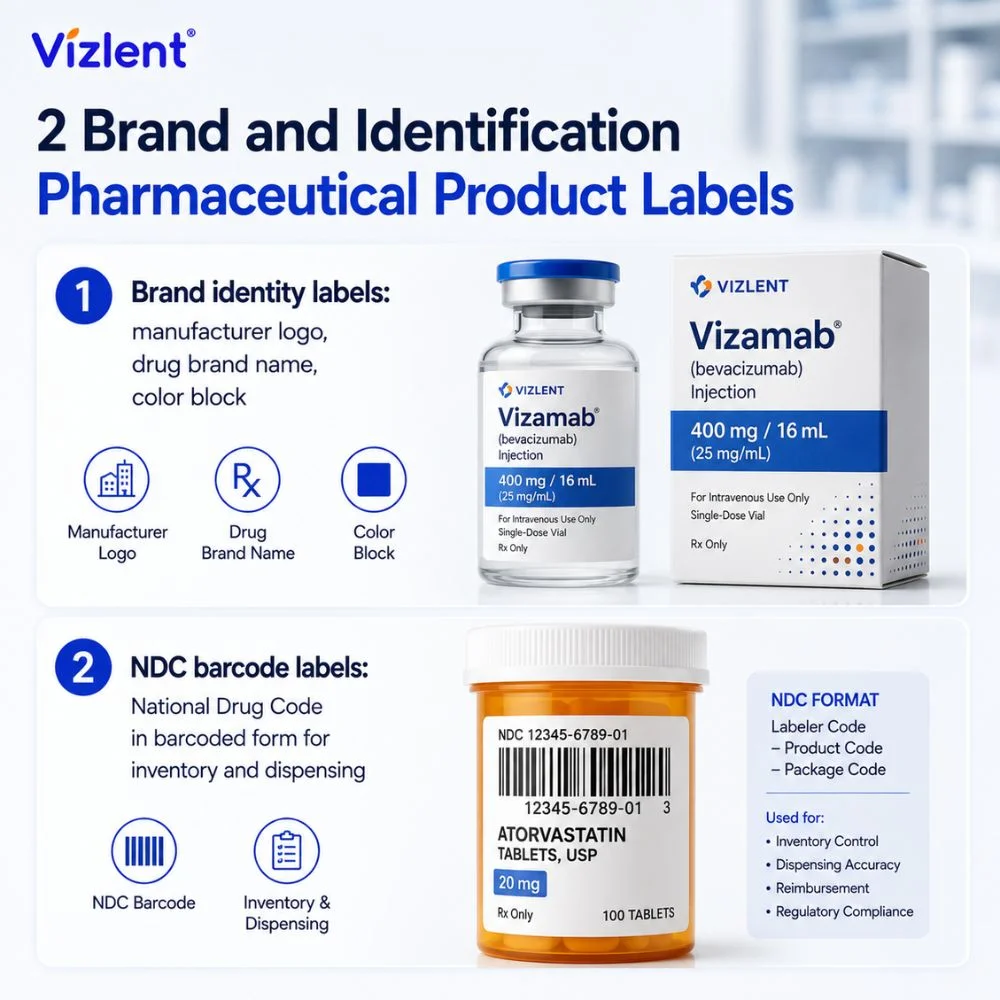
The last two categories handle commercial identity rather than safety. A pharmaceutical product label carries the manufacturer’s brand mark, drug name, strength, dosage form, and other identifying information that helps a pharmacist or patient confirm the right product. NDC barcode labels handle the machine-readable side of identification.
Branding on a pharmaceutical product label is more constrained than on consumer goods. Most jurisdictions cap commercial branding on prescription packaging to keep promotional content from overshadowing the legally required dosing and safety information. The result is a tightly governed visual hierarchy.
The final two types complete the count:
- Brand identity labels: manufacturer logo, drug brand name, color block
- NDC barcode labels: National Drug Code in barcoded form for inventory and dispensing
How to Match Pharmaceutical Label Types to Your Production Workflow
The right type depends on the dose form. A pharmaceutical manufacturer running a sterile fill-finish line for injectables needs vial labels, ampoule labels, and tertiary case labels in one production cycle, while a community pharmacy operates almost entirely on auxiliary and dispense labels. Mapping label types to workflow is the first procurement step.
Contract manufacturers face an even broader category mix. A single CMO production line might switch between blister packaging for solid orals, vial filling for injectables, and IV bag conversion for clinical trial supply, with each switchover requiring a different label substrate and adhesive system. Inventory planning gets complicated fast.
A quick mapping of label types to common production workflows:
- Sterile fill-finish: vial, ampoule, syringe, and IV bag labels
- Solid oral dosage: bottle, blister, and outer carton labels
- Compounding pharmacy: USP 795 and 797 compliant beyond-use date labels
- Hospital pharmacy: dispensing, auxiliary, and anesthesia syringe labels
- Clinical trial supply: blinded investigational labels with patient ID fields
- Cold-chain biologics: cryogenic vial and cold-chain shipping case labels
Common Procurement Mistakes When Sourcing Pharmaceutical Labels
Buyers fall into the same traps repeatedly. The most common procurement mistake is sourcing pharmaceutical labels on unit price alone without validating substrate performance against the actual sterilization cycle, solvent exposure, or temperature range the package will see in production. The second is ordering before sample testing the print fidelity.
Substrate mismatches usually surface during the first commercial run. A label that passed visual inspection in the lab can delaminate during autoclave sterilization, smear under isopropyl alcohol cleaning, or fail to scan after the gamma irradiation step that finishes the package. The cost of rework dwarfs the original label price by an order of magnitude.
Common mistakes worth catching at the RFQ stage:
- Sourcing on unit price without validation testing
- Skipping sample print runs before bulk commitment
- Underspecifying the temperature performance range
- Ignoring serialization print quality requirements (ISO/IEC 15415 Grade B or better)
- Choosing a single supplier with no backup source
- Approving artwork without consulting regulatory affairs
- Treating different label categories as interchangeable on the production line
Pharmaceutical Labels Manufacturer Selection for Business and Bulk Buyers
Sourcing pharma labels is not commodity work. Buyers searching for pharmaceutical labels manufacturer, pharma labels corp, pharmaceutical labels Delhi, or types of pharmaceutical labels business solutions are all asking the same question. Who supplies validated label stock at the scale and quality the regulator expects.
Major pharma hubs source label stock through a mix of regional and international suppliers. Buyers in Delhi, Hyderabad, Mumbai, Shanghai, and Singapore often combine local converters for short runs with international manufacturers like Vizlent for bulk pressure-sensitive coated stock used in pharmaceutical labeling and packaging. The dual-source mix protects against single-source supply risk.
Questions worth answering before committing to a supplier:
- Does the manufacturer hold ISO 9001, FSC, and SGS certifications?
- Can they provide sterilization validation data for your specific cycle?
- Are free samples available before any bulk commitment?
- What is the standard lead time, and how is it protected during peak season?
- Do they support pharma labels across the full temperature range, from cryogenic to autoclave?
- Will they sign a supplier quality agreement with change-notification clauses?
Request a pharmaceutical label sample roll →
Vizlent Supplies Label Stock Across the Full Pharmaceutical Category Range
The 31 types listed cover the major pharmaceutical label categories a packaging engineer or pharmacy procurement lead will encounter. Vizlent supplies pressure-sensitive label stock across nearly every category in the list, with substrates rated for autoclave sterilization, gamma irradiation, cryogenic storage, solvent exposure, and DSCSA-compliant serialization printing. Free sample rolls ship before any bulk commitment, sized to match your converting line.
Bulk orders typically leave the Shenzhen facility within 7 to 15 business days, with full ISO 9001, FSC, and SGS documentation included on every delivery. The materials engineering desk works directly with pharmaceutical converters, packaging engineers, and contract manufacturers on facestock, adhesive, and topcoat selection for each specific label category.
See Vizlent’s pharmaceutical and healthcare label range →
Talk to a Vizlent label specialist →
Frequently Asked Questions
What are the main types of pharmaceutical labels used in packaging?
The main types of labels used in pharmaceutical packaging fall into seven groups: primary, secondary, and tertiary by position; vial, ampoule, bottle, blister, IV bag, and syringe by container format; warning and auxiliary by function; serialization and tamper-evident by regulatory role; specialty labels for anesthesia and cold-chain; performance-rated material variants; and brand identity labels.
What are pharmaceutical auxiliary labels?
Pharmaceutical auxiliary labels are small stickers added to a dispensed prescription by the pharmacist, carrying counseling instructions such as “Take with food,” “May cause drowsiness,” “Avoid alcohol,” or “Refrigerate.” They supplement the primary dispensing label without replacing it. Pharmacies select them automatically based on triggers built into the pharmacy management system.
What does ISO 26825 say about drug labels anesthesia?
ISO 26825 sets the international standard for user-applied drug labels in anesthesia, mandating color-coded labels on syringes in the operating room. Each drug class carries a designated color and a standardized text format. The goal is to reduce syringe swap errors during procedures, where misidentification can directly cause patient harm.
Where do buyers source pharmaceutical labels in Delhi and other major hubs?
Buyers searching pharmaceutical labels Delhi typically combine local converters for short-run finishing work with international pressure-sensitive label stock manufacturers for bulk coated material. Major pharma hubs across India, China, and Southeast Asia follow the same dual-source pattern, balancing speed and cost against the audit and validation depth that larger global suppliers bring to the relationship.
What are pharmaceutical warning labels required to show?
Pharmaceutical warning labels carry hazard-specific text and color coding required by the FDA, DEA, and state pharmacy board rules. Common warnings include controlled-substance status, photosensitivity, sedation, alcohol interaction, refrigeration requirements, and shake-well instructions. The label format is standardized inside each pharmacy management system to match the specific drug being dispensed.
How do pharmaceutical product labels differ from auxiliary labels?
Pharmaceutical product labels are the primary printed labels applied by the manufacturer to the immediate drug container, carrying the legally required identification, dosing, and storage information. Auxiliary labels are smaller stickers added by the dispensing pharmacy to flag specific patient warnings. Both serve different points in the medication lifecycle.
Why are pharmaceutical vial labels usually polyester instead of paper?
Pharmaceutical vial labels sit on small-diameter glass containers exposed to sterilization, cold storage, alcohol wipe-downs, and frequent handling during clinical use. Polyester face stocks resist tearing, solvent attack, and temperature shock far better than paper substrates. They also hold barcode print fidelity through autoclave cycles that paper substrates rarely survive without smearing.
What information must pharmaceutical waste labels carry?
Pharmaceutical waste labels carry hazard classification markings governed by OSHA, EPA, and DOT regulations rather than FDA drug labeling rules. Required content includes biohazard or chemotherapy symbols, accumulation-start dates, generator identification, and color coding. The label material itself has to resist tearing, chemical contact, and the autoclave or incinerator handling involved in regulated waste disposal.
How are pharmaceutical labels manufactured at scale?
A pharmaceutical labels manufacturer at scale typically runs multi-station rotary presses that combine flexographic or UV-offset printing with inline lamination, die-cutting, and rewind into finished rolls. Pressure-sensitive coating happens upstream at a dedicated coater. Each step is documented under ISO 9001 quality systems and validated against the specific pharmaceutical labeling and packaging requirements of the end-use buyer.
Editorial disclosure: Regulatory frameworks referenced above (FDA 21 CFR 211.130, DSCSA, EU FMD, ISO 26825, USP 795 and 797, DEA Schedule classifications) are summarized for general educational purposes. Pharmaceutical manufacturers, pharmacy operators, and packaging engineers should consult their regulatory affairs teams and the current published versions of each regulation before making label selection or procurement decisions.






