
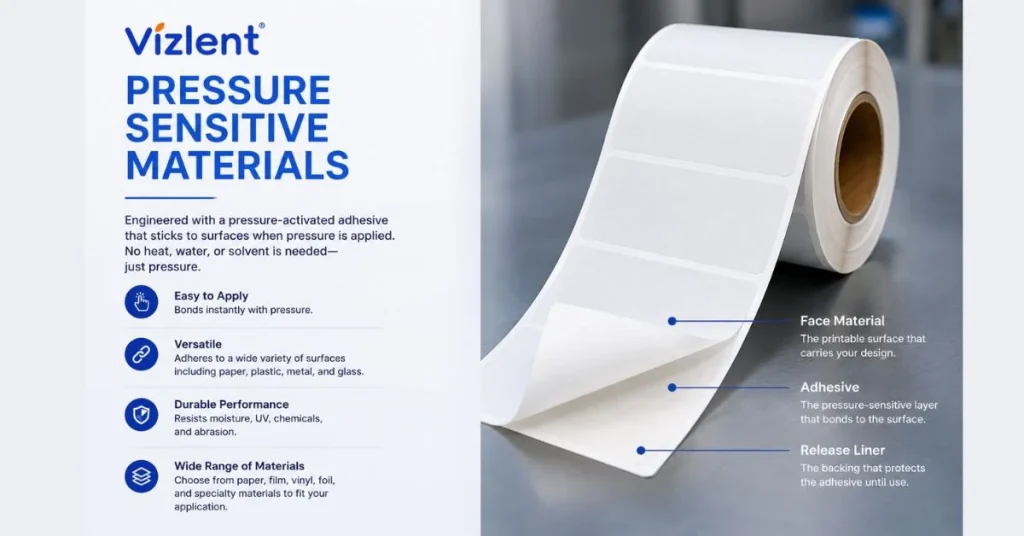
Pressure sensitive label materials are the facestock, adhesive, and release liner layers that combine into a label stock bonding to surfaces through light pressure alone, with no heat, water, or solvent needed to activate it. The facestock carries the print, the pressure sensitive adhesive forms the bond, and the liner protects that adhesive until the moment of application. Because the materials arrive ready to bond, the finished pressure sensitive label materials run on everything from a hand applicator to a high-speed bottling line, which is why they dominate product labeling worldwide.
This guide goes past the basic definition. It covers the full pressure sensitive label construction layer by layer, clears up the self-adhesive terminology question, explains how the adhesive chemistry actually works, and adds the materials sourcing details most articles skip, including market context and the HTS codes importers need.
Pressure Sensitive Label Materials Construction
A pressure sensitive label construction is a laminate of matched layers, and every performance trait traces back to one of them. The facestock is the printable surface, made from paper for dry ambient goods or from films such as BOPP (biaxially oriented polypropylene), polyester, and vinyl when moisture, chemicals, or tearing are in play. Many constructions add a topcoat over the facestock that locks in thermal transfer or inkjet print, a detail that decides whether barcodes survive handling.
Beneath the face sits the adhesive, and beneath that the release liner, usually a glassine paper or PET film with a silicone coating that lets the label peel away cleanly. Liner choice matters more than buyers expect, because a liner that tears or releases unevenly stops a labeling line just as surely as a bad adhesive. The layers behave as one system, so a construction is only as good as its weakest member.
- Facestock: paper, BOPP, polyester, or vinyl, chosen for the surface, conditions, and print method of the label faces.
- Adhesive: the pressure-sensitive layer, formulated as permanent, removable, or repositionable, and tuned to the substrate.
- Release liner: siliconized glassine or PET that protects the adhesive and controls how the label dispenses.
Not sure which construction fits your product? Request free pressure sensitive label material samples from Vizlent and test the full system on your line.
Pressure Sensitive Labels vs Self Adhesive: Is There a Difference?

Buyers comparing pressure sensitive label materials vs self adhesive labels usually discover the terms describe the same product. Self-adhesive is the everyday name, pressure sensitive is the technical one, and customs authorities treat them as synonyms, defining self-adhesive material as tacky at room temperature and bonding under nothing more than hand pressure. So, pressure-sensitive self-adhesive labels are not a contradiction; it is simply the full name.
The distinction that actually matters is against other label technologies. Wet-glue labels need adhesive applied at the labeler, shrink sleeves need heat tunnels, and in-mold labels fuse during container molding, while a pressure sensitive label arrives ready to bond. Vizlent manufactures the underlying self-adhesive material as coated stock, which converters then print and die-cut into finished pressure sensitive adhesive stickers and labels.
How Pressure Sensitive Adhesives Actually Work
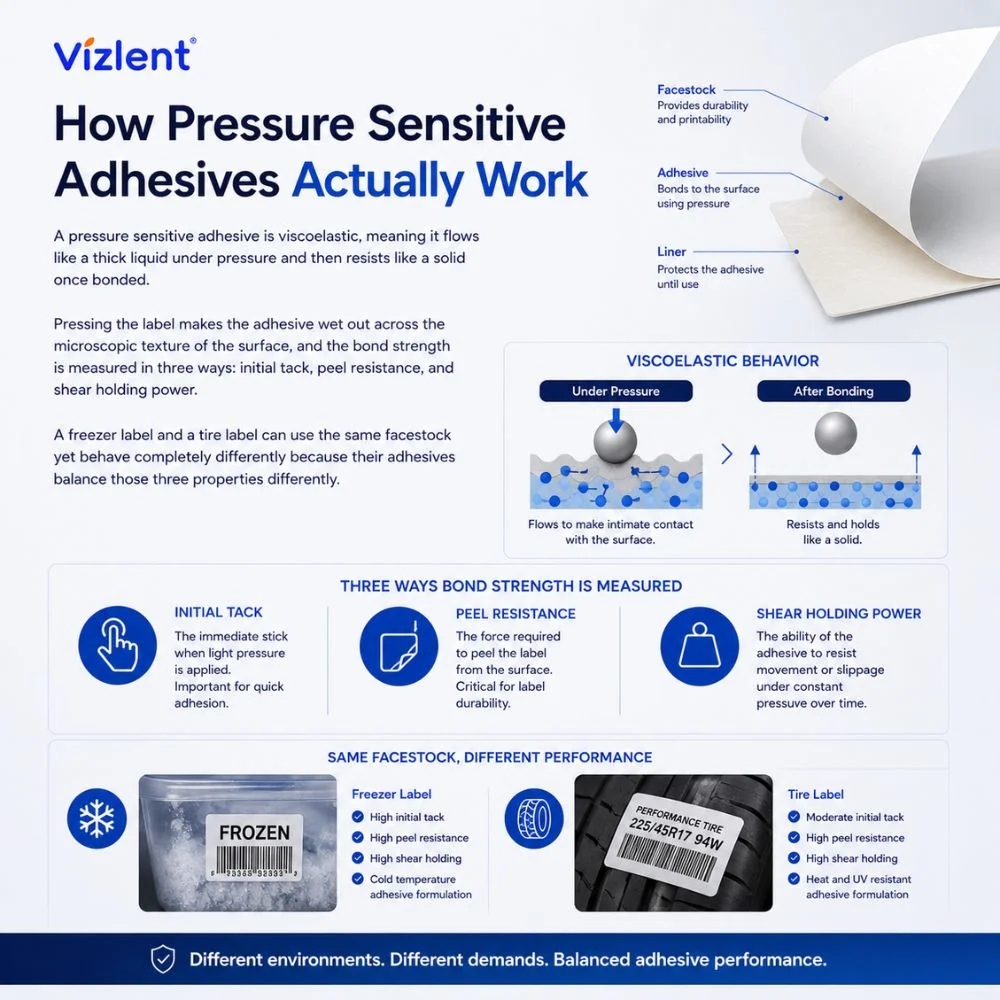
A pressure sensitive adhesive is viscoelastic, meaning it flows like a thick liquid under pressure and then resists like a solid once bonded. Pressing the label makes the adhesive wet out across the microscopic texture of the surface, and the bond strength is measured in three ways: initial tack, peel resistance, and shear holding power. A freezer label and a tire label can use the same facestock yet behave completely differently because their adhesives balance those three properties differently.
Chemistry drives that balance. Acrylic adhesives age well, resist UV and many chemicals, and anchor most permanent applications, while rubber-based hot melts grab faster on difficult and frosted surfaces, and silicone adhesives hold where extreme heat defeats everything else. Permanent grades build to a bond that cannot release cleanly, and removable grades hold securely yet peel away without residue, which is why specifying the adhesive is never an afterthought.
Unsure which adhesive grade your surface needs? Ask a Vizlent engineer for a recommendation backed by peel-strength data on your actual substrate.
Pressure Sensitive Label Materials Application Methods
Pressure sensitive label materials application scales from a thumb to a fully automated line. Hand application suits samples, short runs, and irregular products, while semi-automatic dispensers present each label for faster manual placement. High-volume operations use applicator machines that wipe, blow, or tamp each label onto bottles, jars, and cartons at thousands of units per hour with consistent placement.
Whatever the method, the surface decides the outcome. Substrates should be clean, dry, and above the adhesive’s minimum application temperature, because dust, moisture, and cold all block the wet-out the bond depends on. Low-energy plastics such as polypropylene need an adhesive formulated for them, since a standard acrylic that grips glass firmly can lift from an untreated plastic within days.
Common Pressure Sensitive Label Materials and Durability Options
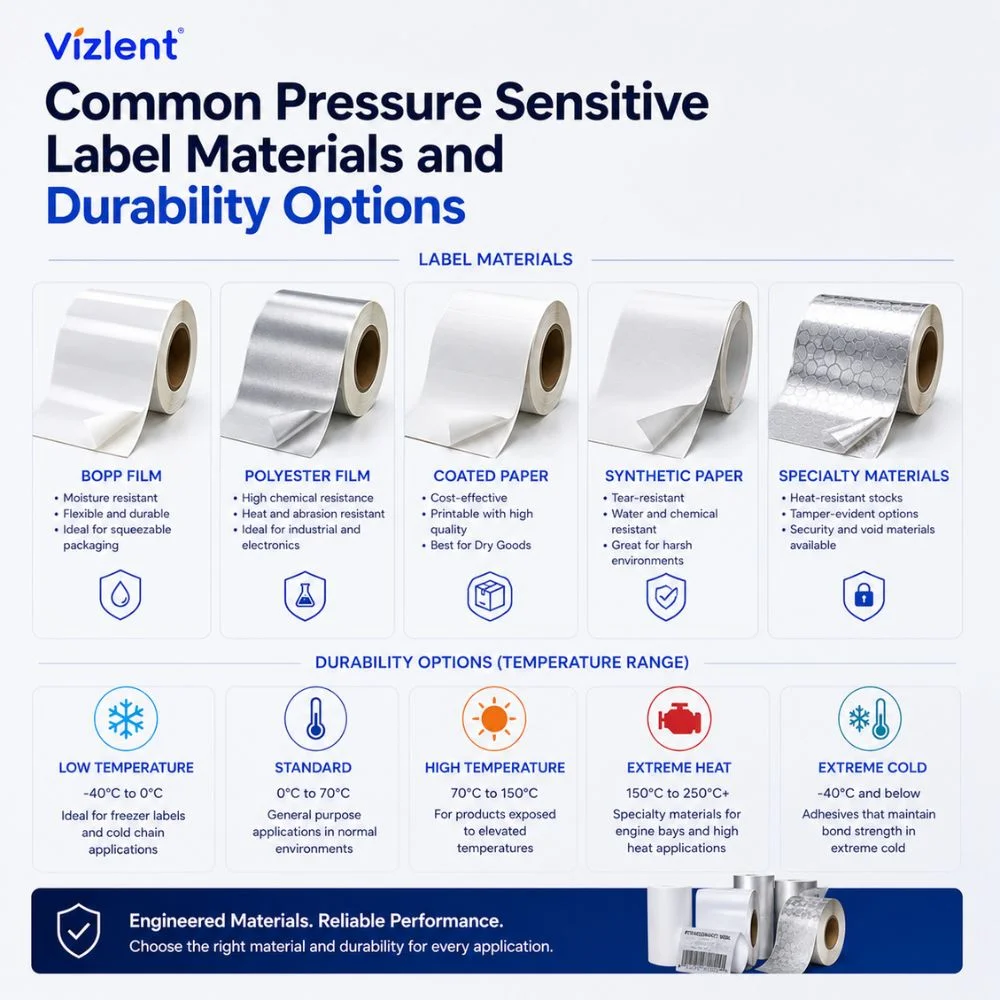
The pressure sensitive label materials’ construction can be tuned to almost any condition a product meets. BOPP film resists moisture and suits squeezable packaging, polyester adds chemical and heat resistance for industrial and electronics work, and coated papers keep costs down on dry goods. Specialty constructions extend the range further, from heat-resistant stock for engine bays to adhesives that hold at -40 degrees Celsius on low-temperature labels.
Durability also covers light and weather. UV-stabilized films on outdoor weather-resistant stock keep print legible through years of sun, and laboratory checks such as peel-strength testing under ASTM D3330 verify the numbers behind the claims. The point of all this range is simple: pressure sensitive adhesive labels are not one product but a family of engineered constructions.
Facing heat, cold, or outdoor exposure? Get a durability-matched construction from Vizlent validated for your conditions.
The Pressure Sensitive Labels Market
The pressure sensitive labels market is the largest segment of the global label industry. Analyst estimates of its 2025 size range from roughly 45 to over 100 billion US dollars depending on how the segment is scoped, with most forecasts agreeing on annual growth of around 4 to 5 percent into the 2030s. E-commerce shipping volume, food and beverage packaging, and pharmaceutical serialization are the demand engines behind that growth.
Asia-Pacific is the fastest-growing region, anchored by the coating and converting capacity concentrated in China. That geography matters to buyers, because much of the world’s label stock begins as jumbo rolls coated in Guangdong facilities before converters elsewhere print and die-cut it. Sourcing closer to that upstream capacity is how converters and brand owners capture factory pricing.
HTS Code for Pressure Sensitive Labels

Importers searching for the HTS code for pressure-sensitive labels should know that classification depends on the label’s material, construction, format, and printing status. Paper-based label stock and labels are generally classified within Chapter 48, while self-adhesive plastic film constructions are commonly classified within Chapter 39. The correct classification affects duty rates and may determine whether additional trade measures, including Section 301 duties on certain China-origin products, apply.
- 4811.41 – Self-adhesive paper and paperboard in rolls or sheets, commonly used for pressure-sensitive paper label stock and jumbo rolls.
- 4821.10 – Printed paper or paperboard labels, including many finished printed paper labels.
- 4821.90 – Other paper or paperboard labels, including many unprinted label products.
- 3919 – Self-adhesive plastic films, sheets, and related materials, including many BOPP, PET, and other film-based label constructions.
NOTE: These HTS headings are provided for general guidance only. Final classification depends on material, construction, dimensions, printing status, and product format. Consult a licensed customs broker or trade professional before importing.
How to Choose Pressure Sensitive Labels Manufacturers
Pressure sensitive labels manufacturers are split into two tiers that buyers often confuse. Upstream material manufacturers coat the adhesive onto facestock and liner, producing the pressure sensitive label materials themselves, while downstream printers and converters turn that stock into finished, printed labels. Knowing which tier you need prevents paying converter margins on raw stock or expecting print services from a coating plant.
Whichever tier fits, vet pressure sensitive label companies on control rather than price alone. Confirm the company runs its own coating or converting lines, request certifications such as ISO 9001, FSC, and SGS along with a Technical Data Sheet, and order free samples to test on your actual surface. For custom pressure sensitive labels and custom stock, a direct manufacturer can adjust the adhesive formula and format, which a reseller never can.
Request samples and a Technical Data Sheet from Vizlent and verify the material before you commit.
Source Pressure Sensitive Label Materials From Vizlent
Pressure sensitive label materials decide everything the finished label can do: a facestock matched to the conditions, an adhesive tuned to the surface and temperature, and a liner that runs clean on the line. Understand those materials, the terminology, the market, and the import codes, and sourcing stops being a gamble.
Vizlent manufactures pressure sensitive label stock at a 20,000 square meter Shenzhen facility, coating paper, BOPP, polyester, and vinyl constructions with adhesives rated from -40 degrees Celsius to high-heat service. As a direct manufacturer since 2011 with ISO 9001, FSC, and SGS certification, we customize facestock, adhesive, and format, ship jumbo rolls, precision-slit rolls, and die-cut sheets worldwide, and provide free samples with test data so you can validate before scaling. Reach out today to discuss your specification and source pressure sensitive label materials built for your application.
Contact Vizlent for a quote and free samples and put tested pressure sensitive label materials on your next run.
Frequently Asked Questions
What are pressure sensitive label materials in simple terms?
Pressure sensitive label materials are the three layers that make up a stick-on label: a printable facestock, a pressure sensitive adhesive that bonds with light pressure alone, and a release liner that peels away at application. No heat, water, or glue is needed at the point of labeling, which is what sets the construction apart.
Are pressure sensitive labels the same as self-adhesive labels?
Yes. Self-adhesive is the common name, and pressure sensitive is the technical one for the same construction, and customs definitions treat the terms as equivalent. The meaningful comparison is against wet-glue, shrink sleeve, and in-mold labeling, which all require activation or equipment that a pressure sensitive label does not.
What is the HTS code for pressure sensitive labels?
It depends on the product. Self-adhesive paper label stock in rolls falls under heading 4811.41, printed paper labels under 4821.10, unprinted paper labels under 4821.90, and self-adhesive plastic films under headings 3919.10 and 3919.90. Confirm the exact ten-digit code with your customs broker, since duty treatment varies by subheading and origin.
What adhesive types do pressure sensitive labels use?
The three main chemistries are acrylic, which ages well and resists UV and chemicals, rubber-based hot melt, which grips fast on difficult or cold surfaces, and silicone, which holds at extreme temperatures. Each comes in permanent, removable, or repositionable grades matched to the surface and service conditions.
How big is the pressure sensitive labels market?
Analyst estimates of the global market in 2025 range from roughly 45 billion to more than 100 billion US dollars depending on scope, with most forecasts projecting 4 to 5 percent annual growth into the 2030s. Asia-Pacific is the fastest-growing region, driven by packaging demand and the coating capacity concentrated in China.
Can I order custom pressure sensitive labels instead of stock sizes?
Yes. Direct manufacturers customize the facestock, adhesive grade, liner, roll width, and die-cut format to the application, which distributors selling stocked material usually cannot. Custom construction matters most when the surface is difficult, the temperature range is wide, or the label must meet a compliance standard.
Can pressure sensitive labels be applied by machine?
Yes, and most production volume is. Applicator machines wipe, blow, or tamp labels onto bottles, jars, and cartons at thousands of units per hour, while hand and semi-automatic application cover samples and short runs. Consistent results depend on a clean, dry surface above the adhesive’s minimum application temperature and a liner that dispenses reliably.






