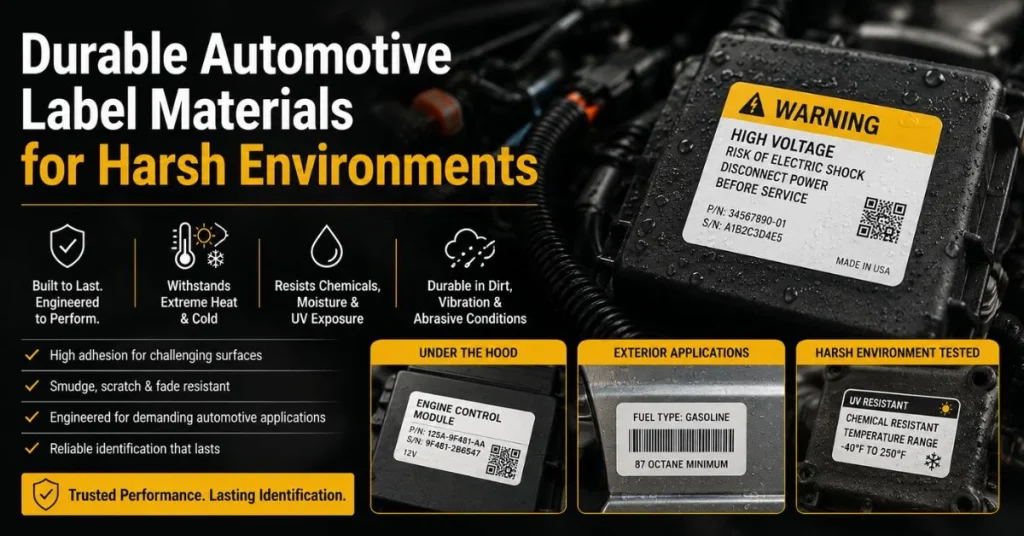
The most durable automotive label materials for harsh environments are polyimide (Kapton) film for under-hood heat above 150 degrees Celsius, polyester (PET) film for chemical and fluid resistance, and aluminum foil laminates for abrasion and dimensional stability. Each pairs with a high-temperature acrylic or silicone adhesive matched to the surface. The right choice depends on the exact heat, fluids, UV, and surface the label faces, and the sections below break down each one.
Few labels work harder than the ones inside a vehicle. They face engine heat, aggressive fluids, sunlight, and constant vibration, often for the legal ten-year life of the car. A standard label fails within weeks in these conditions, sometimes within hours under the hood.
Why Automotive Labels Need Special Materials
The automotive environment combines stresses that almost no other industry packs together. Under-hood temperatures on engine and exhaust-adjacent parts can sit above 150 degrees Celsius, with short spikes much higher, while the same vehicle must survive cold-soak storage down to -40 degrees Celsius. Standard acrylic adhesives lose their grip under this thermal cycling and peel away.
Heat is only the start. Automotive labels meet a broad chemical mix of motor oil, transmission and brake fluid, coolant, diesel exhaust fluid, fuel, and cleaning solvents, many of which are designed to penetrate and strip coatings. The material has to resist all of that while staying bonded to surfaces that range from e-coated steel to low-energy plastics, which is why a generic label simply will not do.
Need a label that survives your toughest application? Request a free automotive sample from Vizlent and test it under real conditions.
The Best Facestock for High-Heat Applications
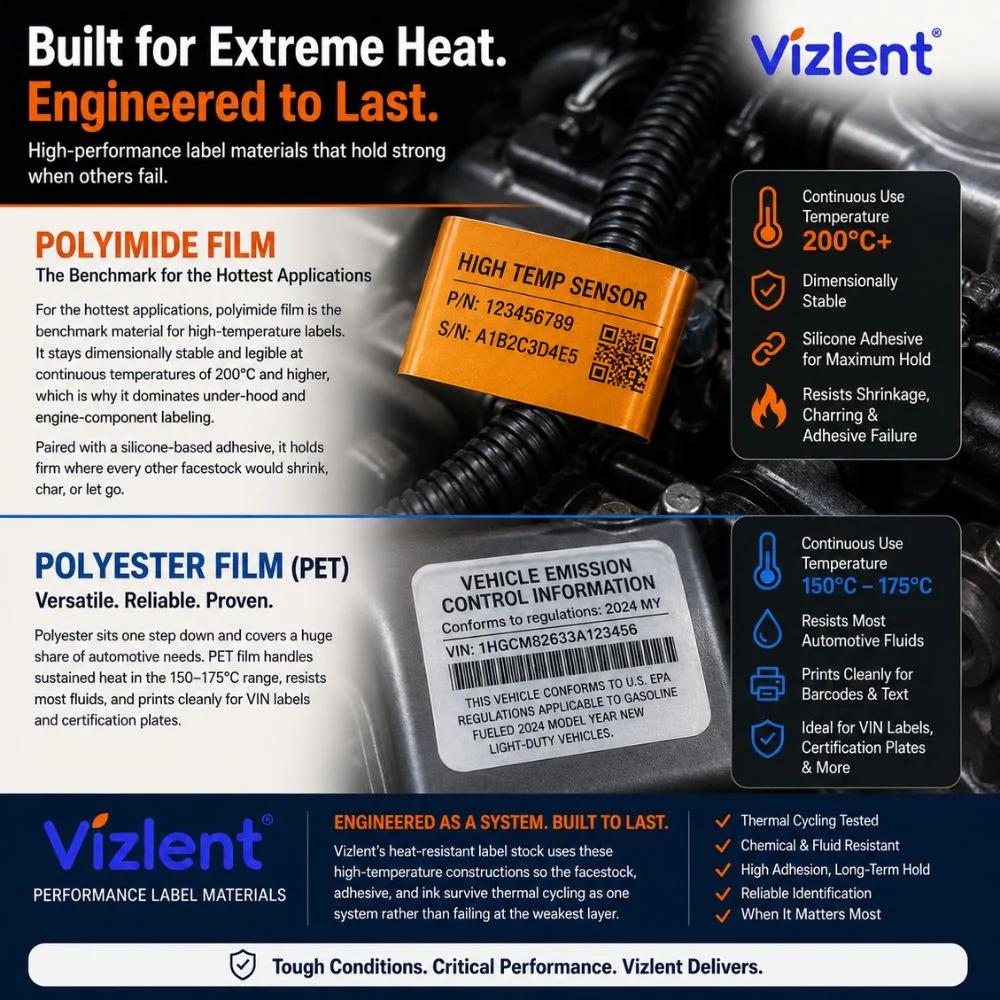
For the hottest applications, polyimide film is the benchmark material for high-temperature labels. Known widely by the trade name Kapton, it stays dimensionally stable and legible at continuous temperatures of 200 degrees Celsius and higher, which is why it dominates under-hood and engine-component labeling. Paired with a silicone-based adhesive, it holds firm where every other facestock would shrink, char, or let go.
Polyester sits one step down and covers a huge share of automotive needs. PET film handles sustained heat in the 150 to 175 degree Celsius range, resists most fluids, and prints cleanly for VIN labels and certification plates. Vizlent’s heat-resistant label stock uses these high-temperature constructions so the facestock, adhesive, and ink survive thermal cycling as one system rather than failing at the weakest layer.
Talk to a Vizlent engineer about the right high-heat facestock for your part.
Materials That Resist Automotive Fluids and Chemicals
Chemical resistance means the facestock and adhesive do not swell, blister, or bleed when fluids hit them. Polyester and polyimide facestocks far outperform paper or standard polypropylene here, because their dense films simply do not absorb the oils and solvents that wreck lesser materials. For any label that meets motor oil, brake fluid, or degreaser, one of these films is the safe starting point.
The adhesive carries equal weight in fluid resistance. Acrylic adhesives generally beat rubber-based ones for standing up to automotive fluids, though the exact formulation matters and should be matched to the specific chemicals involved. Vizlent’s solvent-resistant automotive label stock is engineered to withstand fuel, oil, and brake fluid contact, keeping engine bay labels legible through years of exposure.
Choosing an Adhesive for Difficult Surfaces
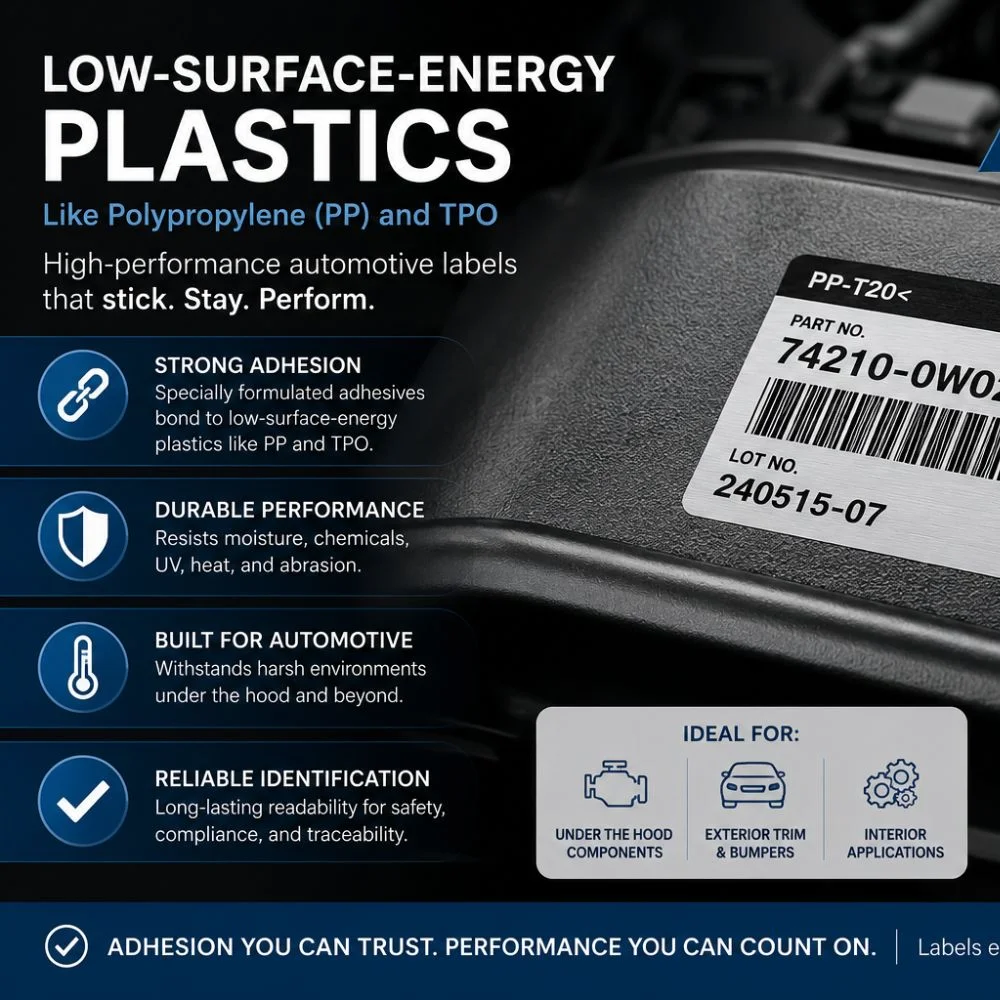
Automotive labels stick to a wider range of surfaces than almost any other product, and surface energy is the hidden challenge. Many modern parts are molded from low-surface-energy plastics like polypropylene and TPO, often below 35 dynes per centimeter, where standard permanent acrylics produce weak peel strength that fails as the bond ages. These surfaces demand a specially formulated adhesive that wets out and grips properly.
Temperature shapes the adhesive choice, too. Cold-soak conditions during winter storage and shipping can drop to -40 degrees Celsius, and an adhesive that holds at room temperature may go brittle and release in the cold. Vizlent’s low-temperature label stock uses adhesives engineered for adhesion down to -40 degrees Celsius, so labels stay attached through the full thermal range a vehicle endures.
Get matched to the correct adhesive for your surface and temperature range.
UV and Weather Resistance for Exterior Labels
Exterior automotive labels live in the sun, and ultraviolet light is a slow destroyer. Tire labels, underbody compliance tags, and window markings face years of outdoor exposure that causes ordinary materials to chalk, embrittle, fade, and lift at the edges. The label has to resist that degradation in both the facestock and the printed colors.
UV-stabilized films are the answer. Polyester and BOPP facestocks treated with UV-resistant topcoats hold their color and integrity through prolonged sunlight, which is why they are standard for weatherproof exterior labels. Vizlent’s outdoor weather-resistant label stock is built for this exposure, keeping print legible and adhesion intact where unprotected labels would deteriorate.
Flame Resistance for Wire Harness and Electrical Labels
Certain automotive applications add fire safety to the list of demands. Wire harness labels and electrical component identification often must resist ignition and meet defined flammability ratings, since these parts carry current and route through tight, heat-prone spaces. A standard label is a liability in these locations.
Flame-retardant label stock answers this need. Materials rated to standards like UL 94 V-0 resist ignition while still surviving the oil, heat, and abrasion of the engine bay. Vizlent’s flame-retardant label stock provides UL 94 V-0 rated identification for wiring harness and cable assembly, combining fire safety with the durability automotive work demands.
Explore flame-retardant options with Vizlent for your electrical and harness labeling.
Matching the Material to the Application
Choosing the right material starts with mapping the exact conditions the label will face. Define the surface and its surface energy, identify both the continuous and peak temperatures, and list the specific fluids and chemicals the label will contact. A label rated for 120 degrees Celsius continuous service can still fail at a 180-degree paint-oven spike, so the full profile matters.
Print method has to match the durability target as well. Thermal transfer printing with a resin-grade ribbon on polyester is the standard for labels needing chemical, abrasion, and heat resistance, because the resin image cures into the topcoat and resists smearing. Confirm any regulatory requirements early too, since VIN, emission, and safety labels under standards like FMVSS 115 must stay legible for the vehicle’s full service life.
Request a Technical Data Sheet from Vizlent and match the material to your specification.
Verifying an Automotive Label Supplier
Run the same checks on any supplier before committing to production. Confirm the company is a direct manufacturer with its own coating lines rather than a reseller, ask how long it has produced automotive-grade stock, and request peel adhesion data measured on your actual target surface, not a stainless steel reference. Verifiable test data is what separates a real automotive material from a generic one with a durable label.
Then test before you scale. Order free samples and run them through your real thermal, chemical, and surface conditions, checking adhesion, legibility, and edge integrity after exposure. A supplier that supports this testing and answers technical questions directly is signaling the engineering depth that automotive work requires.
Request samples and test data from Vizlent and verify the performance yourself.
Source Durable Automotive Label Materials From Vizlent
The most durable automotive label materials for harsh environments come down to matching the facestock, adhesive, finish, and print method to the exact heat, fluids, UV, and surface the label faces. Polyimide handles extreme heat, polyester covers fluids and certification, foil laminates resist abrasion, and the adhesive must suit both the surface energy and the full temperature range. Get the match right and the label performs for the life of the vehicle.
Vizlent manufactures automotive label stock from a 20,000 square meter facility in Shenzhen, with polyimide, polyester, and foil facestocks, high-temperature and low-temperature adhesives, UV-stabilized and flame-retardant constructions, and materials tested through thermal cycling and chemical immersion. As a direct manufacturer since 2011, we customize facestock, adhesive, and format to your application, ship jumbo rolls, slit rolls, and die-cut sheets, and provide free samples so you can test before scaling. Reach out today to discuss your specification and source automotive label materials engineered to last.
Contact Vizlent for a quote and free samples and put a tested automotive label material on your next program.
Frequently Asked Questions
What is the most durable automotive label material?
For continuous heat above 150 degrees Celsius, polyimide (Kapton) film with a silicone adhesive is the most durable choice. Polyester (PET) film is the best all-around material for fluid resistance and certification labels, and aluminum foil laminates excel at abrasion and dimensional stability. The right pick depends on the specific heat, fluids, and surface involved.
What facestock survives under-hood temperatures above 150°C?
Polyimide film, commonly called Kapton, paired with a silicone-based adhesive, is the standard for continuous service above 150 degrees Celsius, typically rated to 200 degrees and higher. Aluminum foil laminates with high-temperature acrylic adhesives also work in the 150 to 175 degree range, where a metallic, printable surface is needed.
Which adhesive works on low-surface-energy automotive plastics?
Low-surface-energy plastics like polypropylene and TPO, often below 35 dynes per centimeter, need a specially formulated adhesive rather than a standard permanent acrylic. Standard acrylics produce weak peel strength that fails as the bond ages. Ask the supplier for peel data measured on your actual plastic substrate.
What print method should automotive labels use?
Thermal transfer printing with a full-resin ribbon on a polyester facestock is the standard for automotive labels exposed to heat, oil, or solvents. The resin ink cures into the topcoat to resist smearing and chemical contact, which wax and wax-resin ribbons cannot match in harsh conditions.
How long must automotive labels stay legible?
VIN, emission, and safety labels must remain legible for the vehicle’s useful life, generally defined as ten years or 100,000 to 150,000 miles in the United States under EPA requirements. This benchmark drives the material qualification for durable automotive labels.