
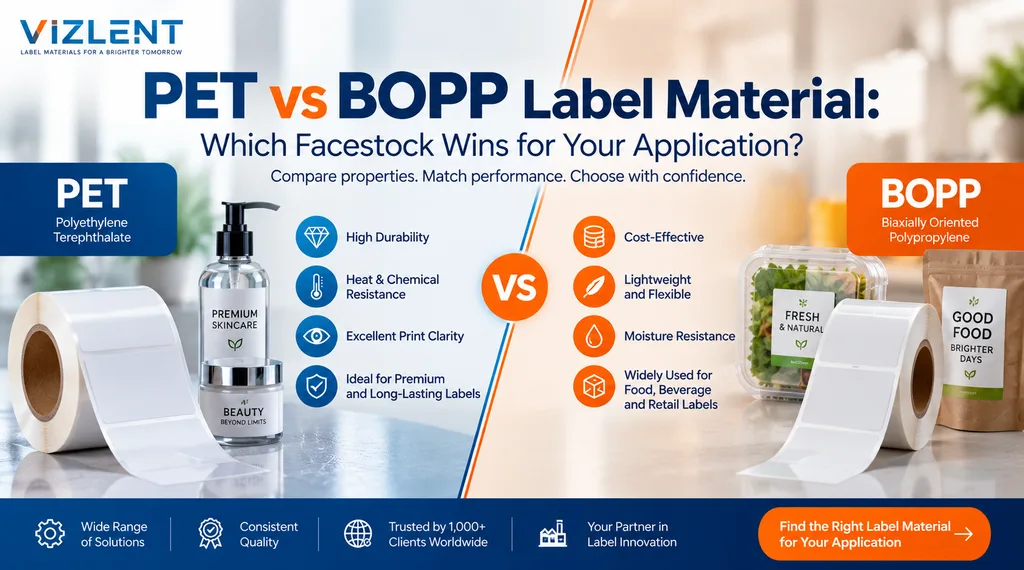
When you hear about PET vs BOPP Label Material, it’s best to understand that Polyester (PET) is the tougher facestock family and biaxially oriented polypropylene (BOPP) is the more economical one. PET generally holds its dimensions and its print at higher temperatures and against a wider range of solvents. BOPP offers moisture resistance, clarity, and conformability at a lower cost per square metre.
Most buyers choose a polymer before defining the exposure the label actually faces. A construction built for a solvent drum will overspend badly on a shampoo bottle. A construction that looks flawless on a chilled beverage can curl off a powder-coated enclosure within a season.
What Are BOPP and PET Label Materials?
Both names describe polymer families, not performance grades. Treating the polymer name as the complete specification can cause material-selection errors. A clear 50-micron BOPP film and a cavitated white BOPP film can behave differently on the same bottle because their constructions and physical properties differ. The same principle applies across polyester label material grades, where gauge, surface treatment, topcoat, and formulation can affect the finished label’s performance.
Treat the resin as the starting point and the full construction as the specification. Facestock, adhesive, liner, topcoat, and any overlaminate work together to determine the finished label’s performance. A technical data sheet for a named construction is therefore more useful for specification than a general claim about a polymer family.
What is BOPP label material?
Buyers asking what is BOPP labels are asking about polypropylene film stretched in both the machine and cross directions, which raises tensile strength, clarity, and dimensional stability. BOPP label material offers strong resistance to water and many oils, though finished-label resistance depends on the adhesive, ink, and topcoat as well. It carries resin identification code 5, and common variants include ultra clear no-label-look film, cavitated white opaque, matte, pearlised, and metallised BOPP sticker material.
Our primer on what BOPP label material is covers the film structure in more depth. For selection purposes, BOPP label stock is a mid-durability film with a soft, conformable hand. It is widely used as a film facestock for consumer packaging where moisture resistance, clarity, and conformability matter.
What is PET label stock?
PET is polyethylene terephthalate, oriented into a stiff, dimensionally stable film. PET label stock generally resists solvents, fuels, and abrasion better than polypropylene, and it carries resin identification code 1. It is a common starting point for rating plates, asset tags, flame retardant electronics labels, and anti-static identification.
PET is also commonly specified at thinner gauges than BOPP for comparable handling strength, typically 23 to 50 microns against 50 to 60, a difference with a commercial consequence worked through below. Vizlent publishes a service capability up to 150 degrees Celsius for its industrial grade PET films. That rating belongs to those named constructions, not to polyester as a category.
PET vs BOPP Label Materials: The Properties That Decide Selection
Comparisons that stop at “PET is stronger” are not useful at a purchase order. Five properties change the answer: thermal behaviour, chemical resistance, stiffness, cost per square metre, and end-of-life behaviour. Everything else follows from those.
The table sets out how the two families generally differ. Figures describe typical commercial constructions and are indicative only, so confirm every value against the data sheet for the grade you intend to buy. Ratings belong to named constructions, not to polymer families.
| Property | BOPP label stock | PET label stock |
|---|---|---|
| Polymer | Biaxially oriented polypropylene | Polyethylene terephthalate |
| Published resin density | About 0.90 to 0.92 g/cm³ | About 1.38 g/cm³ |
| Resin identification code (ASTM D7611) | 5 | 1 |
| Typical facestock gauge | 50 to 60 microns | 23 to 50 microns |
| Relative stiffness | Lower, conformable | Higher, rigid |
| Dimensional stability at elevated temperature | Lower | Higher; Vizlent publishes up to 150 °C for named industrial constructions |
| Solvent and fuel resistance | Moderate | Broader |
| Clarity | Excellent, including no-label-look | Excellent, slight blue cast in some grades |
| Relative material cost | Lower | Higher |
| Behaviour in a PET bottle recycling stream | Floats and can separate | Sinks with the PET |
Indicative comparison. Confirm against the technical data sheet for your specific construction.
Temperature: The First Filter in a PET vs BOPP Label Material Type Decision
Peak temperature eliminates more candidates than any other input, so run it first. PET generally retains dimensional stability at higher temperatures than BOPP, but usable service temperature depends on the complete construction. Film grade, crystallinity, adhesive, topcoat, ink, dwell time, thermal cycling, and mechanical stress all move the result.
Service temperature and application temperature are separate questions, and both need answering. A label may be applied at ambient and then live at 120 degrees, or applied into a cold room at minus 20 and never see heat again. Vizlent supplies both ends through heat resistant label stock and low temperature label stock.
- Below 80 °C, dry or wet: BOPP constructions are usually sufficient and cheaper.
- 80 to 150 °C: evaluate PET constructions first, then qualify film, adhesive, ink, and exposure together.
- Above 150 °C continuous: consider polyimide or another high-temperature construction after reviewing the actual thermal profile.
- Frozen and cold chain: qualify adhesive performance and low-temperature film behaviour together.
Send your thermal profile to a Vizlent engineer and get a construction recommendation before you order samples. Talk to our team.
Chemical, Fluid, and Outdoor Exposure
Polyester generally resists aromatic hydrocarbons, fuels, and cleaning solvents more broadly than polypropylene, which is why PET is common in petrochemical and drum labelling. BOPP handles water, dilute detergents, and many food oils well, and it suits the wipe-down environments most consumer packaging meets. The failure mode buyers underestimate is topcoat or adhesive attack, where ink lifts long before the film shows damage.
Outdoor service combines ultraviolet radiation, thermal cycling, and moisture rather than presenting them separately. UV-stabilised PET with a cross-linked permanent acrylic adhesive and a UV-blocking overlaminate is a common multi-year exterior specification, grouped under Vizlent’s outdoor weather resistant constructions. Ask any supplier for accelerated weathering data on the exact construction, since a short exposure trial is a screening condition rather than proof of long-term service life.
Substrate Compatibility: The Question PET vs BOPP Alone Cannot Answer
Facestock choice does not determine whether a label sticks. Adhesion is governed by the substrate’s surface energy, its roughness and contamination, the application temperature, and the dwell time before the bond reaches full strength. Low-surface-energy plastics such as HDPE and polypropylene, along with powder-coated and textured metals, defeat standard permanent acrylics regardless of which film sits above them.
Match the adhesive to the surface, then choose the facestock for the exposure. Vizlent supplies eight adhesive grades spanning permanent, removable, freezer, and wash-off, including high-tack systems for low-energy substrates. Peel and shear results are only meaningful when measured on your actual substrate under your actual application conditions.
- Glass, painted metal, coated board: most permanent acrylics perform predictably.
- HDPE, PP, textured or powder-coated surfaces: specify a high-tack or rubber-based system.
- Cold or damp application: confirm the minimum application temperature, not just service temperature.
- Any curved or flexible pack: test after the pack has been squeezed, filled, or flexed.
Print and Barcode Performance: Ribbon, Ink, and Topcoat
Print compatibility depends on the complete print system rather than the facestock alone. Both films need a receptive topcoat and surface treatment, because untreated polyolefin and polyester have low surface energy that ink will not anchor to. What differs is which imaging technology each film pairs with most comfortably.
Grade barcodes against the current editions, ISO/IEC 15416:2025 for linear symbols and ISO/IEC 15415:2024 for two-dimensional symbols. Both define measurement and grading methods, and neither establishes that a symbol will meet a given application’s scanning requirement. Where abrasion threatens the printed image, an overlaminate from the laminating film range often costs less than upgrading the facestock.
- Flexographic and UV inkjet: both films, with the correct topcoat.
- Thermal transfer: wax-resin can suit many BOPP constructions and resin is commonly selected for demanding PET applications, using Vizlent’s thermal transfer ribbon and resin ribbon ranges. Validate against the specific topcoat and exposure.
- Laser printing: use a laser-compatible PET construction rated for the printer’s fuser conditions.
- Direct thermal: use a purpose-built thermal-coated BOPP, PET, or other compatible facestock rather than standard uncoated film.
Cost Per Square Metre, Not Cost Per Kilogram
Label stock is quoted by weight but consumed by area, and the density gap is where BOPP’s cost advantage genuinely lives. At equal thickness, published resin densities of about 0.91 g/cm³ for polypropylene and 1.38 g/cm³ for PET mean a kilogram of BOPP covers roughly 1.5 times the area a kilogram of PET does. On a 50 micron film that is approximately 45 grams per square metre against 69, before adhesive, liner, or margin.
The nuance most comparisons miss is that PET is rarely specified at BOPP’s gauge. A 25 micron PET film weighs around 34 grams per square metre, lighter than a 50 micron BOPP, so the yield advantage can reverse once you compare the constructions you would actually buy. Run the arithmetic on your real gauges and ask your supplier to quote per thousand square metres of finished self-adhesive material.
Recyclability: The Factor Most Comparisons Get Backwards
Here is the point that reverses intuition. For PET bottle recycling, floatable polyolefin labels are generally preferred over sinking PET labels, because they can separate from the PET during float-sink processing. The Association of Plastic Recyclers notes that PET has a density of 1.38 g/cm³ and therefore sinks, and its design guidance recommends that closures, labels, and attachments use materials below 1.0 g/cm³.
Polypropylene sits at roughly 0.90 to 0.92 g/cm³ and floats, and APR notes that recovered floatable polyolefin can form a saleable side stream. Outcomes still depend on the whole pack design, including label coverage, adhesive, inks, coatings, metallisation, and the sorting process in your market. One further caution: a resin identification code under ASTM D7611 identifies the resin only and is explicitly not a recyclability claim.
Sourcing a bottle programme with recycled-content targets? Send us your pack specification and we will flag any float-sink risk before you commit to a run.
Compliance: UL 969, Food Contact, and What a Certificate Covers
For safety marking, UL 969, the Standard for Marking and Labeling Systems, is the reference that matters, and its sixth edition was published on 28 July 2025. Its scope covers unprinted materials such as blank label stocks and overlaminations, and it also covers specific combinations of material, ink, and printing process evaluated as a system on named surfaces. The distinction buyers need: a recognised facestock does not by itself show that a finished label system is qualified for your application.
Food-contact suitability follows the same logic. In the United States, some label applications can be covered by 21 CFR 175.105 for indirect-additive adhesives and 21 CFR 175.125 where the adhesive is the food-contact surface. Citing a section does not establish compliance, and requirements vary by market, product category, and intended use, so request current compliance documentation for your jurisdiction.
White BOPP Label Material, Clear, and Metallised Finishes
Finish selection is a commercial decision that quietly changes technical performance. White BOPP label material is cavitated, meaning gas voids create opacity during orientation, which lowers density and typically reduces tensile strength against a clear film of equal gauge. Clear BOPP delivers the no-label-look that beer and beverage brands ask for, and metallised BOPP gives a foil appearance without a laminate.
Each finish carries a downstream consequence worth checking before artwork is signed off. Metallised layers and heavy ink coverage can interfere with near-infrared sorting and can push a floating label into the sink fraction, so confirm the effect with your recycler or through APR test methods. Surface finish can also affect measured barcode contrast, so verify grade on the finish you intend to print rather than on a clear sample.
Converting, Application, and the Failure Patterns We See Most
Stiffness drives behaviour on the line as much as durability in service. PET’s rigidity generally helps clean dispensing at speed and resists edge lift on flat, rigid substrates, but it can fight back on tight radii and squeeze bottles where BOPP conforms with less stress. Stiffer films can also shorten die life, so confirm die specification with your label stock supplier rather than assuming one tool covers both.
Three patterns account for most material complaints that reach our engineering team. Each is preventable with a sample trial run under written acceptance criteria. None is a fault of the polymer itself.
- Specifying PET for a squeeze pack. The film is fine; the geometry is not, and edges lift under repeated deformation.
- Specifying BOPP for a hot-fill or wash-down process. Peak temperature was measured at the product, not at the label surface.
- Changing facestock without requalifying the adhesive. Surface energy, coat weight, and application temperature all shift.
Which Facestock Should You Start From? A Table by Application
Use this as a shortlist, not a specification. Each row names the family most buyers should evaluate first for that application, and every one still needs qualification against your own exposure, substrate, and print system. Treat it as an author recommendation rather than a published rating.
The second column is a starting point, not a guarantee of performance. Where two families could work, the adhesive and topcoat usually decide the outcome. Send the row that matches your application to an engineer and ask for a named construction.
| Application | Starting point to evaluate |
|---|---|
| PET bottle entering a bottle recycling stream | BOPP |
| Cost-sensitive consumer packaging | BOPP |
| No-label-look packaging | Clear BOPP |
| Squeeze bottles and flexible packs | BOPP |
| Outdoor equipment and asset tags | UV-stabilised PET construction |
| Rating and certification plates | PET construction |
| Solvent and fuel exposure | PET construction |
| Sustained high-temperature service | PET or a specialty high-temperature construction |
| Extreme temperature above 150 °C | Polyimide or another specialty construction |
| Frozen and cold chain | Low-temperature construction of either family |
Get the Right Facestock Specified the First Time
Choosing between polyester and polypropylene is a matching exercise, not a ranking exercise. The winner is whichever construction is qualified against your real exposure at the lowest defensible cost. Vizlent has manufactured self-adhesive label stock since 2011 from its Shenzhen facility, coating paper, PET, BOPP, PVC, and vinyl facestocks against eight adhesive grades, to ISO 9001 with FSC and SGS certification.
Our engineering team works from your specification sheet rather than from a catalogue. Further selection guidance sits in the Vizlent knowledge library. The sequence below is the one we recommend to every new converter and brand owner.
- Submit your specification. Peak and application temperature, chemicals, substrate, service life, print method, and target recycling stream.
- Receive a recommended construction. Facestock, adhesive grade, liner, and any overlaminate, quoted as a named construction.
- Request the technical data sheet. Confirm every published figure and its test conditions before you test.
- Test samples against written acceptance criteria. Free A4 sheets and sample rolls are available for line trials.
- Quote at volume. Custom OEM and ODM runs, slit to your equipment.
Send your specification to Vizlent and get a facestock recommendation, a technical data sheet, and free samples before you commit to a bulk order.
Frequently Asked Questions
Which is better in a PET vs BOPP Label Material comparison for beverage bottles?
BOPP is generally the stronger starting point for PET beverage bottles, on both cost and recyclability grounds. Floatable polyolefin labels can separate from the bottle during float-sink processing, while a PET label sinks and travels with the flake, which the Association of Plastic Recyclers identifies as a contamination risk. PET labels remain appropriate where the bottle is not entering a PET recycling stream, or where heat and chemical exposure rule polypropylene out.
What is BOPP labels made from, in plain terms?
BOPP labels are made from polypropylene film stretched in two directions during manufacture, which improves strength, clarity, and dimensional stability. The finished label adds a pressure-sensitive adhesive, a release liner, and usually a printable topcoat. BOPP sticker material offers useful water and oil resistance and carries resin identification code 5.
Is polyester label material always more durable than BOPP label stock?
As a resin family, PET generally tolerates heat, solvents, and abrasion better than polypropylene, but durability belongs to the complete construction. A thin PET film with an under-specified adhesive will fail on a low-surface-energy plastic where a well-matched BOPP construction succeeds. Compare named constructions and their published test data, not polymer names.
Which PET vs BOPP label material type suits cold chain and frozen packaging?
Both films can suit cold-chain applications, but adhesive performance and low-temperature film behaviour must be qualified together. Application temperature is the constraint people miss: many low-temperature adhesives need to be applied above a specified minimum even though they hold well below it. Cold also affects film flexibility, ink and coating performance, and condensation at the bond line, so test the finished construction at your storage conditions.
Can BOPP label stock be used for barcode labels?
Yes, topcoated BOPP prints scannable barcodes through flexographic, UV inkjet, and thermal transfer processes. Grade the result against ISO/IEC 15416:2025 for linear symbols or ISO/IEC 15415:2024 for two-dimensional symbols, which define how print quality is measured and graded rather than guaranteeing scanning performance in your application. Validate on your own equipment before committing to volume.
How do I know a label material genuinely meets UL 969?
Ask for the UL file number and the specific qualified construction, including facestock, ink, print process, overlaminate, application surface, and exposure conditions. UL 969 does cover unprinted materials such as blank stocks and overlaminations, but a recognised component is not the same as a qualified finished label system for your application. Verify the certificate against the current UL directory rather than accepting a supplier statement.
How do I know which adhesive actually works on my substrate?
Start from the substrate’s surface energy, texture, and cleanliness, then match an adhesive grade rated for that surface. Run peel and shear testing on your actual substrate at your actual application temperature, and allow for dwell time before measuring, since many acrylics build strength over hours rather than seconds. Vizlent’s engineering team specifies adhesive grade alongside facestock for exactly this reason.
Should I request samples before ordering PET or BOPP jumbo rolls?
Yes, and define written acceptance criteria before the samples arrive. Set an edge-lift limit, a minimum barcode grade, and clear pass conditions for delamination and print transfer, then run the trial on your own converting line. Vizlent supplies free A4 sheets and sample rolls for this purpose at the time of writing, and short trials should be treated as screening rather than proof of long-term service life.






