
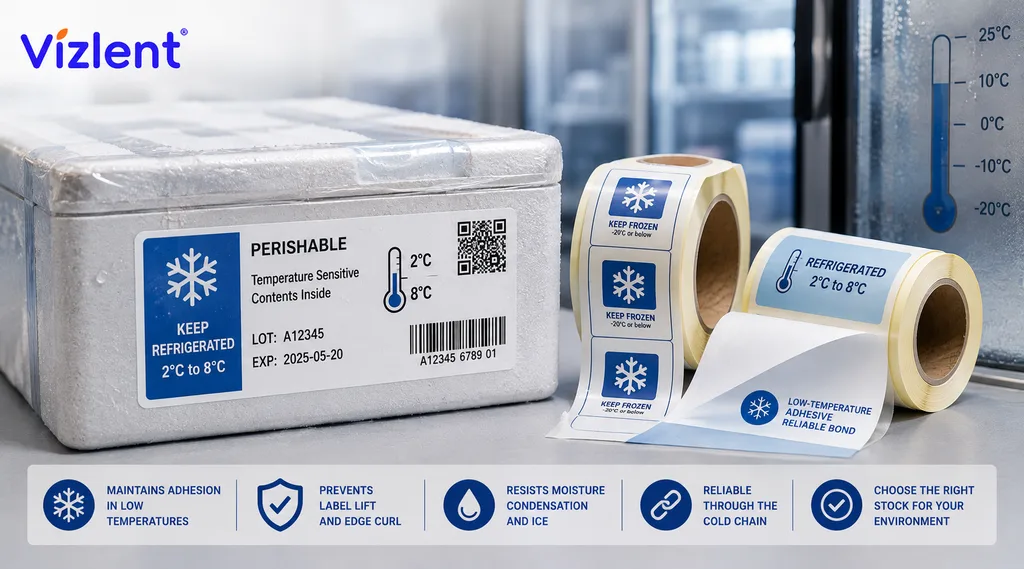
Cold-chain labeling means specifying, printing and applying pressure-sensitive labels that stay bonded and machine-readable through refrigerated, frozen and cryogenic conditions. Most failures here are adhesive failures rather than print failures, caused by applying the wrong construction, at the wrong temperature, to the wrong surface. The fix rests on three data sheet numbers: minimum application temperature, service temperature range, and the container’s surface energy.
That first distinction on why low-temperature adhesives fail is where purchasing goes wrong. Buyers confirm a label survives storage at -20°C and never confirm it can be applied at -20°C, which are entirely separate specifications. Below is the material science behind that gap, the regulatory expectations on top of it, and a qualification sequence to run before you order.
NOTE: Temperature ratings above belong to a complete label construction, meaning facestock, adhesive, topcoat, liner and print system together. No facestock polymer carries a temperature rating on its own. Treat every figure here as an illustration of how specifications behave, not as a specification for any material you are buying.
What Cold-Chain Labeling Actually Has to Survive
A label in a temperature-controlled supply chain does not face one temperature. It faces room-temperature application, a blast-freezing step that rapidly reduces product temperature by tens of degrees within hours, weeks of static storage, a dry ice or refrigerated transport leg, then a humid dock where condensation forms within seconds. Each transition loads the bond line differently, and a construction that handles one can fail at the next.
Vaccine handling gives the clearest published temperature bands, though they are vaccine storage categories rather than definitions of every cold chain. The CDC Vaccine Storage and Handling Toolkit, July 2026 edition specifies refrigerator storage between 2°C and 8°C, freezer storage between -50°C and -15°C, and ultra-cold storage between -90°C and -60°C. Liquid-nitrogen storage can expose labels to temperatures approaching -196°C, while vapor-phase conditions vary by vessel, fill level and position in the rack.
Conditions a single cold-chain labeling application may pass through:
- Chilled distribution: 2°C to 8°C, high humidity, repeated condensation cycles
- Standard frozen: commonly -15°C to -25°C, ice crystals forming on container walls
- Blast freeze: rapid temperature reduction over one to three hours, causing fast substrate contraction
- Dry ice shipping: dry ice sublimes at approximately -78.5°C, with CO2 gas flowing across the label
- Ultra-low temperature freezer: -90°C to -60°C, long dwell, brittle facestock risk
- Cryogenic storage: approaching -196°C, plus frost and disinfection chemistry on retrieval
Why Low-Temperature Adhesives Fail: Four Failure Modes You Can Measure
A pressure-sensitive adhesive is viscoelastic. It must flow, however slightly, to wet out a surface and build bond strength. Cold reduces that ability, and past a point the adhesive behaves less like a bonding layer and more like a film resting on the container.
Cold interferes in four distinct ways, and each leaves a different signature on the returned sample. Diagnosing which one you have tells you whether to change the adhesive, the application step, or the facestock. They appear below in the order they usually surface during a cold chain lab investigation.
Failure Mode 1: The Adhesive Approaches Its Glass Transition Temperature
Every polymer has a glass transition temperature, written as Tg, below which it becomes glassy and loses deformation capacity. Formulators writing in Adhesives & Sealants Industry state it directly: below Tg a polymer “has a brittle consistency and loses its deformation capacity.” That is why an adhesive can feel tacky on your bench and behave very differently inside a deep freezer.
Tg gives useful insight into low-temperature polymer behavior, but it is not a standalone predictor of finished-label performance. Polymer architecture, tackifier system, crosslinking, facestock stiffness, substrate, dwell, peel rate and thermal cycling all contribute. Use Tg to understand the mechanism, then rely on construction-specific testing to make the decision.
Failure Mode 2: Application Below the Minimum Application Temperature
This is a common and highly avoidable cause of cold-chain label loss. Minimum application temperature is the coldest surface an adhesive can wet out on and still bond; service temperature is how cold the bonded label can then get. The two are independent, and a construction can be excellent at one and unsuitable at the other.
Manufacturer data makes the point better than any explanation. Avery Dennison’s cryogenic and cold chain product overview lists two constructions with the same lower service limit but application temperatures roughly 167°C apart. If you label an already-frozen product, you need a construction qualified for cold application, such as a low temperature label whose data sheet states that value explicitly.
| Construction | Facestock | Min. application temp. | Service range |
|---|---|---|---|
| Spec 77392 | 2.3 mil white polypropylene | -20°F (about -29°C) | -320°F to +194°F (about -196°C to +90°C) |
| Spec 79455 | 2.5 mil white polyester | -320°F (about -196°C) | -320°F to +212°F (about -196°C to +100°C) |
Note that the polyester construction here is the cold-applicable one. Facestock polymer does not predict which is which.
Failure Mode 3: Condensation, Frost and Low Surface Energy Substrates
Water interferes with wet-out. A carton pulled from a freezer into a 22°C packing room grows a condensation film within seconds, placing a barrier between adhesive and substrate. On frozen surfaces the equivalent problem is frost.
Some specialized low-temperature constructions are designed for challenging cold surfaces, but frost and condensation can still prevent proper wet-out, so test the exact construction under the intended application conditions. Substrate choice compounds the difficulty, since polyethylene and polypropylene are low surface energy materials that resist wet-out even at room temperature. A cold, damp, low surface energy container is the hardest case any general-purpose construction will meet.
Failure Mode 4: Differential Contraction Between Facestock and Container
Materials shrink as they cool, and not at the same rate. A paper facestock on an HDPE bottle contracts less than the bottle, so the bond line accumulates shear stress on every cooling cycle. That stress tends to concentrate at the edges and produce the familiar curled corner.
Synthetic films reduce this, since their contraction behavior is generally closer to cold storage plastics and they do not absorb moisture and swell. Paper also loses tear strength once frozen and saturated, so it often fails during handling rather than in storage. For sustained sub-zero service, a film-based durable label construction is usually the more reliable starting point.
Changing stock this quarter? Ask every supplier for a data sheet that states minimum application temperature separately from service temperature range, and reject any that publishes only one number.
Application Temperature vs Service Temperature: The Spec That Decides Everything
If cold-chain labeling had one governing rule, it would be to buy for the moment of application and verify for the duration of storage. Suppliers market on service temperature because -196°C reads better than -29°C. Buyers who read only that figure specify a genuinely excellent cryogenic construction that then fails on a line applying to frozen product.
Peel values on a data sheet should cite a test method, commonly ASTM D3330/D3330M-04(2025), whose Method A covers 180 degree peel and Method F covers 90 degree peel. That standard is explicit that its results are a quality assurance tool, cautioning that “these test methods may not provide design information as there is usually no direct relationship between peel adhesion and any functional requirement.” Treat a peel number as evidence of batch consistency, not as proof the label will hold in your freezer.
A complete cold chain label specification states:
- Minimum application temperature, measured on your actual substrate
- Service temperature range, upper and lower bounds
- Facestock material and caliper in microns
- Adhesive chemistry and class, permanent, removable or cryogenic
- Peel adhesion at 20 minutes and 24 hours dwell, with method and conditioning cited
- Liner type and release value, since cold-room dispensing changes it
- Recommended imaging method, ribbon grade or laser compatibility
- Shelf life and storage conditions for the unconverted roll
Matching Facestock to the Temperature Band
Facestock is a coarse filter, not a rating. Coated paper is widely used for chilled distribution and light frozen duty, and remains economical for high-volume cold chain shipping labels on dry cartons. Where moisture, wet handling or sustained deep cold are involved, its absorption and loss of tear strength become the limiting factor.
Synthetic film constructions cover the colder and wetter end of the range, and the meaningful differences sit in the complete construction rather than the polymer name. Polyester constructions are available for ultra-low-temperature and cryogenic applications, and specially engineered polypropylene and polyolefin constructions are available for liquid-nitrogen service. In both cases the actual limit is set by the adhesive, topcoat and construction as a whole, so read the data sheet rather than the material family.
- Coated paper: chilled and frozen cartons in logistics and e-commerce, where handling stays dry
- Polyester (PET): laboratory vials and pharmaceutical storage, available in ultra-low and cryogenic constructions
- Polypropylene (PP) and polyolefin: purpose-engineered constructions for liquid-nitrogen applications, as in ultra low temperature resistant cryogenic labels
- Flexible vinyl (PVC): blood bags and medical pouches where conformability to a soft container matters
- In every case: the published limit applies to the tested construction, not to the polymer
Cold-Chain Label Stock Selection by Application
Working from the application backward is more reliable than working from a material forward. The variables that actually decide the construction are the surface temperature at the moment of application, the container material, the number of freeze and thaw cycles, and the cleaning or disinfection chemistry involved. Two applications sharing a storage temperature can still need different constructions.
The framework below is a starting point for the conversation with your supplier, not a specification. Each entry names the dominant risk rather than a temperature limit, because the limit belongs to the finished construction. Bring your measured application temperature to that conversation and the shortlist narrows quickly.
- Chilled food and beverage: applied above freezing, dominant risk is condensation and wet handling, typically paper or film with a cold-temperature acrylic or rubber-based adhesive
- Frozen food: often applied to cold or frozen surfaces, dominant risk is cold application combined with condensation, typically film or freezer-grade paper with a deep-freeze adhesive
- Ultra-low temperature laboratory: around -80°C storage, dominant risk is dimensional stability through repeated cycling, typically a synthetic film construction qualified at temperature
- Dry ice shipping: approximately -78.5°C with CO2 gas flow, dominant risk is thermal cycling and image durability, typically a cryogenic-qualified synthetic construction
- Liquid nitrogen and biobanking: approaching -196°C, dominant risk is cryogenic cycling on a small curved substrate, requiring a purpose-qualified cryogenic construction
Adhesive Chemistry: Acrylic, Rubber and Cryogenic Grades
Three families cover most cold labeling requirements, and each trades something away. Rubber-based hot melts generally give higher initial tack and good cold application performance, but can be more vulnerable to aging and plasticizer migration. Acrylics typically give up some initial tack in exchange for better UV, chemical and aging resistance.
Cryogenic grades are a specialized subset engineered to remain mobile in deep cold. The practical spread is wide: Avery Dennison notes that most of its adhesives are designed for application in ambient conditions around +5°C, while its deep-freeze adhesives extend application down toward -20°C. Expect a price premium and a minimum order quantity for the specialized end of that range, since these are not commodity coatings.
Printing and Imaging: The Ribbon Matters as Much as the Stock
A perfectly bonded label with an unreadable barcode is still a failed label. Direct thermal is common in chilled food distribution because it is economical and needs no ribbon, but its durability depends heavily on the imaging chemistry, topcoat, storage duration and exposure to moisture, light and chemicals. It is generally less suitable where long-term image durability, chemical resistance or harsh handling is required.
Thermal transfer can deliver a more durable image when the ribbon, facestock and printer are matched to the application. Wax ribbon images well on paper but is a poor match for synthetic film in abrasive handling. A resin ribbon is commonly selected for demanding PET and PP applications where abrasion resistance, chemical resistance and long-term image durability matter, including work in a cold chain laboratory.
Imaging checks worth running before you scale:
- Scan grade verification after the number of freeze and thaw cycles your process actually applies
- Abrasion testing with a gloved hand, replicating retrieval from a freezer rack
- Solvent-rub testing using the disinfectant or cleaning chemistry in the real workflow, for example 70% isopropyl alcohol where that is what the lab uses
- Printing at full production speed, since transfer quality shifts with line speed
What Cold Chain Regulations and Standards Expect From Your Labels
Cold chain regulations rarely name label materials, which is why labels get skipped in validation. What the rules require is that identity, lot traceability and temperature control stay demonstrable across the whole distribution path. A detached or unreadable label can compromise that ability, creating a validation and compliance concern rather than a packaging inconvenience.
Three frameworks carry most of the weight, and each sets cold chain standards and cold chain guidelines your program must support with evidence. None of them prescribes a facestock or adhesive, so documented qualification data is what closes the gap during an inspection. This is where cold-chain labeling stops being a consumable purchase and becomes part of the compliance file.
- Food: 21 CFR Part 1 Subpart O, the FSMA Sanitary Transportation rule, requires food needing temperature control for safety to move under adequate temperature control, with shippers specifying an operating temperature in writing under 1.908(b)(2) and records kept 12 months beyond their period of use
- Pharmaceutical: USP General Chapter <1079> addresses risks and mitigation strategies for storage and transportation of preparations requiring controlled temperatures, and does not specify label materials, alongside EU Good Distribution Practice guidelines 2013/C 343/01 for pharmaceutical and healthcare distribution
- Research and biobanking: small curved cryovial surfaces demand conformability while the adhesive is least mobile, and sponsors commonly require documented multi-year performance before approving a construction
How to Choose the Right Cold-Chain Labeling Stock: Seven Steps
Selection gets straightforward once you start with your process rather than a product catalog. Order matters, because each step narrows the field for the next. Reversing it is how buyers end up with cryogenic stock on a chilled produce line.
The sequence costs a few days of data gathering and one to two weeks of testing, which is modest against the cost of a recall or a tray of unidentifiable samples. Suppliers who resist providing samples are telling you something useful about their confidence. Lock the approved construction into your bill of materials once it passes.
- Measure the application surface temperature with an infrared thermometer at the labeling station, not the room
- Identify the substrate and its surface energy, since HDPE, PP, board and glass behave differently
- Define the full thermal profile, including transport legs and real freeze and thaw cycle counts
- Set the required service life, which for biobanking may run five years or longer
- Shortlist constructions, not facestock families, using published application and service figures
- Prioritize minimum application temperature over headline service claims when the two conflict
- Validate on your own containers, with 24-hour and 30-day pulls plus scan grade checks
Cold Chain Procedures and the Mistakes That Undo Them
Material selection solves part of the problem and process discipline solves the rest. Apply labels before freezing wherever workflow allows, so the adhesive can wet out on a warmer substrate. Where post-freeze application is unavoidable, clear frost from the surface immediately before applying and use a construction qualified for cold application.
Roll handling belongs in your written cold chain procedures too, since storage outside the manufacturer’s recommended temperature and humidity conditions can affect material performance. Condition rolls to the supplier’s stated conditions before running them. Understanding why low-temperature adhesives fail also reframes the economics, since documented material control reduces the risk of uncontrolled substitutions and makes failure investigations far easier.
Mistakes seen repeatedly in the field:
- Reading service temperature as though it were application temperature
- Qualifying at ambient and assuming cold performance follows
- Treating a facestock polymer as though it carried a temperature rating
- Switching liner or facestock supplier mid-program without requalification
- Labeling over condensation and trusting initial tack to hold
Get the Specification Right Before You Order
Cold-chain labeling is one of the few packaging decisions where a small material choice carries outsized risk and the right answer is knowable in advance. Start with your measured application surface temperature, work outward to the full thermal profile, and treat minimum application temperature as the gating specification. Every failure mode described here is addressable with information you can obtain before you order.
If you are specifying for freezer, ultra-cold or cryogenic use, request samples in your exact construction and test them on your own containers. Compare freezer grade label stock options against the specification checklist above before committing to a roll. Ask for the data sheet first, then test, then buy.
Frequently Asked Questions
What temperature can freezer-grade labels be applied at?
It varies by construction, and the figure appears on the data sheet as minimum application temperature, always separate from service temperature range. Published cryogenic constructions range from roughly -29°C to as low as -196°C for minimum application, even where their service ranges are identical. If your line labels a product that is already frozen, you need a construction whose data sheet states a suitable cold application temperature.
Why do labels fall off in the freezer even when applied correctly?
One cause is the adhesive approaching its glass transition temperature, where it loses the deformation capacity needed to maintain contact. A second is differential contraction, where facestock and container shrink at different rates and shear the bond line. A third is moisture, either condensation trapped at application or frost preventing wet-out, and the residue pattern usually indicates which.
Is direct thermal or thermal transfer better for cold chain shipping labels?
Thermal transfer is generally the safer choice where long-term image durability, chemical resistance or harsh handling is required, since the image is a transferred layer rather than a chemical reaction in the facestock. Direct thermal remains widely used in chilled food distribution where cost matters and label life is short, though its durability depends on the specific imaging chemistry and topcoat. Match the decision to how long the code must remain scannable and what it will be exposed to.
What adhesive works on frozen and frosted surfaces?
Specialized low-temperature and cryogenic constructions are designed for cold and difficult surfaces, and their data sheets state a minimum application temperature that reflects this. Frost and condensation can still prevent wet-out, so the surface should be cleared and the exact construction tested under real application conditions. Rubber-based hot melts often provide strong initial tack on cold cartons, while acrylics generally age better, so the choice follows required service life and exposure.
Do cold chain regulations specify which label materials to use?
No major framework names specific materials, but cold chain regulations do require products to stay identifiable and traceable throughout storage and distribution. The FSMA Sanitary Transportation rule, USP <1079> and EU Good Distribution Practice guidelines all assume identity and temperature records remain linked to the physical unit. A detached or unreadable label can compromise that link, so your label qualification evidence becomes part of the compliance record.
How cold can label stock actually go?
Purpose-engineered polypropylene, polyolefin and polyester constructions are available for liquid-nitrogen applications approaching -196°C, but performance depends on the complete construction and its qualification testing. Facestock polymer alone does not establish the limit, as published data sheets show polyester and polypropylene constructions sharing the same lower service bound while differing sharply in application temperature. Confirm the rating applies to your exact facestock, adhesive and liner combination.
How long should I test a cold chain label before approving it?
A meaningful qualification runs at least 30 days with pulls at 24 hours, 7 days and 30 days, on your own containers under your real thermal profile. Include the actual number of freeze and thaw cycles, since cycling causes failures that static storage does not reveal. For biobanking and clinical work, select a construction with documented long-term performance at the required temperature and on the actual substrate.






