
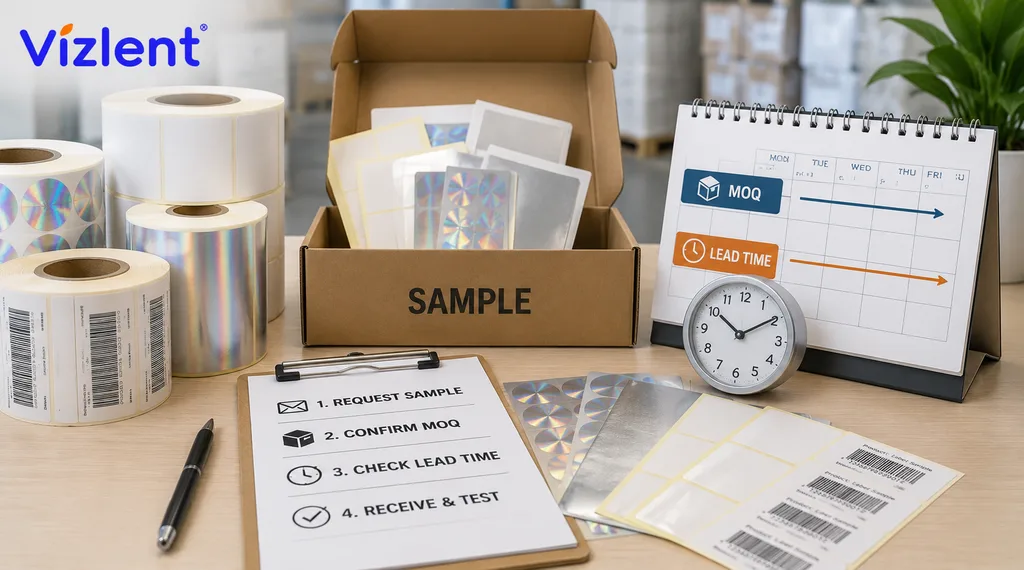
To get a label material sample, send your supplier the application, the substrate you are labeling, your printing method, and the service conditions, then request A4 sheets or a sample roll of two or three candidate constructions. Many label material suppliers offer standard samples at no material charge, although courier and custom trial costs can apply. For Vizlent, a general MOQ is around 1,000 square meters, and standard production lead time is 10 to 15 days after deposit, although the actual minimum varies by material.
Those three numbers decide whether a labeling project ships on time or stalls at the press. Buyers who put full specifications into one clear request move through sampling faster because there is nothing to clarify. Buyers who write “please send label samples” wait longer and often test the wrong construction.
What a Label Material Sample Actually Contains
Once you figured out how to get label material sample, it’s now time to know what a label material sample contain. A label material sample is a piece of the finished laminate, not a swatch of facestock alone. It is normally a three layer construction consisting of the printable facestock, the pressure sensitive adhesive, and the release liner that separates from that adhesive at application. Judging one layer in isolation tells you almost nothing about how the construction will run.
That structure is why datasheets alone cannot settle a material decision. Adhesive coat weight, liner caliper, and face stiffness interact on the die station in ways a spec sheet cannot fully capture. A physical material sample label gives you the most useful preview of runability on your own equipment, alongside supplier data and converting recommendations.
A complete submission should identify:
- Facestock grade and caliper, in mils or microns
- Adhesive class, such as permanent acrylic, removable, freezer grade, or wash off
- Liner type, typically glassine or PET, with caliper stated
- Service temperature range, for both application and end use
- Batch or lot number, so a repeat order traces back to the same coating run
Why Sampling Comes Before the Purchase Order
Sampling is cheap insurance against an expensive failure. One rejected run of 5,000 square meters costs far more than the courier fee on three sample rolls. It also costs press time, converter labor, and, in regulated sectors, a compliance investigation.
The failures sampling catches are rarely dramatic. They appear as edge lift on a curved bottle, ribbon smear on a warm surface, or a liner that splits on a high speed applicator. Each is visible within an hour of testing and invisible on paper.
Three common reasons a construction fails after purchase:
- Substrate surface energy was lower than assumed, so the adhesive never fully wet out
- A temperature spike during curing, washing, or transit exceeded what the face could tolerate
- Printing method and facestock topcoat were mismatched, causing poor ink or ribbon anchorage
How to Get Label Material Sample Requests Answered Faster
Response speed depends largely on how much guessing your supplier has to do. Complete technical requests can often be processed faster because they reduce clarification cycles. A vague request triggers back and forth emails that add days before anything ships.
Treat the request as a technical brief rather than an inquiry. Suppliers with in house coating capability can propose an adjusted adhesive formulation when a standard grade is borderline. That conversation only happens once the technical detail arrives.
Include all seven of these in one message:
- Application, for example chemical drums, cold chain cartons, or automotive underhood parts
- Substrate, named by type: HDPE, powder coated steel, corrugated board, or glass
- Printing method, whether thermal transfer, direct thermal, flexo, digital toner, or UV inkjet
- Service conditions, covering temperature, humidity, UV exposure, and chemical contact
- Application temperature, often the real constraint on cold or damp surfaces
- Required label life, from six months on a carton to five years on an asset tag
- Estimated annual volume, which decides whether the material is stock or custom coated
Then name the format, because ordering the wrong one wastes a full shipping cycle:
- A4 sheets, for print trials and hand applied adhesion checks
- Short sample rolls, often tens of meters depending on supplier and construction, for die cutting, matrix stripping, and dispensing tests
- Comparison packs, for isolating a single adhesive or liner variable
- Certified retains, matched to a lot number for regulated qualification
Ready to compare constructions side by side? Send your application details to Vizlent and request a two option comparison pack.
Label Material Types Worth Sampling Before You Commit
Label material types divide into paper faces, film faces, and specialty constructions built around a single stress. Paper is the value choice for indoor and short life work. Films earn their premium anywhere moisture, abrasion, chemicals, or temperature enter the picture.
Sampling across categories finds the cheapest material that still passes. Many buyers over specify, paying film prices for a carton label that never leaves a dry warehouse. Others under specify and discover the shortfall during the first humid summer.
Match the sample set to the application family:
- Logistics and e commerce, thermal papers and freezer grade adhesives
- Pharmaceutical and healthcare, lot traceable constructions with documented compliance
- Brand protection, eggshell, void, and water sensitive tamper evident stocks
Label Material Paper Grades
Label material paper remains a major category in self adhesive label material, particularly for logistics, retail, and general purpose applications. Semi gloss and vellum grades handle that duty at the lowest cost per square meter. Coated and cast gloss papers step up when print quality carries the brand.
Paper faces have application limits that should be confirmed through testing, particularly under moisture, abrasion, and temperature exposure. Performance varies significantly by grade, coating, wet strength, and overall construction, so grade level assumptions are unreliable. Security grades such as eggshell paper trade durability for deliberate, visible tamper evidence.
- Semi gloss paper, the default for barcode and shipping labels
- Vellum and uncoated, for handwriting and price marking
- Thermal top coated paper, for direct thermal shipping and receipt printers
- Wash off paper, for returnable glass in beer and beverage plants
Film and Specialty Constructions
Film faces answer what paper cannot, but temperature ratings are construction specific rather than a property of the polymer alone. Performance depends on the adhesive, facestock, liner, application surface, dwell time, and environmental cycling working together, and an adhesive often limits the construction before the face does. Confirm the exact adhesive and facestock combination against your intended service conditions rather than reading a polymer level number as universal.
Specialty constructions exist because one property dominates the application. A heat resistant label protects legibility through paint bake or sterilization cycles. An outdoor weather resistant construction is engineered around UV stability rather than initial tack.
What a Label Material Sample Free of Charge Covers
Many manufacturers offer standard samples as part of their sales process, which is why a label material sample free of charge is common rather than exceptional. Vizlent provides free sample rolls and A4 sheets for standard constructions used in peel strength, print compatibility, and die cutting trials, with the buyer covering courier charges. Policies differ by supplier, so confirm what is included before assuming identical terms elsewhere.
What free sampling does not cover is worth stating plainly. Custom coated trial runs, non standard slit widths, and lot certified retains consume real production time and are quoted separately. Requests for dozens of constructions at once also fall outside normal courtesy.
Typically included at no charge:
- Two to four standard constructions per request, as A4 sheets or short sample rolls
- Technical datasheets and application guidance from a technical contact
Typically quoted separately:
- Custom adhesive formulation trials outside the standard range
- Machine width slitting of a sample roll for applicator testing
- Third party laboratory certification against a named standard
Understanding MOQ for Label Materials
MOQ often reflects coating economics, batch requirements, inventory risk, and production efficiency rather than sales policy alone. A coating line must reach stable adhesive weight, web tension, and drying temperature before output is saleable, and that startup consumes material regardless of order size. Vizlent’s general MOQ is around 1,000 square meters, although the actual minimum varies by material.
The unit matters as much as the number. Label materials are quoted in square meters or in linear meters of jumbo roll width, so 1,000 square meters at 1,000 mm width equals 1,000 linear meters. Converting your annual label count into square meters before negotiating prevents the most common misreading of a first quote.
Four variables drive the minimum on any quote:
- Stocked or custom coated, by far the largest factor
- Web width, since narrow slit widths waste more of the master roll
- Adhesive type, because specialty formulations require dedicated line cleaning
- Liner choice, because different liner materials carry different sourcing, availability, and minimum batch requirements
Negotiating a Trial Order Below MOQ
Some manufacturers support trial quantities below their standard MOQ, particularly for qualified projects, and rarely advertise it. Vizlent supports trial orders to help buyers validate constructions before committing to production volume. The lever is a clear forecast, not a request for a favor.
Position the trial as the first step of a planned volume. Accepting a stocked construction for the trial, then moving to custom at volume, removes the supplier’s main objection. Bundling related items in the same shipment improves the economics on both sides.
- Share a twelve month forecast, even a rough one
- Start with a stocked construction, then customize at volume
- Bundle a face material order with thermal transfer ribbon or laminating film
Need a trial quantity below standard MOQ? Ask Vizlent about trial order support with your forecast attached.
Label Material Lead Time and What the Clock Includes
Published lead time almost never means door to door. Vizlent quotes 10 to 15 days after deposit for standard production, with custom OEM and ODM jumbo rolls in the 7 to 15 business day range. International freight, customs clearance, and inland delivery sit on top of that figure.
For an overseas first order, the total calendar extends well beyond production because sampling, qualification, ocean freight, customs, and inland delivery all occur separately. Transit time itself varies with origin, destination, port, carrier, service level, season, and Incoterm, so no single figure applies to every route. Repeat orders of a qualified construction compress sharply because sampling and qualification drop out of the sequence.
Example first order planning timeline. Actual timing varies by supplier, testing requirements, shipping method, destination, and customs:
- Days 1 to 2, sample request submitted with full specifications
- Days 3 to 8, samples picked, packed, and couriered internationally
- Days 9 to 20, in house testing, press trial, and application validation
- Days 21 to 25, quotation, specification sign off, and deposit
- Days 26 to 40, production, quality control, and slitting to order width
- Weeks 7 to 10, ocean freight, customs clearance, and inland delivery
Four avoidable causes account for most delays:
- Late slit width or caliper changes after production is scheduled
- Deposit received later than assumed, shifting the entire timeline
- Incomplete compliance documents, which hold goods at customs rather than at the factory
How to Test a Material Sample Label Correctly
Testing has to happen on your substrate, with your printer, in your environment. A construction that performs beautifully on a laboratory steel panel can fail entirely on recycled corrugated board. Replicate the real application before drawing any conclusion.
Standardized methods keep results comparable across suppliers. FINAT publishes widely used test methods for pressure sensitive label materials covering peel adhesion, tack, release force, and aging, with FTM 1 covering 180 degree peel adhesion and FTM 9 covering loop tack. Related ASTM methods include ASTM D3330 for peel adhesion and ASTM D6195 for loop tack, although test conditions and specimen configurations should be matched before comparing results.
Run this sequence on every sample, and log the result:
- Clean the substrate exactly as your production line does, no more and no less
- Apply at production temperature, since cold application changes adhesive wet out
- Condition the sample for the dwell time given by the test method or adhesive manufacturer before measuring adhesion, since a 24 hour dwell is common for comparative testing but not universal
- Print with your ribbon and settings, then scratch and smear the printed area
- Age the sample in a freezer, oven, humidity chamber, or outdoor rack as applicable
- Verify barcode scan rates after aging, not only before
How to Evaluate Label Material Suppliers
Sample quality tells you what a supplier can produce once. Lot to lot consistency tells you what they can produce for three years. Ask for the second answer directly, because a single sample will never reveal it.
Certification puts an independent floor under those claims, and FSC chain of custody verifies the controlled sourcing and traceability of FSC certified forest based material through the supply chain, while UL 969 covers marking and labeling system performance. BS 5609 specifies requirements and test methods for printed pressure sensitive labels intended for marine use, including resistance to immersion, weathering, temperature cycling, abrasion, and adhesion. Vizlent states that it maintains ISO 9001 and FSC certification, with SGS testing or documentation available for applicable materials.
Verify UL 969 recognition and BS 5609 certification against the exact construction and certificate number rather than a general company statement, then ask these six questions before you commit:
- Do you coat your own adhesive, or convert purchased jumbo rolls?
- What caliper and coat weight tolerance do you hold, and how is it measured?
- Can you supply certificates of analysis by lot number?
- What is the MOQ for this exact construction, and for a custom version of it?
- Which certifications apply to this material, rather than to the company generally?
- What happens if a lot fails our incoming inspection?
Start With the Sample, Not the Purchase Order
Every label sourcing decision that goes wrong shares one root cause, which is a specification confirmed on paper rather than in hand. Sampling can cost a courier fee and several days of project time. A failed production lot costs the material, the press time, and the delivery date.
According to Vizlent, the company has supplied self adhesive label materials since 2011 to more than 1,000 customers across over 50 countries and maintains ISO 9001 and FSC certification. Free sample rolls and A4 sheets are available for peel strength, print compatibility, and die cutting trials on standard constructions, with the buyer covering courier charges. Bring your application details and the technical team will propose the constructions worth testing.
Request your samples now. Contact Vizlent with your application, substrate, and printing method, or browse durable label materials and the label materials knowledge base to shortlist constructions first.
Frequently Asked Questions
How do I request a label material sample?
Send one message containing your application, substrate, printing method, service conditions, and estimated annual volume, then name the format you need. A4 sheets suit print trials, while sample rolls are required for press or applicator testing. Suppliers with complete information can often respond faster because no clarification cycle is needed.
Is a label material sample free?
Often, yes, though policies differ by supplier. Vizlent provides free sample rolls and A4 sheets for standard constructions, with the buyer covering courier costs. Custom coated trials, non standard slit widths, and third party certified testing are quoted separately because they consume production time.
What is a typical MOQ for label materials?
Minimums vary by supplier, material type, web width, and adhesive, so there is no single industry figure. Vizlent’s general MOQ is around 1,000 square meters, although the actual minimum varies by material, and custom coated adhesives or non standard widths typically sit higher. Some manufacturers, Vizlent included, support trial quantities below that minimum when a buyer can share a forecast.
How long is label material lead time?
Standard production at Vizlent runs 10 to 15 days after deposit, with custom OEM and ODM jumbo rolls in the 7 to 15 business day range. That figure excludes international freight, customs clearance, and inland delivery, which vary with route, carrier, season, and Incoterm. A first order including sampling and qualification therefore runs several weeks longer than the production window alone.
Which label material types should I sample for a new product?
Sample at least one paper construction and one film construction so the cost and performance boundary is visible. Add a third specialty option when the application involves temperature extremes, chemical exposure, or tamper evidence. Testing across categories often shows that a lower cost material passes.
How much label material paper do I need for 100,000 labels?
Multiply label area by quantity, then add waste. A 100 mm by 50 mm label covers 0.005 square meters, so 100,000 labels need 500 square meters of face area. Waste depends on die layout, gaps, repeat length, press setup, and splice loss, so apply an allowance specific to your job. As an example, a 10 to 15 percent planning allowance would put the practical requirement near 550 to 575 square meters, which sits below a 1,000 square meter minimum and is exactly when a trial order conversation becomes useful.
Can I test a sample without a label press?
Yes, for adhesion and durability questions. Hand applied A4 sheets on your actual substrate answer peel strength, edge lift, temperature tolerance, and print smear. What hand testing cannot answer is runability, meaning die cutting, matrix stripping, and dispensing behavior.






