
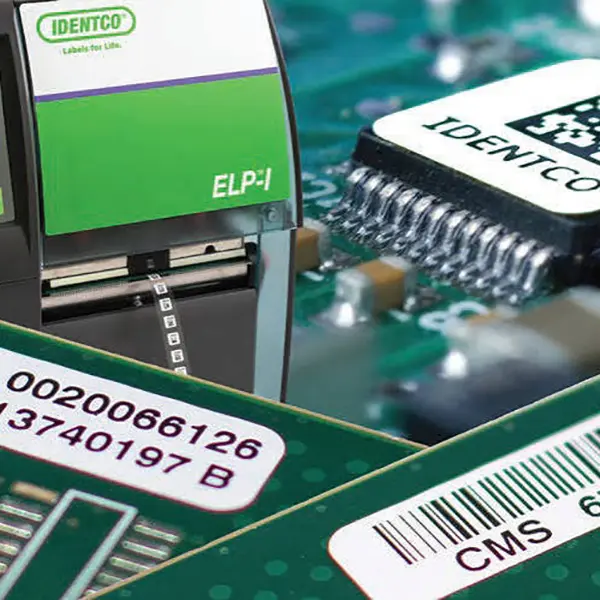
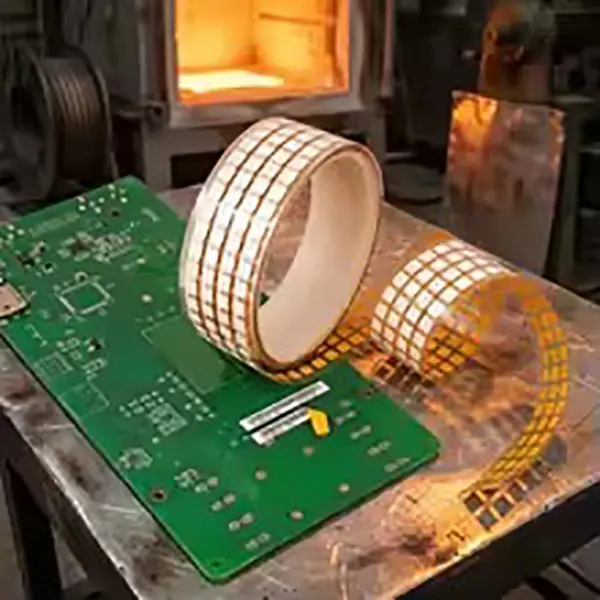
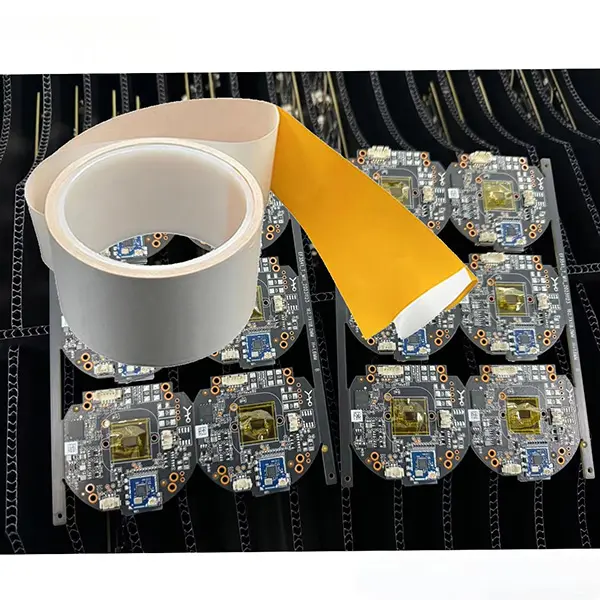
Circuit Board Label & PCB Labels
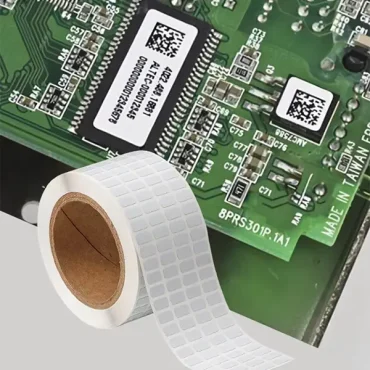
- Comprehensive range covering pre-reflow, post-reflow, and standard-service PCB labelling
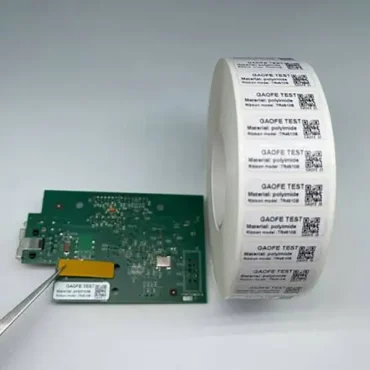
- Face material options: polyimide (PI), white-coated PI, high-temp PET, standard PET
- Adhesive options matched to process temperature: silicone, high-temp acrylic, or standard acrylic
- Compatible with FR-4, ceramic, aluminium PCB, flex circuit, and component body surfaces
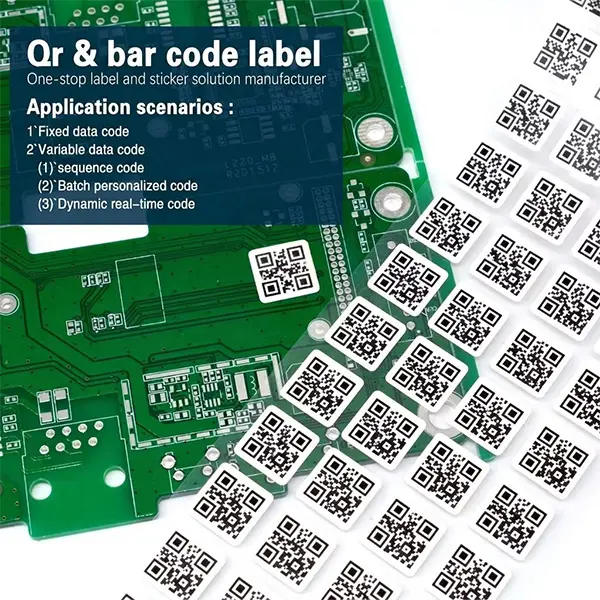
- Supports thermal-transfer, laser, and pre-printed barcode/QR code formats
Introduction to Circuit Board Label & PCB Labels
Circuit Board Label and PCB Labels represent VIZLENT’s broadest product category in electronics identification — a range of label constructions that covers every stage of the PCB lifecycle, from incoming goods inspection through SMT assembly, functional test, and final system integration.
Not all PCBs have the same labelling requirements: a board destined for a consumer appliance that will be hand-soldered and never exceed 85 °C in service has very different label specification needs from an automotive ECU board that passes through a lead-free reflow oven at 260 °C peak and must survive 150 °C field operating temperatures for fifteen or more years.
VIZLENT offers face material and adhesive combinations across this entire requirement spectrum, allowing procurement engineers to select the correct circuit board label for each specific board type and process.
- The common thread across all Circuit Board Labels and PCB Labels from VIZLENT is engineering precision: labels are die-cut to tight dimensional tolerances, printed with permanent resin-transfer or UV-cured inks, and wound on rolls to the mechanical specification required for manual or automated application.
- Variable data — serial numbers, revision codes, barcodes, and QR codes — is generated from customer-supplied data files and factory-printed in the correct sequence for production line use.
- All constructions are RoHS-compliant, and material compliance documentation is available on request for customers subject to REACH, IEC 62321, or similar regulatory requirements.
Application Scenarios for Circuit Board Label & PCB Labels
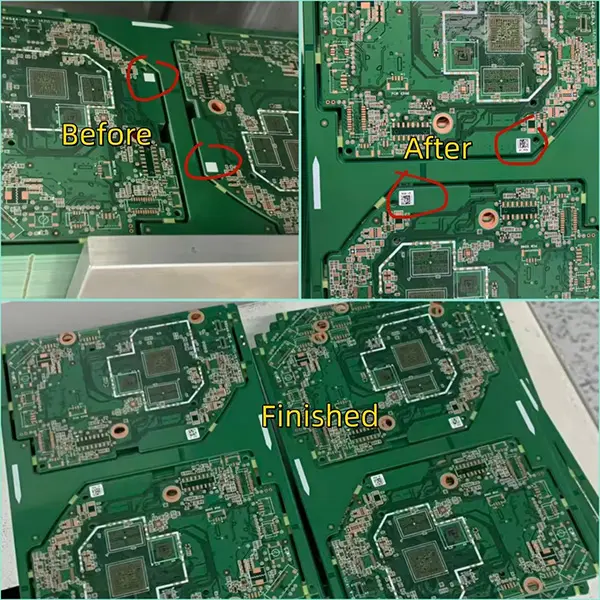
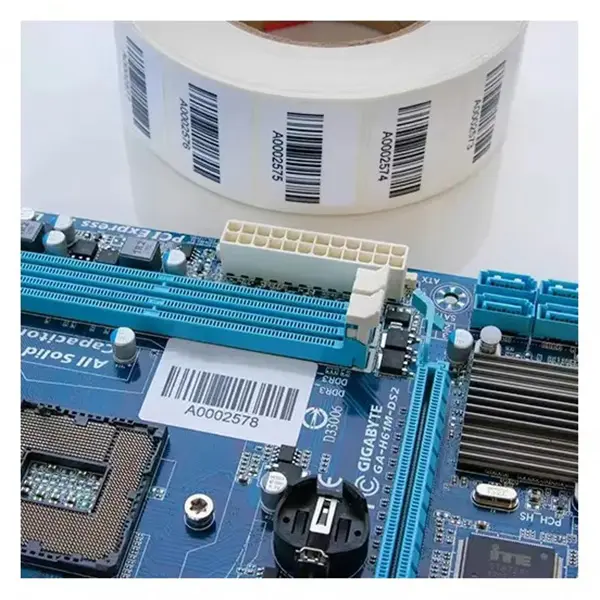


Specifications
| Item | Circuit Board Label & PCB Labels |
|---|---|
| Brand | Vizlent |
| Face Material Options | Polyimide (amber), white-coated PI, high-temp PET (white), standard PET (white) |
| Temperature Range | Standard PET: up to 80 °C; high-temp PET: up to 180 °C; PI: up to 260 °C |
| Adhesive Options | Standard acrylic; high-temp acrylic; high-temp silicone (reflow-grade) |
| Compatible Substrates | FR-4, CEM-3, ceramic, aluminium PCB, polyimide flex, component body |
| Total Label Thickness | 0.070 mm – 0.150 mm (dependent on face material and adhesive selection) |
| Printing Method | Thermal transfer (wax, wax-resin, or resin ribbon by service temperature); laser; pre-print |
| Barcode Formats Supported | Code 128, Data Matrix ECC200, QR Code, Code 39, ITF |
| Chemical Resistance | Flux, IPA, mild solvents; full resistance profile varies by face material |
| RoHS Compliance | Yes — all construction variants |
| MOQ | 5,000 labels per design, size, and material specification |
| Sample | Available on request across all face material and adhesive combinations |
| Payment Term | T/T 30% deposit, balance before shipment; L/C accepted for large orders |
| Production Time | 10–18 working days after specification, artwork approval, and deposit |
You May Also Need
-
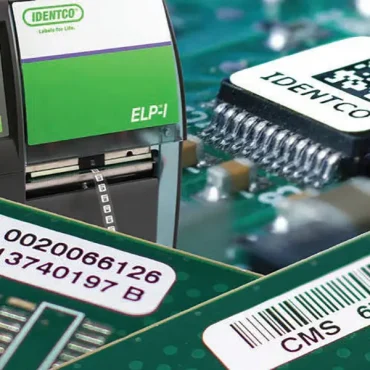
Circuit Board Label & PCB Labels Comprehensive range covering pre-reflow, post-reflow, and standard-service PCB labelling Face material options: polyimide (PI), white-coated PI, high-temp PET, standard PET Adhesive options matched to process temperature: silicone, high-temp acrylic, or standard acrylic Compatible with FR-4, ceramic, aluminium PCB, flex circuit, and component body surfaces Supports thermal-transfer, laser, and pre-printed […]
-
Automatic PCB Labelling Heat Resistant Labels Precision die-cut labels on accurately wound rolls for automated label applicators Consistent label gap and registration enables reliable tamp-blow and wipe-on application Polyimide face rated for lead-free SMT reflow up to 260 °C High-temperature silicone adhesive — stable, non-flowing, no outgassing at reflow White-coated polyimide face option for high-contrast […]
-
300 Degree Polyimide Labels for Semiconductor and Printed Circuit Board Manufacturing Processes Polyimide film rated for short-duration exposure up to 300 °C Survives semiconductor backend packaging processes and high-temperature cure ovens High-temperature silicone adhesive stable at continuous 260 °C and short-peak 300 °C No thermal decomposition, discolouration, or dimensional change at rated temperatures Send Your […]
-
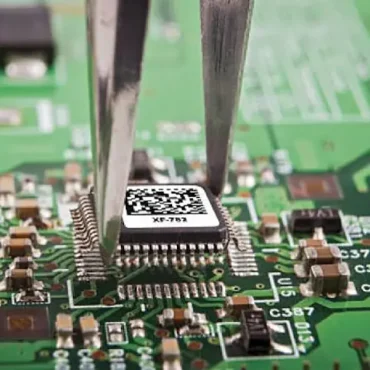
Data Matrix Polyimide Labels for PCB identification Data Matrix ECC200 code encodes high data density in a compact square symbol Polyimide base film rated for continuous and peak service to 260 °C Survives lead-free SMT reflow without code degradation or delamination White-coated polyimide face provides high print contrast for reliable 2D scan rates Supports very […]
-
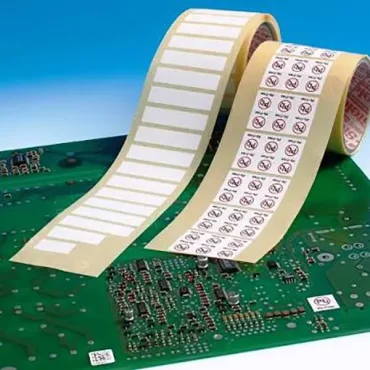
PCB Labels for Printed Circuit Board and Electronics Broad substrate compatibility: FR-4, ceramic, aluminium, and flex PCBs Heat-resistant polyimide or high-temperature polyester face material Stable adhesion through reflow, wave soldering, and cleaning processes Supports thermal-transfer, laser, and pre-printed barcode and QR code formats Available with sequential serial numbers, Data Matrix, Code 128, or QR codes […]
-
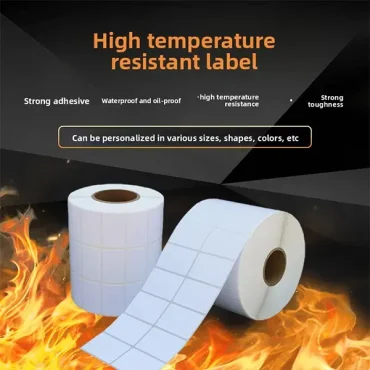
PCBs Labels Heat Resistant Labels Withstands SMT reflow soldering peak temperatures up to 260 °C Polyimide or high-temperature polyester face material options High-temperature silicone or acrylic adhesive — no bleed, no char Dimensionally stable through thermal cycling — no curl or shrinkage Compatible with thermal-transfer (resin ribbon) printing for permanent legends Send Your Inquiry Now […]
Frequently Asked Questions
VIZLENT’s standard guidance is to select the label specification based on two primary factors: the maximum temperature the label will experience during any process step, and the substrate surface the label will be applied to. If the label is applied before SMT reflow (peak ≤ 260 °C), specify polyimide face with silicone adhesive. If applied post-solder with a maximum service temperature below 150 °C, high-temperature PET with acrylic adhesive is sufficient. For ambient-temperature applications on assembled boards, standard PET labels provide an economical solution. Our sales and technical team can advise on the correct specification once you provide your process temperature profile and substrate type.
Yes. For boards that undergo SMT reflow during manufacture and then operate at elevated temperatures in the field — such as automotive ECUs, industrial motor drive boards, or outdoor power electronics — VIZLENT specifies polyimide face with silicone adhesive as both the process-stable and the field-service-stable solution. Polyimide is rated for continuous service at up to 260 °C, well above the field operating temperature of most electronic equipment, and the silicone adhesive maintains its bond strength over the full temperature range the board will experience in service.
The standard MOQ is 5,000 labels per SKU (size, face material, adhesive, and print content combination). For customers ordering multiple label sizes for a single PCB programme — for example, a large board identification label and a smaller sub-assembly traceability label — VIZLENT can discuss combined-volume pricing where the aggregate quantity across SKUs meets a threshold. Production lead time is 10–18 working days from artwork approval and deposit receipt for each SKU.
Ribbon selection depends on the face material and the thermal stress the label will encounter. For polyimide face labels destined for reflow soldering, VIZLENT strongly recommends a full-resin thermal-transfer ribbon, which produces print that is resistant to the thermal and chemical stresses of reflow and post-solder cleaning. Wax and wax-resin ribbons are not suitable for high-temperature service as the print may smear or transfer at elevated temperatures. For standard-temperature PET PCB labels in ambient-service applications, a wax-resin ribbon provides a good balance of print durability and cost.
Yes. VIZLENT offers a hybrid format where fixed content — company name, part number, revision code, logo, and fixed barcode symbology structure — is factory-printed in advance, leaving a defined blank zone on the label for in-house thermal-transfer overprinting of variable data such as serial numbers or date codes. This approach combines the quality and consistency of factory printing for fixed elements with the flexibility of in-house printing for variable content, and is particularly useful for customers who produce multiple product variants on a single PCB platform and need to differentiate labels at the point of use.

