
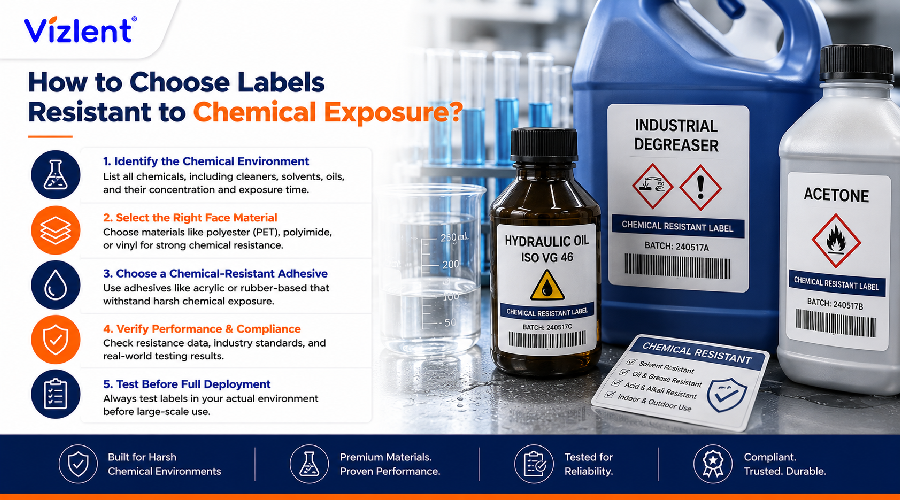
Choose materials like polypropylene or polyester that won’t easily breakdown when exposed to any harsh substances. Start with matching the facestock, adhesive, and any topcoat to the exact chemicals, temperature range, and surface material the label will actually contact, rather than trusting a generic waterproof or durable label claim. Standard acrylic adhesives swell, soften, and lose bond strength when exposed to hydrocarbons and solvents, while facestock inks smear and delaminate under the same conditions. This guide walks through how to evaluate facestock chemistry, adhesion to difficult surfaces, and regulatory requirements before specifying labels resistant to chemical exposure for your specific application.
Start With the Facestock When Choosing Labels Resistant to Chemical Exposure
Labels resistant to chemical exposure begin with facestock selection, since the facestock is the layer that directly contacts splashes, vapors, and cleaning agents in most industrial environments. Polyester (PET) facestock with a solvent-resistant topcoat generally provides the broadest resistance to aromatic hydrocarbons like xylene, toluene, and benzene, outperforming vinyl and paper facestocks in direct contact with these chemicals. Vizlent Label’s Petrochemical & Drums range documents this construction specifically for drums, totes, and containers exposed to fuel, oil, and solvent contact.
Chemical resistance in any label construction depends on the facestock, ink or toner system, adhesive, and any topcoat or laminate working together, since a facestock that resists a chemical does poorly if the adhesive beneath it does not. Chemical proof labels marketed without disclosing which specific chemicals were tested should prompt a follow-up question, since resistance performance varies significantly across product chemistries and contact durations. Requesting immersion or contact test data for the exact chemicals in your environment, rather than a general chemical-resistant claim, is the only reliable way to confirm fit.
- Polyester (PET) facestock: Broadest resistance to aromatic hydrocarbons among common constructions.
- Vinyl facestock: Flexible option for curved or contoured containers, moderate chemical resistance.
- Topcoats and laminates: Add a protective barrier layer between the label surface and chemical contact.
Buyers should submit a complete list of every chemical the label surface may contact, including cleaning agents and vapors, not just the primary container contents. A supplier that requests this level of detail before recommending a construction is generally more reliable than one offering a single blanket chemical-resistant product. Testing the actual facestock and adhesive combination against your specific chemical exposure remains the standard first step before a bulk order.
Chemical Resistant vs Solvent Resistant vs Acid Resistant Labels
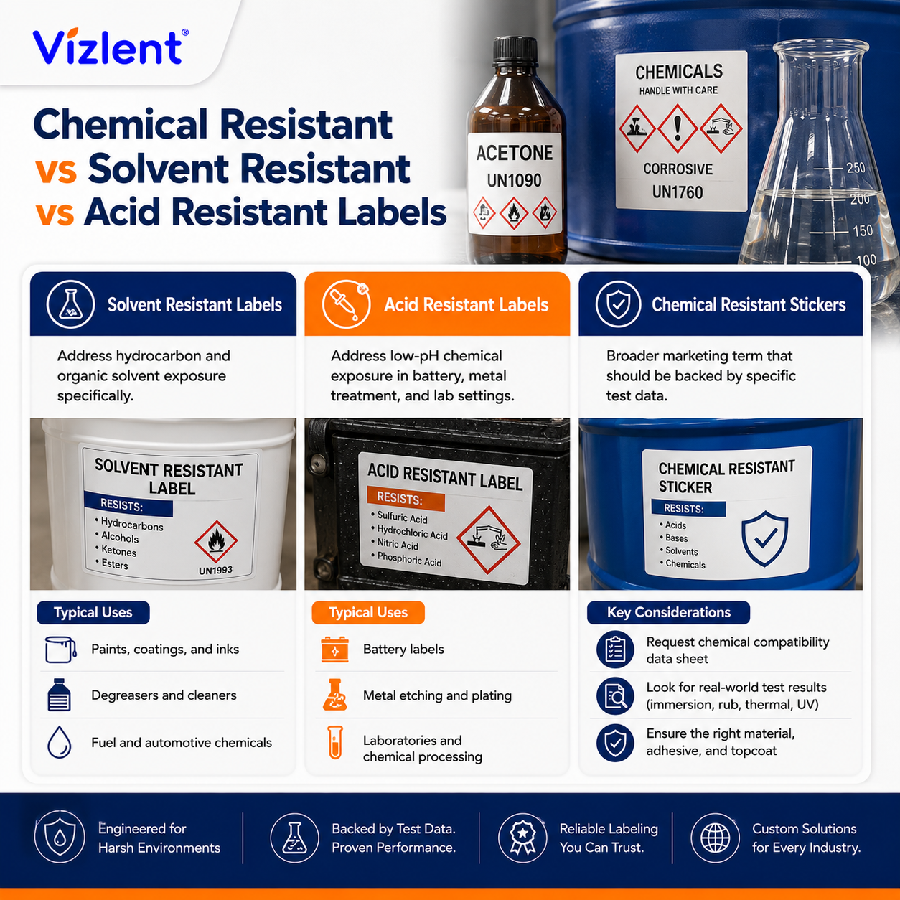
Chemical resistant stickers, solvent resistant labels, and acid resistant labels are often used interchangeably, but each term technically points to a different, narrower resistance property. Sorting through this terminology is part of choosing labels resistant to chemical exposure correctly, since a mislabeled resistance property can lead to a costly specification mistake. Solvent and chemical resistant labels generally address hydrocarbon and organic solvent exposure, such as fuels, degreasers, and industrial cleaners, while acid resistant labels specifically address low-pH chemical exposure common in battery manufacturing, metal treatment, and laboratory environments.
Buyers occasionally search for solvent resistant labels, which is a common misspelling of solvent resistant labels rather than a distinct product category, and both spellings point to the same underlying construction. Confirming which specific chemical family a label was tested against, rather than assuming a general chemical-resistant claim covers acids, solvents, and hydrocarbons equally, prevents a costly mismatch in a lab or industrial setting. A manufacturer’s technical data sheet should specify exact test chemicals and exposure durations rather than a single vague resistance rating.
- Solvent resistant labels: Address hydrocarbon and organic solvent exposure specifically.
- Acid resistant labels: Address low-pH chemical exposure in battery, metal treatment, and lab settings.
- Chemical resistant stickers: Broader marketing term that should be backed by specific test data.
Specifying the exact chemical family in a purchase order, rather than relying on general chemical-resistant terminology, is the clearest way to avoid confusion between a buyer and a supplier. A manufacturer’s technical team can typically confirm which construction satisfies a specific chemical exposure requirement once the exact substances have been listed. This distinction matters most in laboratory, battery manufacturing, and industrial chemical environments where a single wrong assumption can compromise safety documentation.
Adhesion to Low-Surface-Energy Containers
Labels resistant to chemical exposure on HDPE and polypropylene containers face an adhesion challenge separate from the chemical resistance question, since these plastics have a surface energy of approximately 31 to 35 mN/m, well below the threshold standard acrylic adhesives need to bond properly. Confirming both chemical resistance and adhesion performance together is essential when specifying labels resistant to chemical exposure for these substrates, since a facestock that resists chemicals is useless if it lifts off the container within weeks.
Standard permanent acrylic adhesives typically achieve only 8 to 14 ounces per inch of peel strength on untreated HDPE, which is well below the minimum needed for a label expected to survive outdoor exposure and chemical contact together. Chemical resistant bottle labels applied to HDPE or polypropylene bottles need an adhesive specifically formulated and tested for low-surface-energy substrates rather than a standard permanent acrylic.
Drum and container curvature adds a further complication, since large-format labels applied to a cylindrical drum body must conform in both directions without lifting at corners or edges. Chemical resistant asset tags mounted on curved or textured equipment housings face a similar conformability requirement, even though the underlying chemical exposure profile may differ from a drum label. Requesting peel adhesion data generated on your actual container surface, including any surface contamination from filling lubricants or condensation, is more reliable than trusting data from an idealized test panel.
- HDPE and polypropylene surface energy: Approximately 31 to 35 mN/m, below standard adhesive thresholds.
- Standard acrylic peel strength on untreated HDPE: Only 8 to 14 ounces per inch.
- LSE-rated adhesives: Formulated specifically to wet out and bond on low-surface-energy plastics.
Requesting adhesion data on your specific drum, bottle, or container stock, including reconditioned containers if applicable, rather than assuming new-container test data transfers directly, avoids a common specification mistake. A label that performs well on a smooth test panel can still fail on a textured or contaminated real-world surface. Physical testing on your actual container remains the only reliable way to confirm adhesion before a bulk order ships.
Chemical Resistant Stickers, Tags, and Asset Labels
Chemical resistant stickers applied directly to product surfaces and chemical resistant tags in a hang tag format serve similar identification purposes but differ in attachment method, with tags typically used where a permanent adhesive bond is undesirable or impractical. Both formats fall under the broader category of labels resistant to chemical exposure, and choosing between them depends more on the mounting surface than on the underlying chemical resistance requirement. Chemical resistant asset tags used for equipment identification in industrial and laboratory settings need to survive years of intermittent chemical splash and cleaning cycles while remaining scannable for inventory purposes. This is a longer service life requirement than a single-use product label typically faces.
Format selection for chemical resistant stickers and tags depends heavily on the mounting surface and expected handling, since a flat sticker bonds well to smooth equipment housings while a tag attached by string or fastener suits irregular or frequently serviced equipment. Chemical resistant label paper, as distinct from synthetic film facestocks, generally offers lower chemical resistance and is better suited to indoor applications with minimal splash exposure rather than direct immersion or heavy solvent contact. Choosing paper over a synthetic facestock for a genuinely chemical-exposed application is one of the most common specification mistakes buyers make when trying to reduce cost.
- Chemical resistant stickers: Direct adhesive application for smooth equipment surfaces.
- Chemical resistant tags: Hang tag format for irregular or frequently serviced equipment.
- Chemical resistant label paper: Lower resistance, suited to indoor or minimal-splash environments only.
Matching the format to the actual mounting surface and expected chemical exposure level, rather than defaulting to whichever format a supplier stocks by default, is what determines real-world performance. A manufacturer’s engineering team can typically recommend the right format and facestock combination once the surface material and exposure conditions have been described. Requesting samples of both sticker and tag formats side by side helps confirm the right choice before a bulk order.
Overlaminates and Label Paper Options
Chemical resistant overlaminate labels add a protective clear film layer on top of the printed facestock, extending chemical and abrasion resistance beyond what the base facestock alone provides. This layered approach is especially useful for labels that need to survive both chemical splash and mechanical abrasion from forklift handling, drum rolling, or pallet stacking in distribution environments. An overlaminate also protects printed barcodes and text from fading or smearing when exposed to solvents that would otherwise degrade unprotected ink.
Selecting between a laminated construction and a chemical resistant label paper option depends on the severity of expected exposure and the acceptable cost per label, since laminated constructions generally cost more but extend service life significantly in harsh environments. Vizlent Label’s Laminating Films range documents overlaminate options that pair with a base label construction to add this additional protective layer. Buyers should request accelerated weathering data, expressed in ASTM G154 or G155 testing hours, to compare overlaminate options on a consistent basis rather than relying on marketing claims alone.
- Chemical resistant overlaminate labels: Added protective layer for chemical and abrasion resistance together.
- Laminated constructions: Higher cost, extended service life in harsh chemical environments.
- Unlaminated label paper: Lower cost, suited to indoor or low-exposure applications only.
Requesting a side-by-side sample of laminated and unlaminated options, tested against your specific chemical exposure, helps confirm that the added lamination cost is justified for your application. A label expected to remain legible for months of outdoor tank farm exposure generally justifies the overlaminate cost, while an indoor, short-service-life label may not. Physical testing remains more reliable than assuming either option automatically fits your specific requirement.
Printing Chemical Resistant Barcode Labels
Chemical resistant barcode labels need print quality that survives the same chemical exposure as the facestock and adhesive beneath them, since a barcode that fades or smears under solvent contact defeats the purpose of a scannable label regardless of how durable the underlying material is. Confirming that your chemical resistant label printer and ribbon combination produces a scan grade that holds up under post-exposure conditions, not just at the time of printing, is a step many buyers overlook. Thermal transfer printing with a resin ribbon generally offers better chemical resistance than wax or wax-resin ribbons for this reason.
Chemical resistant direct thermal labels, which print without a ribbon by using heat-sensitive facestock coating, are convenient for many applications but generally offer weaker long-term chemical and UV resistance than thermal transfer printing with a durable facestock. Direct thermal printing can be acceptable for short-service-life labels with minimal chemical exposure, but is rarely the right choice for drum labels, outdoor asset tags, or any application expecting years of service life. Confirming your expected service life and exposure conditions before choosing between direct thermal and thermal transfer printing avoids a costly mismatch discovered after labels are already in the field.
- Thermal transfer with resin ribbon: Generally the most chemical-resistant print method available.
- Chemical resistant label printer and ribbon combination: Confirm scan grade after exposure, not just at printing.
- Direct thermal printing: Convenient but weaker long-term chemical and UV resistance.
Requesting a printed sample and running it through your actual chemical exposure conditions, rather than assuming print durability from a facestock specification alone, is the most reliable way to confirm barcode legibility over the label’s expected service life. This step matters most for inventory and compliance labels that need to remain scannable for the entire time a product or asset is in service.
GHS Compliance and Common Chemical Label Misconceptions
A frequent misconception is the belief that the only labels that can be used on chemical containers are GHS compliant labels, when in practice GHS hazard communication labels are one required element alongside DOT placarding and UN certification marking, not a complete substitute for every other labeling requirement. GHS labels specifically must display hazard pictograms, signal words, hazard statements, precautionary statements, product identifiers, and supplier information as required under OSHA 29 CFR 1910.1200 or the applicable national GHS regulation. Additional labels, such as lot codes, barcodes, and pipeline or valve identification markings, are frequently required alongside the primary GHS label rather than instead of it.
Confirming which regulatory frameworks apply to your specific product and container, rather than assuming GHS compliance alone satisfies every requirement, avoids a compliance gap discovered during an audit or inspection. DOT hazmat labels require specific color accuracy tolerances, and GHS labels require minimum element sizes for pictograms that a matte facestock may not support in some digital print processes. Confirming print method and facestock finish against these specific regulatory requirements before finalizing a specification prevents a label that looks correct but fails a compliance review.
- GHS labels: Hazard pictograms, signal words, and precautionary statements under OSHA or national regulation.
- DOT placarding: Separate color accuracy and format requirements for transport documentation.
- UN certification marking: Durability requirements spanning the packaging’s entire service life, including reconditioning.
Working with a manufacturer that understands these overlapping regulatory frameworks, rather than one that only quotes a generic chemical-resistant label, gives more confidence during a compliance audit. Requesting documentation showing how a label construction satisfies each applicable framework, rather than assuming one certification covers everything, is the clearest way to avoid a gap. This distinction matters most for chemical drum and container labeling where multiple regulations apply simultaneously.
Ready to Source Labels Resistant to Chemical Exposure
Choosing labels resistant to chemical exposure comes down to matching a specific facestock, adhesive, and certification requirement to your actual chemicals, container material, and regulatory obligations. Vizlent has manufactured self adhesive label stock since 2011, supplying converters, distributors, and brand owners across more than fifty countries with materials certified to ISO 9001, FSC, and SGS standards. Send an inquiry through Vizlent’s contact page to request samples and a quote suited to your exact chemical exposure profile, or explore the full Petrochemical & Drums product range to compare constructions side by side.
For applications needing additional protective layers, Vizlent’s Laminating Films range covers overlaminate options that extend chemical and abrasion resistance beyond a base label construction. Vizlent’s Durable Labels range and knowledge base cover additional material comparisons for teams evaluating labels resistant to chemical exposure against other demanding environments. Specifying labels resistant to chemical exposure correctly is what actually determines a label’s success in the field, not the marketing claim printed on a spec sheet.
Frequently Asked Questions
How do I choose labels resistant to chemical exposure?
Choosing labels resistant to chemical exposure starts with identifying every chemical the label surface may contact, then matching facestock, adhesive, and any topcoat to that specific exposure profile rather than trusting a general durability claim. This same process applies equally to a chemical drum, a laboratory container, or an industrial asset. Polyester facestock with a solvent-resistant topcoat generally offers the broadest resistance among common constructions. Requesting immersion or contact test data for your exact chemicals is the most reliable way to confirm fit before a bulk order.
Are the only labels that can be used on chemical containers are GHS compliant labels statement true?
No, this is a common misconception, since GHS compliant labels are one required element alongside DOT placarding and UN certification marking rather than a complete substitute for every labeling requirement. Additional labels such as lot codes, barcodes, and pipeline identification markings are frequently required alongside the primary GHS label. Confirming which regulatory frameworks apply to your specific product avoids a compliance gap.
What is the difference between chemical resistant, solvent resistant, and acid resistant labels?
Solvent and chemical resistant labels generally address hydrocarbon and organic solvent exposure, while acid resistant labels specifically address low-pH chemical exposure common in battery and metal treatment applications. A label validated against one chemical family is not automatically validated against another. Requesting a technical data sheet specifying exact test chemicals avoids assuming broad chemical resistance where only narrow resistance was actually tested.
Why do chemical resistant labels sometimes fall off HDPE containers?
HDPE and polypropylene have a surface energy of approximately 31 to 35 mN/m, well below what standard permanent acrylic adhesives need to bond properly, so a chemically resistant facestock can still fail if the adhesive underneath is not formulated for low-surface-energy substrates. Standard acrylic adhesives achieve only 8 to 14 ounces per inch of peel strength on untreated HDPE. Specifying an adhesive tested specifically on your container material resolves this issue.
Should I use chemical resistant stickers or tags for equipment identification?
Chemical resistant stickers suit smooth equipment surfaces where a permanent adhesive bond is appropriate, while chemical resistant tags in a hang tag format suit irregular or frequently serviced equipment where a removable attachment method works better. Chemical resistant asset tags used for inventory purposes need to remain scannable through years of intermittent chemical exposure. Matching the format to your mounting surface and service requirements avoids an early failure.
Do overlaminates make a meaningful difference in chemical resistance?
Yes, chemical resistant overlaminate labels add a protective clear film layer that extends both chemical and abrasion resistance beyond what the base facestock alone provides, which matters most for labels facing both chemical splash and mechanical handling. Laminated constructions generally cost more but significantly extend service life in harsh environments. Requesting accelerated weathering data helps compare overlaminate options on a consistent basis.
Is direct thermal printing suitable for chemical resistant barcode labels?
Chemical resistant direct thermal labels are convenient and cost-effective but generally offer weaker long-term chemical and UV resistance compared to thermal transfer printing with a resin ribbon. Direct thermal can work for short-service-life labels with minimal chemical exposure, but is rarely the right choice for drum labels or long-term outdoor asset tags. Confirming your expected service life before choosing a print method avoids a costly mismatch.
What is a common misspelling people search for related to solvent resistant labels?
Solvent resistant labels is a common misspelling of solvent resistant labels, pointing to the same underlying construction rather than a distinct product category. Both spellings refer to labels formulated to resist hydrocarbon and organic solvent exposure. Searching either term should return the same type of facestock and adhesive construction from a knowledgeable supplier.






