
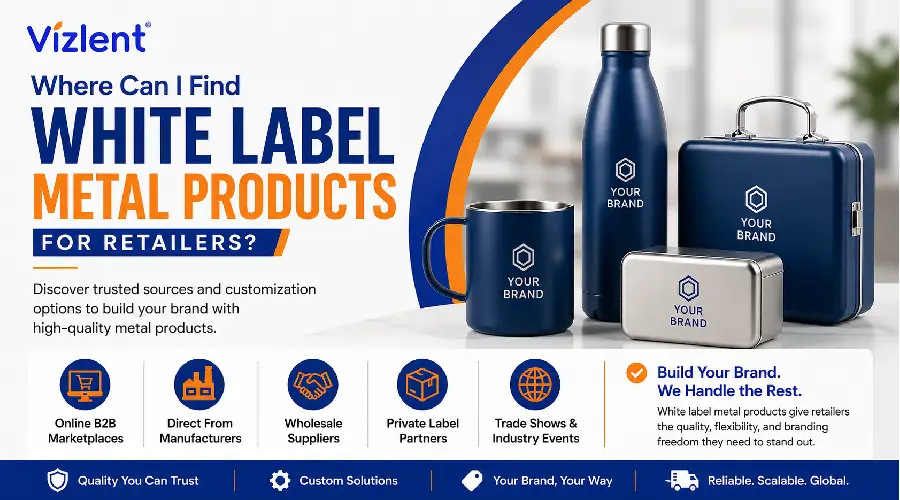
You can find white label metal products for retailers with factory-direct manufacturers in China like Vizlent Labels, verified B2B marketplaces such as Alibaba and Global Sources, industry trade shows, and OEM specialists that produce unbranded metal goods ready for your own branding. The fastest route is to shortlist certified factories, request physical samples, and confirm that each product can carry your brand identity before you commit to a purchase order. Retail buyers who follow this sequence cut sourcing risk and reach store shelves weeks sooner than buyers who order blind.
The white label model works because the manufacturer handles production while you control the brand, the packaging, and the retail price. Metal goods such as cookware, hand tools, hardware, shelving, drinkware, and signage all adapt well to private branding. Reliable sourcing routes range from online supplier directories to factory-direct partnerships, and each channel rewards a slightly different buying strategy.
What Are White Label Metal Products?
White label metal products are finished metal goods produced by one manufacturer and sold without branding so that retailers can apply their own name, logo, and packaging. The manufacturer owns the production process while the retailer owns the customer relationship and the shelf price. That structure separates factory work from brand work, which lets each side focus on what it does best.
White label products differ from custom OEM goods because the base design already exists and only the branding changes. An existing design keeps tooling costs near zero and shortens lead times to weeks instead of months. Retailers usually complete the branding step with printed packaging, engraved marks, or permanent adhesive identification such as laser etched labels that bond to metal surfaces for the life of the product.
Popular white label metal product categories include:
- Stainless steel drinkware, cookware, and kitchen utensils
- Hand tools, tool kits, and hardware fittings
- Metal shelving, racks, and retail display fixtures
- Aluminum signage, nameplates, and badges
- Steel storage boxes, tins, and organizer containers
Why Retailers Choose the White Label Model
Retailers choose white label sourcing because it delivers stronger margins than reselling national brands. Industry analyses consistently show private brand gross margins running 25 to 30 percent above comparable branded goods, since no brand royalty sits inside the unit cost. The retailer also gains full control over pricing, positioning, and promotion.
Media attention has pushed the model into the mainstream, and growing search interest in phrases like white label metal products for retailers business insider coverage reflects that shift. Store brands now account for roughly one fifth of unit sales in United States retail, according to the Private Label Manufacturers Association. Shoppers treat a well-made store product as equal to a national brand, provided the quality holds up and the brand protection measures on the packaging look credible.
Where Can I Find White Label Metal Products for Retailers?
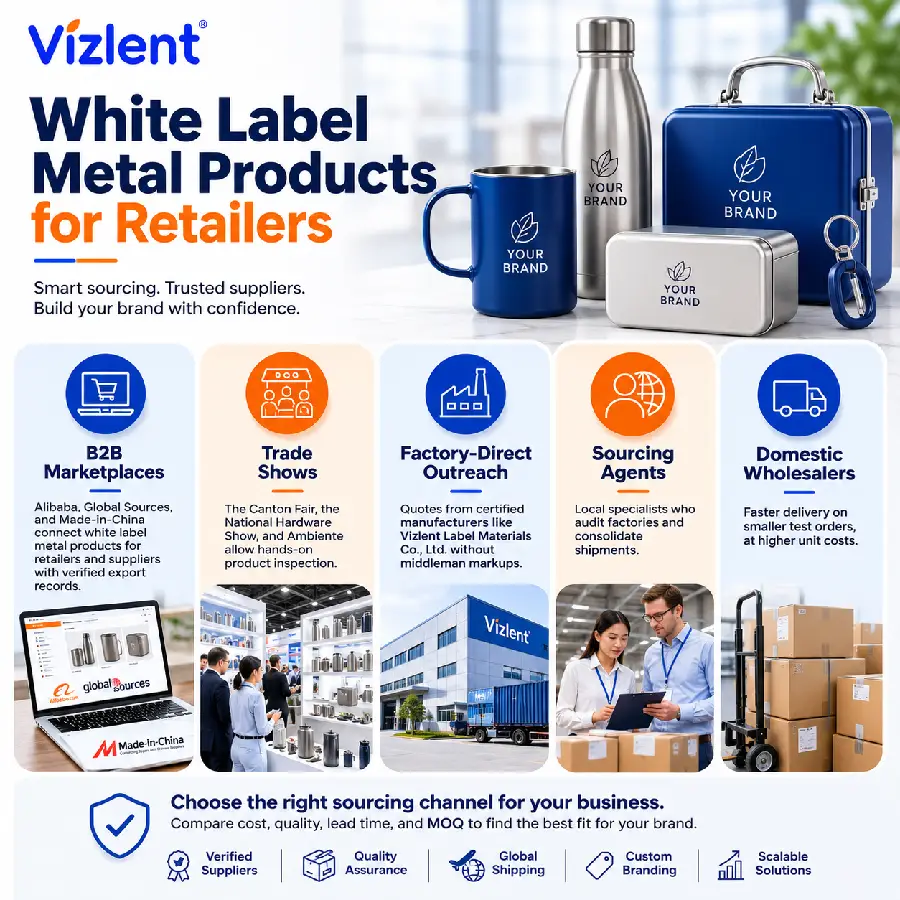
The most reliable sources are factory-direct manufacturers, vetted B2B marketplaces, sourcing agents, and trade exhibitions where you can inspect metal goods in person. Each channel suits a different order size, budget, and risk tolerance. Buyers asking where can I find white label metal products for retailers usually start online, then verify the two or three strongest candidates offline.
Online directories work best when you filter for verified suppliers with audited factories and documented export history. Trade shows such as the Canton Fair and the National Hardware Show let you compare finish quality, weld consistency, and coating durability side by side. Sourcing agents typically charge 3 to 8 percent of order value, and in return they handle inspection, negotiation, and freight for buyers who cannot travel.
Proven sourcing channels at a glance:
- B2B marketplaces: Alibaba, Global Sources, and Made-in-China connect white label metal products for retailers and suppliers with verified export records
- Trade shows: The Canton Fair, the National Hardware Show, and Ambiente allow hands-on product inspection
- Factory-direct outreach: Quotes from certified manufacturers like Vizlent Label Materials Co., Ltd. without middleman markups
- Sourcing agents: Local specialists who audit factories and consolidate shipments
- Domestic wholesalers: Faster delivery on smaller test orders, at higher unit costs
Sourcing White Label Metal Products From China
China produces more than half of the world’s crude steel and close to 60 percent of its primary aluminum, which makes it the natural first stop for metal sourcing. For volume buyers, white label metal products for retailers China sourcing combines deep production capacity with mature export logistics. Guangdong, Zhejiang, and Jiangsu provinces host dense clusters of metal fabrication factories with decades of OEM experience.
Verification matters more than price when you buy from overseas. Request ISO 9001 certificates, third-party audit reports, and references from active clients in your own market before wiring any deposit. Confirm as well that every mark applied to the goods, from barcodes to durable labels, survives shipping humidity, container heat, and warehouse handling.
How to Evaluate White Label Metal Products Companies
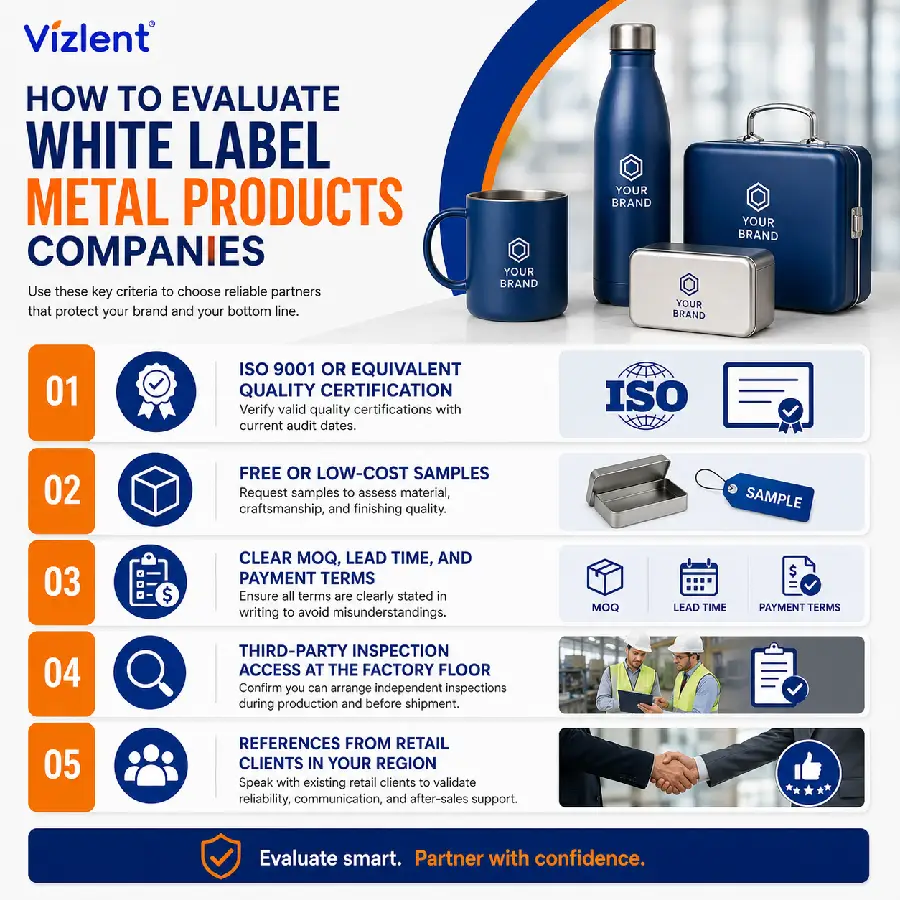
Strong white label metal products for retailers companies share a short list of traits: verifiable certifications, transparent pricing, sample programs, and consistent communication. Factories that answer technical questions within one business day usually run disciplined production floors as well. Weak communication before the order almost always predicts weak quality control after it.
Distribution partners deserve the same scrutiny as factories, since white label metal products for retailers and distributors pass through several hands before reaching your stockroom. Ask every candidate for defect-rate data, packaging photos, and proof of tamper protection such as VOID stickers on sealed export cartons. A supplier who documents these details in writing is a supplier you can scale with.
Supplier evaluation checklist:
- ISO 9001 or equivalent quality certification with current audit dates
- Free or low-cost samples before any bulk commitment
- Clear MOQ, lead time, and payment terms stated in writing
- Third-party inspection access at the factory floor
- References from retail clients in your region
Ordering in Bulk: MOQ, Pricing, and Lead Times
White label metal products for retailers bulk orders typically start at 500 to 1,000 units per SKU, though many factories accept smaller trial runs at a 10 to 20 percent price premium. Unit costs drop sharply between the first and third volume tier, so ask for a tiered quote across three order levels. Standard production runs 15 to 45 days depending on finish complexity and coating requirements.
Budget beyond the unit price, because freight, duties, inspection, and branding materials add 15 to 30 percent to landed cost. Barcode and compliance marking usually runs on thermal printers, so confirm your label stock pairs correctly with thermal transfer ribbons rated for film facestocks on metal goods. Locking these details before production prevents costly relabeling at the warehouse.
Best Practices for a White Label Retail Program
Building a white label metal products for retailers business starts with a narrow product line, one reliable factory, and a clear brand standard covering every mark on the product. Successful buyers document white label metal products for retailers best practices in a short supplier manual that travels with every purchase order. That manual should define finish tolerances, packaging specs, label placement, and inspection criteria.
Test each product in real retail conditions before a full rollout. Track return rates, customer reviews, and shelf performance for at least one quarter, then scale the winners and cut the rest. Retailers who repeat this cycle protect margin while building a brand customers ask for by name.
Field-tested rules for new programs:
- Start with 3 to 5 SKUs and one audited factory
- Order pre-shipment inspection on every production run
- Standardize branding artwork, label placement, and packaging in writing
- Hold 60 to 90 days of safety stock during any supplier transition
- Review supplier scorecards quarterly and renegotiate pricing annually
Common Sourcing Mistakes Retailers Should Avoid
The most expensive sourcing mistakes happen before the first purchase order is signed. Buyers who select a factory on price alone often discover coating defects, inconsistent welds, or missing compliance marks only after the container lands. A sample order and a written specification sheet cost very little compared with a full shipment of unsellable stock.
Skipping the branding plan is the second most common error. Metal surfaces reject standard paper labels within weeks, so artwork, adhesive selection, and placement need to be settled while the goods are still in production. Retailers who treat labeling as an afterthought end up paying twice: once for branding that fails, and again for the security and identification materials that should have been specified from the start.
Mistakes that drain margin fastest:
- Choosing the cheapest quote without an audited factory behind it
- Ordering full volume before testing a physical sample
- Leaving label material selection until after production ends
- Ignoring landed cost items such as duties, freight, and inspection
- Working without a written specification and defect tolerance sheet
Branding: The Step That Turns Unbranded Metal Into Your Product
Branding converts an anonymous metal item into a product that carries your reputation, and the label material you choose decides how long that brand survives on a metal surface. Powder-coated steel, anodized aluminum, and stainless finishes each demand a different adhesive chemistry. Constructions engineered as heat resistant labels or outdoor weather resistant materials keep logos, ratings, and safety marks legible for years.
Application method matters as much as material. Removable options such as flexible magnetic stickers suit display fixtures and promotional signage, while permanent pressure-sensitive constructions suit tools, appliances, and automotive components. Matching the label construction to the product’s service environment is the difference between a brand that lasts and a brand that peels.
How VIZLENT Supports White Label Metal Product Branding
VIZLENT is a factory-direct, Shenzhen-based label material manufacturer that has supplied pressure-sensitive stock to more than 1,000 clients across 50+ countries since 2011. Our ISO 9001, FSC, and SGS certified materials cover the full branding workflow for metal goods, from laser etched identification to tamper-evident security seals. Retailers, converters, and print houses use our stock to apply brand marks that hold on steel, aluminum, and coated surfaces.
Every project starts with free samples, so you can test adhesion on your actual products before placing a bulk order. Our engineering team advises on facestock, adhesive grade, and liner selection based on your surface type and service temperature. Learn more about our company or send your inquiry today to receive a factory-direct quote within 24 hours.
Get Factory-Direct Label Materials for Your White Label Program
Your white label program is only as strong as the branding that carries it. VIZLENT supplies certified label stock engineered for metal surfaces, backed by free samples, flexible MOQs, and 7 to 15 day lead times on custom OEM orders. From tamper-evident security seals to permanent brand marks, one supplier covers every construction your product line needs.
Send us your surface type, service environment, and print method, and our team will respond with a material recommendation and a factory-direct quote within 24 hours. Contact VIZLENT today and put a brand on your metal products that stays there. You can also explore more sourcing and labeling guides on the VIZLENT blog.
Frequently Asked Questions
Retail buyers raise these questions most often when they begin sourcing unbranded metal goods. Each answer reflects current market conditions and the sourcing standards used by experienced import teams.
Where can I find white label metal products for retailers?
You can find white label metal products for retailers on verified B2B marketplaces such as Alibaba and Global Sources, at trade shows like the Canton Fair, and through factory-direct outreach to certified manufacturers in China. Start with online supplier filters for audit status and export history, then confirm quality with physical samples. Buyers with larger budgets often add a sourcing agent to handle factory inspection and freight.
What is the difference between white label and private label products?
White label products use one standard design sold to many retailers under different brands, while private label products are made exclusively for one retailer, often with custom specifications. White label costs less and ships faster because the design and tooling already exist. Private label offers more differentiation but requires higher volumes and a longer development window.
What is the typical MOQ for white label metal products?
Most factories set minimum order quantities between 500 and 1,000 units per SKU for white label metal goods. Smaller trial orders are often available at a 10 to 20 percent price premium. MOQs drop further when you reuse a factory’s standard finishes and stock packaging instead of requesting custom changes.
Is China still the best place to source white label metal products?
China remains the leading source because of its steel and aluminum capacity, dense fabrication clusters, and mature export infrastructure. Vietnam, India, and Taiwan are growing alternatives for buyers who want to diversify their supply chains. Total landed cost, certification, and lead time should drive the final decision rather than the country name alone.
How do I verify a white label metal products supplier?
Verify a supplier by requesting ISO 9001 certification, a recent third-party audit report, retail client references, and product samples. Order a pre-shipment inspection from an independent service such as SGS or Bureau Veritas on your first production run. Suppliers who resist documentation at the quote stage rarely improve after payment clears.
What labels work best on metal surfaces?
Labels built on film facestocks with acrylic or modified adhesives perform best on metal because they resist temperature swings, oils, and abrasion. Polyester and laser etched constructions handle harsh service environments, while magnetic options suit temporary or repositionable branding. Always test adhesion on the exact finish, since powder coating and bare stainless steel behave very differently.
How much can retailers earn on white label metal products?
Retail margins on white label metal goods commonly run 40 to 60 percent after landed costs, compared with 20 to 35 percent on national brands. The exact figure depends on category, order volume, and freight conditions. Drinkware, hand tools, and storage products tend to deliver the strongest early returns for new programs.
Can I brand white label products after they arrive in my warehouse?
Yes, many retailers apply branding in-house using pre-printed pressure-sensitive labels, which avoids factory art charges and supports smaller test batches. In-house labeling requires materials matched to the metal surface and, for barcoded items, compatible ribbons and printers. Factory-applied branding becomes more economical once volumes pass a few thousand units per SKU.






